Tags
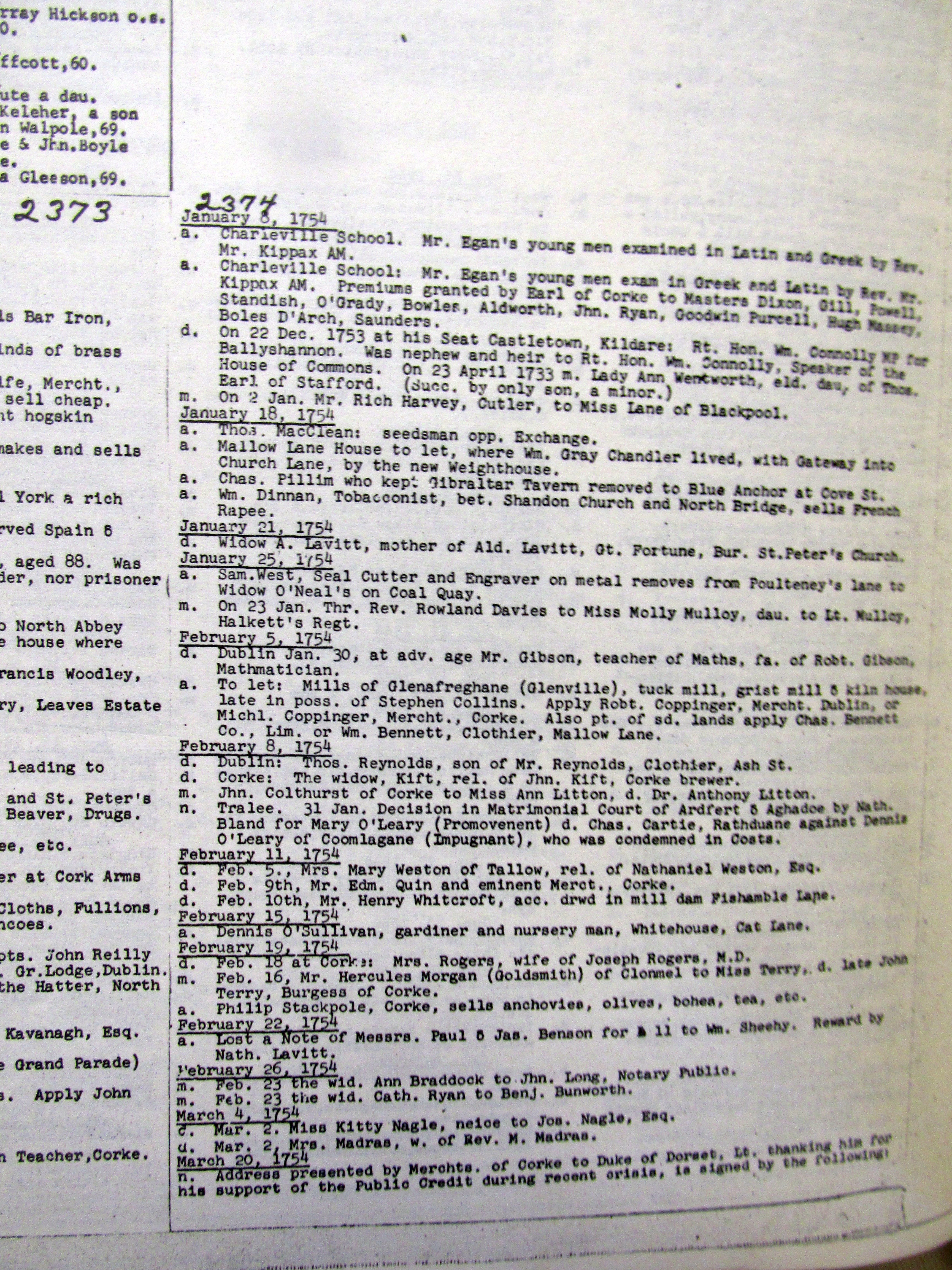
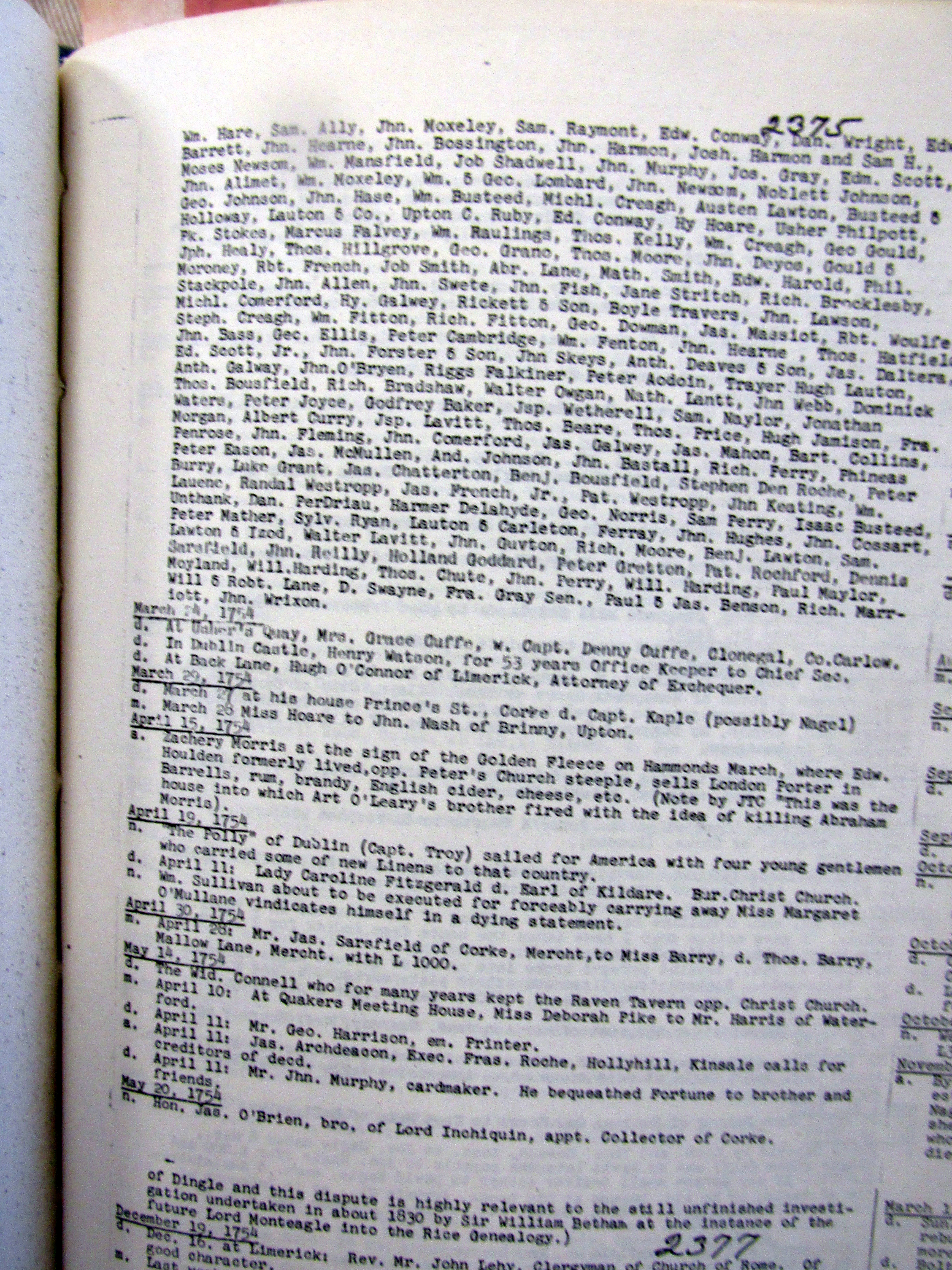
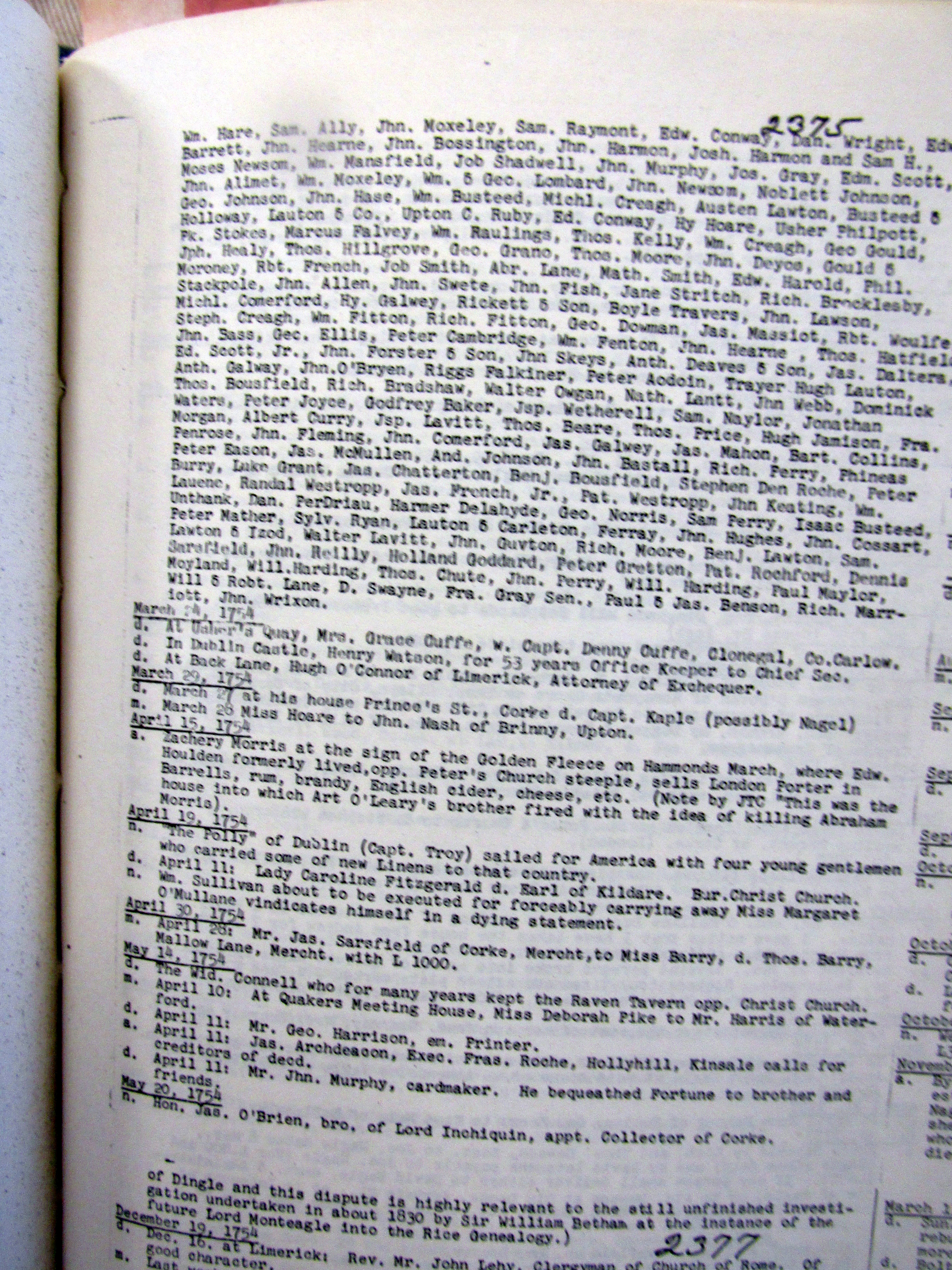
Address by Merchants, and their listing, of Cork, 20th March 1754, to the Duke of Dorset Lord Lieutenant, thanking him for his support of the Public Credit during the Recent Crisis.
From John T. collins Newspaper Extracts
Later Banking crisis:
14 Sunday Dec 2014
Posted in Uncategorized
Tags
Address by Merchants, and their listing, of Cork, 20th March 1754, to the Duke of Dorset Lord Lieutenant, thanking him for his support of the Public Credit during the Recent Crisis.
From John T. collins Newspaper Extracts
Later Banking crisis:
14 Sunday Dec 2014
Posted in Uncategorized
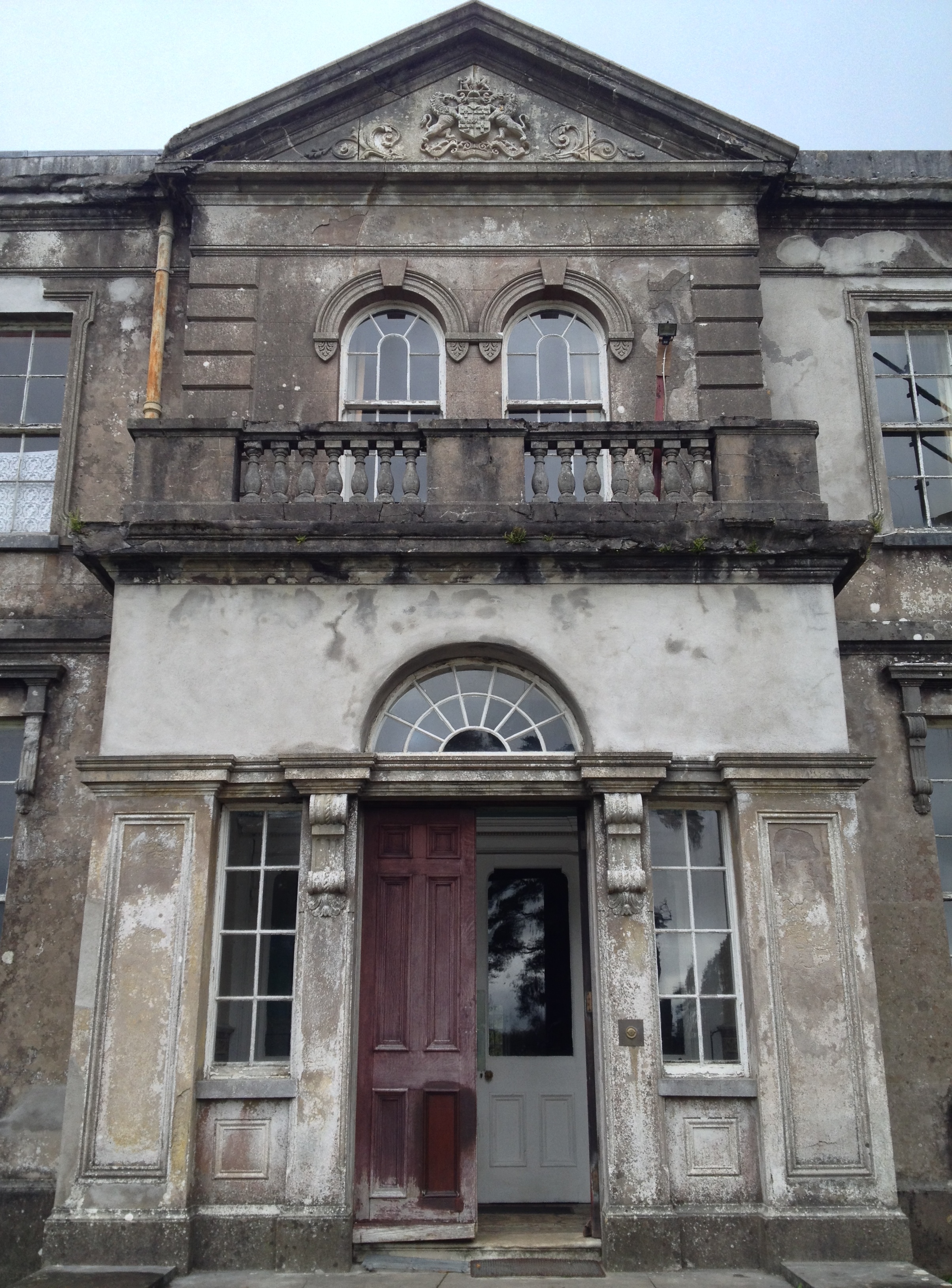
In December 1880 William Bence Jones published The Life’s Work in Ireland of a Landlord Who Tried to Do His Duty. Although intended as an apologia, the book only brought further notoriety to a man already widely reviled here: the Cork Examiner described him as ‘the most thoroughly disliked man in the county.’ How did this come about? Bence Jones had inherited an estate in County Cork originally bought by his grandfather William Jones, son of an Archdeacon of Llandaff, who came to Ireland after marrying Elinor Winthrop whose father had been Mayor of Cork in 1744. Both William Jones and Bence Jones’ father, another William, were absentee landlords, never even visiting their property, but in 1838 when still in his mid-twenties he had settled on the estate after discovering his agent had been embezzling the family. Bence Jones devoted himself to improving the 4,000 acres in his possession, directly farming a quarter of the land while…
View original post 1,372 more words
14 Sunday Dec 2014
Posted in Uncategorized

Fermoy, County Cork owes its origins to Scottish entrepreneur John Anderson who settled in this part of the country in 1780. The following decade he bought land on the Blackwater river and there developed a town, its growth greatly helped by the presence of a military barracks which Anderson also built. The demand for better quality housing in turn led to the creation of St James’s Place on rising ground on the northern side of Fermoy. Begun in 1808 it was intended to have six residences but within ten years Anderson had suffered a series of financial reverses and so only five houses were built. In the last century these handsome redbrick buildings were allowed to deteriorate and by the start of the 1980s they had all been internally divided with 1 St James’s Place condemned as unfit for human habitation.
Subsequent restoration of this house and three of its…
View original post 66 more words
14 Sunday Dec 2014
Posted in Uncategorized
13 Saturday Dec 2014
Posted in Uncategorized
Blind Harpist Arthur O’Neill, Recollection of Night of Music at Colonel John Irwin’s House, Co. Sligo 1759.
Jones William Irwin of Streamstown, County Sligo, whose house was famous for hospitality to itinerant musicians. Jones Irwin’s own father, Colonel John Irwin, was a patron of the famous blind harpist, Turlough O’Carolan, who, in 1713, dedicated a ballad, ‘Colonel John Irwin’, to him. (4) The harpist, Arthur O’Neill, also blind since childhood and one the last of the traditional bard harpists, records a visit to Jones Irwin’s house in 1759 in his memoirs.
I am totally at a loss how to describe this gentleman’s uncommon manner of living at his own house and among his tenantry. This gentleman had an ample fortune and was passionately fond of music. He had four sons and three daughters who were all proficients; no instrument was unknown to them. There was at one time a meeting in his house of forty-six musicians who played in the following order: the three Miss Irwins at the piano; myself at the harp; six gentlemen, flutes; two gentlemen, violoncellos; ten common pipers; twenty gentlemen, fiddlers; four gentlemen, clarionets. At the hour this hospitable gentleman’s customary meeting was finished, some guests contiguous to their places went away, but those who lived some miles off remained, and in order to accommodate them Mr and Mrs Irwin lay on chairs in the parlour. For my part, I never spent a more agreeable night … (5)
Art O’Neill in Beara
13 Saturday Dec 2014
Posted in Uncategorized
Early Irish Medicine from Dian Céch, the Irish God of Healing, Queen Macha Mong Ruadha legendary Hospital at Emain Macha pre 377 BC, Women Physicians under Brehon Laws, Arabic medical texts translated to Irish, Hereditary Medical families, the O’Cassidy Medical Manuscripts largest collection of Medical Manuscript Literature World Wide pre 1800 and the career of Doctor Richard Gumbelton Daunt (1843-1893), of Kilcascan Castle, Co, Cork family, Pioneer in Public Health Medicine, in Brazil 19th century, Genealogist.
urrushistory.com/2014/11/23/treatise-on-medicine-translated-by-john-ocullinane-physician-to-donal-mccarthy-reagh-and-his-tutor-pierce-o-h-uallachain-begun-at-kilbrittan-castle-1414/
This is from Volume 6 of Irish Migration Studies in Latin America and is devoted to the Irish Health Personnel input.
Early Medical Education in Ireland p 157-165.
P. 193-201, Doctor Richard Gumbelton Daunt (1843-1893), of Kilcascan Castle, Co, Cork family Pioneer in Public Health Medicine In Brazil 19th century, Genealogist. He was probably born in Yorkshire but regarded himself as staunchly Irish. He spent a lot of effort on his own and his Brazilian wife’s genealogy and Irish culture generally.
Apart from these chapters the Journal is a fascinating account of a forgotten contribution of Irish men and women in Latin American Medicine.
http://www.irlandeses.org/0811.
pdf0811-2
General O’Leary, Bagota:
13 Saturday Dec 2014
Posted in Uncategorized
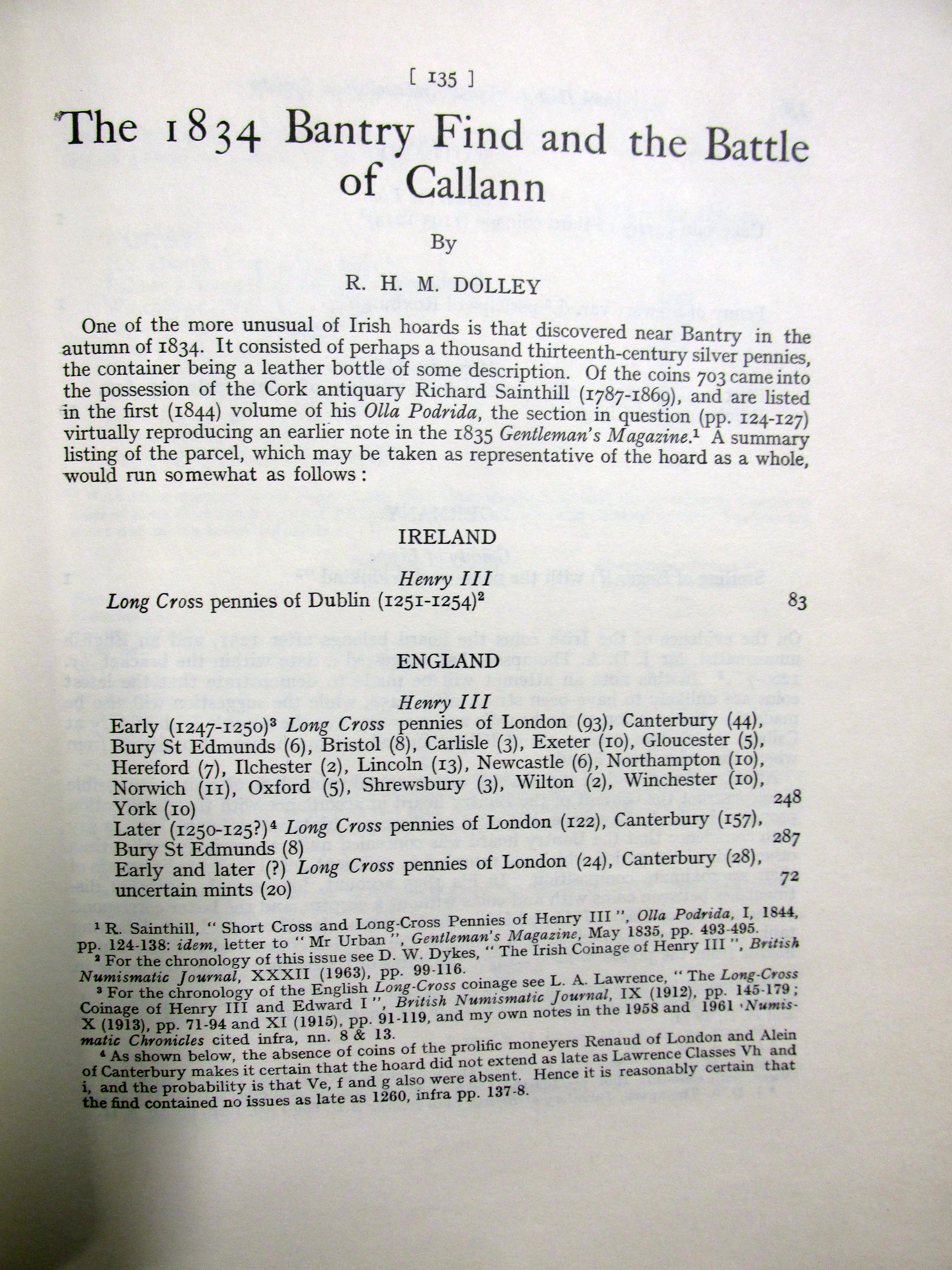
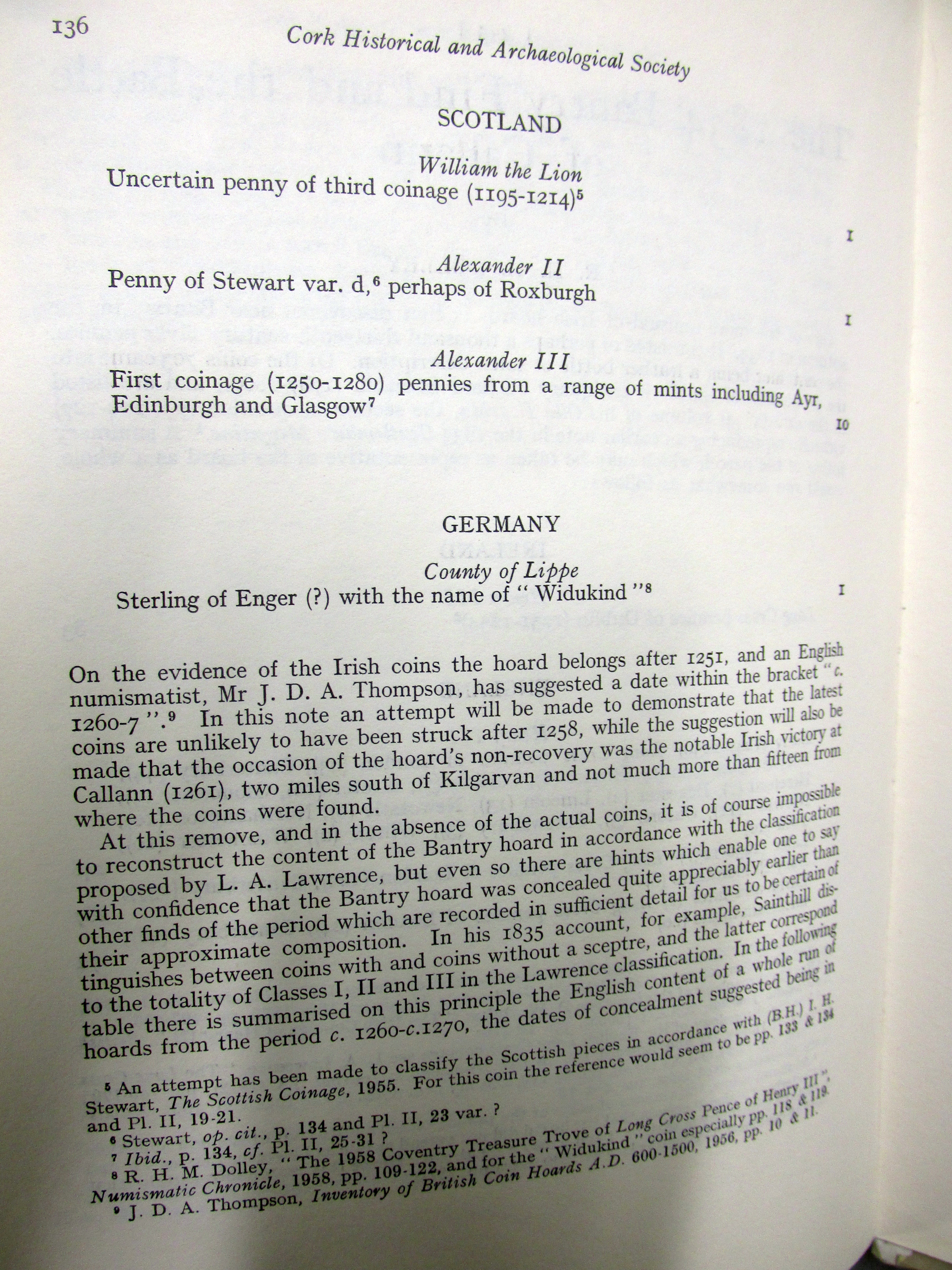
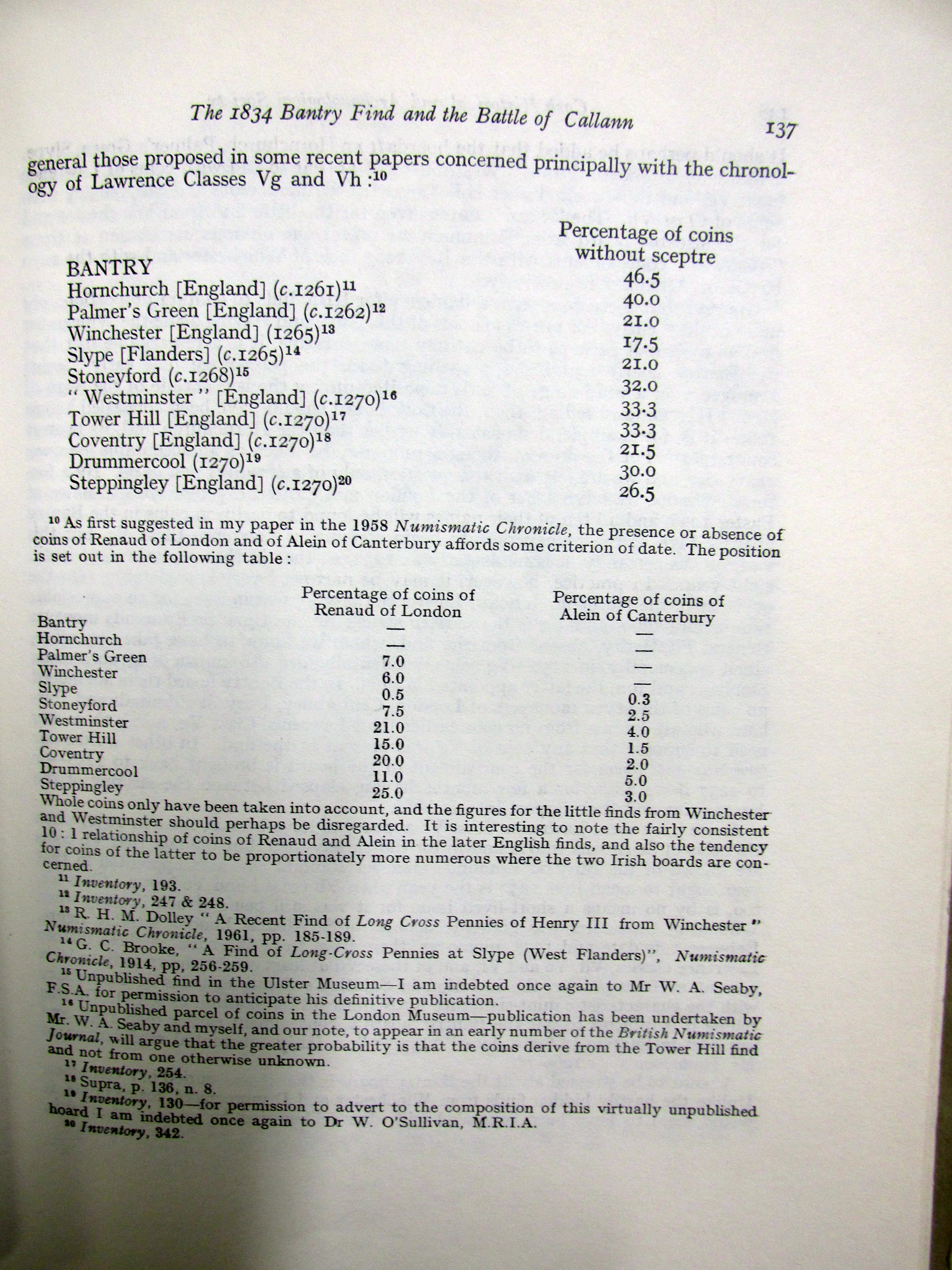
Discovery of 13th century coins (c 1,000 pennies Scottish and German coins) at Bantry, West Cork and the Battle of Callan 1261.
From JCHAS.


13 Saturday Dec 2014
Posted in Uncategorized
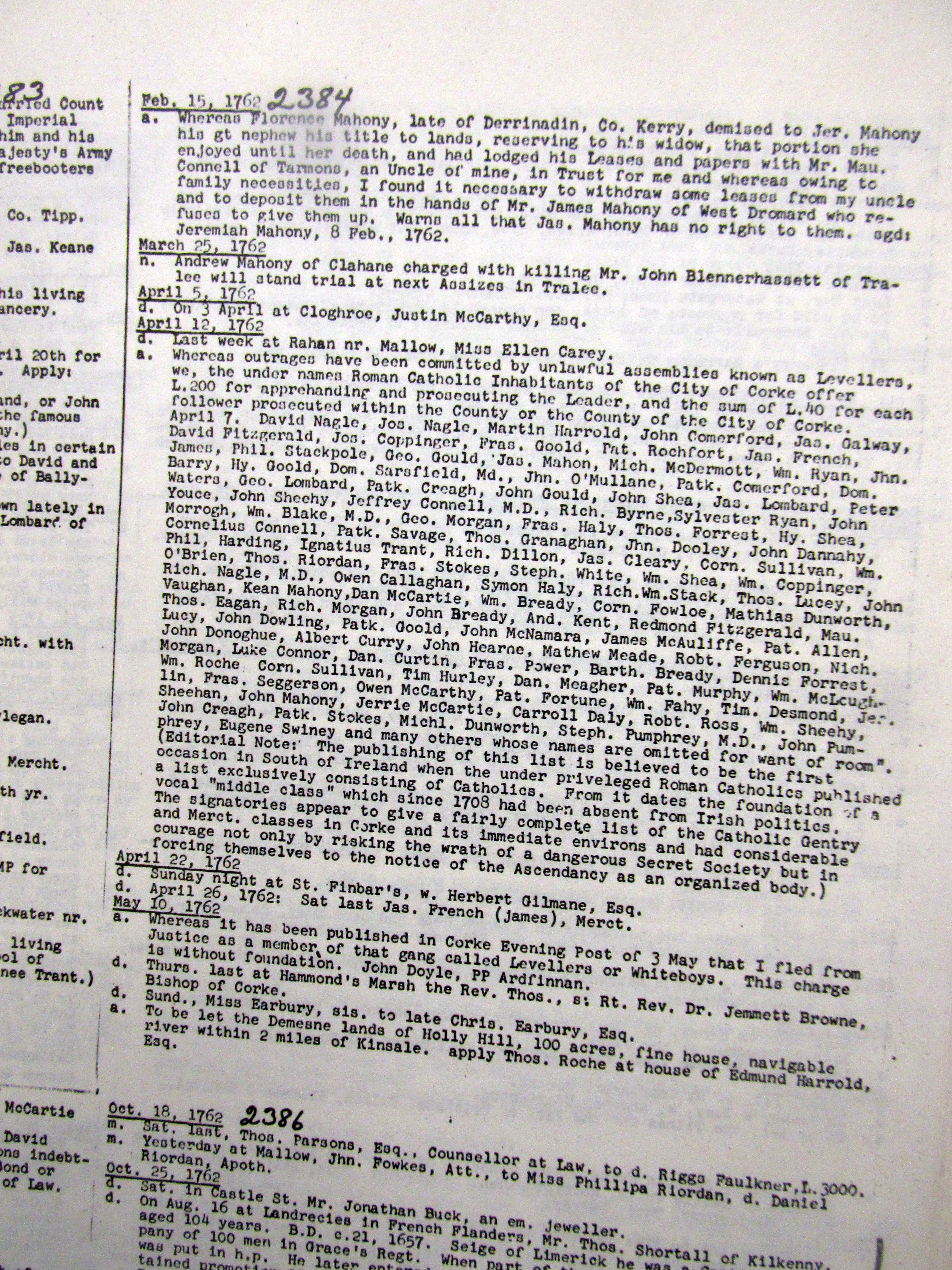
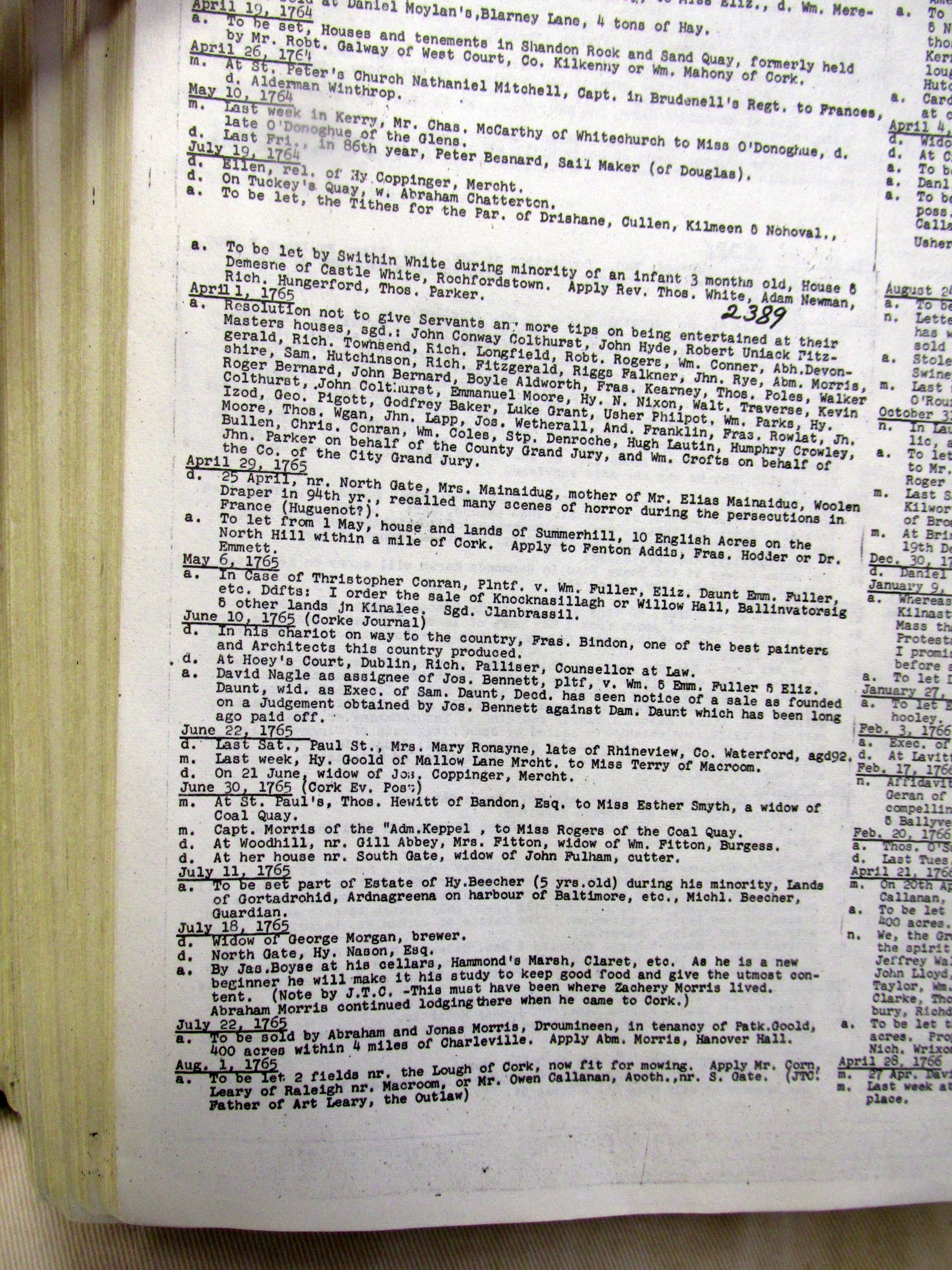
First sign of emergence of Cork Middle Class, Offer in April 1762 of £200 for apprehension of Leader of the ‘Levellers’, individuals names. Also list of Grand Jury and agents April 1765. This is from John T. Collins, Newspaper Extracts. He says this was the first time the Catholics emerged from the shadows of the Penal Laws. It was hazardous to come out against the Levellers. The listing names the prominent Catholics in the city at the time.
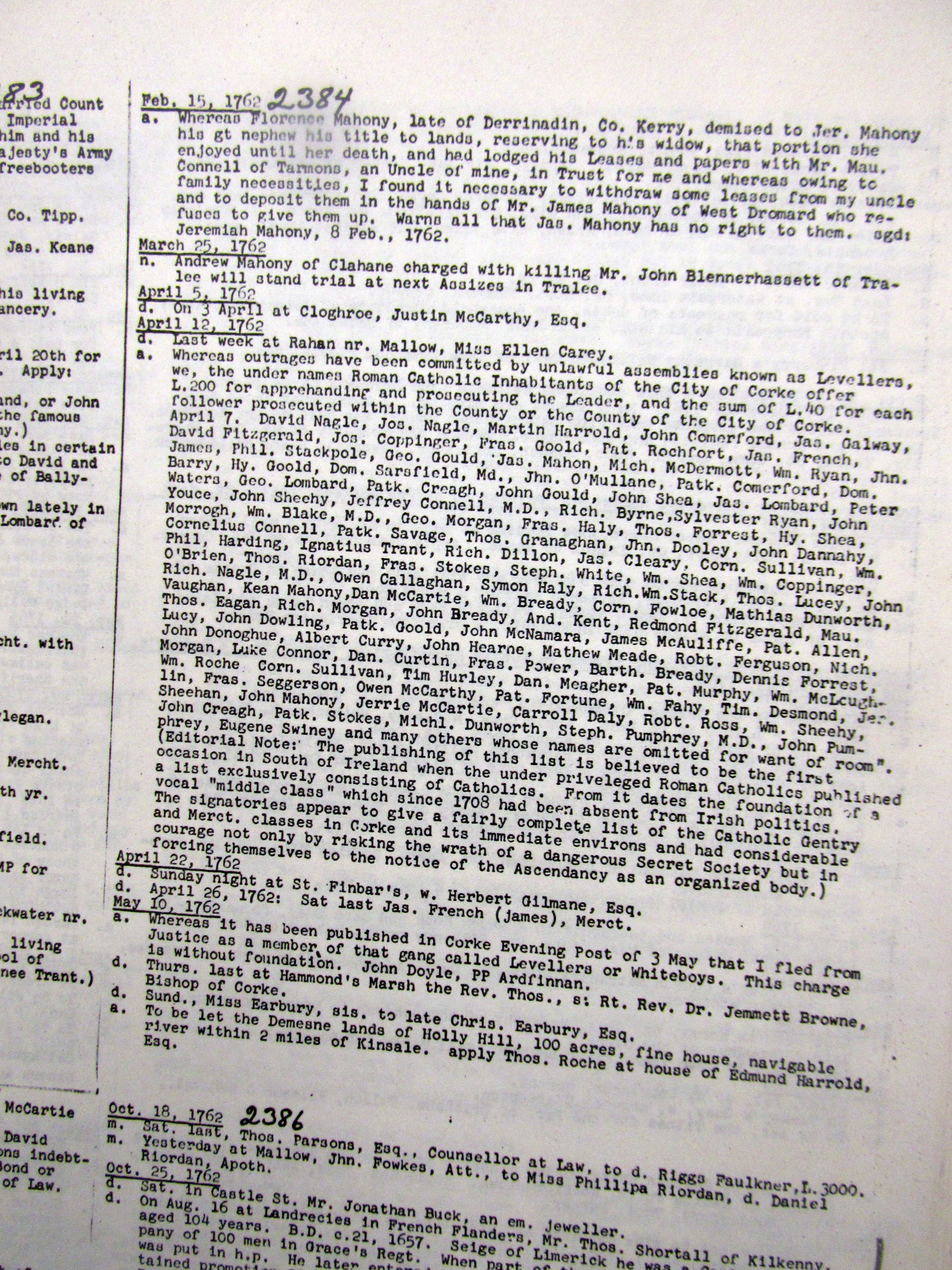
The administrative affairs of Co. Cork was run by the Grand Jury 23 in number a self perpetuating clique. It was not until the County Councils came into being in the 1890s that a democratic administration was put in place.

13 Saturday Dec 2014
Posted in Uncategorized
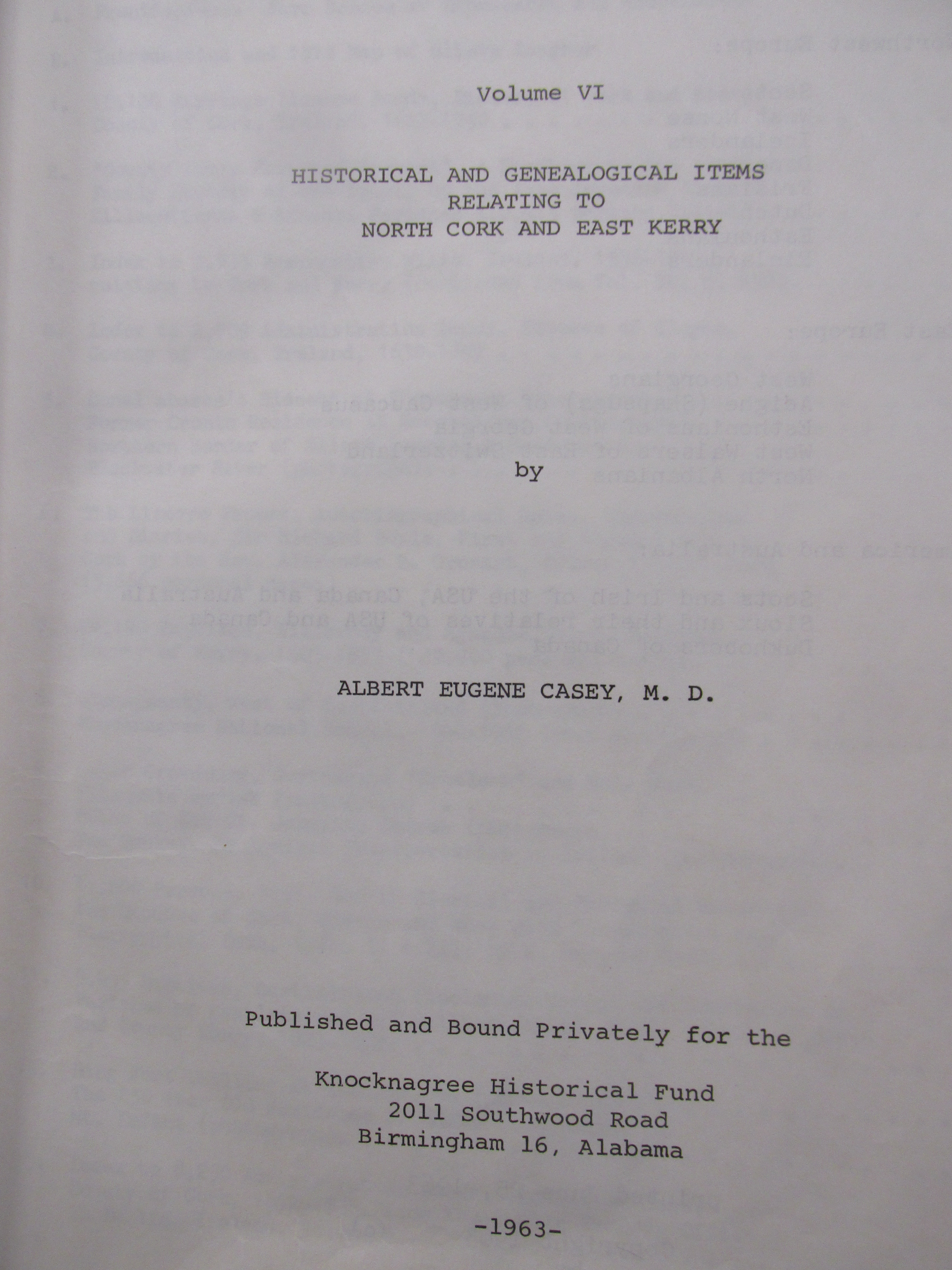
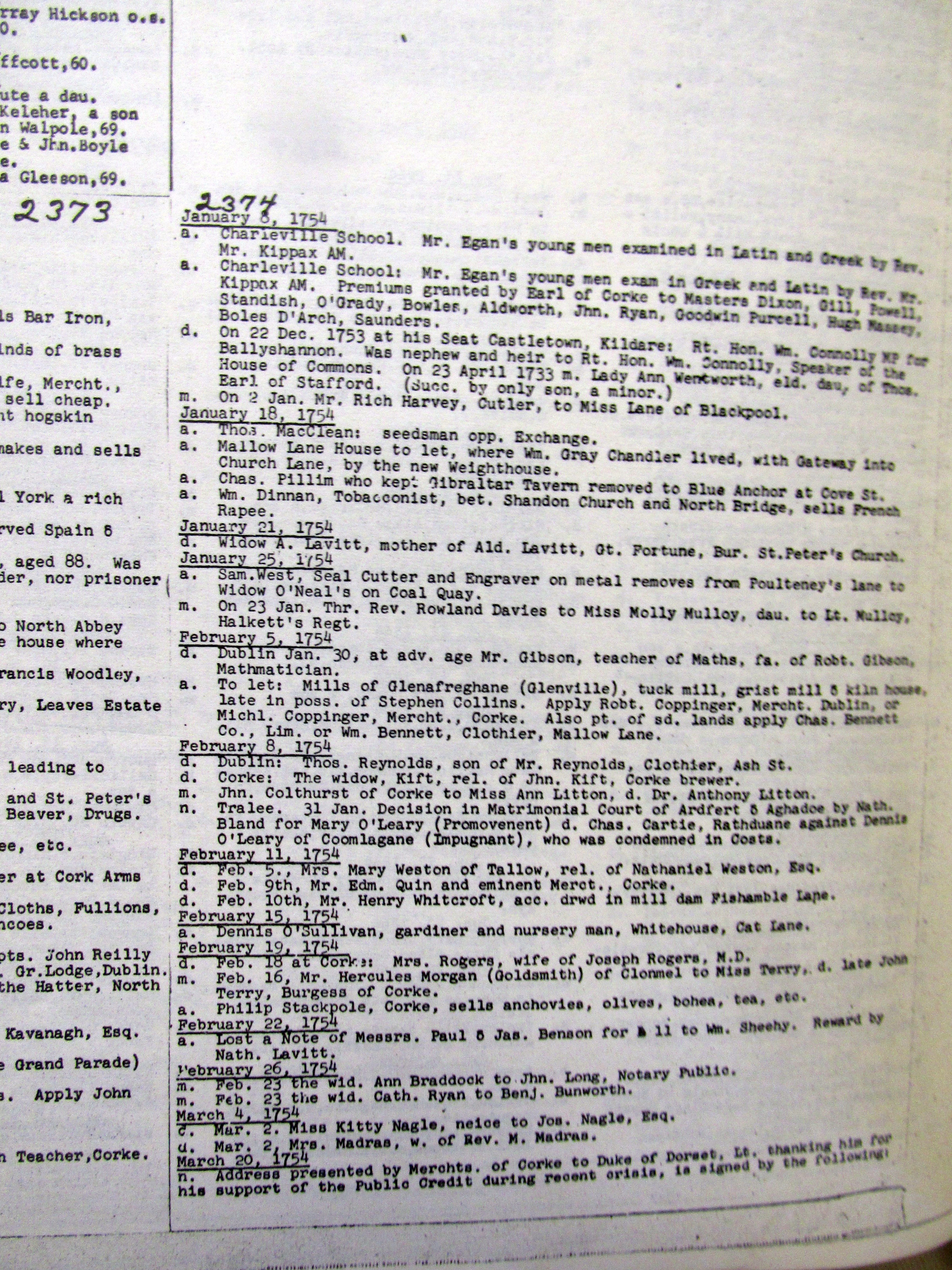
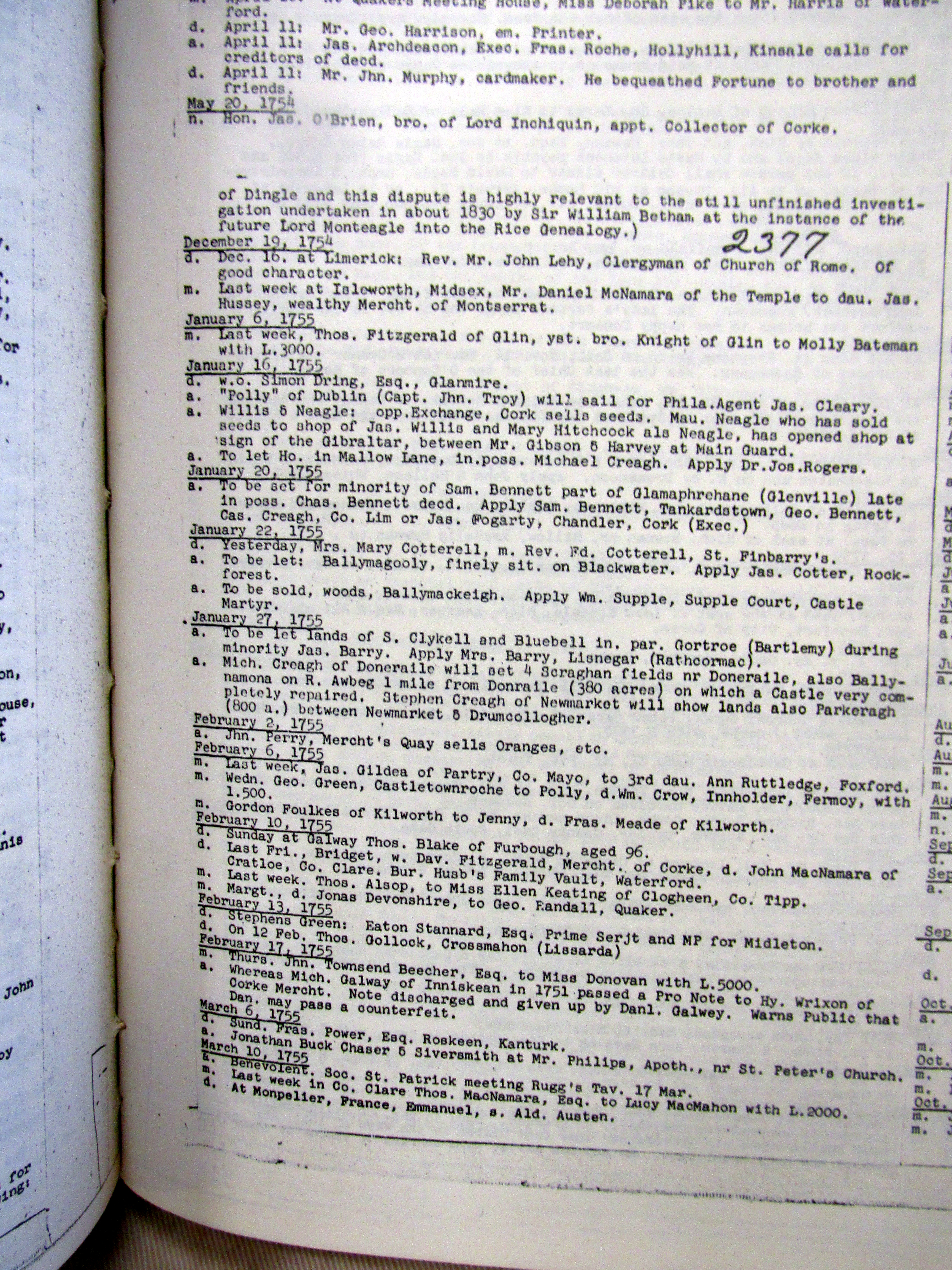
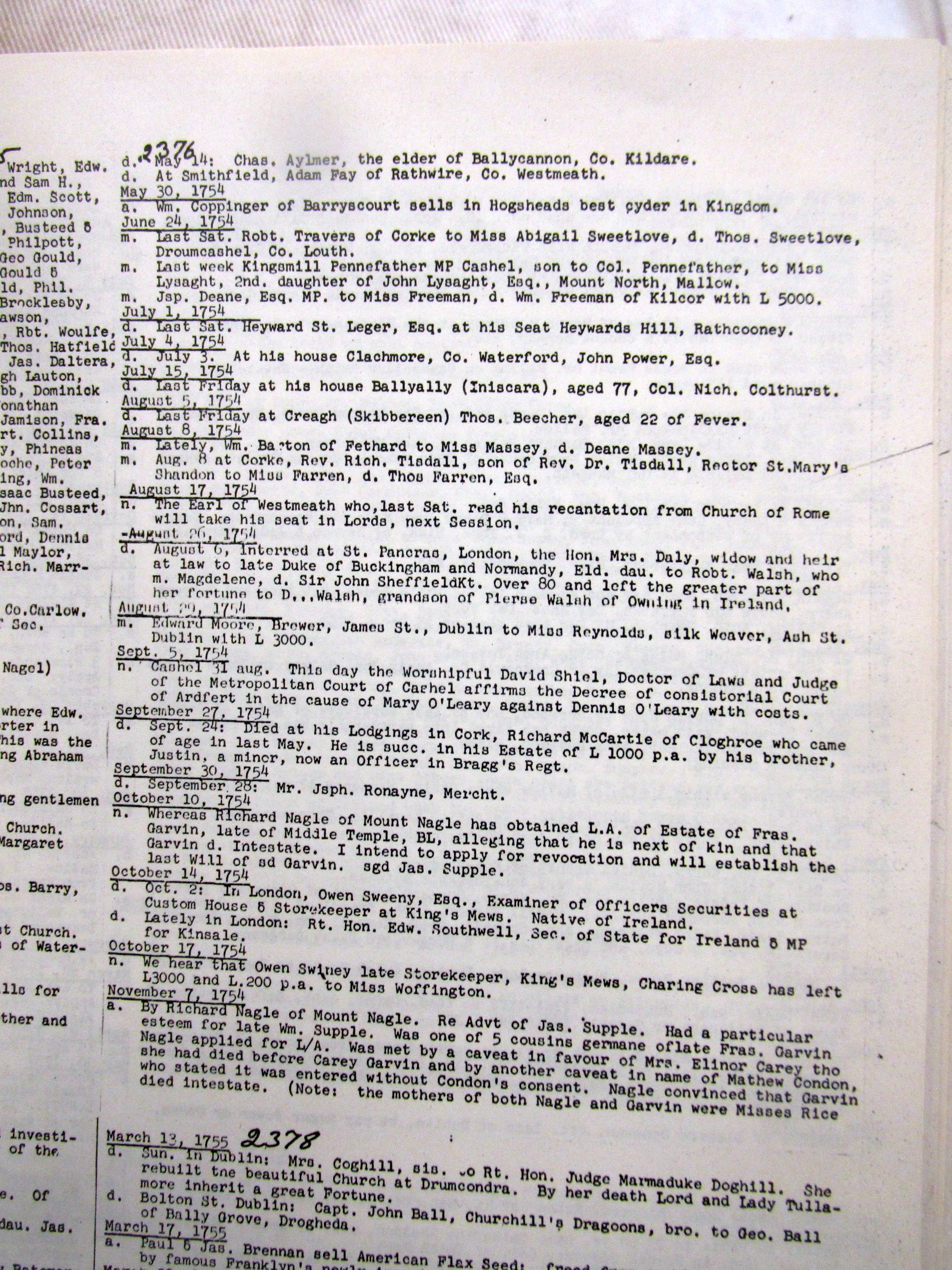
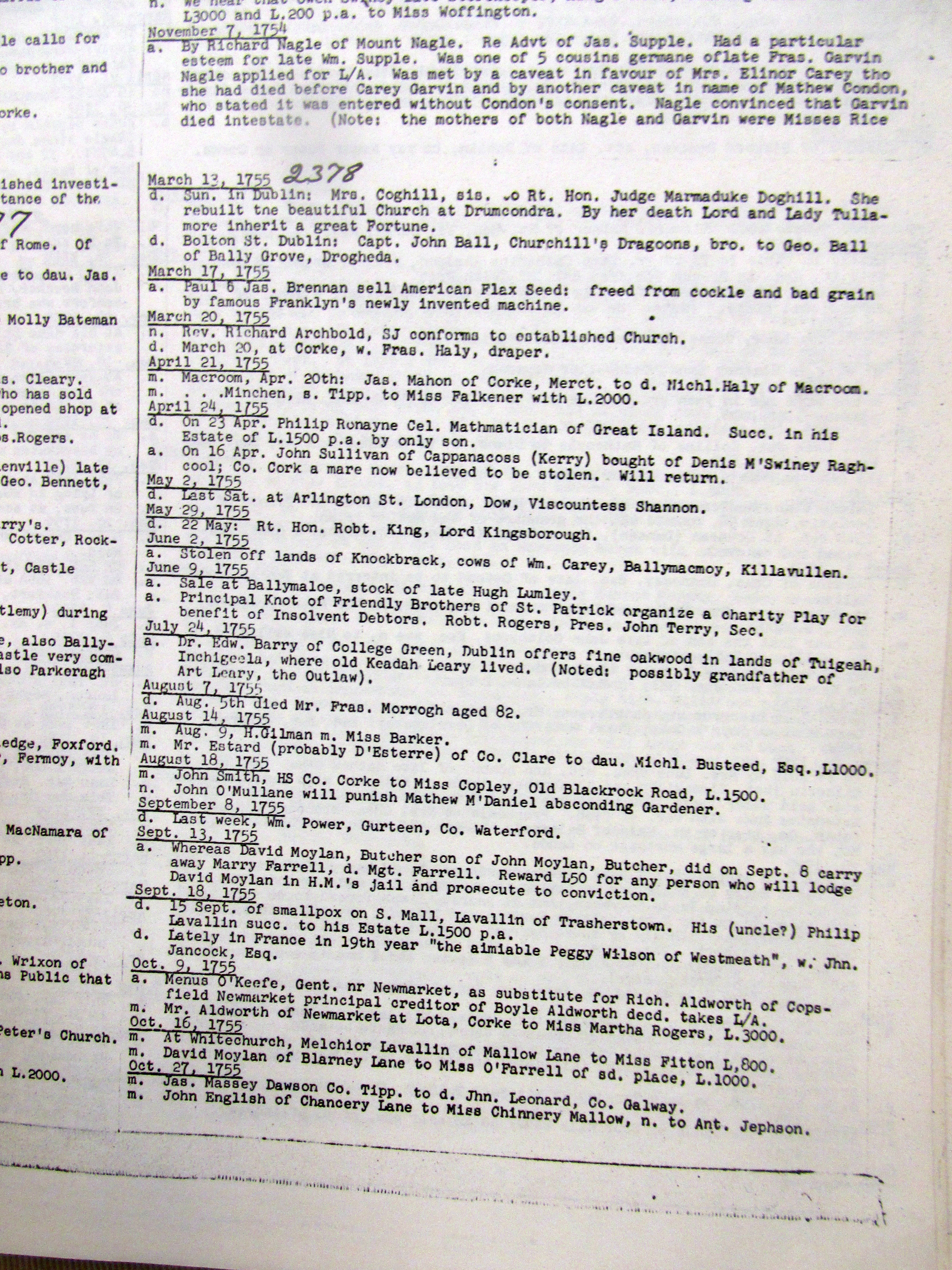
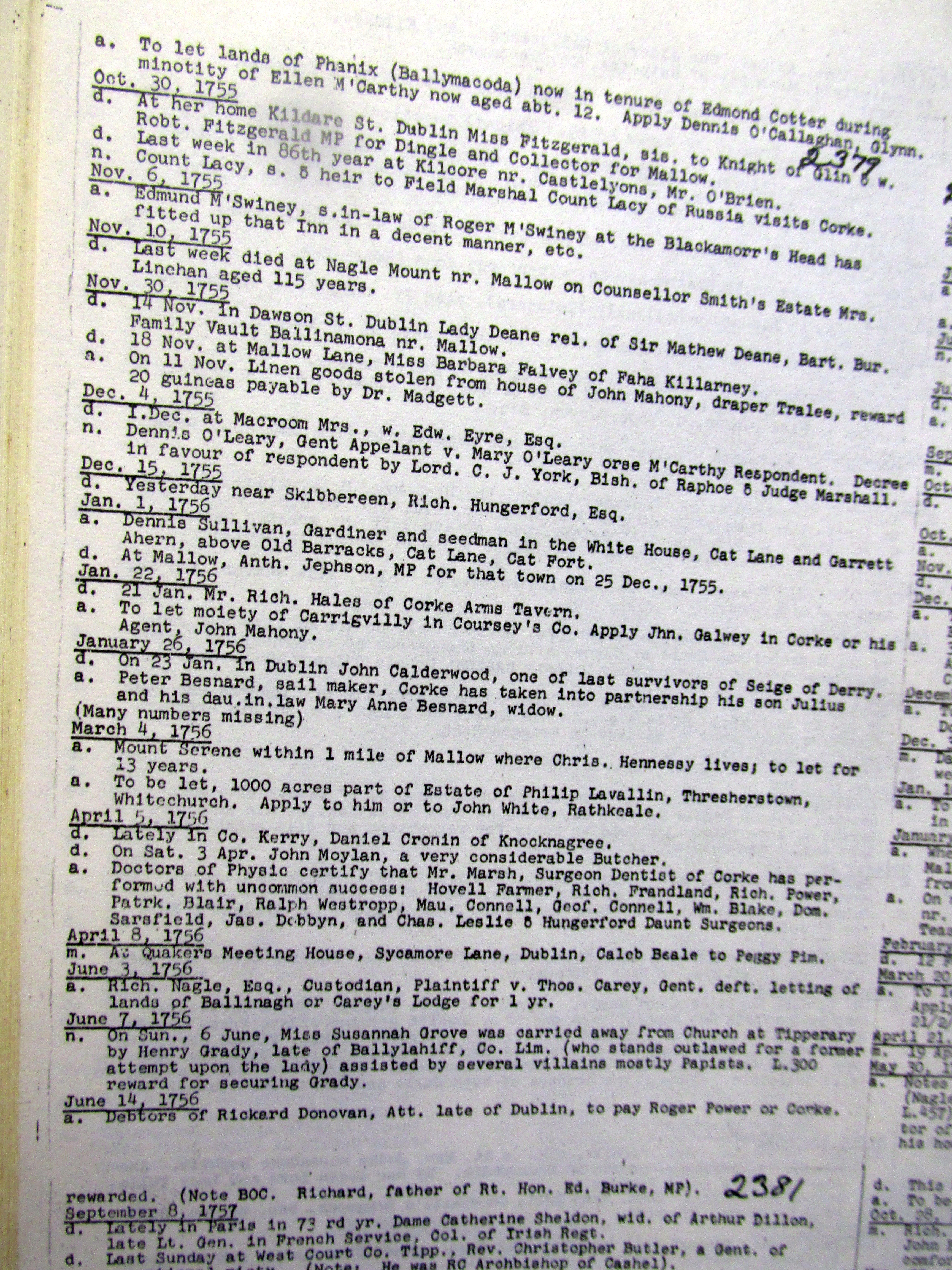
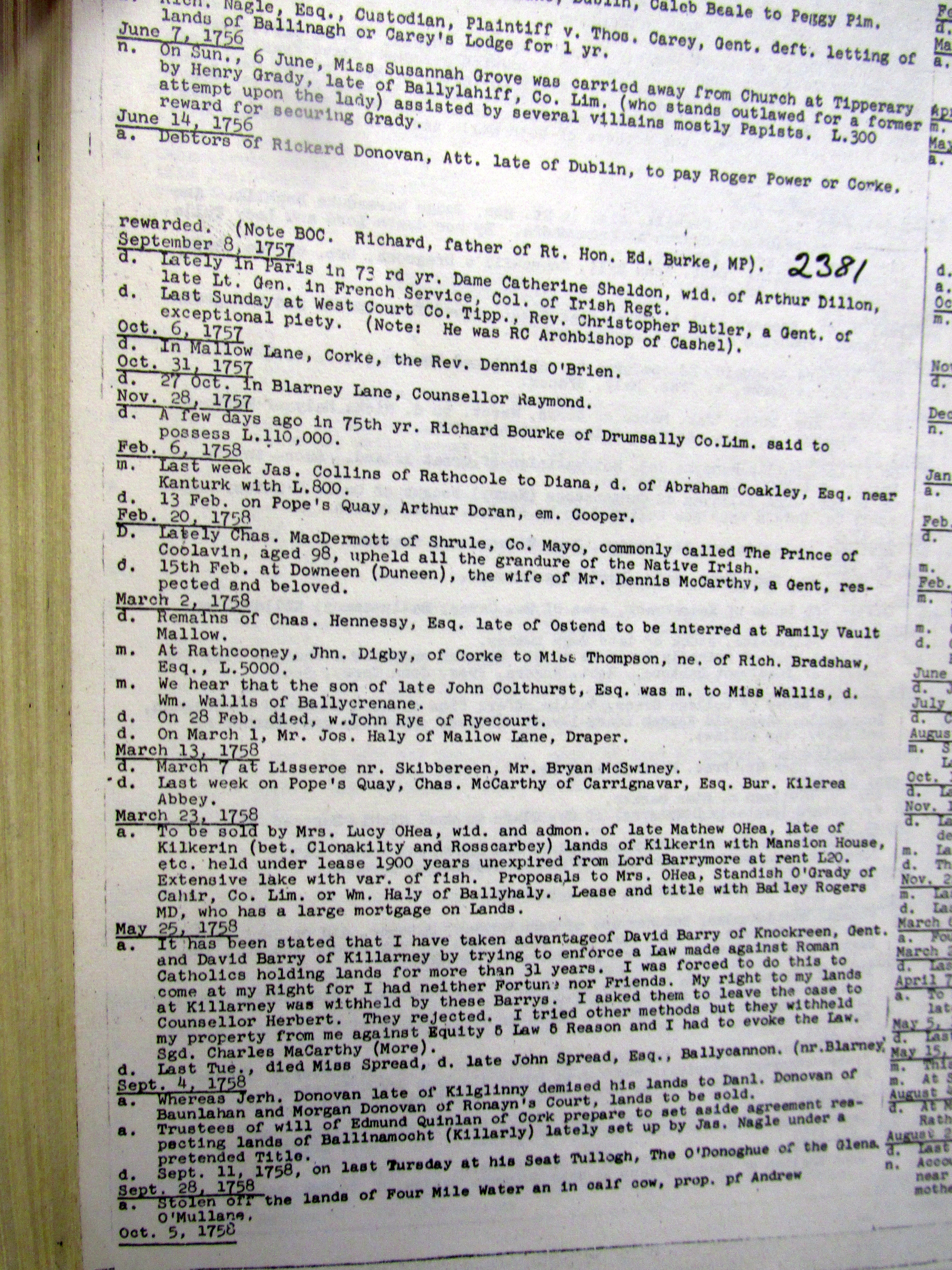
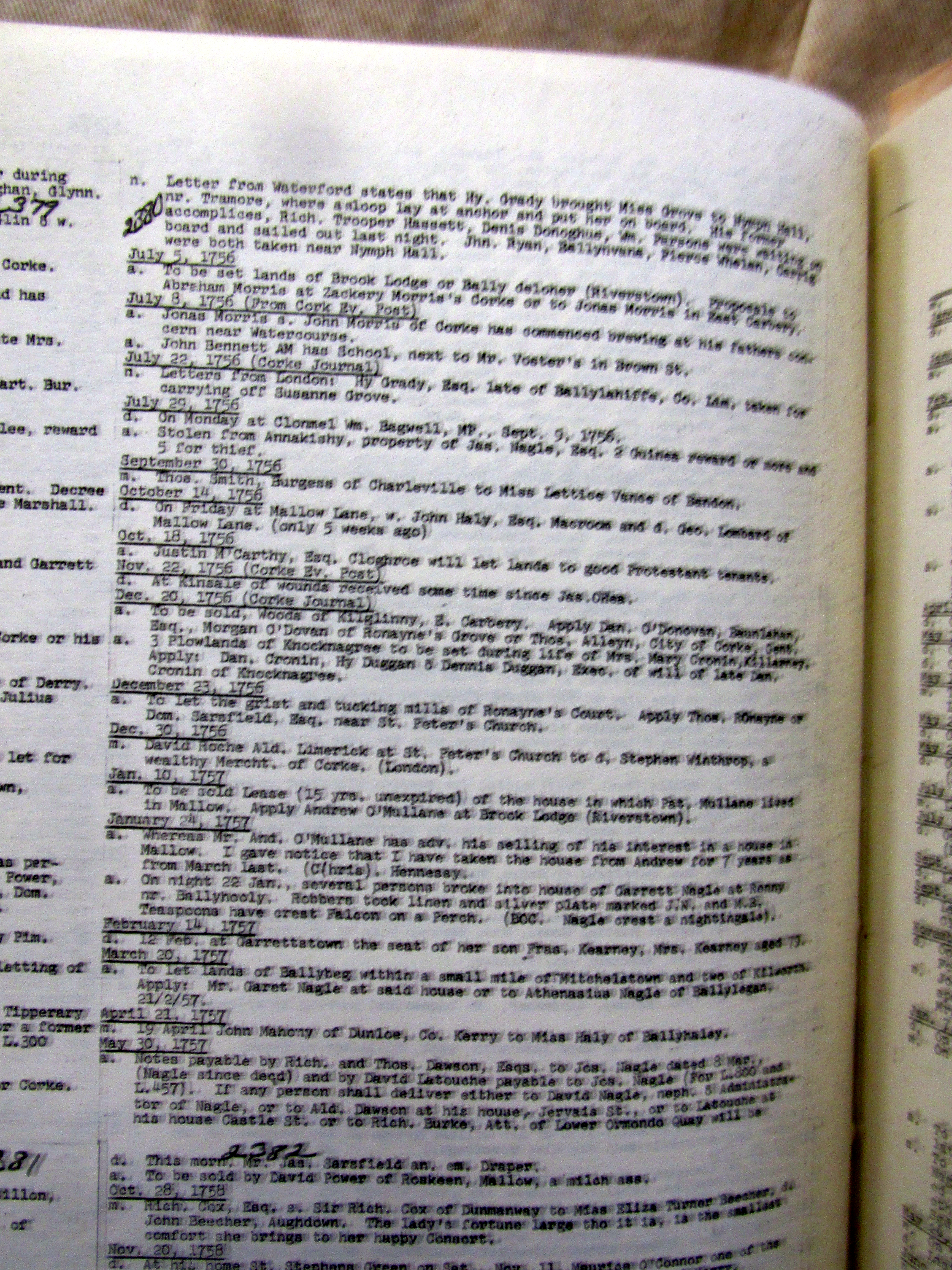
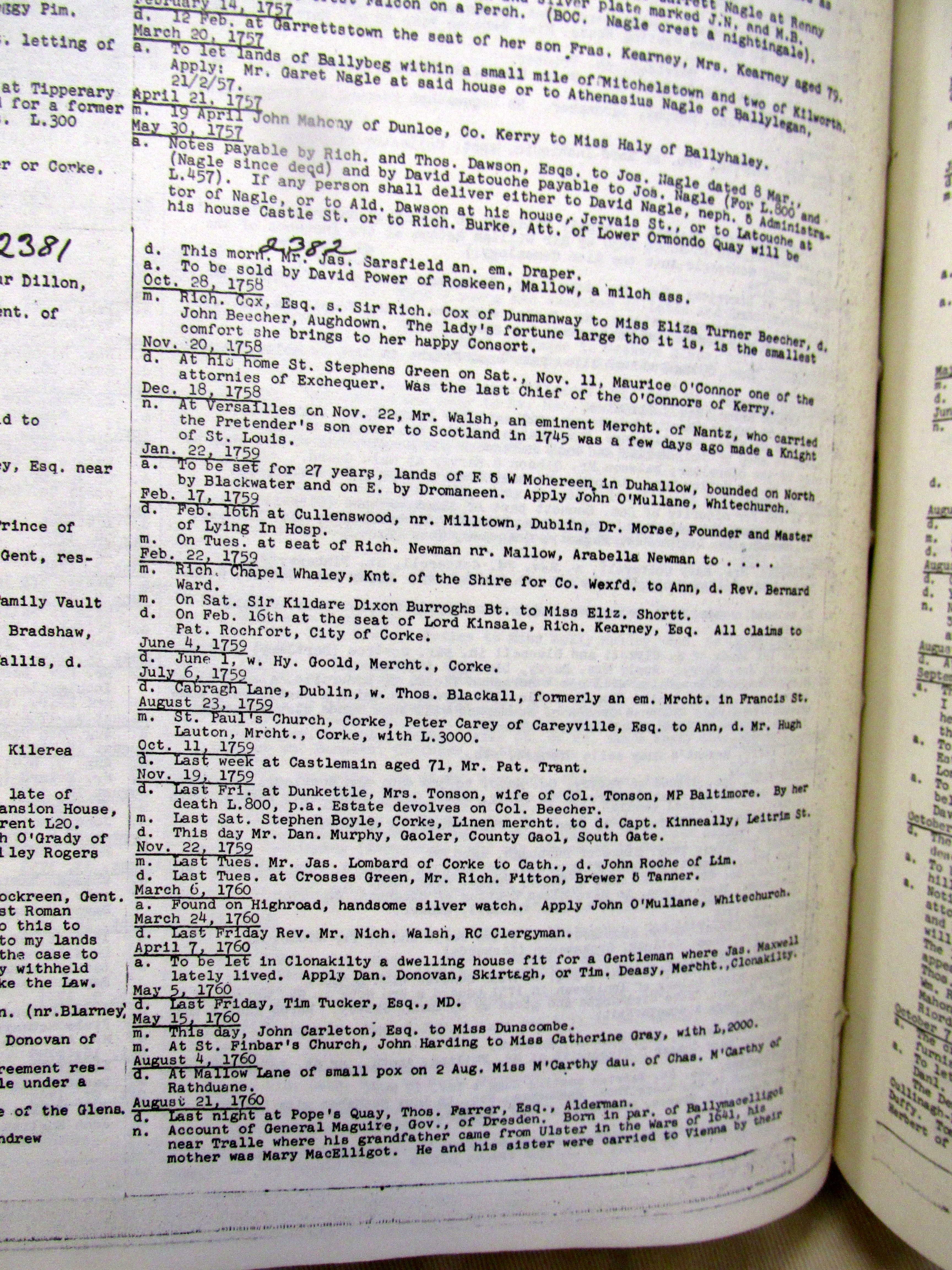
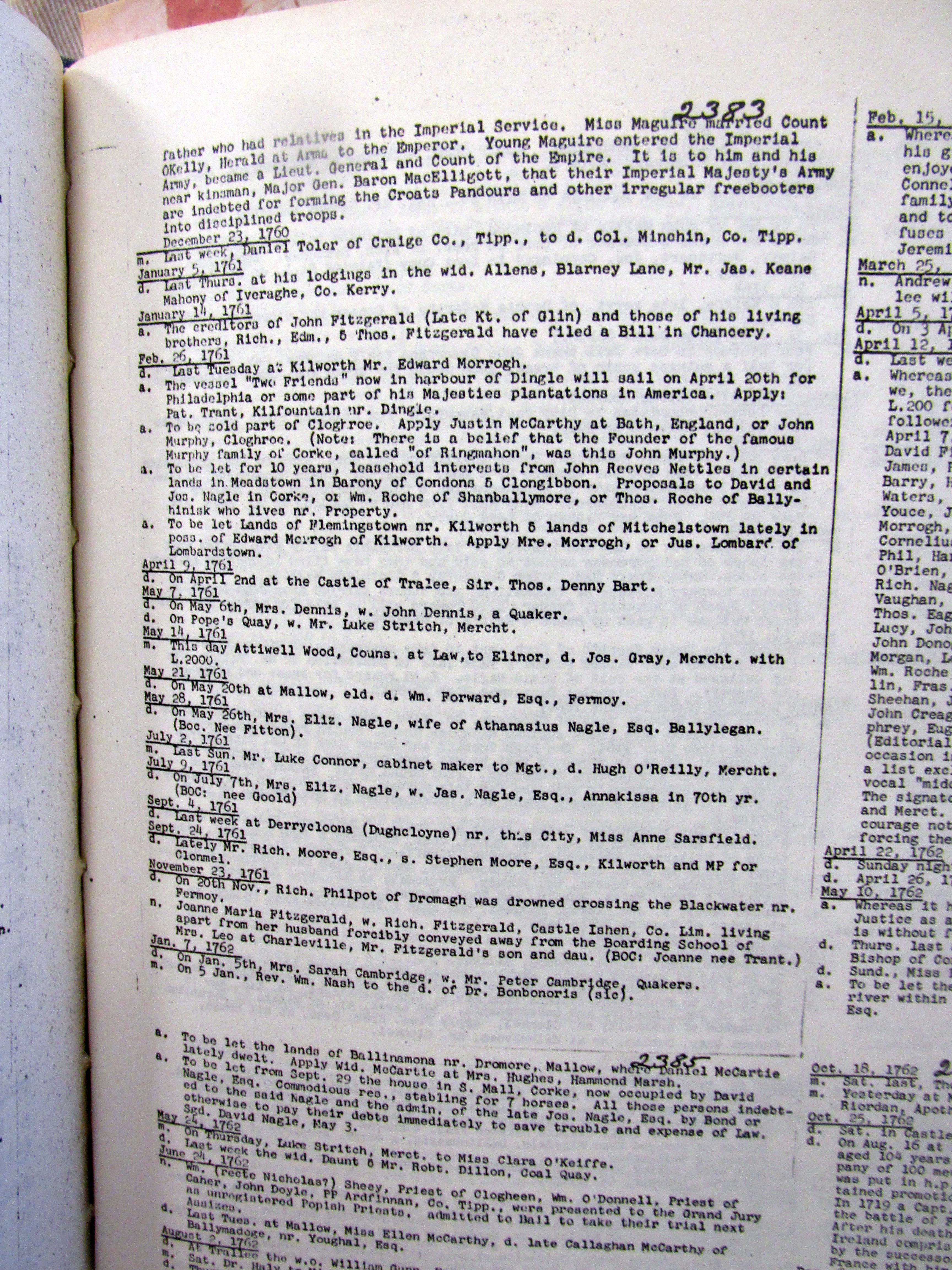
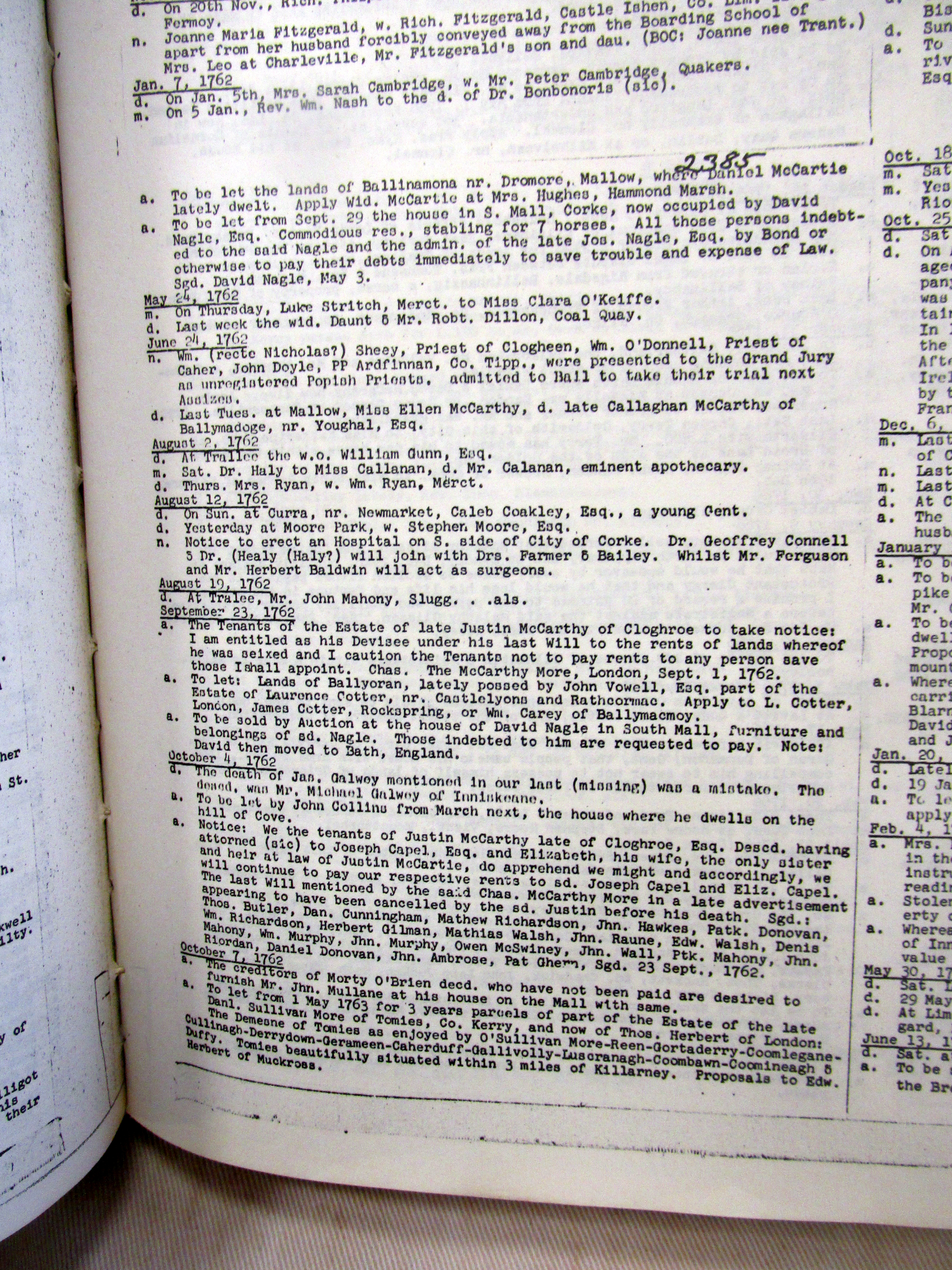
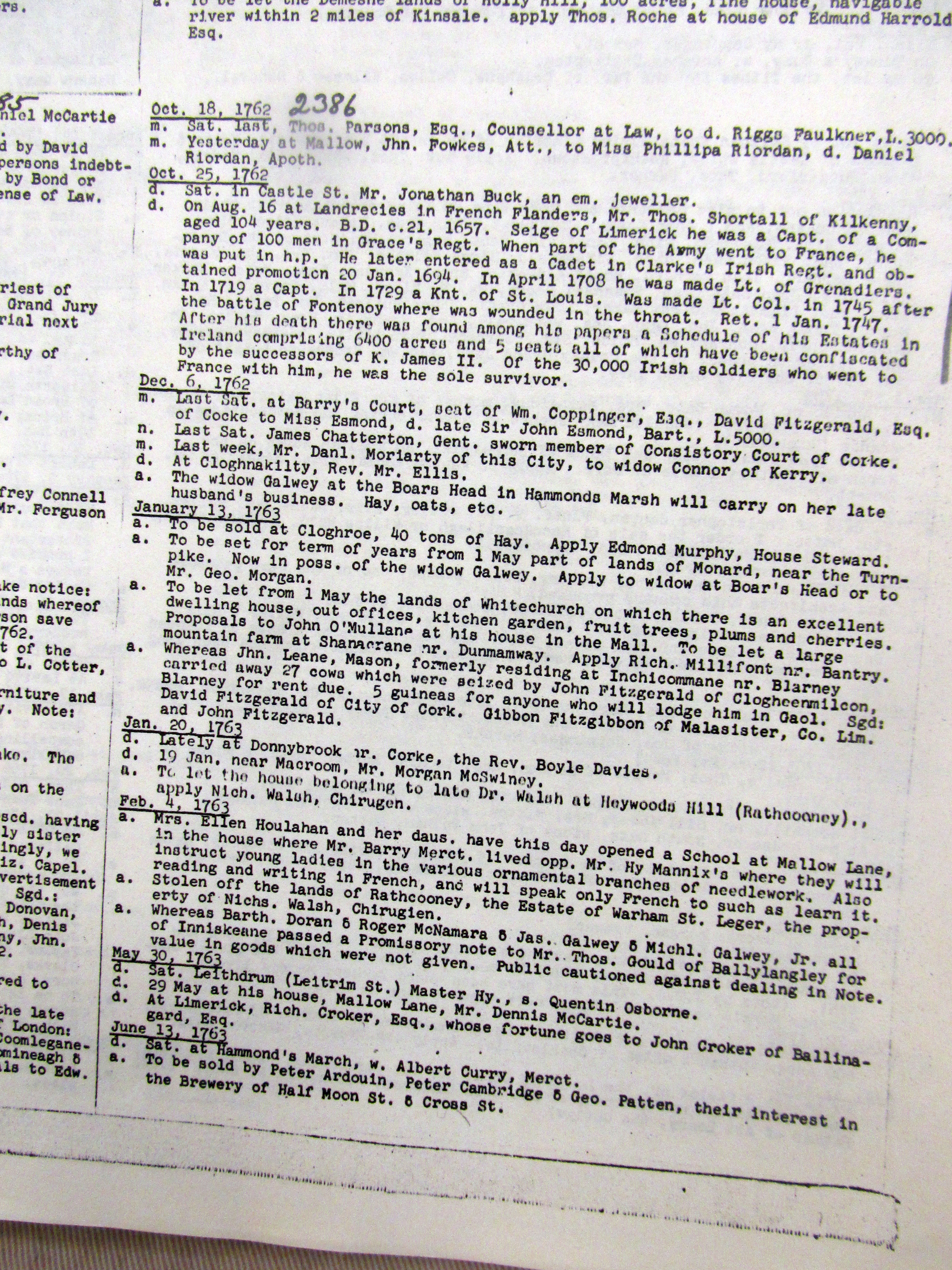
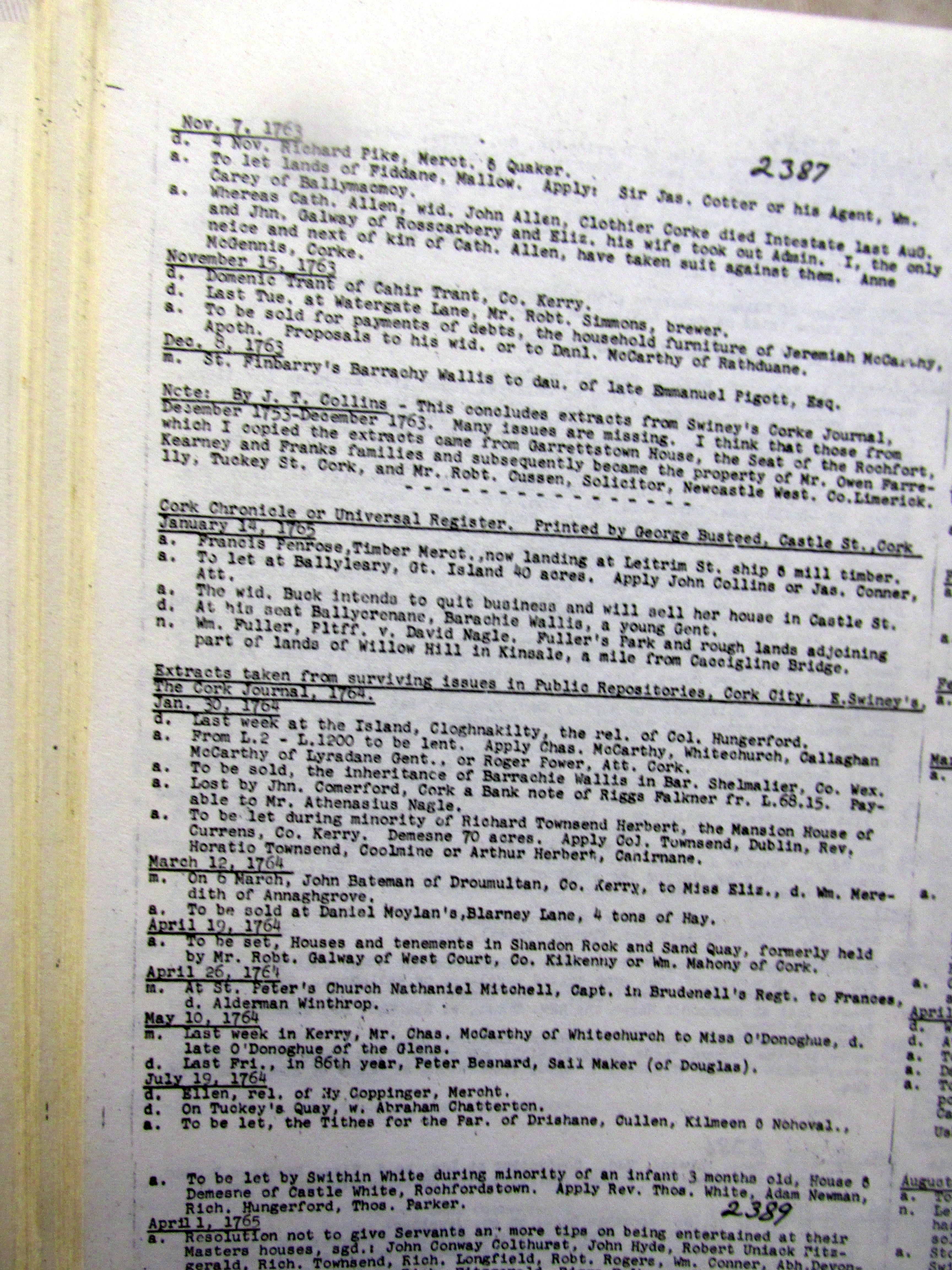
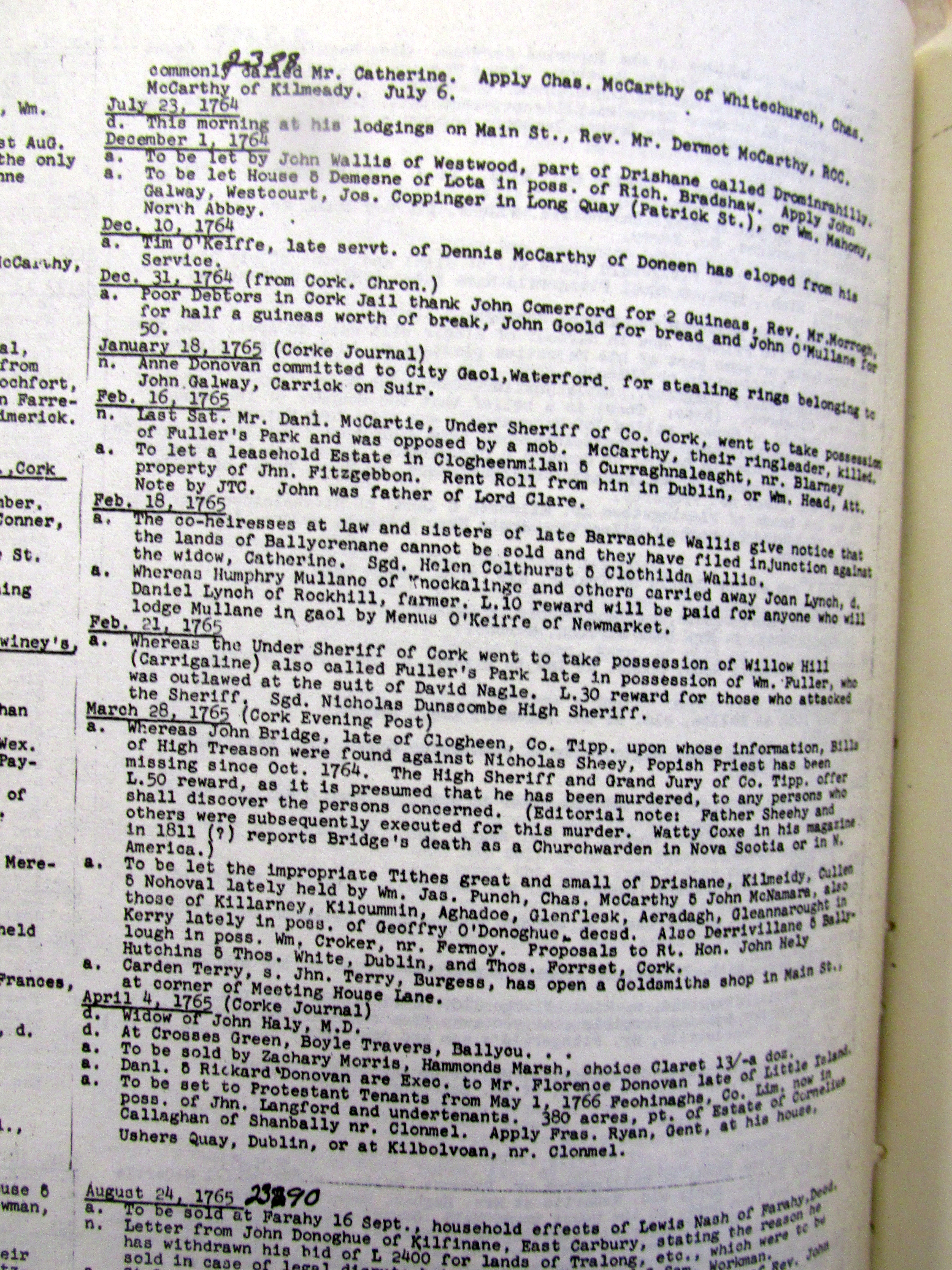
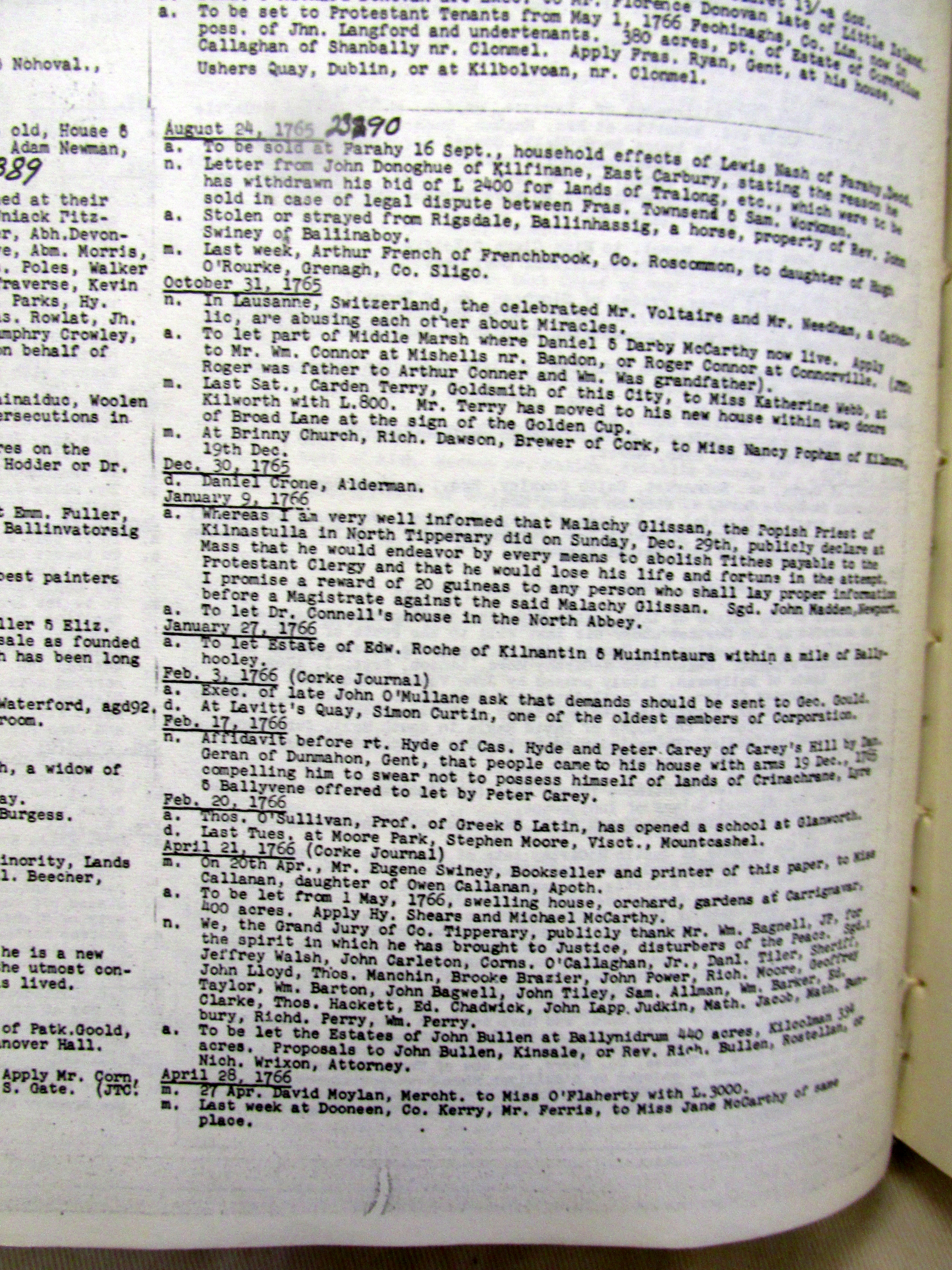
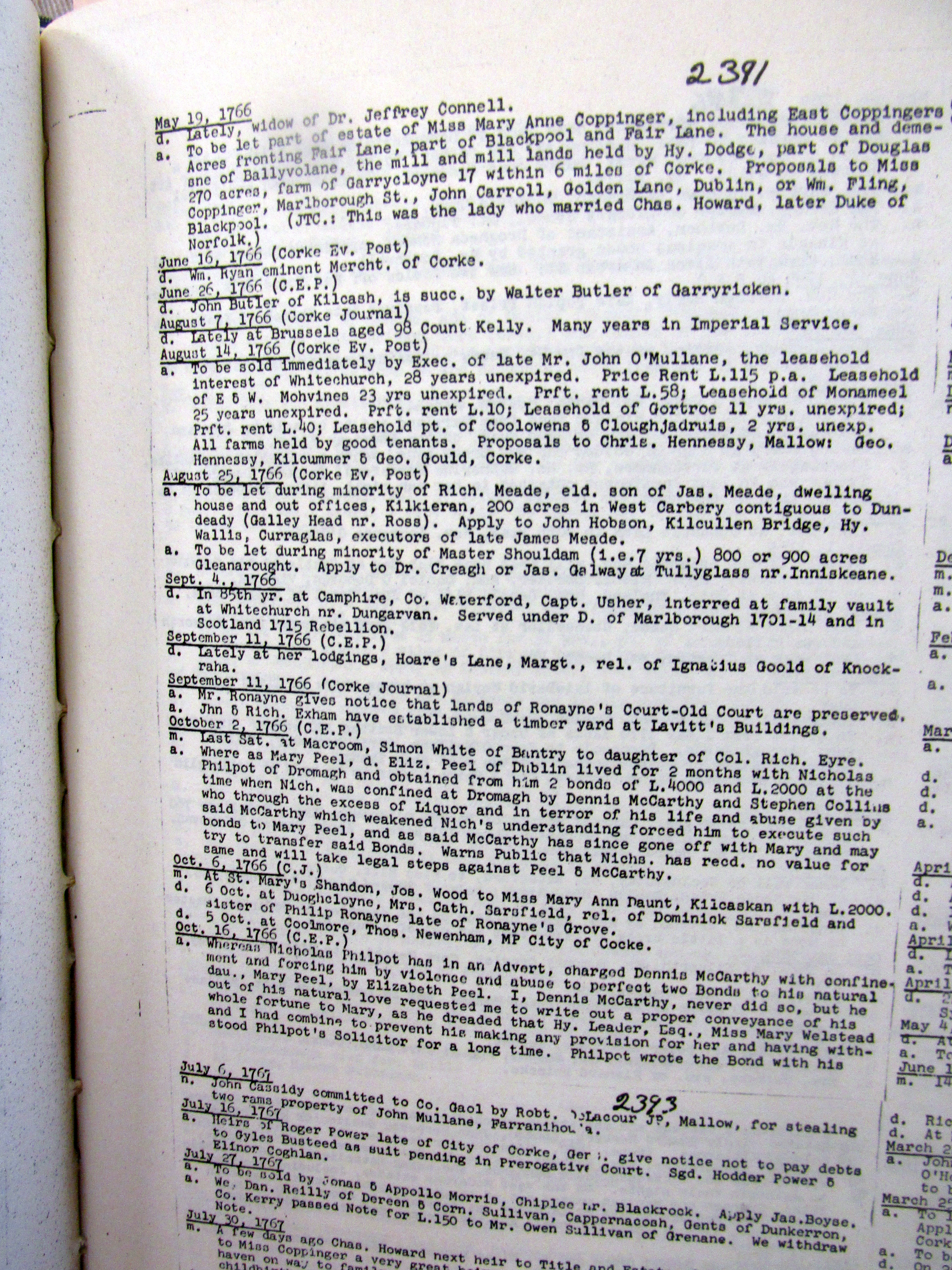
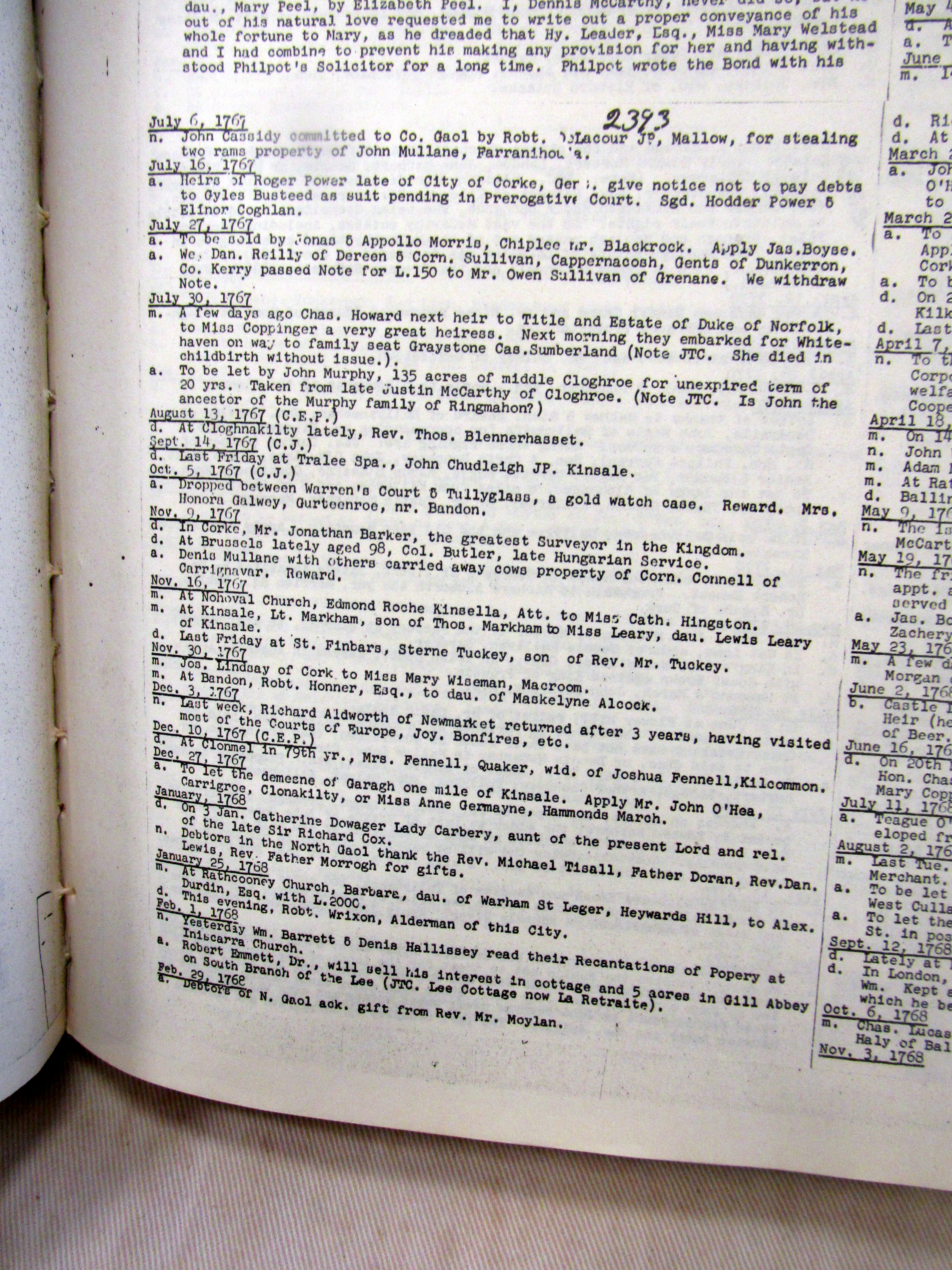
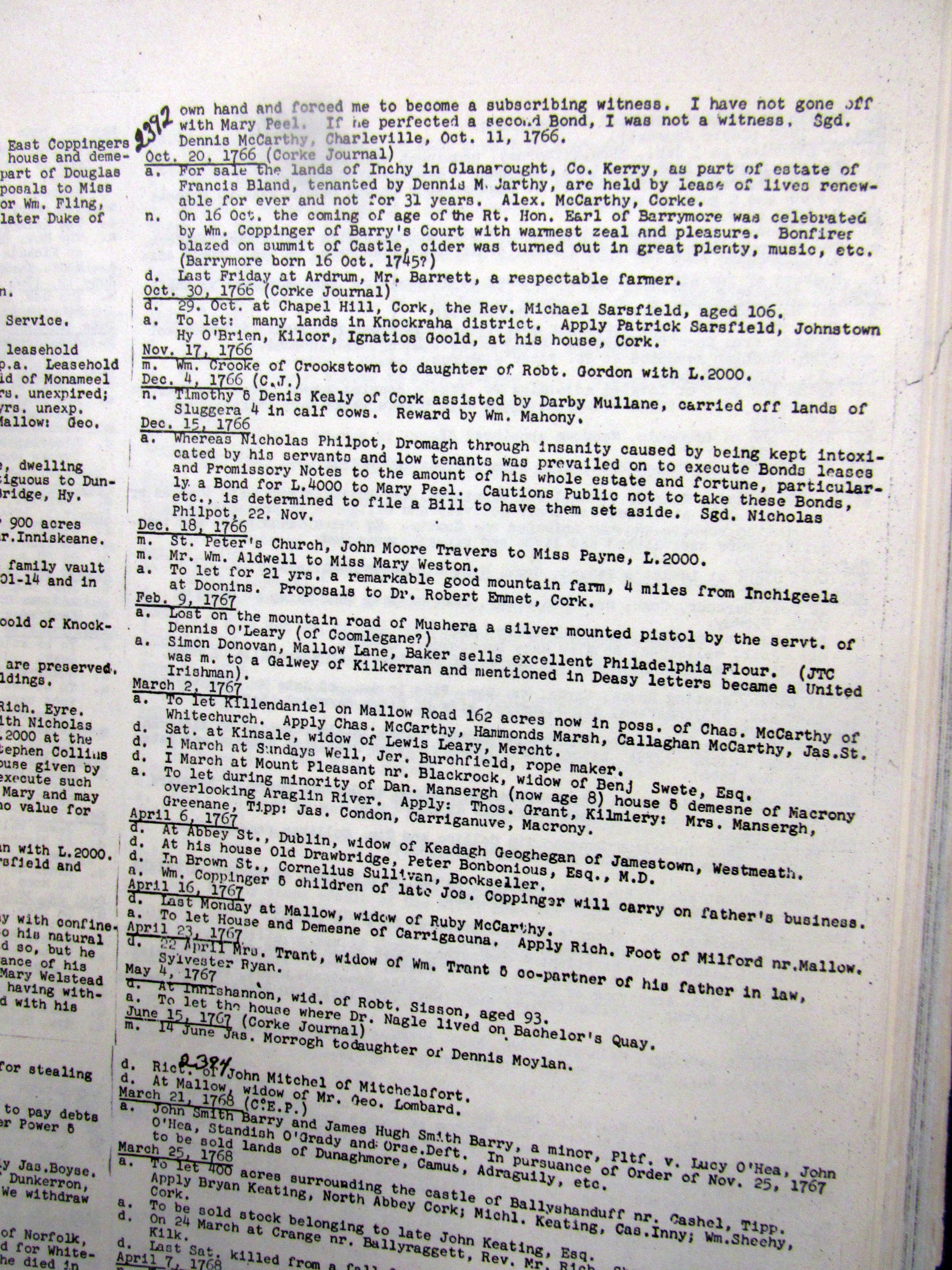
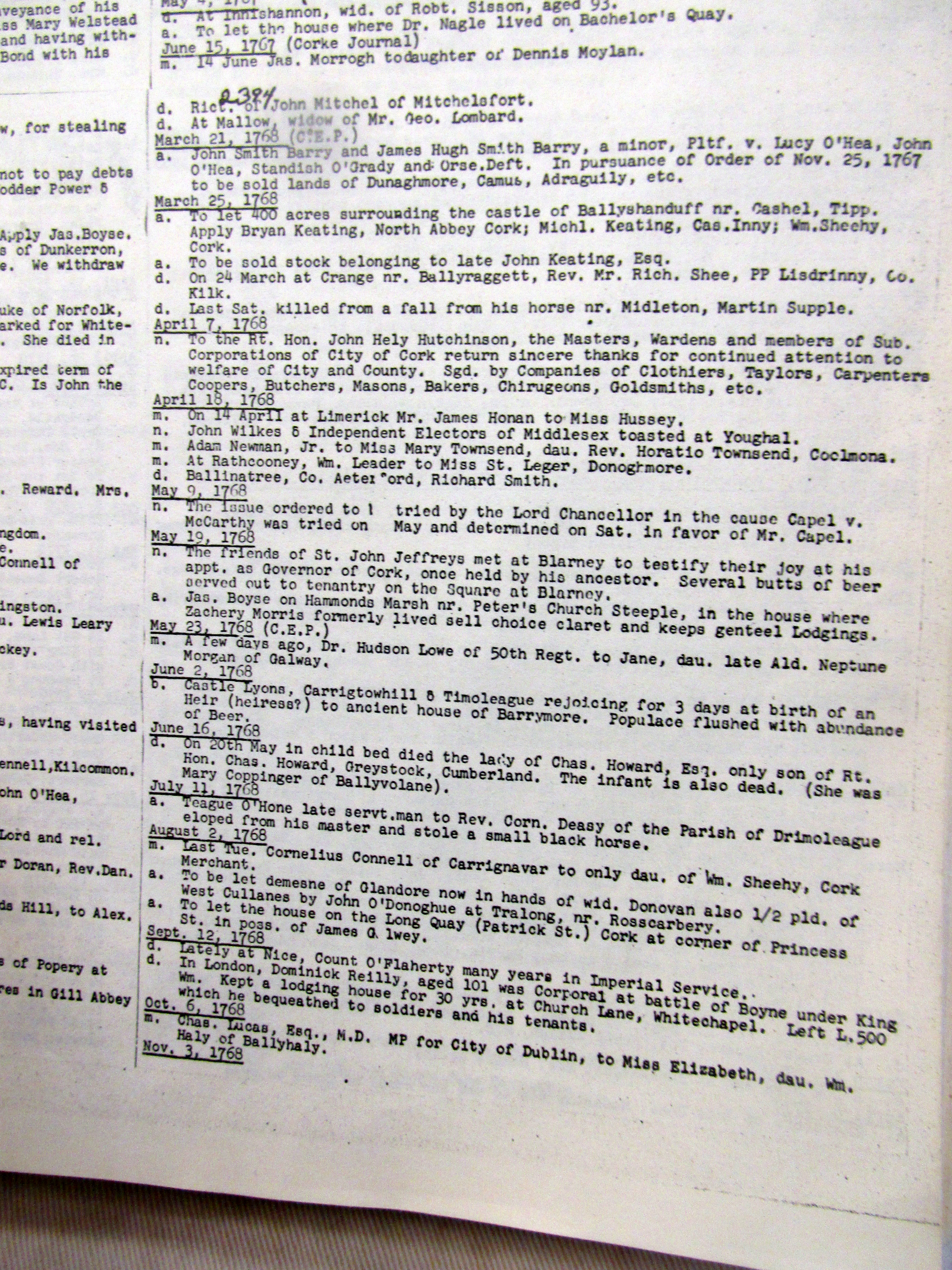
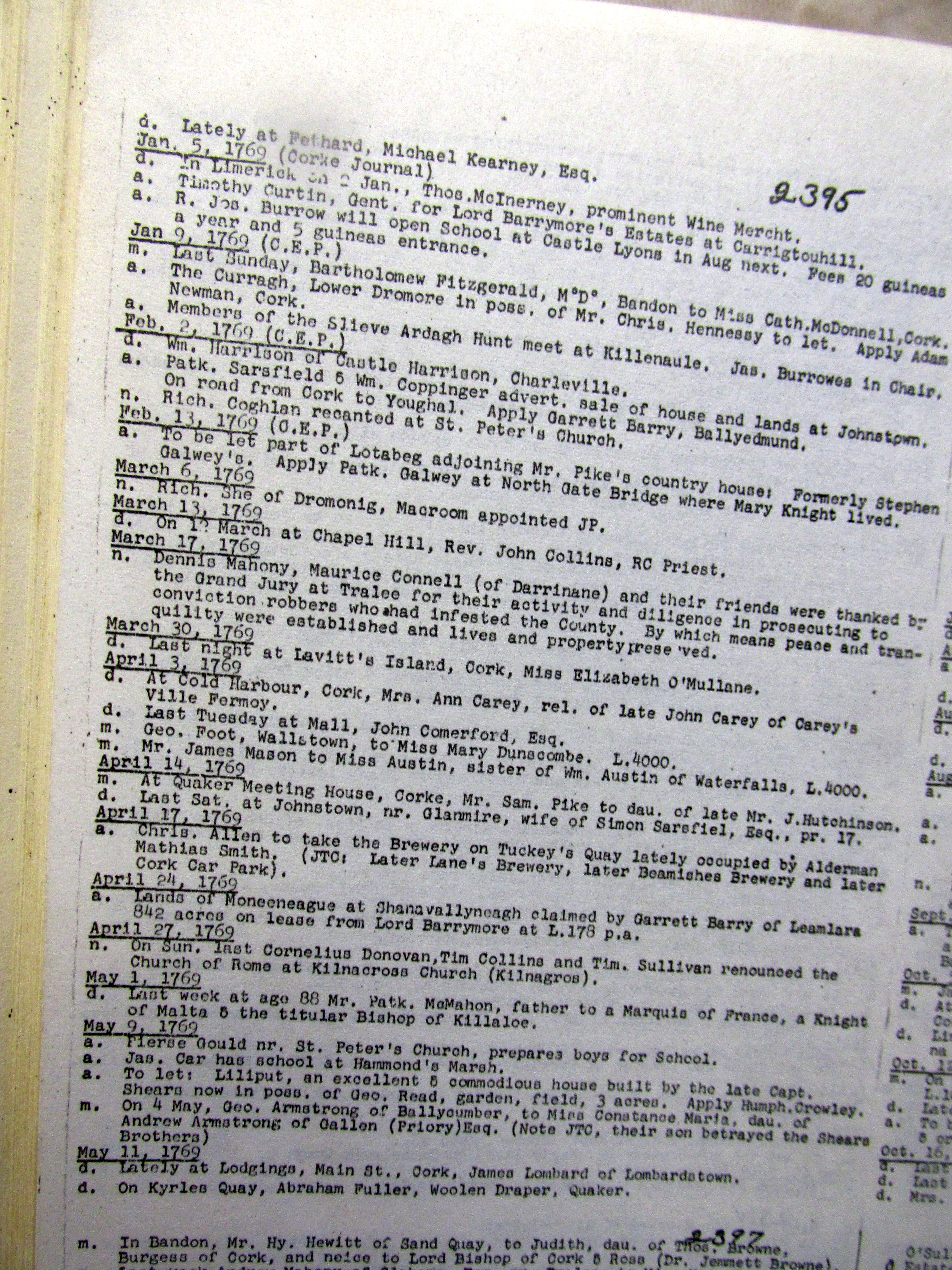
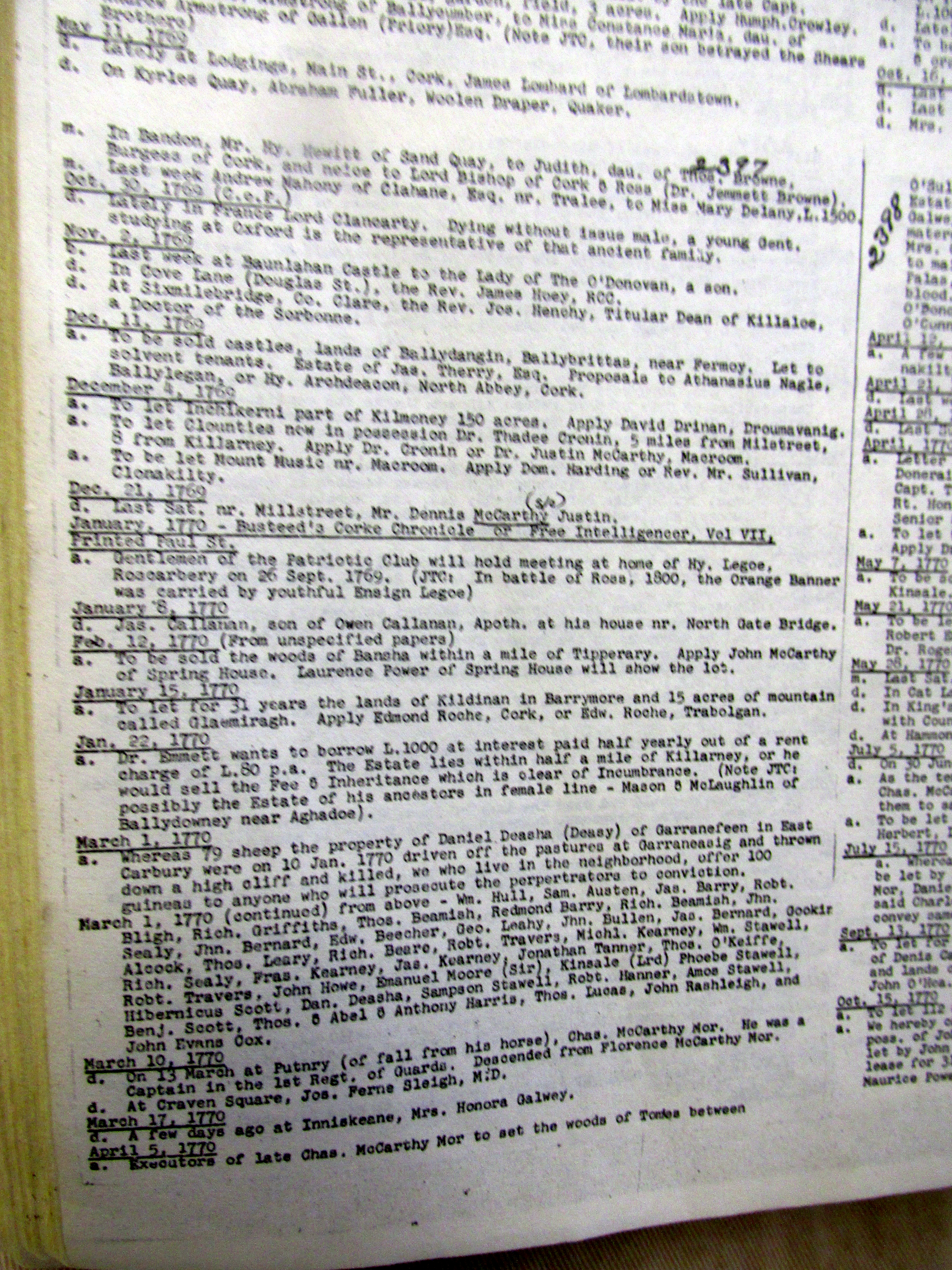
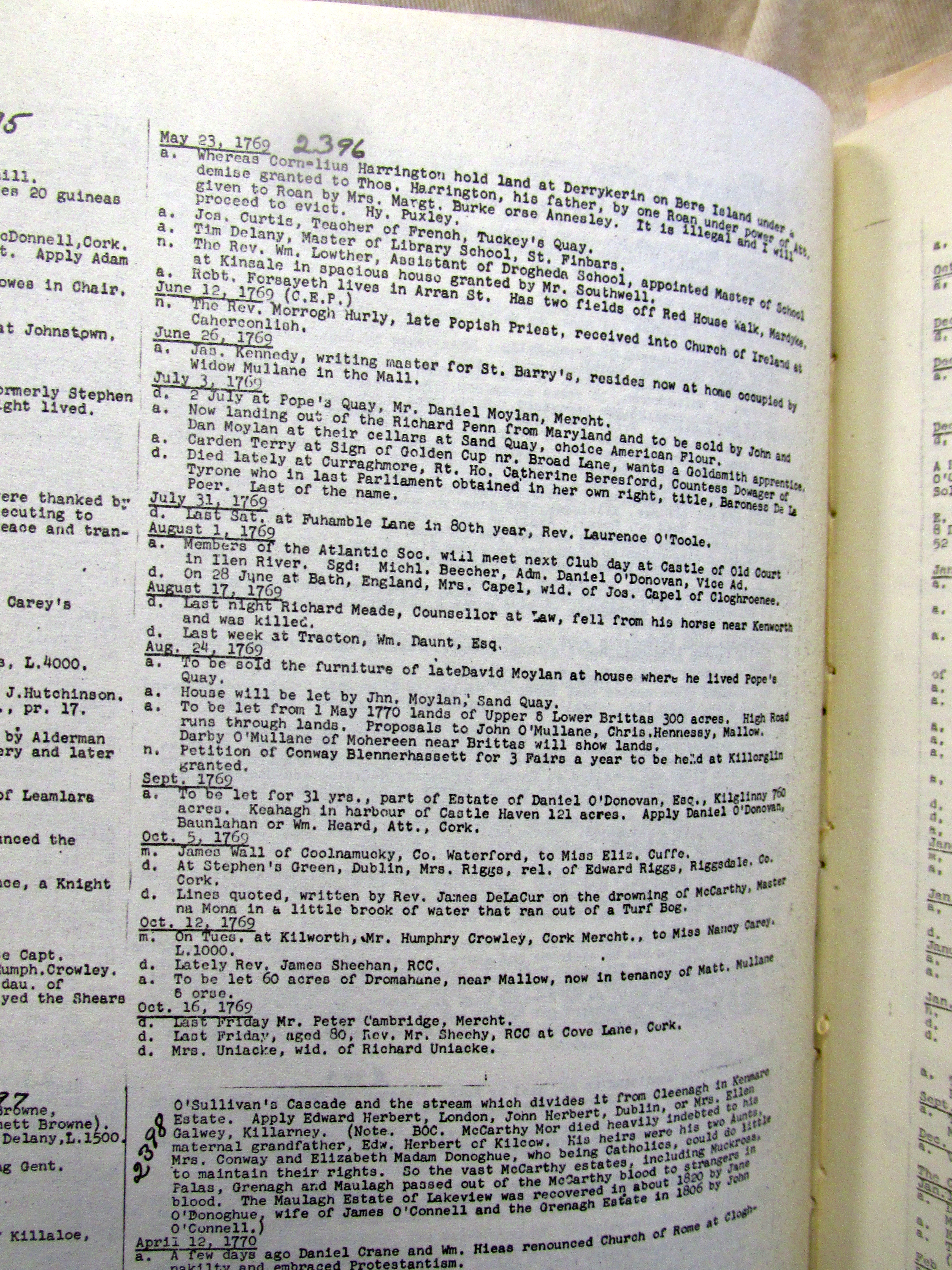
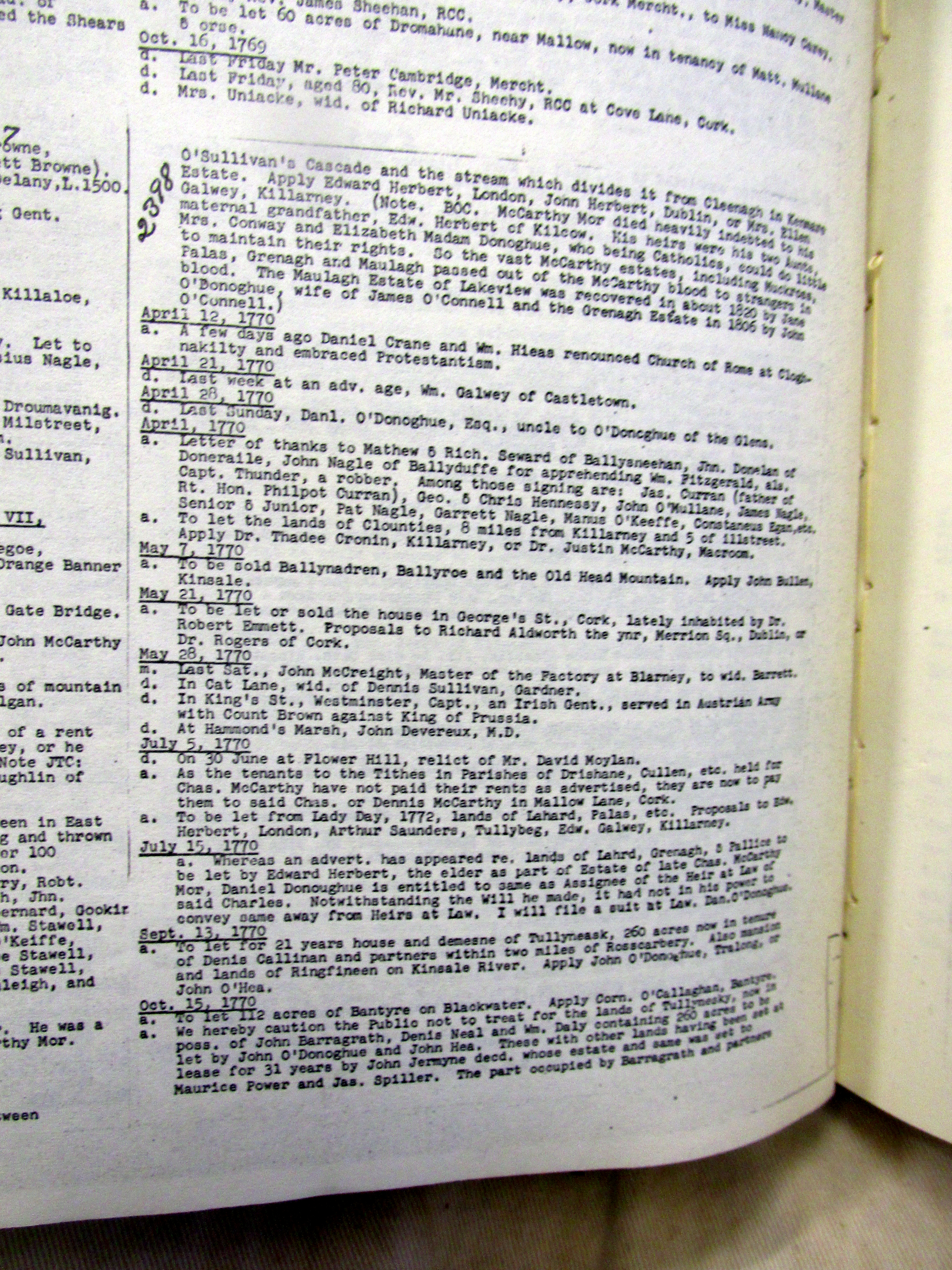
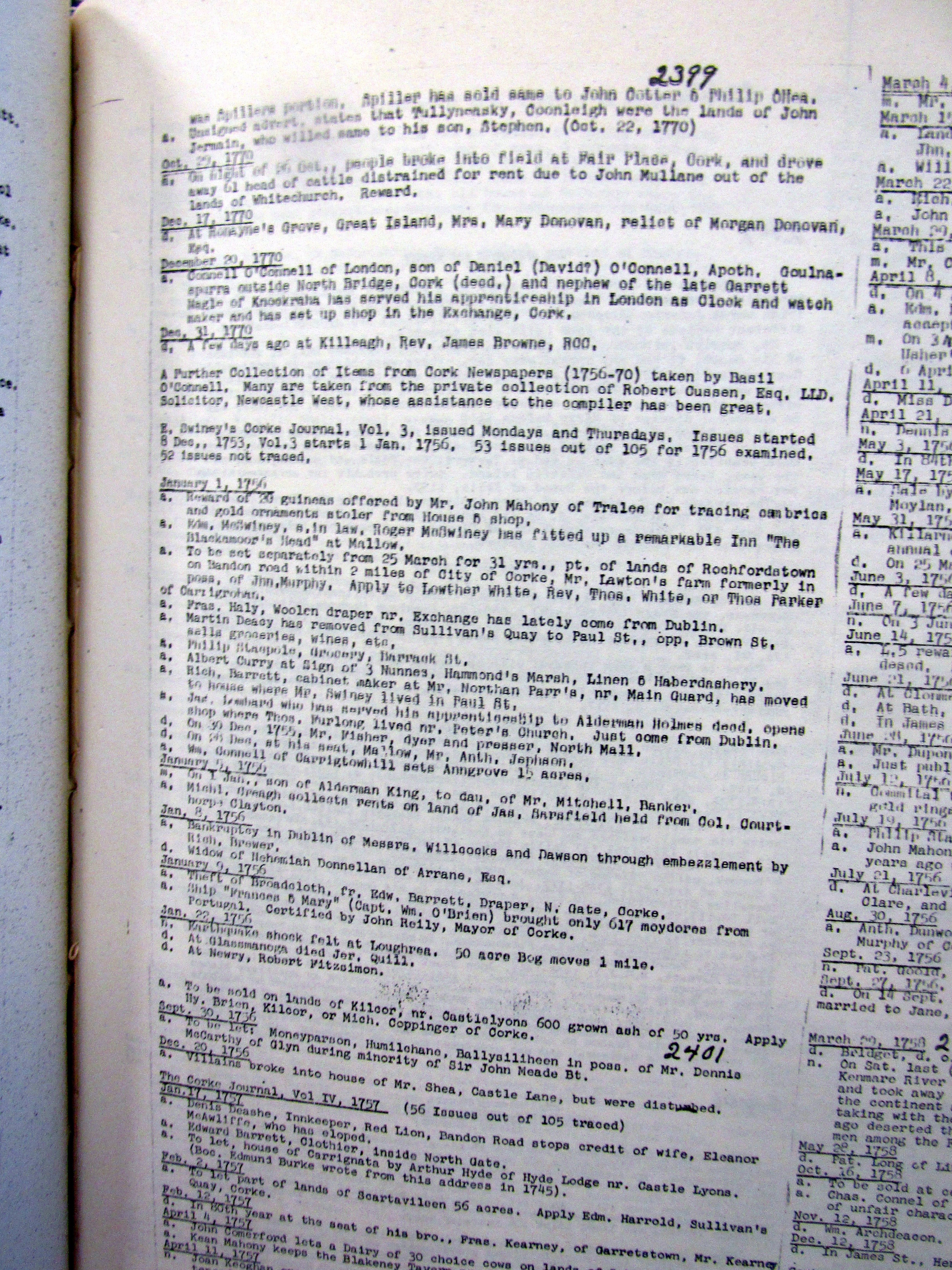
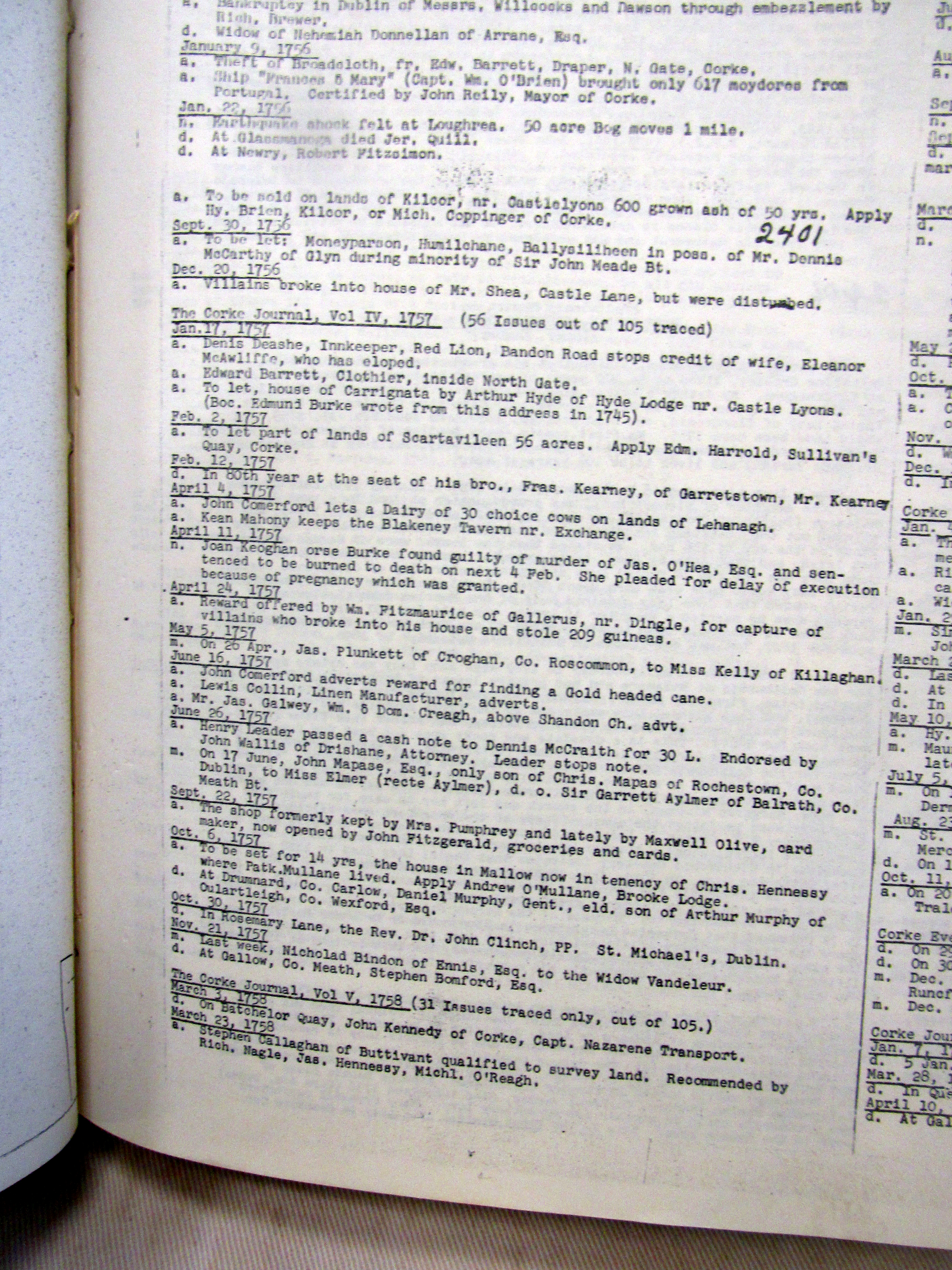
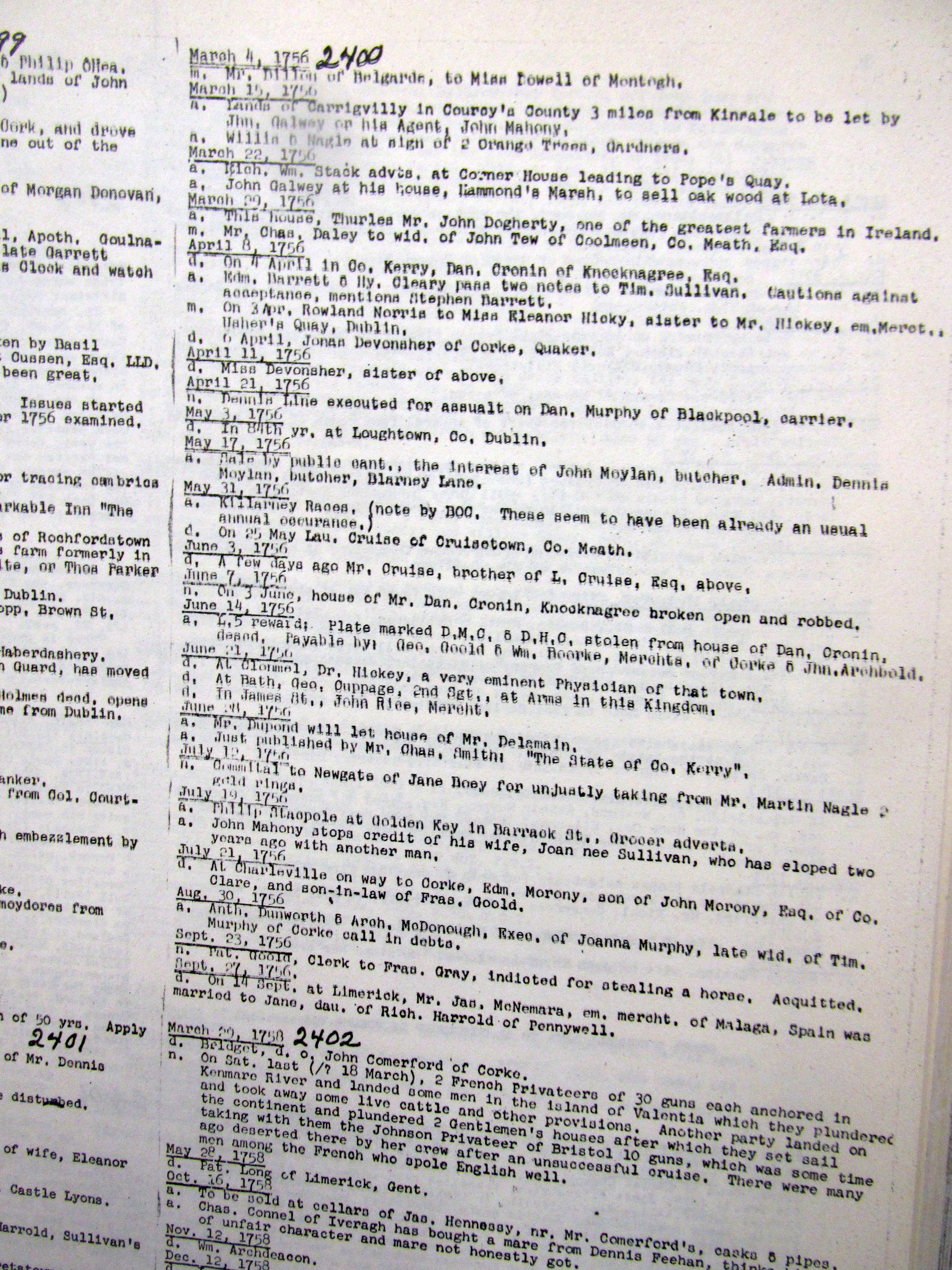
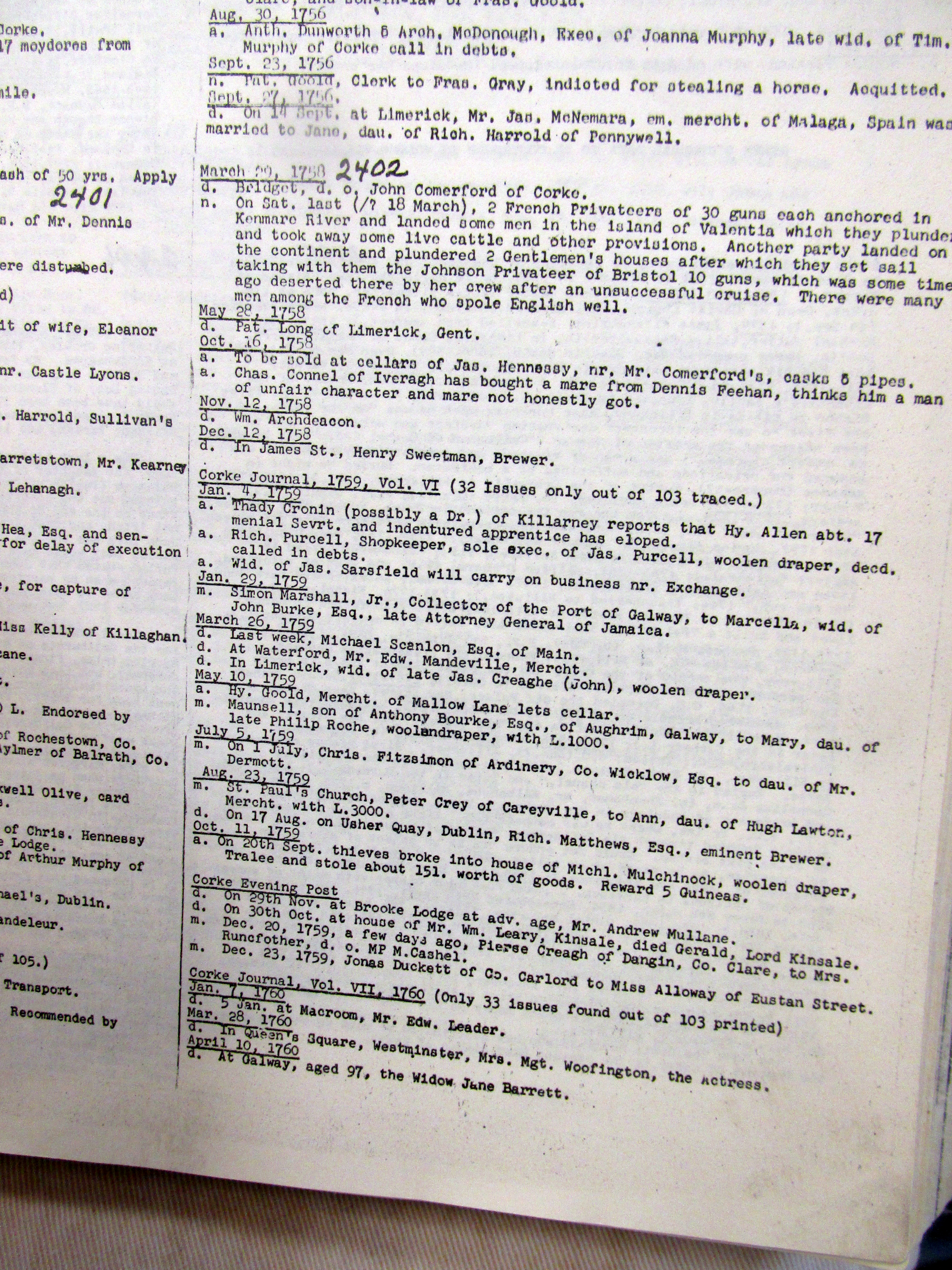
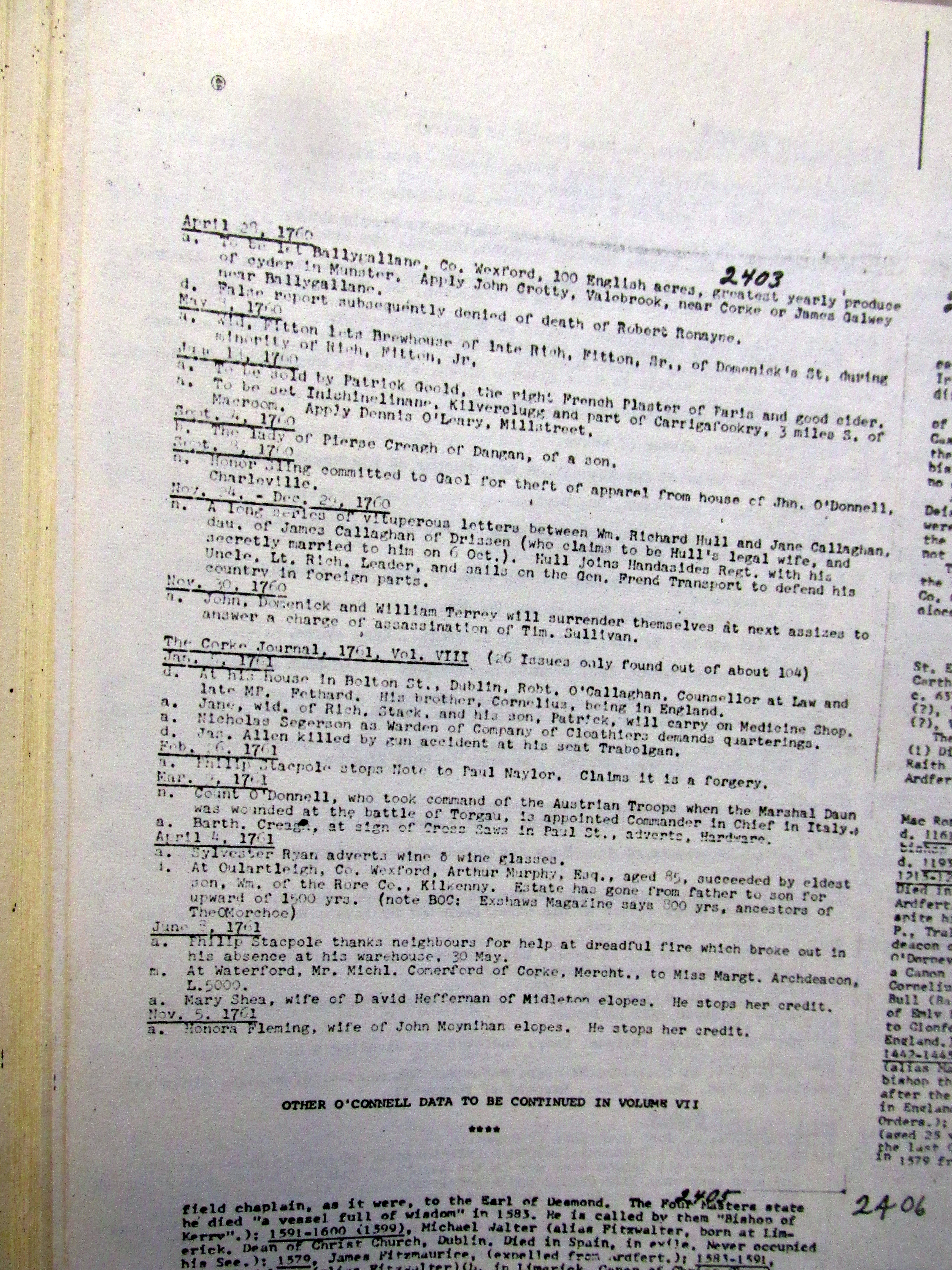
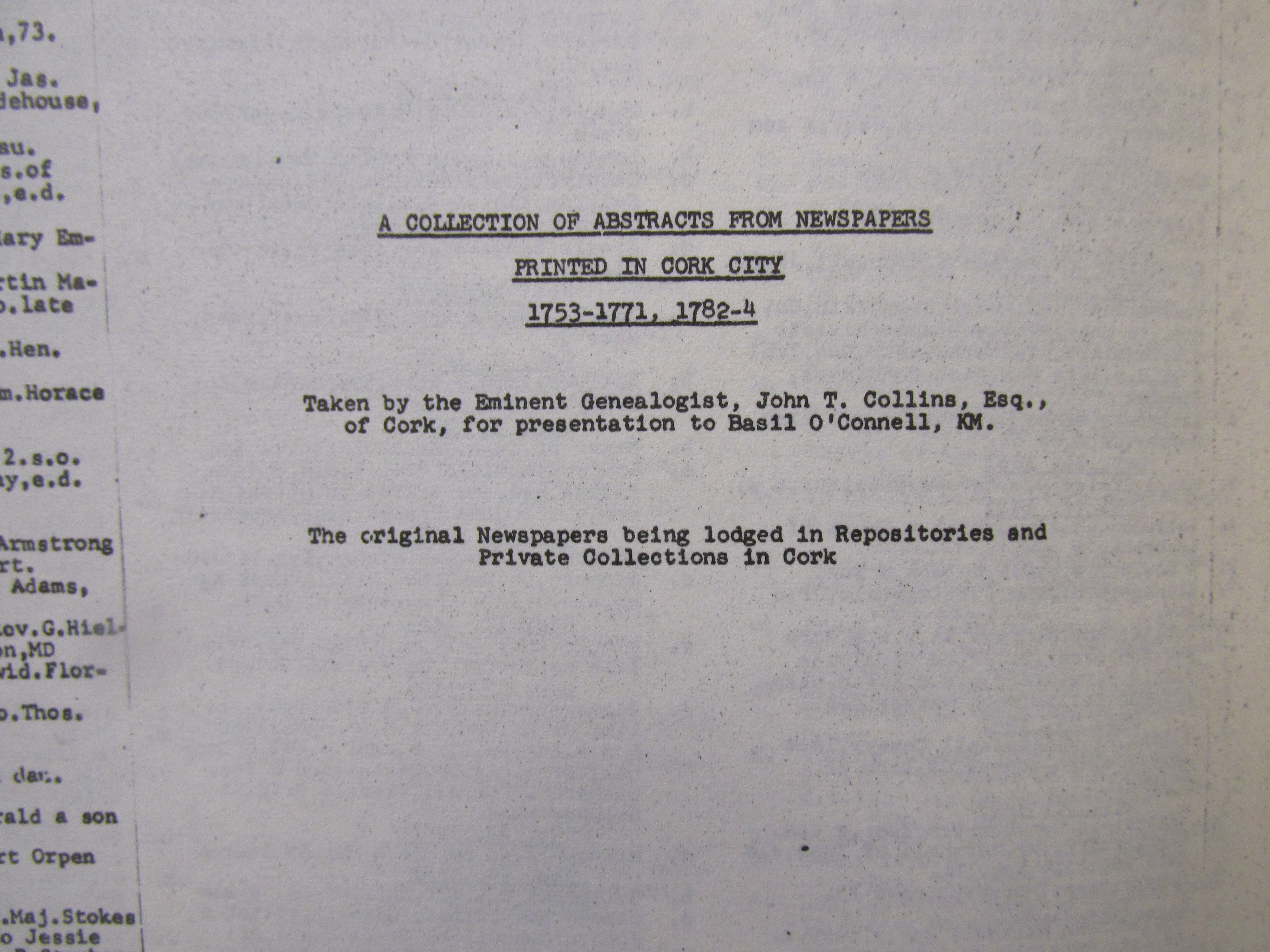
Some additional Cork Newspaper Extracts from 1754 of a Genealogical and Historical interest extracted by John T. Collins.
In terms of provenance it seems that he was ve access to the colection by Mr. Cussen, Solicitor, Newcastle West. It may have originated with Garretstown House near Kinsale with the Kearney family and their relations the Franks and Rochford families then to Owen Farrelly, Solicitor, Tuckey St., Cork and Robert Cussen, Solicitor, Newcastle West, Limerick

12 Friday Dec 2014
Posted in Uncategorized
‘An Act to prevent the further growth of popery’, Convert Rolls for 18th Century Co. Cork and other Renunciations against ‘Popery’, Co. Cork with letter January 1732 from Parish Priest, Bantry listing supporters of Crypto-Catholics.
The Bantry letter was located probably in the 1950s by Father TJ Walsh in the Archives of Cork Dioceses. He was later Parish Priest, of Durrus. He was an esteemed historian.
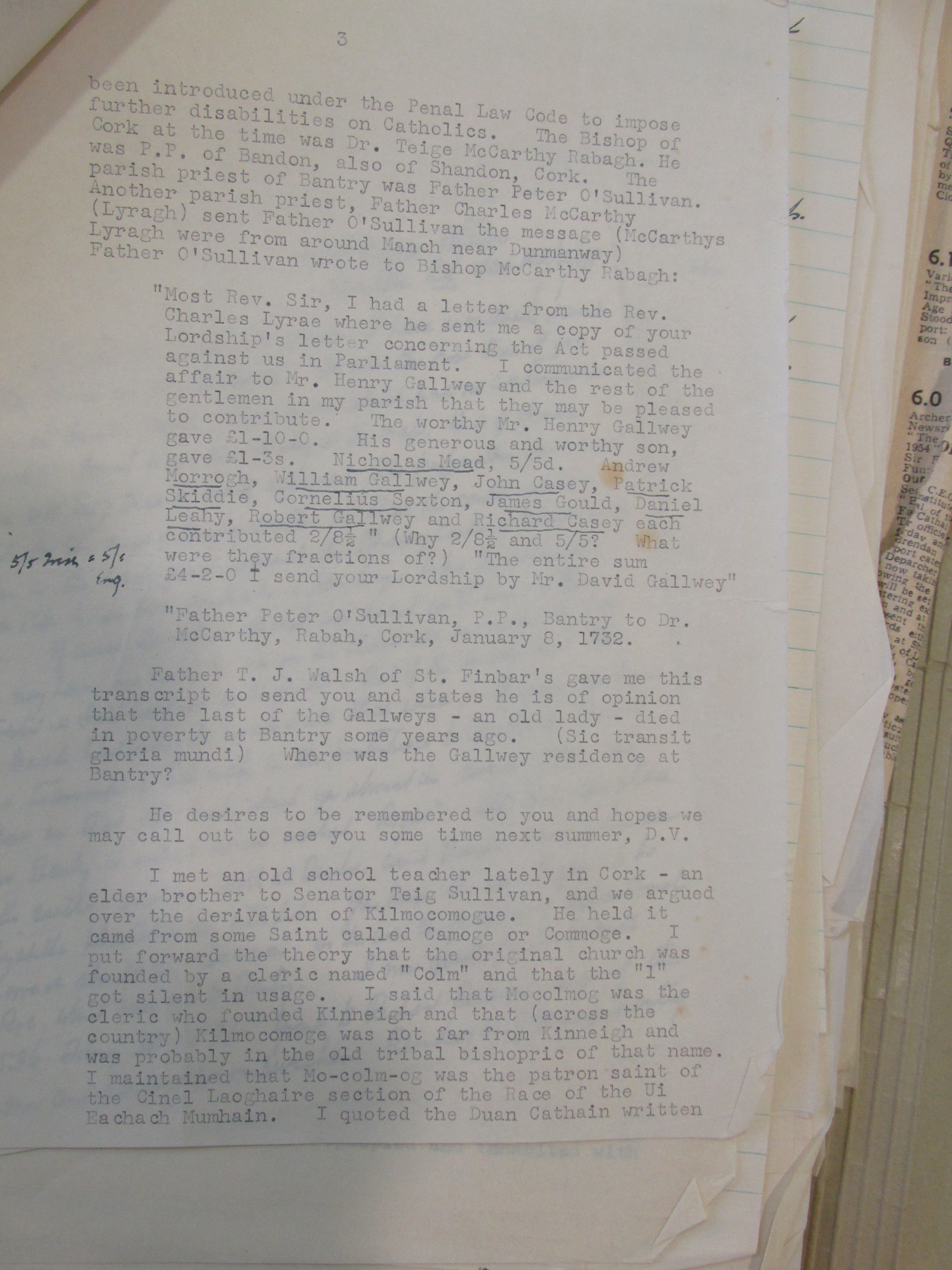
The book compiling the Convert Rolls was done by a scholar Eileen O’Byrne for the Irish Manuscripts Commission. A revised version is now available on line.
http://www.irishmanuscripts.ie/servlet/Controller?action=publication_item&pid=61
https://plus.google.com/photos/100968344231272482288/albums/6090895410812374209
The enclosed spreadsheet (a work in progress) sets out a summary together with some genealogical information with Dr. Edward Mac Lysaght’s version of the Irish names for families of Gaelic origin.
https://docs.google.com/spreadsheets/d/12-TQFfRKt_p6AGtxLaHODge_ReszztDcE-NFF1626_c/edit#gid=0
Looking at the names the cluster of old Cork families emerges. The Penal Laws obeyed the Law of unintended consequences, some of its provisions were used by Catholic and Crypto-Catholic lawyers to subvert it, so up to 30% of the land of Ireland remained in de facto Catholic hands.
It also promoted genetic diversity as it meant over time the Planter families were intermarried with stock of Gaelic, Norman, or Danish/Norse ancestry. Despite the ostensible names the population of Co. Cork is in fact very diverse in its origins.

 West Cork History