Robert Swanton, Ballydehob, (1764-1840), West Cork, United Irishman, Emigre to New York, Businessmen, Lawyer, US Political Activist, Judge, Home to Die With His Own People, Grave Early Example of Inscription in Irish Old Gaelic Script and Graveyard Inscription in old Irish, Gaelic Script, Port Fairy, Victoria, Australia for native of Co. Clare, Ireland, Aindriás Landrach (Andrew Landers), Fíor Gael, 1828-1912, with Photograph of Grave.


durrushistory's avatarWest Cork History

Updated:

Robert Swanton, Ballydehob, (1764-1840), West Cork, United Irishman, Emigre to New York, Businessmen, Lawyer, US Political Activist, Judge, Home to Die With His Own People, Grave Early Example of Inscription in Irish Old Gaelic Script and Graveyard Inscription in old Irish, Gaelic Script, Port Fairy, Victoria, Australia for native of Co. Clare, Ireland, Aindriás Landrach (Andrew Landers), Fíor Gael, 1828-1912, with Photograph of Grave.

Australia old Irish Inscription:

Graveyard Inscription in old Irish, Gaelic Script, Port Fairy, Victoria, Australia for native of Co. Clare, Ireland, Aindriás Landrach (Andrew Landers), Fíor Gael, 1828-1912, with Photograph of Grave

His niece is buried in the same crypt she married Nathaniel Evanson of Durrus.

Judge Robert Swanton (1764-1840), Ballydehob, New York, Ballydehob, West Cork, US Citizenship application 1800, Officer New York Militia 1811, Marriage New York, Appointment as Judge, Republican Politician.

‘A Thick Irish Brogue’ John Gilbert Higgins (1891-1961), Rhodes Scholar, Newfoundland Lawyer, Politician, Senator…

View original post 95 more words

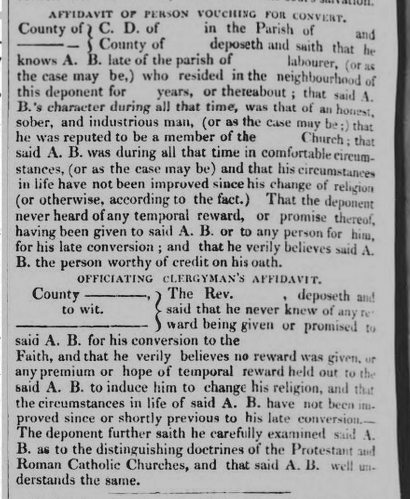
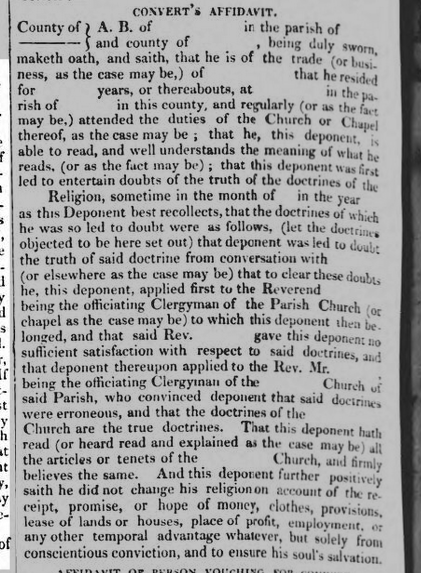
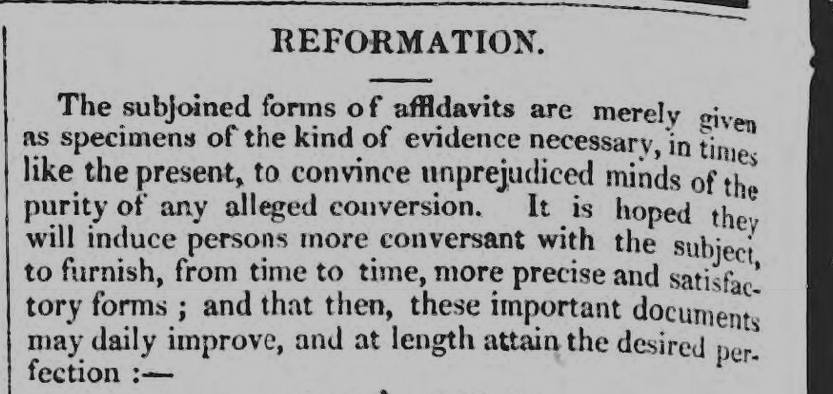
Format of Converts Affidavits in relation to Conversion (From The Errors of Papacy) Deponent Swears ‘That He did not Convert for Any Temporal Advantage But Solely From Conscientious Conviction an To Ensure His Souls Salvation’, part of Penal Law Regime.


Format of Converts Affidavits in relation to Conversion (From The Errors of Papacy) Deponent Swears ‘That He did not Convert for Any Temporal Advantage But Solely From Conscientious Conviction an To Ensure His Souls Salvation’, part of Penal Law Regime.

The English as conquerors had an extraordinary mix of military brutality and legalism. Land was seized and forfeit and then under the auspices of Chichester House (Dublin, site of old Irish Parliament) a fig leaf of legality was put up to entertain ousted claimants. Likewise with the Penal Laws designed to extirpate Irish Nationality again the extraordinary quasi-legality.:

Penal Laws in Co. Cork early 18th century, Father Donogh Sweeney, Doctor of Sorbonne, Paris, , arrested like common criminal for saying Mass by Richard Hedges, Macroom, Warrant 16th October 1712. Petition of 1717 of Samuel Potter Innishannon to Lord Liutenant re ‘Bringing to Justice’ two Popish priests Charles Carthy and Teige Mahony for saying Mass and a Popish Schoolmaster Owen Cartie and who has shown great diligence in apprehending and prosecuting many secular and regular Popish clergy

‘An Act to prevent the further growth of popery’, Convert Rolls for 18th Century Co. Cork and other Renunciations against ‘Popery’, Co. Cork with letter January 1732 from Parish Priest Bantry listing supporters of Crypto-Catholics

Conversions among Catholic Lawyers to the Church of Ireland, 1704-1778. Official concern about ‘Catholic Wives’ 1714, Two thirds of the Business of the Four Courts consists of Popish Discoveries 1723, Andrew Arcedeckne (b Kilkenny 1691) Attorney General Jamaica 1716-7. Dennis Kelly Chief Justice, Jamaica Bryan Finucane Co. Clare Chief Justice, Nova Scotia 1776, Richard J Uniacke, Co. Cork, Solicitor General, Nova Scotia to 1830, Edward Savage, Co. Down Judge South Carolina after 1765

Galwey Public Remounciation against Evils of Popery, Bantry, Co. Cork, 1730s. the Penal Laws and Caputo-Genocide in East Pakistan 1970s, and the Moranos, Crypto-Jews in Spain.

Screen Shot 2015-09-29 at 03.09.15
Screen Shot 2015-09-29 at 03.08.57
Screen Shot 2015-09-29 at 03.08.37
Screen Shot 2015-09-29 at 03.08.27

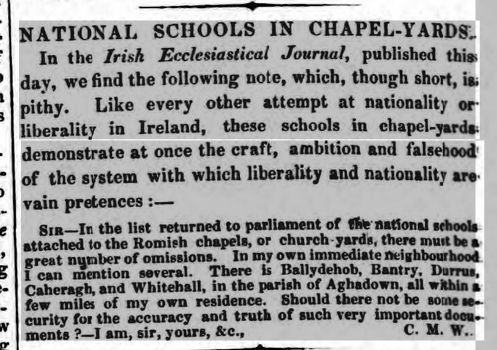
National Schools in Chapel Yards 1843, at Ballydehob, Bantry, Durrus, Caheagh, Whitehall (Skibbereen) ‘These Schools in Demonstrate at Once the Craft Ambition and Falsehood of the System with which Liberality of Nationality are Vain Pretences


https://www.google.ie/maps/place/Aughadown,+Co.+Cork/@51.5477795,-9.37507,15z/data=!3m1!4b1!4m2!3m1!1s0x4845a3eec9a8475d:0x1800c7a937df2b00

National Schools in Chapel Yards 1843, at Ballydehob, Bantry, Durrus, Caheagh, Whitehall (Skibbereen) ‘These Schools in Demonstrate at Once the Craft Ambition and Falsehood of the System with which Liberality of Nationality are Vain Pretences

The writer lives a fee miles from the school. The publication was noted for inflaming the embers of sectarian animosity

Report on Popery, 1731 setting out Masshouses and Popish Schools in Co. Cork, Drinagh, Inchigeela 7 sheds, Killaconenagh (Castletownbere) swarms of Priests are constantly going to and from France, 600 families in Parish of whom 12 are of Reformed Church, , Kilmoe (Ballydehob), Friars frequently landing from France and dispersing throughout the country, copied from documents in Bermingham Tower, Dublin Castle probably destroyed in 1922.

Schools in Bantry/Skibbereen/Schull area West Cork 19th century.

Screen Shot 2015-09-29 at 03.34.24

Screen Shot 2015-09-29 at 03.34.17

Letter to Skibbereen Eagle 1862 by O’Donovan Rossa re Giving Relief on Cape Clear Island


https://www.google.ie/maps/@51.4528032,-9.478312,14z

Letter to Skibbeereen Eagle 1862 by O’Donovan Rossa re Giving Relief on Cape Clear Island

Recollections of O’Donovan Rosa, pre Famine West Cork Beggars, Cripples, Fair at Newmill, Faction Fights, ‘The Nation’, Whiteboys, ‘Keepers’ minding Corn before Seizure by Landlord During Famine.

Professor Thadeus O’Mahony (1822-1903), Ballineen, West Cork, Church of Ireland Minister, Professor of Irish at Trinity College Dublin (1861-79), Botanist, and the Brehon Law Commission in the 1850s with Dr. John O’Donovan. His father was Cornelius O’Mahony Gentleman. He married Annabella Geoghegan of Rathmines daughter of Henry in 1856. The same year he was Treasurer of the Ossianic Society in TCD and the O’Donovan Rossa/James Stephens Connection

Souvenir of Funeral of O’Donovan Rossa (1831-1915), pieces by Arthur Griffith, Curtis O’Leary, James Connolly, McDonagh among others.


Screen Shot 2015-09-06 at 20.02.33

Screen Shot 2015-09-06 at 20.02.41

Screen Shot 2015-09-06 at 20.02.53

1837, Rebuilding Ancient and Venerable Establishment the erection of new Kinsale Carmelite Priority and Public Thanks to Citizens of Bandon including John and Isaac Biggs, Esquires, Edward Barry, Es., James Allman , Distiller Esquire, Mr. Dawson, Junior, Esq., Main St.


https://www.google.ie/maps/place/Kinsale,+Co.+Cork/@51.7060497,-8.5225014,15z/data=!3m1!4b1!4m2!3m1!1s0x484461fb98d2012b:0x0a00c7a99731ef70

Rebuilding Ancient and Venerable Establishment the erection of new Kinsale Carmelite Priority and Public Thanks to Citizens of Bandon including John and Isaac Biggs, Esquires, Edward Barry, Esq., James Allman, Esquire, Distiller, Mr. Dawson, Junior, Esq., Main St.

Allman’s Distillery Bandon, Co. Cork, from 1825-1929, Genealogy and Overton Cotton enterprise..

Invitation by Henry Townsend DL, 1839, on behalf of The Reformers of the West Riding of Cork to Daniel O’Connel MP to Dinner in Bandon, Co Cork, with 200 Liberals in attendance including, Francis Bernard Beamish MP (1802-1868), Rickard Deasy (1766-1852) Brewer Clonakilty, James Clugston Allman Distiller Bandon, James Redmond Barry J.P., Cmmisioner for Fisheries, Edward O’Brien, Masonic Lodge Bandon, John Hurley Brewer., Major E. Broderick, Henry Owen Beecher Townsend (1775-1847), Major Mathew Scott J.P. (1779-1844), Philip Harding, Carrigafooka, Macroom, Richard Dowden (1794-1861) Unitarian, Frances Coppinger Esq., Parkview, Bandon.

The Old ‘Cork and Bandon’, Railway, Unveiling of Plaque in 1994 by Colm Creedon, Horse drawn Sidings, Allman’s Distillery, Bennett’s Mills, Shannon Vale. Staff Photograph, 1919, Freight Statistics, Steamer Service Bantry to Castletownbere, West Cork, 1883-1946.

Screen Shot 2015-09-29 at 03.26.25

Screen Shot 2015-09-29 at 03.26.12

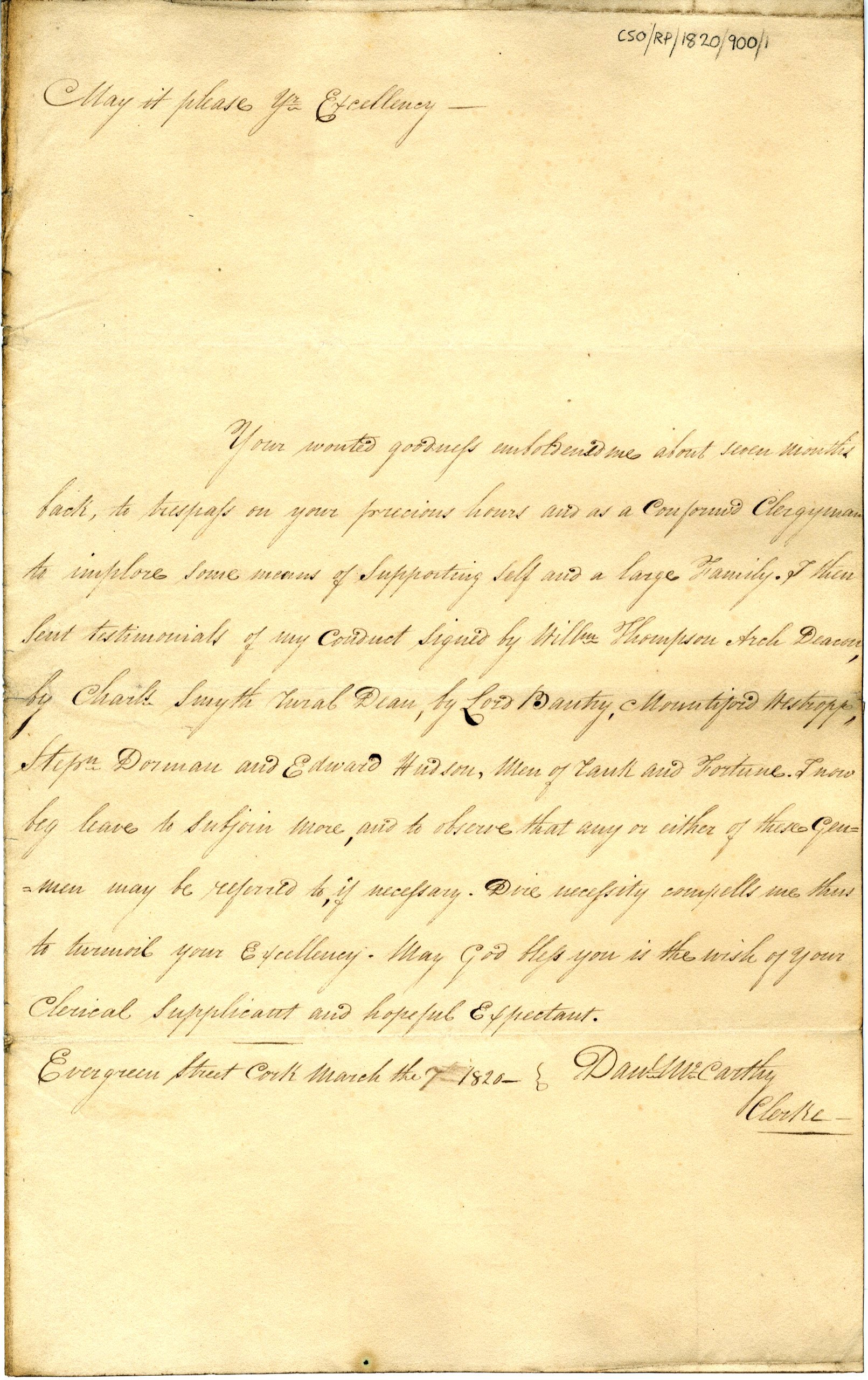
Father/Reverend Daniel McCarthy (1758-1828), ’An tAthair Tadgh Na Muclagh’, Formerly Parish Priest Durrus, West Cork 1790, Marriage to Sarah Blair, of Blair’s Cove, Durrus, and His Petitions to Dublin Castle, Genealogies.


Father/Reverend Daniel McCarthy (1758-1828), ’An tAthair Tadgh Na Muclagh’, Formerly Parish Priest Durrus, West Cork 1790, Marriage to Sarah Blair, of Blair’s Cove, Durrus, and His Petitions to Dublin Castle, Genealogies.


Rev/Father Daniel McCarthy:

https://docs.google.com/document/d/1BnjAwZ6eFk_0sTMsjxYBo3YFQLNqJ4J2utWIftpJXqs/edit


https://docs.google.com/document/d/1BnjAwZ6eFk_0sTMsjxYBo3YFQLNqJ4J2utWIftpJXqs/edit

Henry Bryan, and Extended Dukelow, Durrus family, from Knockeenboy, Dunmanway, West Cork, 1855-1930 was a fluent Irish speaker, musician and folklorist. He moved to Glenville in 1892 and his house became a mecca for travellers from other parts of Ireland for folklore and Irish stories.


He was a descendant of the marriage of Michael O’Sullivan, Bantry, (Heart Tax Collector and land Owner and reputed descendant of O’Sullivan Bere) and Mary Vickery, Whiddy Island.

From Ron Price a descendant of the extended family:

Between 1981 and 1990 I made notes immediately after speaking to various Co Cork people about my Cork ancestry. I now wish to make those notes available to anyone interested. Any clarification comments added at this stage are in square brackets. I would welcome any questions or comments.

Source: Thomas (Tommy) Bryan (b 1930) of Ballybrack, Glenville, Co Cork

Notes from conversation on 8 May 1989

– Definitely heard that William Dukelow was relatively prosperous. As well as his 5 sons who worked on the farm he had 2 hired men working from first thing in the morning. Mrs Roberts views, which are slightly anti-William perhaps influenced by his heavy drinking – she is very anti-drink. He had heard that William was very diligent in managing the farm. They had a very balanced diet supplemented by herrings caught in William’s own boat. Pickled herring for the winter.
– Heard that William Dukelow was killed when walking back from Durrus.
– William Dukelow’s son Charles spent some time in Canada before returning home.
– William Dukelow definitely gave £200 dowry with Anne on marriage. Dowry details were negotiated by the 2 sets of parents. The £200 did not go to Henry Bryan, but £100 to his sisters Frances and Minnie as dowries for their marriages.
– William [was] supposed to have £2000 in Bantry Bank, while some of his neighbours were evicted.
– William drank most evenings in the hotel in Durrus.
– There was a Mr Leathem who preached on the evils of drink – he was a former schoolteacher who had lost his job through drink. He was put up at Brahalish one night after preaching to Mrs Dukelow & girls. William arrived back late, with[a] bottle of whiskey. On hearing of the guest, he insisted in loudly shouting out his name and insisting he shared the bottle with him. Next day Mr Leathem got up late & claimed that it was lucky that he had there to save William from being smothered in drink. Mrs Dukelow regarded him less highly as [a] result.
– Henry Bryan had to sell the Knockeenboy farm to pay off debts. (The land at Ballybrack is no better.) At one point he was rather hard-up – so went back to Brahalish looking for assistance. Anne’s parents [were] not impressed – “you got a good girl; a £200 fortune” &; [they] gave no help. Henry referred to Margaret Dukelow as of the “Cob Dubh” breed (black face in Irish) because of her dark face in response to his request.
– Henry Bryan ‘s family (and his cousin) were the first Protestants to live in Ballybrack neighbourhood. An old local man recently told him the crossroads beside the farm became known as “the Planter’s Cross”.
– Ballybrack farm [was] rented from a Charles Allworth who lived in Sunnyhill, Mallow. He was known as “the halfpenny bun landlord” because he always carried a large halfpenny bun around with him.
– Fanny Bryan of Ballymana eloped with Thaddeus Bryan by climbing out a widow of the Model School she was attending. Thaddeus had a horse waiting – they went off to Thaddeus’ married sister then living near Clonakilty. He then left her there for a couple of weeks which rather offended her. She was aged around 18.
– Fanny Bryan was well educated – could speak three languages – English, Irish & French.
– Heard that Thaddeus & Fanny had eleven children, but [he] can only name ten. – Before William; Anne were married William Dukelow came to inspect the Knockeenboy farm to assess the suitability of the family. [He was] not impressed – house too crowded; cluttered, so he stated. William [was] about to go. Henry had his horse’s bridle hidden to prevent him from going – got William another bottle of whiskey; eventually all was arranged.
– Henry’s daughter Ellen had an accident in the quarry behind the farm & had [a] leg amputated. She never really recovered & died as a result.
– Henry Bryan was a good singer ; musician – played [the] melodeon.
– Henry’s Uncle Charlie took him to his sister Ellen married to Busteed. He wanted to stay on when Charles insisted on leaving – he subsequently referred to him as “the old grey goat”. [see clarification below]
– Ballybrack farm did not originally include the 10 feet on the right-hand side beyond the chimney. The upstairs windows were originally flat-topped.

Victorian Social Mobility. James Skuse, from Clashadoo, Durrus, West Cork to Schoolmaster, Businessmen, Resident Blackrock Castle, Ship Owner Cork, Died 1913 Estate £18,137, Blackrock, Cork.

Tags


James Skuse, from Clashadoo, Durrus, West Cork to Schoolmaster, Businessmen, Resident Blackrock Castle, Ship Owner Cork, Died 1913 Estate £18,137, Blackrock, Cork.

His residency at Blackrock Castle owned by the Cork harbor Commissioners may have been connected to him being a ship owner.

The Skuses may descent from a Cork soldier in the East Company whose son was born in India and returned presumable home to Derrynafulla, Glengariff. The family were involved as bailiffs and policemen and lived in Clashadoo, Durrus either on the present McCarthy farm or on a house attaching.

James Skuce married in 1853 in Rathelaren  (Church of Ireland) parish church,  his profession  was  School Master, resident in  Ballycotton, Co. Cork, he married Miss Catherine Harris who was a School Mistress, also resident in Ballycotton.   The birth record and baptism of their eldest son in 1856 in Drimoleague and James was described as a school master then. At the time of his wife Catherine’s  death in 1868  James’s  occupation was given as Clerk.  James later remarried, this marriage was to Miss Rebecca Sophia Lester, a spinster resident in Kinsale, the marriage was in St Stephen’s Church in Dublin.

In 1875 when James and Catherine’s eldest daughter married, James’s profession is then given as Merchant.

The letter 1881 letter written by James to his brother, James  states about his work pursuits, and mentions about  one of the ships that he part owned.  An Irish newspaper item mentioning another ship which he owned and this was in a collision with another vessel.

Irish Examiner May 5th 1876 page 3

James is mentioned in the English newspaper in Buckinghamshire and in the Commercial Gazette London in connection with The London and County Banking Company.

Bucks Herald
Saturday, February 22, 1879

The London and County Banking Company
Persons of whom the Company or Partnership consists.
Name. Residence. Occupation.
Skuce, James, Arbutus-place, Blackrock-road, Cork, Esq.

He also had shares in the T. Lyons and Co. Ltd, so could this have been the corn store he had been a Manager of prior to his retirement ?

The Irish Times
Friday, March 1, 1912
Page 11

  1. Lyons and Co. LTD – Annual Meeting … held yesterday at the warehouse, South Main street, Cork. …

Shareholders present: – … J. Skuce ..

The 1901 Census gives that James Skuce was aged 70, and was a  retired Manager of a Corn Store. James died in 1913, he had been a very successful business man as he  left a small fortune, which was left  to his young widow and his unmarried daughters.

In the 1881 letter to his nephew, James Skuce states he was Chief Manager to the Chief Merchant in Cork, who was also part owner of his two ships, the “Glennarow”, a large iron ship 1500 tons, then on passage to Australia; and the “Assyrian” a 2 year old large timber ship, 1800 tons, then on route to Boston. USA. His son was second officer on the “Glennarow”.

In the 1901 Census he gives On the 1901 Census, James Skuce, Head of family, Church of Ireland., can read and write, 70, Retired Manager of Corn Store, Retired from Business, married, Born in Co. Cork.

May  have been a manager of RH Halls Company.  In the early 20th century extended family working in Cork Grain companies.

The letter 1881 letter written by James to his brother, James states about his work pursuits, and mentions about one of the ships that he part owned. I have this weekend found a Irish newspaper item mentioning another ship which he owned and this was in a collision with another vessel.

Irish Examiner May 5th 1876 page 3

these newspaper items below.

James Skuce married in 1853 in Rathelaren (Church of Ireland) parish church, his profession was School Master, resident in Ballycotton, Co. Cork, he married Miss Catherine Harris who was a School Mistress, also resident in Ballycotton. I found the birth record and baptism of their eldest son in 1856 in Drimoleague and James was described as a school master then . At the time of his wife Catherine’s death in 1868 James’s occupation was given as Clerk. James later remarried, this marriage was to Miss Rebecca Sophia Lester, a spinster resident in Kinsale, the marriage was in St Stephen’s Church in Dublin.

In 1875 when James and Catherine’s eldest daughter married, James ‘s profession is then given as Merchant.

The letter 1881 letter written by James to his brother, James states about his work pursuits, and mentions about one of the ships that he part owned. I have this weekend found a Irish newspaper item mentioning another ship which he owned and this was in a collision with another vessel.

Will:

Will of Mr Skuce, Cork, of St John’s, Blackrock Road. Cork, who died on the 31st October last, left personal estate in the United Kingdom valued at £18,137 10s., of which £5,201 5s is in England, and probate of his will, dated 23rd September, 1913, has been granted to his widow, Mrs Sophie Rebecca Skuce, of St John’s aforesaid, and his daughter, Miss Mary Skuce, of Clonfina, Kenilworth Road, Leamington, Warwick, and his nephew, Mr Allan Skuce, of the National Bank, Dundalk, Co. Louth, Ireland. Bank Official. The testator left £500 to his daughter, Mary, and the residue of his estate upon trust for his wife, and his daughters, Sophie, Emily and Dorothy, in equal shares.

Irish Examiner May 5th 1876 page 3

Interesting to see  the custom of that time was to support unmarried family and so his married offspring did not get anything which must have been a hard disappointment.

19th Century Upward Social Mobility. Snapshot of a West Cork family, 1881 letter from James Skuce to his Nephew in Canada from Canadian Archives, from Derrrynafulla, Glengariff, Clashadoo, Durrus to teaching, Businessman, Shipowner, Occupier of Blackrock Castle Cork, Probate £18,000, family Emigration, RIC.

19th Century Upward Social Mobility. Snapshot of a West Cork family, 1881 letter from James Skuce to his Nephew in Canada from Canadian Archives, from Derrrynafulla, Glengariff, Clashadoo, Durrus to teaching, Businessman, Shipowner, Occupier of Blackrock Castle Cork, Probate £18,000, family Emigration, RIC.

Comment:

The connections keep on coming. I was researching James Skuce as he was a witness to a Cork City marriage between Watkins Harris and Mary Wilson in 1862. Watkin’s address is listed as White Street in Cork. Nine years earlier Skuce had married Catherine Harris in Rathclarin – likely a cousin of Watkins. An 1867 directory has James Skuce as superintendent of the ‘Industrial Ragged School’ – in White Street. (I was following this line of reasoning to try to tie Watkins back to the Harris families in Ballycatteen townland in Rathclarin.)

I found the two ships he mentioned in the 1883 Lloyds’ Register of Shipping – the ‘Glenavon’ of Cork (owner R.C. Hall) and the ‘Assyrian’ of Cork (owners R.C. Hall and A. Herbert). No mention of Skuce’s ownership (maybe he only had a fractional share and might not then be listed) but it does seem to link him to the grain business of R&H Hall.

It looks like one of the Halls occupied Blackrock Castle in the late 19C – so perhaps that is how Skuce came to be associated with the castle. I can find no clear reference to Skuce ever having lived there. For many years he lived at Arbutus Place on the Old Blackrock Road. He lived at St Johns – around the corner – at the time of his death in 1913.
Christian names West Cork 1690-1860 and a Guide to Irish Christian Names, Los Angeles.


durrushistory's avatarWest Cork History

Updated:

https://drive.google.com/file/d/0B6hnQGE3ANjzNk8tRGY3OUl3RFlDYnYzTUZRVjNTOUhtZW40/view?ts=56096dad

Courtesy Danny Tobin.

  Catholic Records 1760-1840.

The names are taken from a sample of the births registered in the parish of Muintervara for the period 1820-1840.  As the parents and the sponsors are named it is assumed that on average they were born from 1790.  The sample is divided into the period 1790-1820 for the parents and sponsors and 1820-40 for the children.

Female

1790-1820

Mary 56  Catherine 34  Ellen 24  Hanora  16  Anne 14  Brigid   13  Margaret 13 Elizabeth  10  Jane 7  Judith 7  Grace  5  Julia 4    Nancy  2  Norry  2  Nano  2  One each Frances, Mercy, Sarah, Maria, Ella, Susan, Sally, Joan.

1820-40

Mary  16  Catherine  9  Ellen 7  Anne  7  Margaret  6    Hanora  5  Johanna  5  Brigid 4 Judith  4  Julian  3  Helen 2  Eliza  2   One each Martha, Nancy, Jane.

Male

1790-1820

John 31  Denis  30  Daniel  30…

View original post 257 more words