1850, Cork Consistory (Probate/Matrimonial) Court, Vice-Chancellor (Judge) Venerable Samuel Kyle, Holder of Multiple Benefices and Sinecures, Non Resident in London Registrar, Barrister, Mr. Henry Stopford Kyle, Work done by Deputy, All Proctors Protestant, Case of Intestate Alexander McCarthy, Butter Merchant Intestate and the Ursuline Convent.


1850, Cork Consistory (Probate/Matrimonial) Court, Vice-Chancellor (Judge) Venerable Samuel Kyle, Holder of Multiple Benefices and Sinecures, Non Resident in London Registrar, Barrister,  Mr. Henry Stopford Kyle, Work done by Deputy,  All Proctors Protestant, Case of Intestate Alexander McCarthy, Butter Merchant Intestate and the Ursuline Convent.

Te Consistory Court’s jurisdiction probably went back to Norman times.  In Ireland the complication was that the State Church, the Church of Ireland until 1870 represented a minority, the Irish Protestants of the Anglican tradition.  The Court was abolished for civil purposes and probate transferred to an all Ireland institution, the Probate Office in the Four Courts in 1867, where it still operates at Phoenix House.

http://www.courts.ie/offices.nsf/fd1b5d60ef39f31380256e43003d0107/be735bced234bbbc80256e45005861c7?OpenDocument

 All the Consistory  Court records some Wills going back to 1535 were destroyed in the loss of the Public Records Office in 1922.

The Rev Kyle was examined by a Parliamentary enquire and this is reproduced here.

ConsistoryCourtCork1850 (1)

The Rev. Kyle  was clearly at a loss as to how his court, one of the few in Ireland well run, was subject to this line of questioning.  The tectonic plates had shifted, as reflected in the line of questioning.   Enclosed here are details of the personnel of the Court and Dinny Lane’s  (Barrister, Businessman, Jailed United  Irelander) lampoon on the Rev. Kyle:

https://docs.google.com/document/d/1FWBV3gRAeVpYqD5Nlq9j4by9xQGww9Y141pT1mZshpA/edit

The references to Miss McCarthy and the Ursulines in the enquiry is the case of Alexander McCarthy, an intestate Cork butter merchant.  He died leaving £80,000 probably the equivalent of €100 million nowadays.  Leaving no will, the McCarthy sons, not being happy with their share, commenced an action against  the Ursuline Convent in Blackrock where their sister was a nun.   Their father had given the convent £1,000 as her dowry.   For someone of   social status the norm  was £400 but he also wanted some form of schooling for the poor.  The case went from the Consistory Court all the way to the House of Lords in London.  That Court  finding for the brothers on the ground that Sister McCarthy did not have a legal personality as she was some kind of dupe to the Reverend Mother.  The case caused outrage in Cork in Catholic circles.

Apart from these immediate family issues, it throws up the staggering wealth of the Catholic merchants. In the mid 18th century the provisioning trade to the Colonies and to the British Army and Navy was controlled by the Hoares, Hares (Later Lord Listowel) and various Quaker House of Pike, Beale, Penrose.  By 1800 the bulk of the trade lay with the Catholic Houses of McCarthy, Callaghan, Fagan, Sugrue, Daly and others. They also took advantage of their Continental networks.  The most remote townland in West Cork was involved in this trade of butter, pigs and cattle.   Daniel O’Connell in Parliament gave  evidence in 1828 stated that the bulk of the deposits and shareholdings at the Bank of Ireland was held by Catholics, having ben debarred by the Penal Laws from land.

The Rev Kyle said the all the Proctors were Protestant as well as the Advocates.  However at least two senior Catholic Barristers Joseph Scannell and Francis Walsh appeared regularly.

Cork Lawyers:

https://docs.google.com/spreadsheets/d/1mMDGaZCW9Z6Cq_C_gwm_FB2orzTe2WxR0WcLXjZZO40/edit

Benjamin Sullivan, (1720-1767), O’Sullivan Mór, Clerk of the Crown for Co. Cork and Waterford Kinsman to Laurence Sullivan, Chairman East India Company.


durrushistory's avatarWest Cork History

Benjamin Sullivan, (1720-1767), O’Sullivan Mór, Clerk of the Crown for Co. Cork and Waterford Kinsman to Laurence Sullivan, Chairman East India Company.  Barry Crosbie’s book 212 Cambridge press says they wee brothers adn sons o Philip O’Sullivan and Miss Irwin a trading family with Roscommon and Cork connections.  He suggests Benjamin became a Judge in Calcutta which seems unlikely.

https://books.google.ie/books?id=DpvRF0W5KIMC&pg=PA45&lpg=PA45&dq=clerk+of+the+crown+for+cork+1750&source=bl&ots=US9h-C-l5P&sig=BNrHrORmT-zggnlr20xZ3uVq9eg&hl=ga&sa=X&ved=0ahUKEwiymt717p3LAhVDnw4KHbbMB_kQ6AEIHzAB#v=onepage&q=clerk%20of%20the%20crown%20for%20cork%201750&f=false

https://durrushistory.wordpress.com/2013/12/17/laurence-sulivan-1713-1786-cork-born-chairman-of-the-east-india-company-and-m-p/

According to Denny Lane, Cork Antiquarian Benjamin Sullivan styled himself the head of the O’Sullivan Mór, sept.

https://durrushistory.wordpress.com/wp-admin/post.php?post=7557&action=edit&message=6&postpost=v2

1720-1767 Benjamin Sullivan Attorney, Barrister, 1752 Clerk of the Crown for Counties Cork and Waterford. Thomas Harrison writing clerk to him 1742, Married Bridget Limerick daughter of Dr. Limerick, Rector Kilmoe (Ballydehob), 1742 Father Phipil mother Elizabeth Irwin a Presbeterian, Parish of St Paul. Benjamin Sullivan Senior Esq., eminent Atttorney died London 1767, May have been Recorder of Cork 1765. Son Sir Benjamin Sullivan, Kt, Judge Supreme Court Madras, the Right…

View original post 107 more words

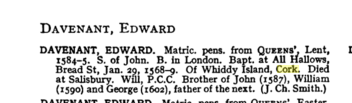
Edward Davenant (1568-1639), Record of Cambridge University, England Entry 1584 of ‘Whiddy Island’, Bantry, Co. Cork. Later owner fishery.


Edward Davenant (1568-1639), Record of Cambridge University, England Entry 1584 of ‘Whiddy Island’, Bantry, Co. Cork.  Later owner fishery.


This corroborates the Fishery at the time being financed from London Merchants .

https://wordpress.com/post/durrushistory.com/20050


He is son of John, brothers John 1587, William 1590, George 1602.


Screen Shot 2016-02-28 at 12.07.18


Death:


1639 Edward Davenant Whiddy Island Will dated Whiddy 29th December 1636. He was brother of Bishop of John Davenant of Salisbury, active in Bantry Fishery since 1608 when he leased Whiddy Island from Sir Owen O’Sullivan’s widow. To son Edward D.D. New Sarum, Wilts His father-in-law was Simms, London. One daughter marrried John Palmer of Whiddy, another son John of Whiddy married Ann Boyle both drowned crossing to Whiddy 1641. William may have been another son. Paddy O’Keeffe papers, Cork Archives He was born London 1586 son of John, Cambridge 1584. Brothers Cambridge graduation: John 1587, William 1590, George 1602.


1660 …Davenant Notary Public Cork Probably attorney. Edward Davenant Whiddy isladn EDWARD DAVENANT (1568-1639), RECORD OF CAMBRIDGE UNIVERSITY, ENGLAND ENTRY 1584 OF ‘WHIDDY ISLAND’, BANTRY, CO. CORK. LATER OWNER FISHERY.”He was the Grandfather of Ralph Davenant founder of Davenant Foundation School. The school was originally located on the Whitechapel Road. In 1965 the school relocated to Loughton Essex. Caulfield’s Annals of St. Finbarr’s Cathedral


Marriage:


Pre 1610 Edward Davenant …Symms Whiddy she London Paddy O’Keeffe papers (In Symms papers) mentioned that her father was from London  


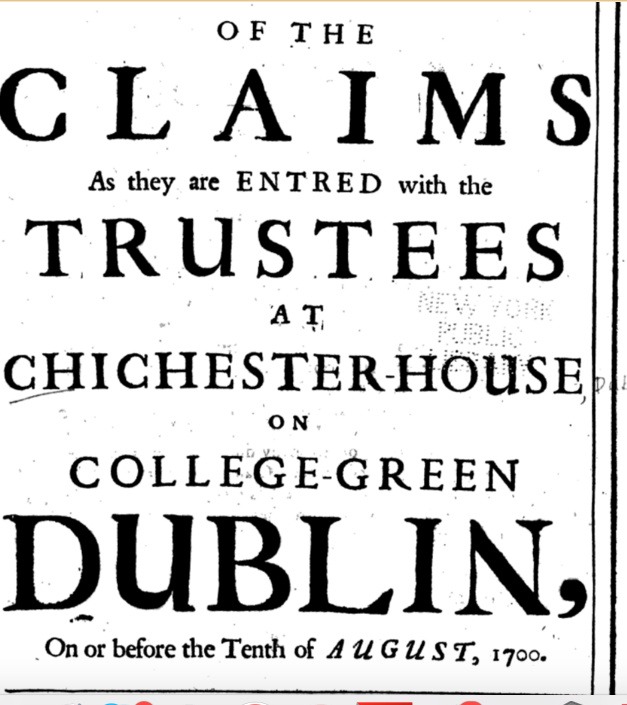
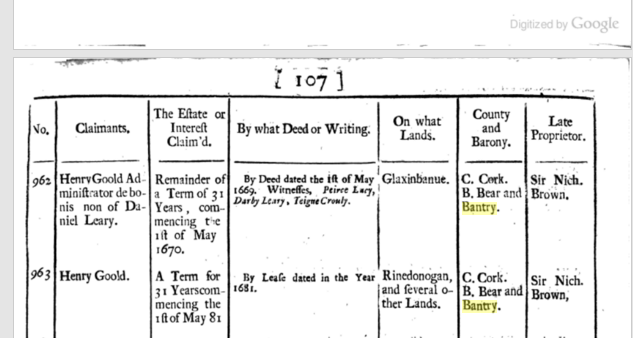
1700. Claims Entered of Lands Forfeit by Rebellion, in Baronies of Bere and Bantry and Carbery, West Cork with Chichester House, Dublin.


1700.  Claims Entered of Lands Forfeit by Rebellion, in Baronies of Bere and Bantry   and Carbery, West Cork with Chichester House, Dublin.


The English inserted a veneer of Legality on the forcible seizure of Irish lands with  the Chichester House apparatus from 1700.  One Estate which succeeded through the process was the O’Regan Estate outside Leap which remained in the extended family until the Land Acts in 1905.


Early Genealogy of Sir Teague O’Regan of Balltnaclohy and Gortniglogh, Killeenlea, near Leap, Carbery West Cork, Temporary holding of lands from 1615 by Sir Walter Coppinger, loss by forfeiture and subsequent restoration under Articles of Treaty of Limerick 1690, later family including fashionable Dr.O’Regan of Mallow and Legal Luminaries, friend of Daniel O’Connell. Estates finally sold by descendants Cagney family early 20th century to tenants.

There are references to the Townsends , in at least one instance they held land in trust for the O’Heas in Barryroe.

Chichester House was opposite Trinity College Dublin on the site on a old Nunnery.  It was  later demolished to make way for the Irish Parliament and is now the band of Ireland at College Green.

In relation the White claimant tis is the extended Lord Bantry family.  The wives name Sheehy adds to Bantry Historians belief that  the Whites came from Co. Limerick not the invented spurious Genealogy they conjured  up  in the early 19th century.

The Browns are referred to, as Catholics (Kenmare Estate) it is remarkable that the Estate survived as there were three generation where only one male heir was born.


The Galweys were major losers but again their survival is  remarkable.  One one Estate outside Macroom The Hedges Eyre granted a favourable Lease held in trust by Thornhills.


1840 Legal Action on 1740 Deed Whereby Thornhill acted as Trustee for Galweys on Hedges Eyre Macroom, Co. Cork, Estate to Circumvent Penal Laws and Ejectment Action by Hedges Eyre estate in 1840.


Subscription list of donations by the Gentlemen of the Parish of Bantry, sent by Father Peter O’Sullivan, Parish Priest of Bantry, West Cork, 8th January 1732 to Bishop Doctor Teige McCarthy Rabagh, against Penal Laws included are The Worthy Mr. Henry Gallwey £1-10-0 his generous and worthy son £1-3s, Nicholas Mead 5/5d, Andrew Morrogh, William Gallwey, John Casey, Patrick Skiddie, Cornelius Sexton, James Gould, Daniel Leahy, Robert Gallwey, and Richard Casey each contributed 2 shillings 8 pence halfpenny, Conformity and the Fishing Trade, Father Walsh Parish Priest of Durrus, Blackrock and Aonghus Ó Dalaigh, Dromnea, Kilcrohane, poet.


They were also agents to the Shouldham (half McCarthy) estate, Dunmanway and the the Kenmare estate.

Sale by Cant (Highest Bidder) in Chichester House, Dublin 1703 of Galwey lands in East and West Carbery Forfeited, Kilfaghna, Drombeggy, Cullinagh, Dirryleigh, Shrilane, Gortard, Balliisland and ten small islands, Knockeeridane, Castlehaven, Gortard, Creaghm, Coney Island, Baltimore, Raghmore, Cloghanmore, Cloghanbeg, Lissangel, Caheragh, Gortnamuckla Lisalchorig with some tenants listed, Coppingers, Hollow Blade Company, South Sea Bubble.

Screen Shot 2016-02-28 at 09.00.01


https://books.google.ie/books?id=pWJZAAAAYAAJ&pg=PA198&lpg=PA198&dq=thomas+gan+attorney+cork&source=bl&ots=YErHW7Y-yj&sig=HWvXFJ761JKVhxdh_yhjfVg9sYU&hl=ga&sa=X&ved=0ahUKEwjL37rFk5nLAhUBbRQKHSopAtQQ6AEISDAJ#v=onepage&q=macroom&f=false


Screen Shot 2016-02-28 at 08.39.08


Screen Shot 2016-02-28 at 08.39.58

Screen Shot 2016-02-28 at 08.40.50

1828 Excursion by an Englishman from Bandon, Co. Cork. Oppression at Clonakilty Magistrates Court, Custom of expelling Reporters, Tithe Plaintiff Sitting as Magistrate.


1828 Excursion by an Englishman from Bandon, Co. Cork.  Oppression at Clonakilty Magistrates Court, Custom of expelling Reporters, Tithe Plaintiff Sitting as Magistrate.

In Clonakilty the Sovereign of the Town for the time being was a Magistrate.  Many of the local Church of Ireland clergy were also Magistrates. This is referred to.


https://books.google.ie/books?id=CGMNAAAAYAAJ&printsec=frontcover&dq=bandon&hl=en&sa=X&redir_esc=y#v=onepage&q=bandon&f=false