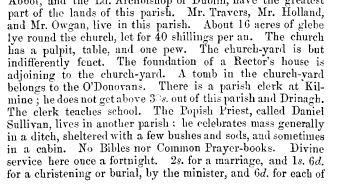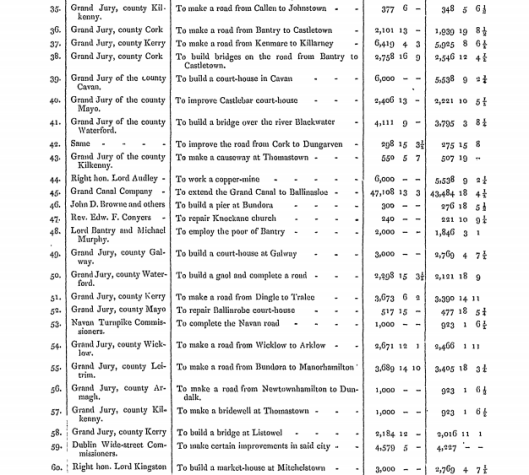
Spring Assizes 1793 to Spring Assizes 1803, Return of J.W. De La Cour and William Phillips, Treasurers of Cork County and City Grand Jury of Expenditure including Allocations to Militia including Bounty to Militia Soldiers and Family Subsistence Money.


Spring Assizes 1793 to Spring Assizes 1803, Return of J.W. De La Cour and William Phillips, Treasurers of Cork County and City Grand Jury of Expenditure including Allocations to Militia including Bounty to Militia Soldiers and Family Subsistence Money.


http://www.dippam.ac.uk/eppi/documents/8322/page/196221


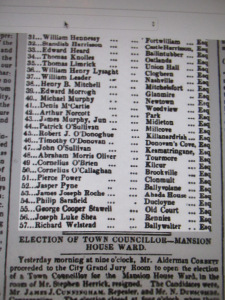
1831. Enumerators by Name And Emoluments for Census in Cork City and County.


1831.  Enumerators by Name And Emoluments for Census in Cork City and County.

A cursory glance at the naes would suggest that many are related to the Landed families or Clergymen of the Church of Ireland.

http://www.dippam.ac.uk/eppi/documents/10766/page/239996

Note in the appendix the references to half notes.  It was common to send half of a banknote.  When a particular condition was fulfilled the other half would be sent.


The men from Muintervara (Durrus/Kilcrohane) who have the distinguished honour of being the first Western district to have given the death blow to the Tithe system, proceeded under the conduct of Richard O’Donovan Esq of Tullagh and Timmy O’Donovan Esq at Monster Meeting Mount Gabriel 1832


durrushistory's avatarWest Cork History

The men from Muintervara (Durrus/Kilcrohane)who have the distinguished honour of being the first Western district to  have given the death blow to the Tithe system, proceeded under the conduct of Richard O’Donovan Esq of  Tullagh and Timmy O’Donovan Esq at Monster Meeting Mount Gabriel 1832

Most of the tithes of the Dioceses of Cork were acquired by underhand means by Richard Boyle, The Great Earl of Cork in the early 17th century.

For Durrus/Kilcrohane they were acquired by Nathaniel Evansons and share between him and the local Church of Ireland Minister aided by Tithe Proctors

The Tithes in 1833: ‘The year’s tithe due to Mr. Alcock, the Rector Durrus, was nearly collected in one day. The summary collection was effected by the police who act as drivers. In the case referred to the determination to to obtain ‘Tithe Distress’ was so great that I have been informed that the house…

View original post 1,648 more words

Safe Shares :1910-1914 : Stock dividend warrants for interest due issued by the following companies: Argentine Great Western Railway Company Limited; Buenos Ayres Western Railway Limited; Canadian Northern Railway Company; Central Argentine Railway Limited; The Central Uruguay Railway Company of Monte Video, Limited; The Consolidated Gold Fields of South Africa Limited; The Cordoba Central Buenos Ayres Extension Railway Limited; East Indian Railway Company; The Eastern Telegraph Company; The Great Northern Railway Company; Great Western Railway; Arthur Guinness Son & Co. Limited; Lipton Limited; London Brighton and South Coast Railway Company; Midland Railway Company; and Western Australia Government.


Safe Shares :1910-1914 : Stock dividend warrants for interest due issued by the following companies: Argentine Great Western Railway Company Limited; Buenos Ayres Western Railway Limited; Canadian Northern Railway Company; Central Argentine Railway Limited; The Central Uruguay Railway Company of Monte Video, Limited; The Consolidated Gold Fields of South Africa Limited; The Cordoba Central Buenos Ayres Extension Railway Limited; East Indian Railway Company; The Eastern Telegraph Company; The Great Northern Railway Company; Great Western Railway; Arthur Guinness Son & Co. Limited; Lipton Limited; London Brighton and South Coast Railway Company; Midland Railway Company; and Western Australia Government.

From Armstrong papers. http://www2.ul.ie/pdf/943693677.pdf

After the proceeds of the sale of estates were received in the late 1890s and early 1900s many Landed families might have invested in the type of portfolio as set out above.

Work War 1 and the taxation measures of Lloyd George decimated the capital assets of Britain and  Ireland’s well off class.

Magistrate possibly of the Armstrong Tipperary line.

Rev. George Armstronge/Armstrong, 1796.  Signed petition 1827 against Catholic Emancipation as Chancellor Ross.  Rector of Rosscarbery, 1831, daughter Eleanor m John Fitzhenry Townsend, 1867, Fitzwilliam Square, Dublin and Drishane, later Admiralty Judge of High Court.


1749. Lease Parties: Edmond Schuldham, city of Dublin, and Dunmanway, of the first part William Armstrong, Mealiffe, County Tipperary, of the second part Property: The town and lands of Dromlinagh/Dromleena? situate in the Barony of Carbery, (McCarthy Lands by Marriage) County Cork.


135 Lease Parties: Edmond Schuldham, City of Dublin, of the first part William Armstrong, Mealiffe, county Tipperary, of the second part Property: The town and lands of Dromlinagh [Dromleena?] situate in the barony of Carbery, County Cork Term: 31 years Conditions: Yearly rent of £46 by two equal instalments on 1 November and 1 May. Schuldham to retain mine, mineral, shooting, hunting, and fishing rights to said lands Date: 1 August 1749 Size: 1 membrane (outsize)

1749.  Lease Parties: Edmond Schuldham, City of Dublin, and Dunmanway, of the first part William Armstrong, Mealiffe, County Tipperary, of the second part Property: The town and lands of Dromlinagh [Dromleena?] situate in the Barony of Carbery, (McCarthy Lands by Marriage), County Cork.

From Armstrong papers.  There are frequent references to commercial transactions 1740s between the parties.


Click to access 943693677.pdf

Nexus: Picton, Ontario and Muinterbhaire and Mizen Peninsulas, Williamson, Baker, Attridge, Dukelow, King, O’Sullivan and Hurley families


durrushistory's avatarWest Cork History

Marthene Williamson of Nova Scotia has put a significant amount of time researching families many of whom come from the Rossmore/Brahalish area of Durrus. More like Beamishes come from Mizen. It is interesting that through the Canadian and other records you can in effect get births from 18th century Ireland.

Another feature of the Canadian census records is language.  Many of the Cork Protestant families put Irish into the box for language.  It is not possible to say if it was Irish or the variation of English spoken in Ireland.  Accounts of descendant speak of a soft brogue and language spattered with phrases and words from Irish.  Even when they were speaking English they were almost speaking irish with english words using a different syntax than that used in England.

It is interesting that the free language app Duolingo has Irish in the top 10 with the largest market North…

View original post 1,714 more words

1848. Attendance Book, Dunmanway, West Cork, Church of Ireland (Regular, Not Great), Parishioners Names, Addresses, Age, Deaths, Confirmations.


1848.  Attendance Book,  Dunmanway, West Cork,  Church of Ireland (Regular, Not Great), Parishioners Names, Addresses, Age, Deaths,  Confirmations.

Some of the names reflect theories of the linen industry by Sir Richard Cox in the early 18th century.  he brought families from Leitrim and Fermanagh.  Names such as McGivern probably a variation  of McGovern reflect this.

Gentleman’s Magazine 1749 on Sir Richard Cox and the development of the Linen Industry in Dunmanway, Co.Cork

The Norwoods probably originate from Ballinascarty.  When they came to Dunmanway they brought according to family lore tow Deasy brothers their ploughmen from whom the Dunmanway Deasys descend.  The Norwoods were teachers, middlemen and professionals.


1702, Deed from Rev. John Patrickson, Chantor of Cloyne (Dunmanway Sister Elinor Patrickson ancestors of Durrus Blairs) to Sir Richard Cox (1650-1733), Bandon, Chief Justice of Ireland, of Lands at Dunmanway and Kilbarry, Coolsnagh, Coomshiplogh, Inchiragh, Derrynacahreagh, Cloontiuirk, Dereens, Tonetove, Derrylahan, Mills and Tolls, Park, Castle, Malthouse, bounded by Derrenasabagh, Gortnavan. Founding Deed of Dunmanway Names John Clay, John Turk, Thomas White, Mathew Rhems, William Short, John Farr, George Lantry, John Lumsie, George Stuke, Richard Nott, William Sisk, Thomas Roche, James Grace, William Smith George Moore Bounded by the Lanes of Mahonoh and Cox Magistrates.


1853, Landed Estates Court Sale of Estate of Joseph Bennett, including Kilbrogan/Kilronan, Dunmanway, Northagill (Gortnadihn, Kilfadean, Knockenagh, Shreelane Parish of Kilmacabea), West Cork, along line of proposed Dunmanway to Drimoleague Railway, Maps, Major Tenant Listing.


Pre 1922, Pension Enquiry Forms Church of Ireland Fanlobbus and Coolkelure (Dunmanway) West Cork.


An Old Man Recounts: The First Time I visited Dunmanway c 1790, The Roads were Bad, My Sister and I were in Two Panniers at Each Side of A Horse My Mother on A Saddle in Between, Then Cars with Block Wheels Sawn of of a Thick Tree Bound Round With Iron, The They Got What They Called Scotch Cars With Spokes and Felloes at Opening of The Office of The Electric and International Telegraph Company , Dunmanway, Co.Cork, 1865. Messages from Cork, London and Crookhaven.


1817. Peter Besnard Inspector General of Linen for Provinces of Munster, Leinster and Connaught, report, Banon, Clonakilty, Rosscarbery, Skibbereen, Dunmanway, Bantry, Export to West Indies and USA, Exertions of Lord Bantry and Vicar of Bantry Rev. Smith, Lord Carbery. Redmond Barry, Colonel Hodder, Trade Depressed. Praise for Right Honourable John Foster, Collon, Co. Louth, Promoter of Linen Industry as Chancellor of the Exchequer early pioneer of Capital Spending.


”’\\