Trí Cois-Céim an Coillaigh, 3 steps of the Cock, sign of the Day’s starting to Lengthen – http://wp.me/p1UlSr-VR
Shared from WordPress
24 Saturday Dec 2016
Posted in Uncategorized
24 Saturday Dec 2016
Posted in Uncategorized
Trí Cois-Céim an Coillaigh, 3 steps of the Cock, sign of the Day’s starting to Lengthen – http://wp.me/p1UlSr-VR
23 Friday Dec 2016
Posted in Uncategorized
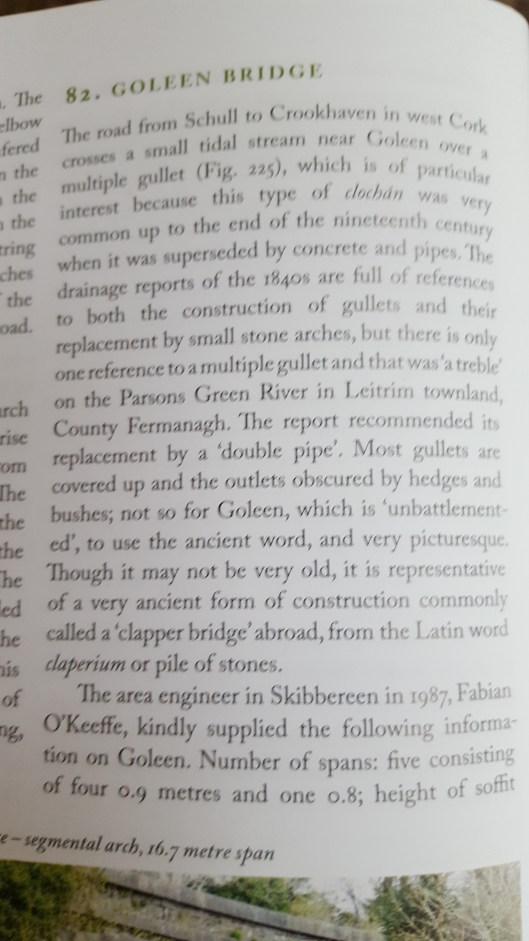
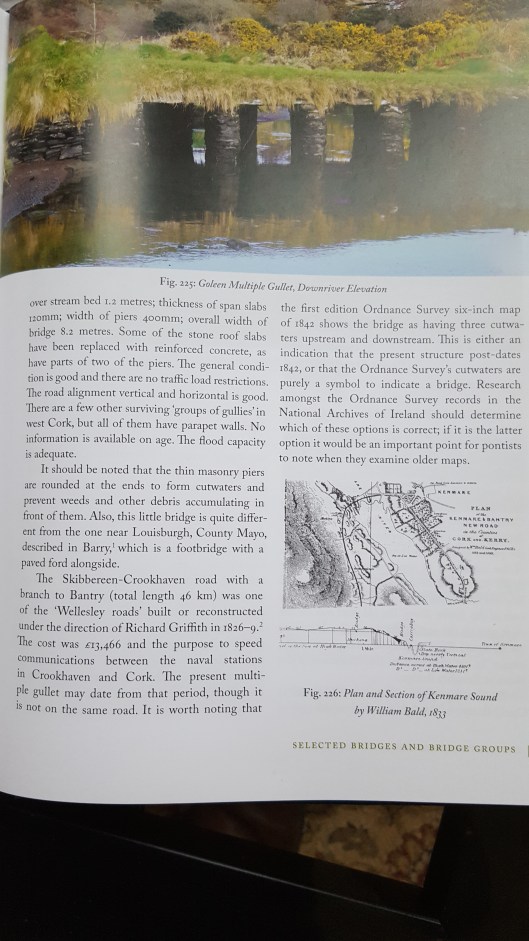
Goleen Bridge (Multiple Gullett/Clochán), West Cork
23 Friday Dec 2016
Posted in Uncategorized
Skibbereen to Crookhaven:
Griffith’s ‘Wellesley Roads’ included Skibbereen to Crookhaven, 46 km. built between 1826 and 1829 and costing £13,466,
Griffiths Cork projects known as the ‘Wellesley Roads’ included Skibbereen to Crookhaven, 46 km. built between 1826 and 1829 and costing £13,466, Bantry to Skibbereen, Crookhaven to Bantry and the road to north Cork to Banteer. HIs works are characterised by a high degree of engineering excellence. It was said that in building bridges he insisted on going to bed rock for foundations, the Grand Jury contractors would be happy with building on gravel resulting in so many were washed away in floods. His schemes highlights the deficiencies of the Grand Jury system and might be looked at like the recently completed motorway schemes in Ireland. The effects were dramatic, on the Mizen Peninsula they first wheeled carts made their appearance. Alexander Nimmo (1783-1832), the Scots Engineer who was also involved said the North Cork Road opened up the entire area to commerce with a beneficial result.
1824, Evidence of Sir Richard Griffith Esq., Road Engineer, to House of Commons Select Committee, on Harmony in West Cork between Protestant and Catholics, Distress of 1822, Only Part of Ireladn he Employed Poor Protestants on Road Building, Evidence of Alexander Nimmo, Scots Road Engineer on Building of 19 miles on the Northern Side of Bantry Bay under Joint Supervision of Captain O’Sullivan Most of His Workers are His Tenants Not Paid in Cash but in Rent Abatement. Elsewhere Nimmo’s evidence of Enormous Economic Benefits of Road Building
Griffith’s Roads: Report of Patrick Leahy, Civil Engineer, 1834 to Co. Cork Grand July of Progress of Road from Dunmanus Bay to Skibbereen, Nearly Completed, Extension to Ballydehob Approved, and Report of Edmund Leahy, County Surveyor to Grand July 1840 on Ballylickey to Crookstown, 27 miles Active, Bantry to Glengariff 10 miles Near Completion, Crookhaven to Barleycove, Ballydehob to Bantry To Be Finished Current Season.
23 Friday Dec 2016
Posted in Uncategorized
Griffith’s Roads: Report of Patrick Leahy, Civil Engineer, 1834 to Co. Cork Grand July of Progress of Road from Dunmanus Bay to Skibbereen, Nearly Completed, Extension to Ballydehob Approved, and Report of Edmund Leahy, County Surveyor to Grand July 1840 on Ballylickey to Crookstown, 27 miles Active, Bantry to Glengariff 10 miles Near Completion, Crookhaven to Barleycove, Ballydehob to Bantry To Be Finished Current Season.
View original post 11 more words
22 Thursday Dec 2016
Posted in Uncategorized
…
1734, Cork Subscribers to the Poetry of The Rev. Robert De La Coer (The Mad Parson), (1709-1781)
Subscribers from p 59, mostly from Cork or with Cork connections.
JAMES DE LA COUR or DELACOURT, an Irish poetical writer, was the second son of Robert De la Cour, esq. of the County of Cork, in Ireland, and born at Killowen, near Blarney, in that county, in 1709. He was educated at the university of Dublin, where to his classical studies he added an uncommon predilection for poetry, and before he had reached his twenty-first year, produced a poem entitled Abelard to Eloisa, in imitation of Pope, which was thought to possess a considerable portion of the spirit and harmony of that master. From this time he proceeded to publish shorter poems and sonnets, which were all favourably received; and in 1733 appeared his principal work, The Prospect of Poetry. So creditable a publication, and at such an age, gained him much and deserved applause; and in this list of admirers he had to count on some of the best judges in both countries.
Soon after this he took holy orders, but had little zeal for the profession, and produced his sermons as matters of ordinary duty: his muse was the mistress which engaged his principal attention; and, as the muses generally love “the gay and busy haunts of men,” this pursuit was of no service to his promotion or clerical character. He unfortunately, too, loved his bottle as well as his muse; and by such indulgences sunk in the esteem of his fellow citizens, who said poetry affected his head; and in a little time they gave him the title of “the mad parson,” under which general character, the graver kind of people grew cautious of his acquaintance, whilst the young ones solicited his company to enjoy his eccentricities. In time he fell so much into this last seduction, that be was the volunteer of any party who would engage him for the night. This constant dissipation at last enfeebled his understanding; and the charge which malice and ignorance at first fastened on him, was now realized; his intellects were at times evidently deranged; and he fancied himself, after the example of Socrates, to be nightly visited by a demon, who enabled him to prophesy all manner of future events.
In the career of this unhappy impression, the following circumstance deserves some notice: A gentleman one day meeting the doctor in a bookseller’s shop, during the siege of the Havannah, asked him whether he could tell him when the garrison would surrender? “O yes,” says De La Cour, very confidently, “I’ll tell you the precise day; it will be on the 14th of August next” “Do you pledge yourself for that day?” “So much so,” replied the doctor, “that I will stake my character as a prophet on it, and therefore I beg you will take a memorandum of it.” The gentleman immediately noted it in his pocket-book; and it so happened, that on that very day we had in account of its surrender to the British arms. A public event thus predicted six weeks before it happened, and falling in so accurately according to the prediction, of course made a great noise in a little place. The common people wondered at, and even philosophers could not resist pausing on the coincidence of circumstances: but the doctor was elated beyond measure. He now claimed the diploma of a prophet, and expected to be consulted on the issue of all important circumstances.
He continued thus many years, prophesying and poetizing; and though in the first he made many mistakes, in the latter he in a great measure preserved the vis poetica; particularly in his satires on individuals, which sometimes exposed and restrained those too cunning for the law, and too callous for the pulpit. He had originally a little estate of about £80 per year left him by his father, which, with the hospitality of his friends, enabled him to live independent. Towards the latter end of his life, he sold this to his brother-in-law, for a certain sum yearly, and his board and lodging; but at the same time restrained himself from staying out after twelve o’clock at night, under the penalty of one shilling. In consequence of this, the doctor’s balance at the end of the year was very inconsiderable.
He died about 1781, at the advanced age of seventy two, leaving behind him many monuments of poetical talents, and adding another testimony to the truth of Dr. Johnson’s observation, “that nothing will supply the want of prudence; and that negligence and irregularity long continued, will make knowledge useless, wit ridiculous, and genius contemptible.”
21 Wednesday Dec 2016
Posted in Uncategorized
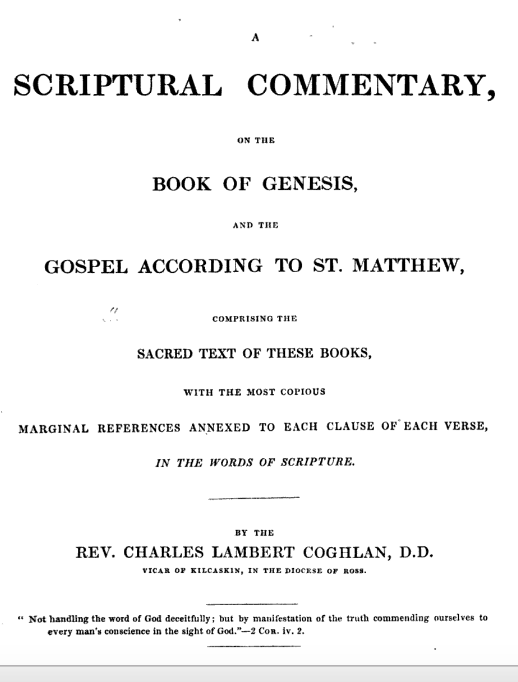
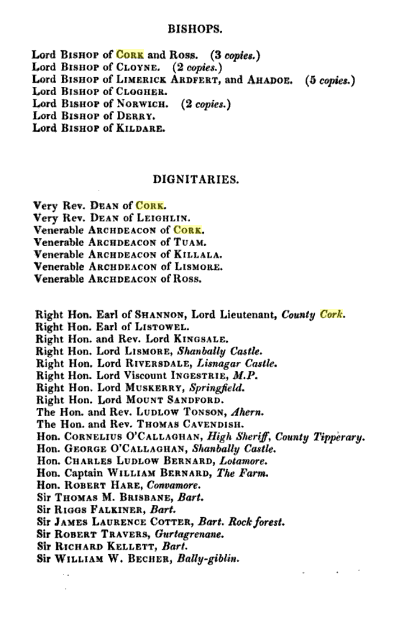
Probably descended from the Coughlans of Carrigmanus Goleen.
….


…


…
……


……


……


20 Tuesday Dec 2016
Posted in Uncategorized
Early. 19th Century Political Figures in Bantry and Carbery District, Tithes, Cess Payments, Baronial Constables, Drivers, Village Pounds
Tithes
Tithes were a medieval tax of one tenth of crops. The benefits went to the clergy who were expected to provide civil services out of it. In Cork Richard Boyle (ancestor the the Dukes of devonshire and numerous other lines) managed by underhand methods in the early 17th century to acquire most of the Diocesan tithes. A large part was ‘impropriate’ and in time were traded as any form of property. Much of the later trouble with tithes came from the vigorous enforcement to entitlement sby tithe proctors who sometime acquired the tithes or received a significant proportion of money collected.
The Tithe Composition Act of 1823 provided that a special Vestry could appoint an arbitrator to determine the amount of tithe. The exemption of pasture from tithe was abolished in…
View original post 5,423 more words
20 Tuesday Dec 2016
Posted in Uncategorized
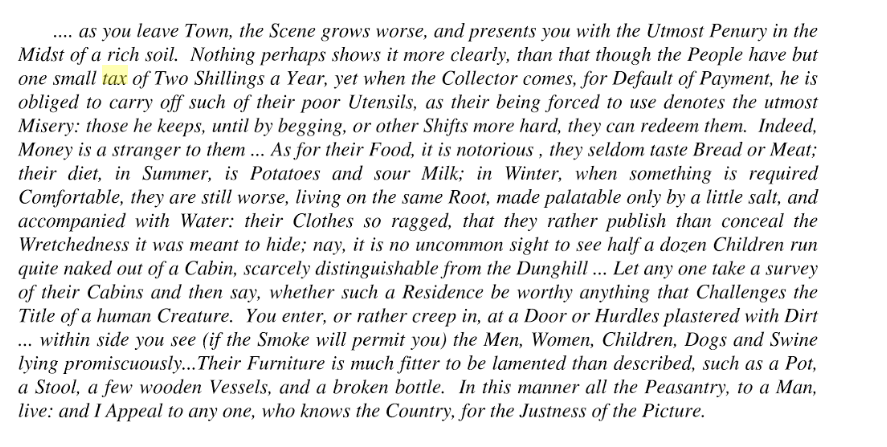
Edmund Burke (1729-1797) on the Misery of an Irish Cabin c 1750
https://en.wikipedia.org/wiki/Edmund_Burke
18 Sunday Dec 2016
Posted in Uncategorized
1770 West Kerry, Land Measurement, an Ounce, one sixteenth of a Greeve, enough for a Potato Garden
..
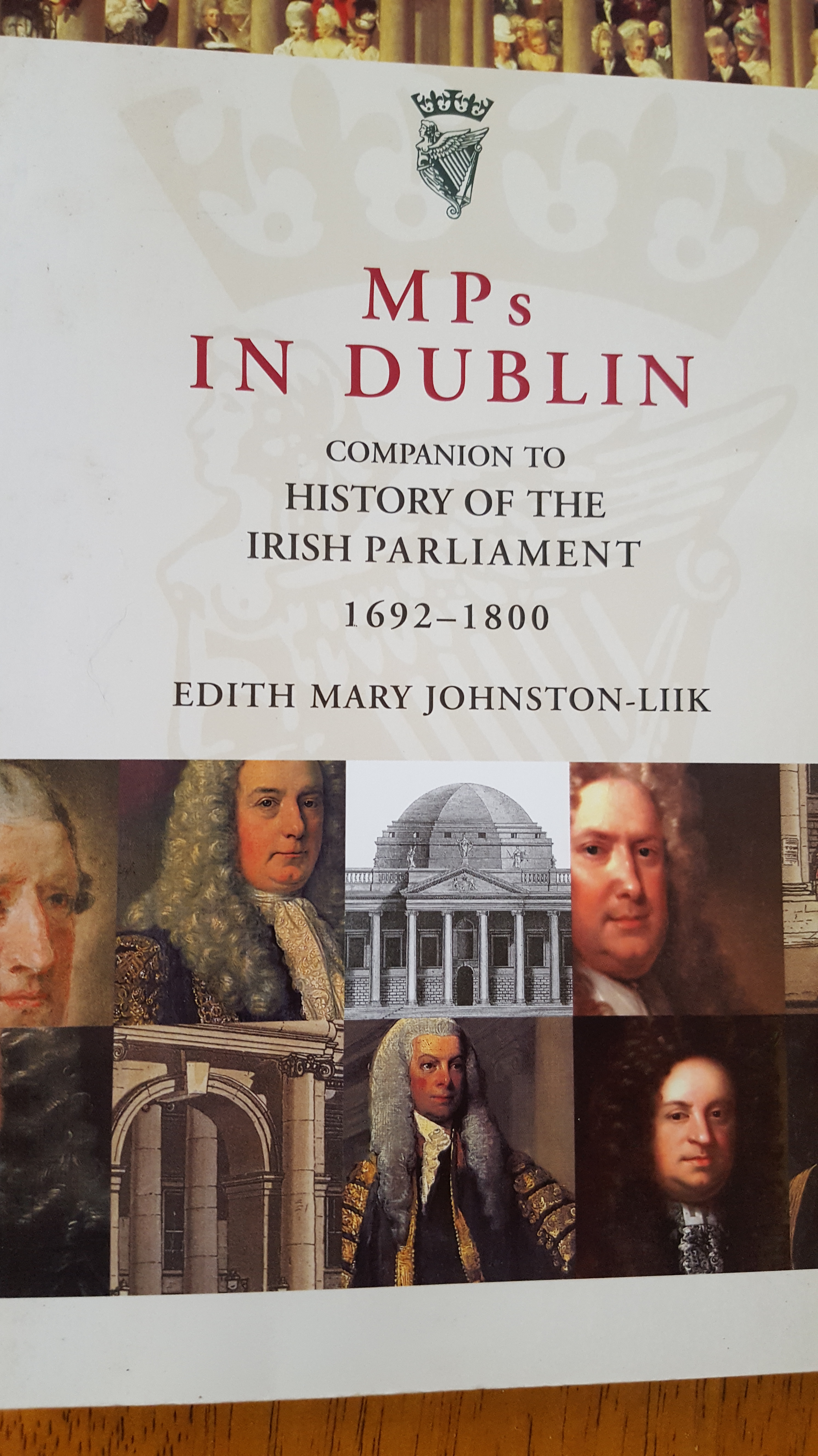
In Edith Mary Johnston-Liik’s companion book pmn the History of the Irish Parliament she deals with the multiplicity of 18th century land measurements.
On she quotes from Arthur Young’s Travels in West Kerry 1770, Parish of Tooavistar, in an Ounce, one sixteenth of a Greeve, enough for a Potato Garden
….
…
17 Saturday Dec 2016
Posted in Uncategorized
1832. Lord John Carbery (Evans-Freke) 6th Baron Carbery (1765-1845), 1821, Castle Freke, Rosscarbery. Pamphlet urging Reform of Cork Grand Jury Places mentioned Parishes of Kilmeen, Kilmacabea, Rosscarbery. Ploughlands, Gneeves Cuasses
Lord John Carbery (Evans-Freke) 6th Baron Carbery (1765-1845), 1821, Castle Freke, Rosscarbery. Son of Sir John Freke, married 1783 Lady Catherine Charlotte Gore succeeded by nephew George Evans-Freke. MP Donegal and Baltimore. 1817 Chairing Cork Committee of Linen production an encouraging local development. 1821 writing to Chief Secretary re disaffection, Castlefreke, Clonakilty, sitting Rosscarbery, 1835. 1822 Lord Lieutenant sends £500 for local distress. 1822 Cork Trustee for The Encouraging Industry in Ireland. Protestant protest meeting Cork 1834. Author of pamphlet urging reform of Cork Grand Jury. Reputed to have bell rung in London church on hearing of death of Father John Power, Parish priest Kilmacabea. Subscriber 1821 Dr Thomas Wood’s ‘Primitive Inhabitants of Ireland. Present at enquiry Skibbereen 1823 into enquiry into fatal affray at Castlehaven caused by Rev. Morritt’s tithe extraction. – 1823 Blamed notorious tithe extractor Rev. Morritt for fatal affray at Castlehaven, welcomed Petty Session Courts and urged abolition of Manor Courts. Subscriber Lewis Topographical Dictionary of Ireland 1837. listed 1843. Lord of Manor appointing Seneschals. Member Commission on Magistrates 1838. Member provisional Committee projected Bandon to Bantry Railway 1845. HIs life size statue in Rosscarbery Cathedral has an inscription how he founded schools in various parts of his estates, clothed the surrounding hills with trees and improved agriculture and the amelioration of his countrymen’. Carberys intermarried with O’Driscoll family. Left estate valued at £90,000. Left rental of estates for life to his wife. On his death he directed that the principal family seat and residence should be Castle and that his inheritor should reside there at least four months in the year. If the inheritor was to become Roman Catholic, the interest in the estate would cease and go to the next in line provided such party was protestant.
…

 West Cork History