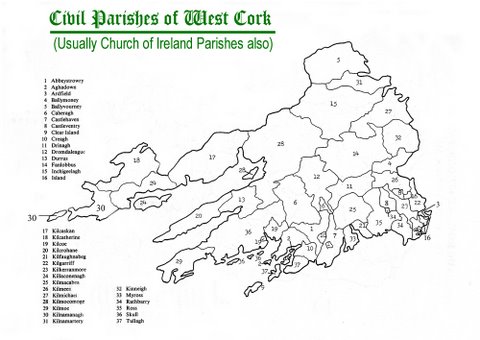
West Cork Civil Parishes
08 Saturday Oct 2011
Posted in Uncategorized
08 Saturday Oct 2011
Posted in Uncategorized
08 Saturday Oct 2011
Posted in Uncategorized
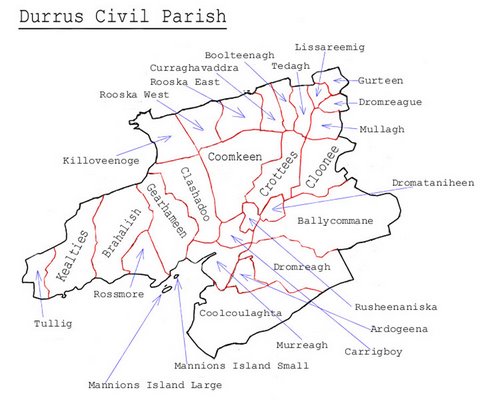


Richard Townsend, Dunbeacon, born Australia, Ireland’s oldest magistrate
07 Friday Oct 2011
Posted in Uncategorized
REPORT from Dr. Stephens to the Board of Health on the Bantry
Workhouse
Bantry, 20 February, 1847
Sir,
I have the honour to state for the information of the Central Board of Health, that pursuant to their orders I visited the Bantry Workhouse yesterday, and made enquiry into the character of the sickness prevalent in it, also as to the ages of the patients who died in the week ended the 6th instant, the duration of their stay in the workhouse previous to death, the state of the house as to ventilation and the diet and drink for the sick, together with the number of cubic feet allowed to each inmate in the sick and healthy wards.
With reference to the workhouse, I find it clean and orderly; the wards are spacious, and not having the number of beds they are capable of accommodating without inconvenience, the air of the house generally good, with the exception of the male infirm ward, in which the air was most impure from want of ventilation, as also the male dormitories for boys from six to ten years of age, whose habits are filthy; the same to be said of the female day-room, which is also a nursery for children
and their mothers; the air of this room was most impure, the women being very inattentive to the habits of decency, which the matron, who is herself most orderly, finds it very difficult to make them observe. ‘
The enclosed paper contains the ages of patients, their stay in the house, and the number of cubic feet allowed to each lunatic.
Language would fail to give an adequate idea of the state of the Fever Hospital; such an appalling, awful, and heart-sickening condition as it presented I never witnessed, or could think possible to exist in a civilized or Christian community. As I entered the house, the stench that proceeded from it, and prevailed through it, was most dreadful and noisome; but oh, what scenes presented themselves to patients lying on straw, naked, and in their excrements, as light covering thrown over them; in two beds, living beings beside the dead, in the same bed with them, and dead since the night before. I saw a woman who had been delivered but four days, almost expiring, with her wretched infant nearly suffocated; I administered at once wine, and had warmth applied, as there had been no medical attendant appointed during the illness of Dr. Tisdall, one of the medical men of the town, I was told had been there two days before; no medicine, no drink, in dirt, no fire, the unhappy beings who were able to express their wants crying out for drink, water, water, asked for, but no one to give it to them; others crying out for something to eat, as they said they were starved; many imploring to be taken out of it as they were not sick, but weak; thirty soon were found fit to be removed. The prevailing disease is dysentery, rendered highly contagious from the fetid state of the several wards.
The wards are saturated with wet and ordure, the walls -marked with the same. No nurses in the house except one of the paupers, totally unfit for the duties, every person being afraid to enter what was considered a pest-house; it is useless to enlarge or dwell further upon this revolting subject.I directed the clerk
of the union to bring to the board room any guardian or guardians he could find; three came, and in the presence of the chaplains of the house, and the master and matron, I laid before them the state of things I had just witnessed, with feelings I will not attempt to describe, and stated to them what should be done to arrest the frightful evil so widely spreading. In the yard, filthy beds and bedding were heaped up and allowed to remain there; the same state of things in the infirmary, where dysentery was almost universal.
The supply of water for the workhouse being carried by women: the want of it at present was great, from the great increase of washing. It is said to be not good; it is impregnated with iron, and much disliked
Having done all that was possible for me to do here I purpose to proceed to Cork, to attend the meeting of the Board of Guardians there on Monday, after which I shall proceed to Mitchelstown, where I hope to be on Tuesday to comply with the wishes of the Central Board of Health. –
I have, &c.
(Signed) R. Stephens
A sworn enquiry was held and the physician was called on to resign.
07 Friday Oct 2011
Posted in Uncategorized
Godwin Swift letters Crookhaven 1757
Extract from letter of Godwin Swift (Customs Man), 16th May 1757 from Crookhaven
‘Now with regard to the place and provisions: you are to know that you see nothing here but mountains of rock (not cliffs) and yet those rocks are more dear to poor people or strangers as the lands within 2 miles of Dublin. There is here undoubtedly great plenty of fish, yet the people are so lazy they’d rather live on salt mackerel and potatoes then give themselves the trouble to take fresh fish. There is no garden stuff here, very bad mutton and lamb, and no beef, not a tree or even a shrub within 8 miles of the place….
30th June 1757 ‘…nothing but rocky mountains around us for 20 miles, where not even a slide car can go the road, nor any other cattle than little horses bred and used to this country….you can’t conceive the wretchedness of it. We have neither bread to eat nor malt liquor wine or cider to drink, nor meat except a little mutton and bad lamb. Our liquor a bad toddy, our victuals potatoes and fish and lie in a cottage..
Toby Bernard, Mizen Journal 2004
Richard Griffith built the road to Skibbereen in the 1820s
Cork Customs Personnel:
https://docs.google.com/spreadsheets/d/1K9FbQLKPjRm9HLMNy99__AAMLmis519psiSvcP71Rts/edit#gid=0
07 Friday Oct 2011
Posted in Uncategorized
Carrigbuie, from George Bennett’s History of Bandon 1869
About five miles south-west of Bantry is the pretty little village of Carrigbuie. It is agreeably situated at the head of Dunmanus Bay–one of the great inlets from the Atlantic–and in a district where copper barytes, flags, and slate of superior quality, are to be found in abundance. The copper-mines in this locality are favorably known. The “south band,” which runs along the coast from Mizen-head to Roaring-water, has already produced copper-ore worth a hundred thousand pounds. The Bandon barytes mine has rewarded the energy and perserance of a Liverpool company with a yield of several thousands of tons. Flag quarries, which overhang the sea, produce flags of a fine buff co lour, and are represented as capable of being worked to great advantage; and the slate veins of Sea-lodge and Rossmore, already traced to a length of two miles, are found to have an average width of ninety feet. These are also worked by an English company, who has a ready market for their produce in France, as well as in many parts of England and Scotland. “After a careful and minute search of the Carrigbuie estate of the Earl of Bandon, we find,” say Messrs. Thomas and Son, the eminent mining engineers, who have been for a long time acquainted with that country, “that there are no less than thirteen ploughlands that contain minerals, offering every inducement to the capitalist to develop them.”*
Carrigbuie-that is, the yellow rock-lies in a well-sheltered vale, through which flows a noisy stream, which empties itself into the bay here. Previous to the expiration of the lease by which Carrigbuie was held under the Earls of Bandon, it consisted of but a few thatched cabins, which are described as being both filthy and miserable. These have now disappeared; and a great improvement has taken place in its appearance, as well as in its prospects, since it has come into Lord Bandon’s hands. The mud cabins have been replaced by rows of clean and substantial houses. Good-sized shops display tempting wares in their windows and on their shelves. A post-office delivers and dispatches the inhabitants’ letters. A dispensary is furnished with every requirement for the sick; and a hospitable hotel, with its well-supplied table and its comfortable accommodation, helps to persuade the traveller that he is at home.
Durrus Church is but a short distance from Carrigbui It was built about the year 1798, on the site of a chapel-of ease, which was used for divine service before the breaking out of the great rebellion in 1641. After the suppression of that memorable rising it does not appear to have been used again; as in little more than sixty years afterwards, although its walls (which were built of large square stones, imbedded in clay mortar) were standing, its roof was gone.
Most of the lands of Durrus and Kilchohane were forfeited by the Irish proprietors in 1641. In the reigns of William the Third and Queen Anne, the principal landed proprietors in this immense district were Judge Bernard, Lord Angelese, Colonel Freke, Lord Cork, Mr. Hull, Mr. Hutchins, and Major Eyre.
*Vide Descriptive reports on the mines, minerals, flag, and slate quarries on the estate of the Earl of Bandon in the south-west of the county of Cork, printed at the Mining Journal office, Fleet Street, London, 1865.
07 Friday Oct 2011
Posted in Uncategorized
The site irishgenealogy.ie has now put the parish records of the Muintervara parish online from 1820. In the absence of census records pre 1901 it is a valuable source of family information, for example the bulk of the birth records as well as itemizing the child, date of baptism, include the name of the mother and father and the sponsors. The town land is also given but to our modern eyes often in a rather corrupt version reflecting that many of the people in the early 19th century were Irish speaking and the priests were perhaps unfamiliar with local usages. The Church of Ireland records are not included perhaps in time they will be included. The existing Church of Ireland records are accessible in the library of the Rppresentative Church Body in Dublin.
A preliminary view of the records suggests a birthrate for the parish in the 1820s of c200 per year. What is also interesting is the interconnections between the minor landlord families in the period 1820-50 the O’Donovans of O’Donovan Cove/Fort Lodge, the Blairs of Blair’s Cove and the Evansons of various addresses in marriage patterns and was sponsors for each other.

