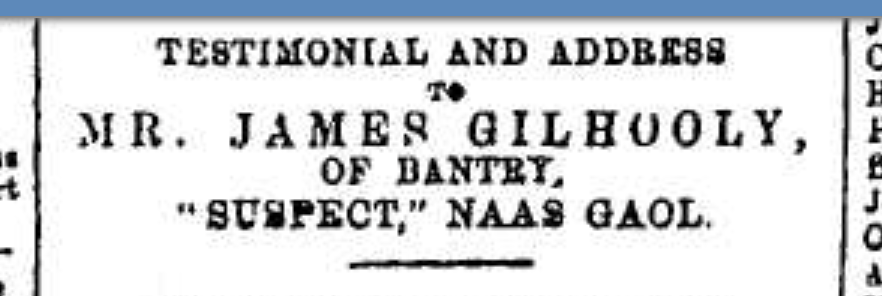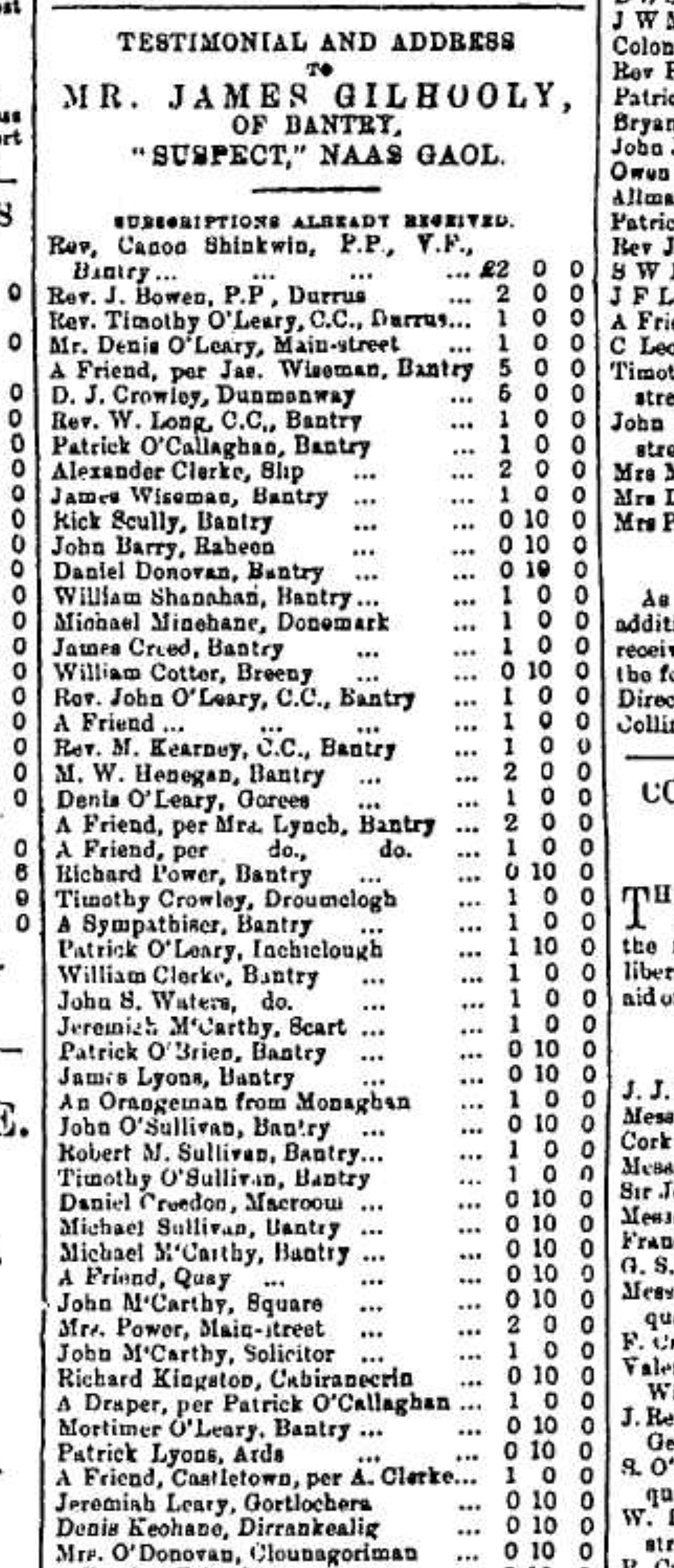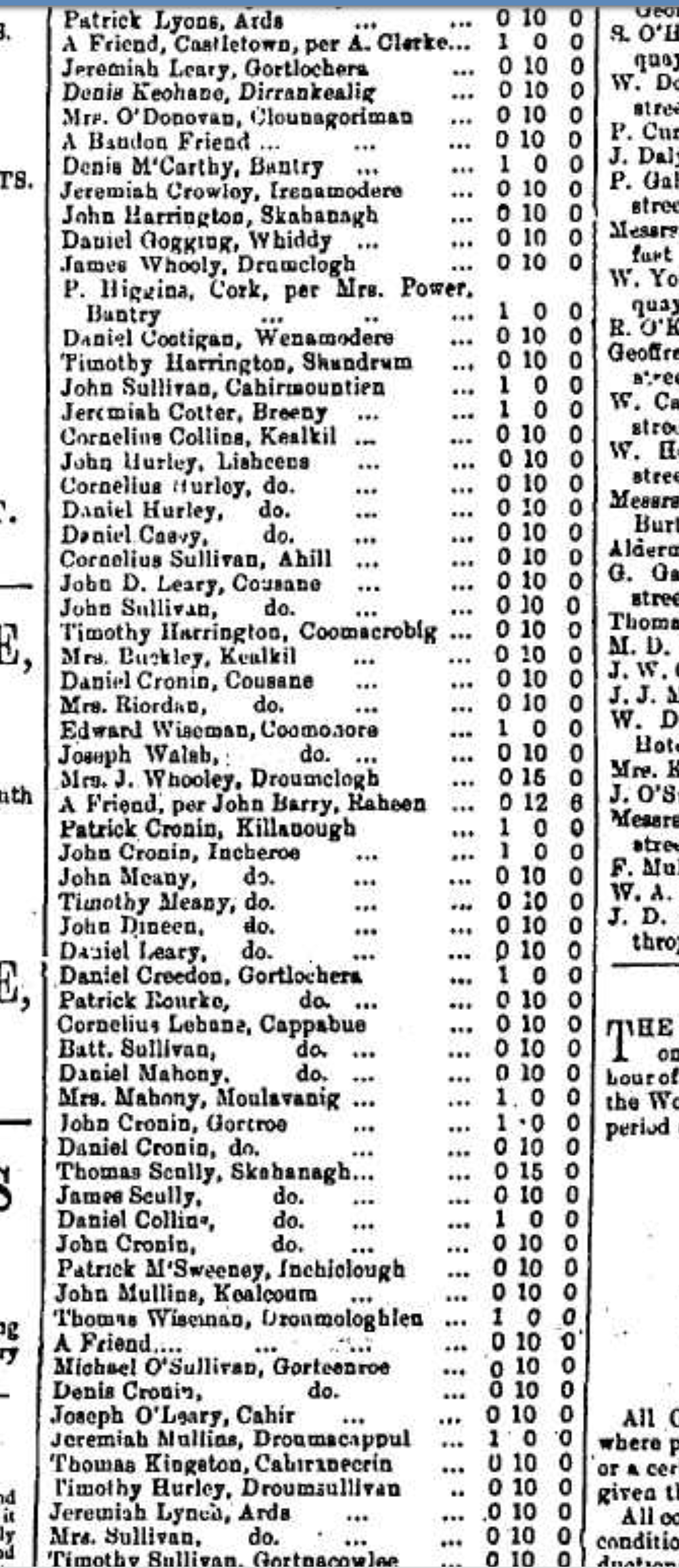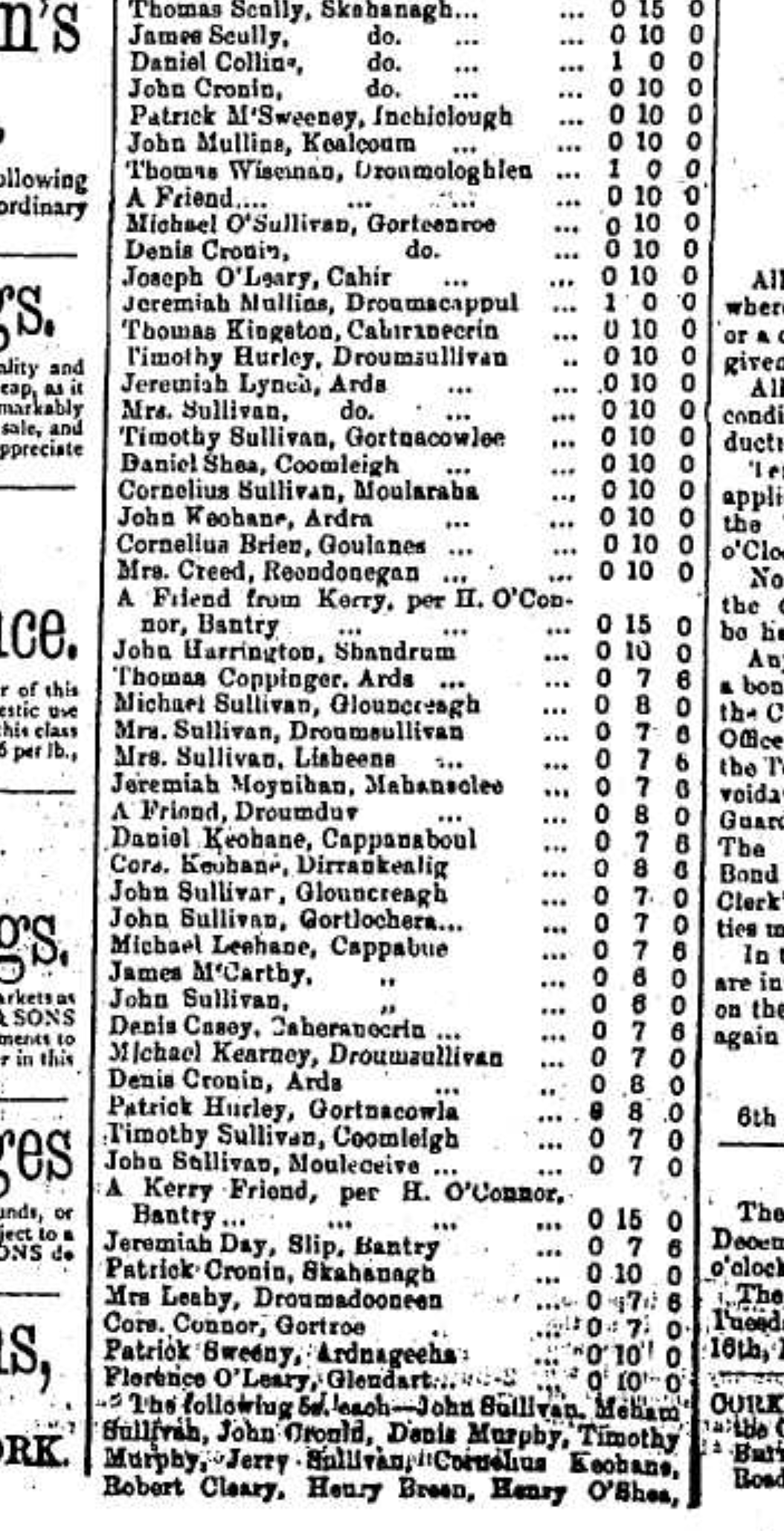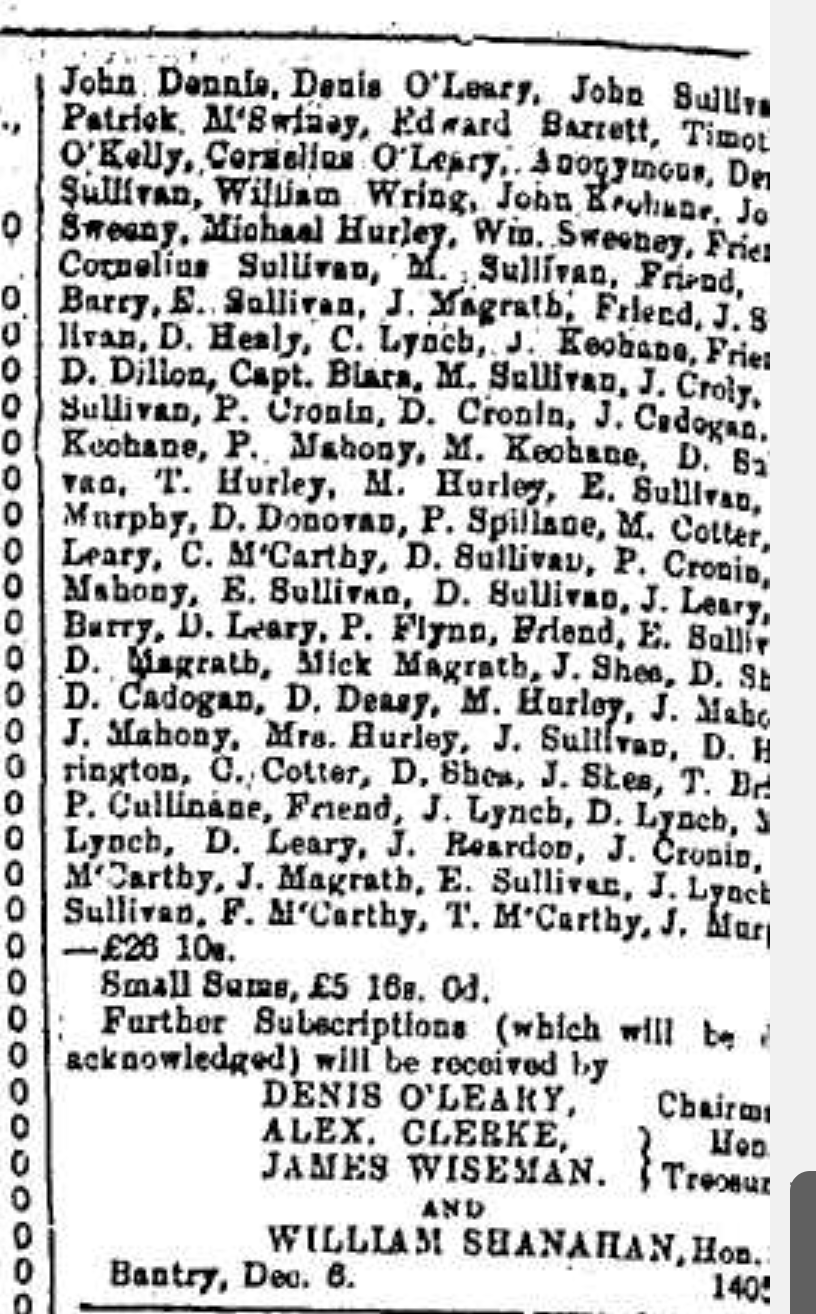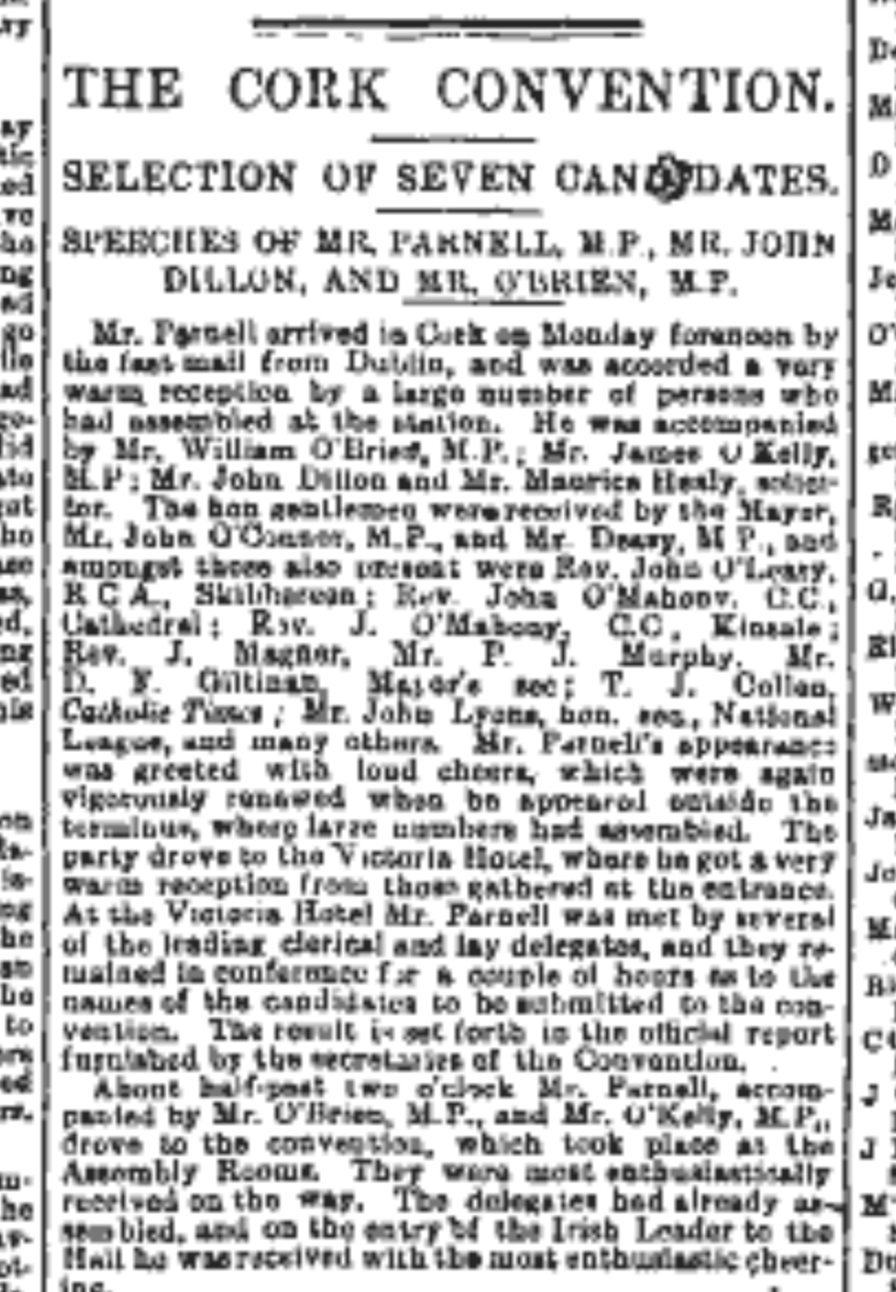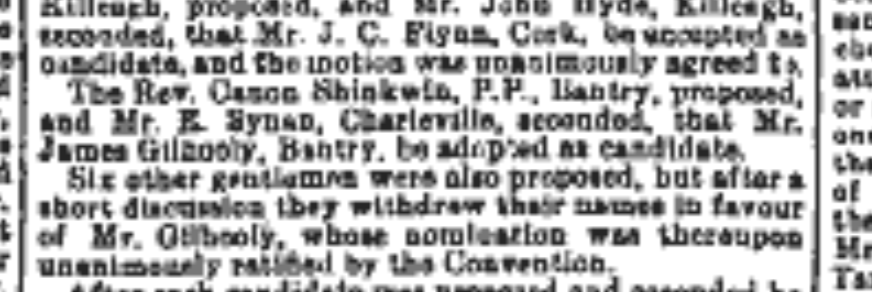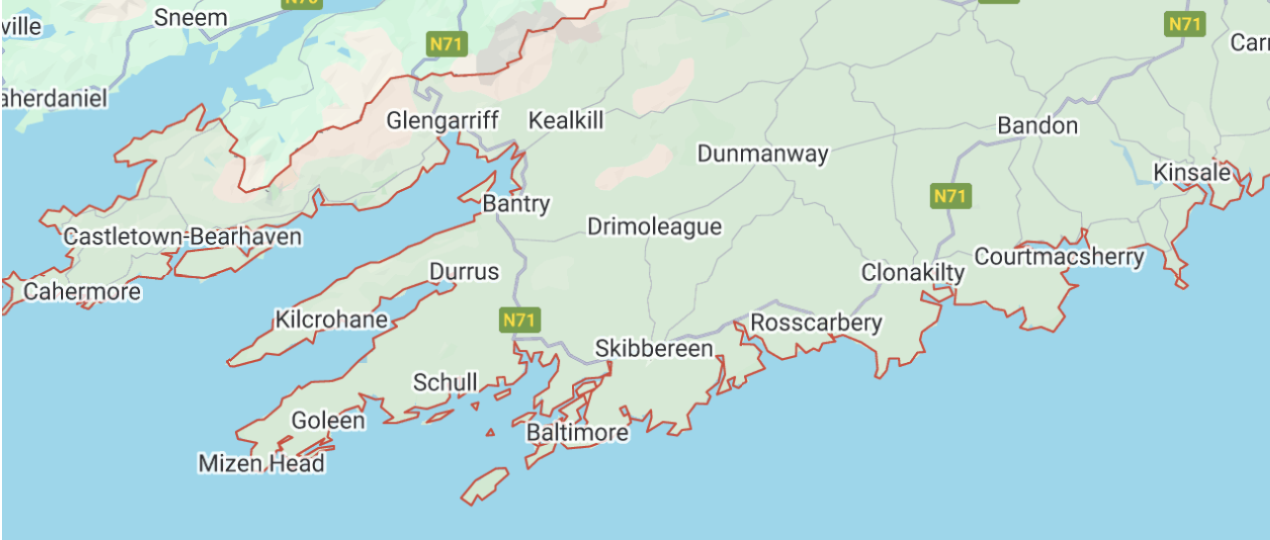
James Gilhooly (1847-1916) , Pre 1910, Main St., Bantry, son Peter, coast guard officer. Born Bantry, draper, MP for West Cork since 1885, J. Warren Payne, Stood as Conservative in West Cork Constituency General Election 1885 got 373 (9%) of the votes his opponent James Gilhooley Irish Parliamentary Party got 3,920 votes (91%). Imprisoned five times. 1882 Stewart Bantry Regatta. He was one of the Bantry Band and a Westminster MP throughout the Parnell period and then John Redmond’s leadership. He spent time in prison. There is an Address from the Inhabitants of the Bantry District presented to him on his release from prison, approving of his conduct leading to his imprisonment. 1895 Seeking assistance for widespread distress Durrus, Kilcrohane. Signed Requisition 1905. Cork Junction Railway Bill. Requisition to the Right Honourable The Earl of Bandon K.P., to Call a meeting for the purpose of Approving the Cork Junctions Railway Bill.A member Bantry RDC, Co. Council 1910, m Mary d Jeremiah Collins, Kilbarry, Dunmanway, 5 children. 1892 attending the funeral of Jane Dillon nee Roycroft (1843-1892). Attending the funeral Bantry 1899 of Miss O’Connor of merchant family.
Continuing our journey around Ireland, this blog from Dr Stephen Ball, of our House of Commons 1832-68 project, looks at politics in the small boroughs of county Cork, where competition between the rival parties encouraged a vibrant political culture, but also prompted sectarianism, bribery, violence and coercion.
Ireland in 1832, from Thomas Starling, Geographical Annual of Family Cabinet Atlas (1834)
The county of Cork was widely referred to as ‘the Yorkshire of Ireland’, due to its extent, wealth and resources. However, under the Irish Reform Act of 1832, Ireland’s largest county returned just eight MPs, compared to Yorkshire’s 37, although the latter was barely twice as populous. Half of Cork’s parliamentary representatives were elected by the four single-member boroughs of Youghal, Bandon, Kinsale and Mallow. The principle that the reformed House of Commons was designed to represent specific and distinctive ‘interests’, rather than numbers, is amply demonstrated by the fact that whereas in 1831 the population of the two-member County Cork constituency was 700,366, and that of the city of Cork, which also returned two MPs, was 107,000, the population of Youghal was only 9,820, that of Bandon, 9,608, Mallow, 7,100 and Kinsale, 6,897. While the county boasted 13,351 electors in 1851, Kinsale had only 139, and Youghal, the largest of the one-member boroughs, 261. However, defenders of the reformed system argued that the continued enfranchisement of such boroughs was justified because they each represented distinct social, economic and political interests, and allowed a diverse mixture of oligarchic and popular influences to decide their own representation in Parliament.
The constituency of Youghal in 1832
Regarded as the county’s second town, Youghal was a busy seaport on the estuary of the river Blackwater. The pre-reform constituency had been controlled by the corporation and freemen under the influence of the town’s main landowner, the Duke of Devonshire. The Irish Reform Act expanded the electorate and consequently increased the influence of the town’s merchants, shopkeepers, artisans and publicans, making the constituency a hotbed of local politics. The curbing of the duke’s Whig influence after 1832 created opportunities for the Irish popular interest, but also raised the possibility of electoral success for organised popular Conservatism. Consequently, sectarian rivalry, intimidation and corruption were features of the borough’s seven contested elections. Daniel O’Connell’s son, John, defeated the Conservatives on the Repeal interest at the 1832 and 1835 elections, during which the town was, according to the future Chartist leader, Feargus O’Connor, frequently in ‘a state of siege’. His father’s compact with the Whigs meant that O’Connell stood aside in 1837 and at the next two general elections the duke’s nominee held off Conservative challengers before suffering defeat at the hands of another Repealer in 1847. The collapse of the repeal campaign and a loss of confidence in the Whig ministry allowed Isaac Butt to win the seat for the Conservatives in 1852. Despite moving away from orthodox Conservatism as he became increasingly critical of Ireland’s fate under the Union, Butt held Youghal until 1865, when he was easily beaten by a wealthy Liberal banker, who in 1868 was defeated by an ‘heroically corrupt’ London merchant.
Known as the ‘Derry of the South’, Bandon was Cork’s next largest borough. A handsome market town founded by the first Earl of Cork as a plantation settlement in 1610, it had served as a rallying point for Williamite forces in 1689. Its once thriving linen industry had declined by the 1820s, but the town still contained leather works, flour mills and distilleries. A ‘rotten borough’, it had been controlled by a close corporation under the Earl of Bandon before the Irish Reform Act increased its electorate from 13 to 266. Of these 70 were resident freemen who propped up the Conservative interest. Despite being only one third of the population by the 1860s, Protestants, including a substantial number of Orangemen, made up almost three-quarters of the electorate. They were efficiently organised, and the Whig influence of the absentee Duke of Devonshire could not compete with that of the staunchly Protestant and constantly resident Earl of Bandon, whose family dominated the representation until 1868. The Liberals contested six often disorderly and violent elections but could make no headway against the Bandon interest, whose agents were was not above plying Devonshire’s tenants with drink to secure their votes, as some of them were polled with the fumes of the previous night’s ‘debauch still thick upon them’.
1650s, Richard Brockelsby, clothier, Cork persecuted as Quaker d 1696, p. 15
Cork linen Probates, p. 15
Miscellaneous records from 1732, p. 16
Bantry/Beara from 1796, p. 18, 24, 29
1783, Cork Election List of Freemen voters, many from the county
1835. 1st Report From His Majesty’s Commission For Inquiring Into the Condition of The Poorer Classes in Ireland, p. 26
1841 Effects of Cotton, Calico, British Competition. Evidence of William Crooke Esq., Macroom, to 1841 Enquiry on Land, p. 27
1853 Local Loan Reproduction Records, Schull, p. 32
Lord Bandon was an enthusiastic exponent of flax growing in the 1860s, p. 32
Census Extracts, p. 33
1829 Census Inchigeela p. 34
Bandon Clothiers Weavers collapse to trade, p. 39
1790 Coqueberts Irish Visit Bandon, p. 60
Adderly Innishannon, p. 61
Bandon Cotton Manufacturers, p. 85
Duke of Devonshire Estate Correspondence re weavers, p. 85
1830 Distress in Bandon. Number of Active Looks Dropped from 1,200 to 200. Deplorable State of the Cotton Trade. One sixth of Bandon’s Population in Destitution, p. 89
1851 Innishannon Encumbered estates Sale p. 101
Thomas, ‘The Industrialist’ Adderley Innishannon, p. 108
Bantry p. 116
Bantry, Durus 1937 School Folklore Project, p. 131, 408
Flax meitheals, p. 134
Clonakilty, p. 138, 158
Call for revival of flax industry this was probably Written by Eamonn O’Neill, Kinsale TD, 1945, p. 200
1954 flax pays, p. 240
Drimoleague, p. 240, 307
Dunmanway, Richard Cox, p. 263
Kinsale, p. 282
The Kinsale Cloak, p. 292
Skibbereen, p. 295
Using Linen Thread for Candles, Weaving, p. 305
Flax Ponds, p. 307
World War 2, p. 307, 340, 341
Early history, estates, p. 318
Innishannon from Bishop Pocock Tour, 1752., p. 325
The Linen and Flax Industry in Dunmanway, West Cork, Fines for Steeping Flax in the River Bandon and other Rivers , 1835, p. 330
American Civil War, 1864, p. 333
World War 1 Mills, p. 340
Flax Growing 1796, p. 343
Flax Growers of Ireland, 1796 – County Cork, high concentration in Clonakilty/Drinagh/Dunmanway area, spinning wheel premium list p. 344
Exports of Cloth from Cork,1683-1777, p. 398
Distribution of Flax, Ireland, 1796, p. 400
Loom.p. 403
Exports of Linen 1791, p. 406
Fishing Nets., p. 407
Samuel Vickery (1832-1912) Reminiscences to his Daughter Martha Ellen, Evansville, Indiana, USA, Childhood in Rooska, Parish of Durrus and Reendonegan, Bantry, West Cork, p. 408
Flax Acreage Co. Cork, 1939-1945, p. 411
Gírle Guairle, from Dineen Irish Dictionary, 415
Clonakilty Linen Hall 1817 p. 415
Richard S. Harrison on Flax in West Cork, p. 416
The Sealy, Cornwall and Allin Families, Merchants and Bandon Gentry, Catherine Fitzmaurice, 2017, 422
From the National Archives, Chief Secretary Papers.
Cover letter from James Doherty, F Murphy, Richard Sullivan, John Stewart and John Atkins, church wardens, parish of Fanlobbus, barony of East Carbery, Dunmanway, County Cork, to Henry Goulburn, Chief Secretary, Dublin Castle, enclosing memorial to Richard Wellesley, 1st Marquis Wellesley, Lord Lieutenant, Dublin Castle, requesting information and direction on how to pursue individuals living in adjacent parishes on charges of profaning the Sabbath. Indicates that application was made to local magistrates on the matter, but without satisfaction since they felt unable to act against offenders who lived at a distance of 10 or more miles. Also complains of not knowing how to press for punishment those who are found drunk in a public place. [Names of parish overseers have been cut away from both cover letter and memorial].
Paul DUELOS, A.M., vicar of Ballymodan. He died in 1717 or 1719.
French Prisoners, Freemasons, Bandon 1746-1747, p. 177
David la Touche Colthurst (1828 – 19 January 1907)[1] was an Irish Home Rule League politician. He was elected Home Rule Member of Parliament (MP) for County Cork at the 1879, p. 178
..
From the mid 17th to early 18th century something around 5,000 Huguenots moved to Ireland from religious persecution in France. The bulk arrived after the Revocation of the Edict of Nantes in 1685. Dr. Alicia St. Ledger the historian of the Cork Huguenot community puts the number in Cork mid 18th century at around 300. In Cork City where many settled they had a French speaking church and minister. This group tended to be well educated, affluent, and involved as merchants, apothecaries, surgeons and as property developers reclaiming the Cork City marshes. Over time they became English speaking and drifted into the mainstream Church of Ireland and gradually into the wider Catholic community.
No one knows for definite when the various Huguenot families arrived in the Mizen/Durrus areas. In the main they were unlike their co religionists in Cork as they were artisans, small to medium farmers or labourers and coopers. Oral tradition has it that they arrived by boat to Dunmanus Bay. They arrived perhaps c 1750s co incident with various attempts throughout West Cork by Landlords to develop weaving, linen and flax. The old village of Carrigbui (Durrus) was sometimes described as a weaver’s colony.
About 1750 around 60 Huguenots arrived in Cork on board the galley ‘Redhead’ destined for Innishannon with their pastor Rev. Peter Cortes.
They may have been being involved in Thomas Addisons failed silk enterprises in Innishannon and left Kilmacsimon Quay for Dunmanus Bay.
The obituary of the Rev. Charles ~Donovan in the Skibbereen Eagle in 1893 is most unusual insofar as it included a very detailed genealogy. Maybe the Rev. Charles or one of the family wrote it; it looks like it relies on family papers. His career is ironic as a rabid Proselytiser preying on the starving Catholics of the Mizen Peninsula; you would not imagine his genealogy. His ancestor Daniel O’Donovan, head of Clan Cahill fought with his O’Donovan Regiment for King James in the battle of the Boyne in which four of his sons dyed. HIs grandfather Richard O’Donovan on his marriage to an English woman had to change his name to Donovan, he may have been a Catholic as he had to post a bond for £1,00 to the Church of Ireland Bishop of Cork. HIs son Charesl was a senior civil servant in Bengal and a Magistrate. His Indian born grandson Dr.Charles Donovan was a world renowned medical scientist. In a sense it shown family survival consequential on the Penal laws and adaptation.
Rev. Charles Donovan (1812-1893), p.1
Funeral and genealogy, p. 3
Among the funeral attendance, p. 14
Proselytiser, 16
1847 Plea for the preservation of the poor in Schull.p. 14
1849 Protection Meeting Ballydehob, p. 16
1849 Opening of Rev. Spring Protestant Church, Cape Clear, p. 18
1856 attending funeral of James 2nd Earl of Bandon, p. 19
1889 funeral of Archdeacon of Ross, Rev. Dr. Woodroffe, p. 20
Charles Donovan, JP., Bengal, died 1915 aged 74. His son known in Ballinadee as Judge Donovan, p. 21
1905 Judge Donovan, Courtmacsherry Regatta, p. 23
Grandson Colonel Doctor Charles Donovan, (1863-1951), p. 24
His ancestor Daniel O’Donovan, head of Clan Cahill fought with his O’Donovan Regiment for King James in the battle of the Boyne in which four of his sons died., p. 28
His grandfather Dr. Richard O’Donovan surgeon of Nohoval, p. 30
How the Parish got the name Barryroe The history of the name Barryroe for the Parish is quite complicated. To summarise, ‘Barry’ has its roots in the lands under the patronage of Saint Barruch being given to a Norman (therefore French) military clan calling themselves the people of Barruch i.e. de Barri. The ‘Roe’ part refers to Lawrence Barry (c. 1400) who was named Red Barry possibly because he had a red complexion or even red hair? Ruadh is Irish for Red so Barra Ruadh or Barraí Rua anglicised became Barryroe.
The Parish includes townlands such as of Abbeymahon, Ardgehane, Ballycremond, Butlerstown, Carrigeen, Courtmacsherry (where Courtmacsherry Church is), Donaghmore, Dunworly, Grange More/Beg, Lehenagh, Lislevane, Shanaghobarravane, Ternanean (where Barryroe Parish Church is).
Denis Florence McCarthy
MacCarthy, Denis Florence (1817–82), Young Irelander, poet, and translator, was born 26 May 1817 at 24 Lower Sackville St., Dublin, the only son of John MacCarthy (d. 1857), a catholic woollen merchant with premises on Eden Quay, Dublin, and Sarah MacCarthy (née Courtney) (d. 1845). After attending a private school in Dublin, he entered Maynooth College to study for the priesthood, but discovered he had no vocation, and in 1834 enrolled at TCD, becoming a member of the circle of Thomas Davis (qv) centred on the College Historical Society. He entered the King’s Inns, Dublin (1841), and Gray’s Inn, London (1842), and was called to the bar (1846). He never practised law, preferring instead to pursue a literary career.
May have family links to Clonakilty/Dunmanway. His poem Clan of Mac Caura refers to Arigideen river. Champion of poet J.J. Callanan