Christmas was formerly observed in the Highlands on what is now known as “Twelfth Night”. In the Celtic lands, the people did not at first take to the introduction of the New Style calendar in 1752, and tenaciously clung to the ‘old way’ of things, including their conviction of Jan. 6th as the “real” Christmas day. Still celebrated in Ireland as Nollaig na mBan:
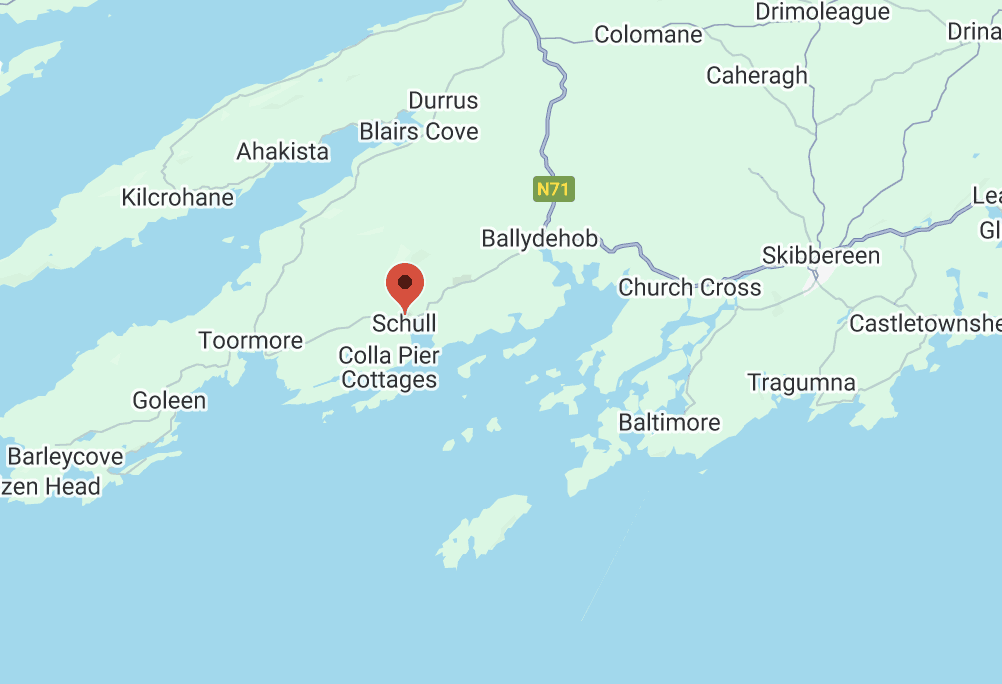
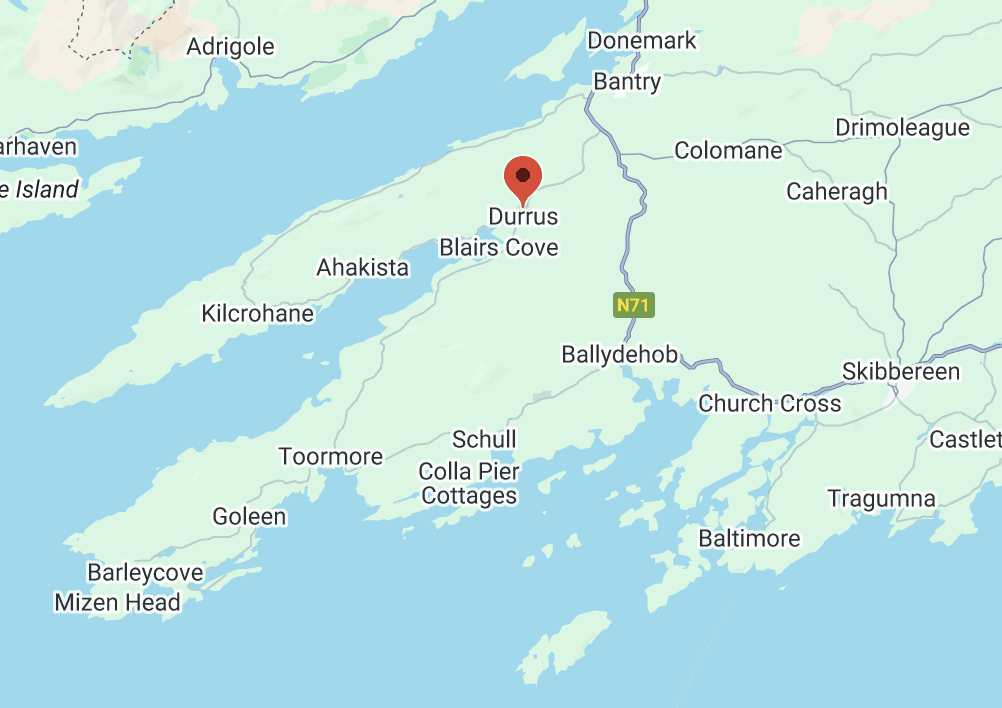
In Durrus Tom Dukelow originally from Clashadoo spent some time in Tyrone. He had sold his Clashadoo farm and on his return in the 1930s bought Sea lodge a house and a few acres across the disused pier built by Lord Bandon at Gearhameen, Durrus on Dunmanus Bay. I was told he was one of the last persons to hold a licence to grow tobacco. He also operated as a merchant. In the long hot summer of 1940 tuna and pilchards returned to Dunmanus Bay. He bought the pilchards from local fishermen and pressed them for their oil. He ran a scoraiochting/rambling house where in the winter all the neighbours gathered. Neither the Parish Priest nor the Minister were happy as they did not like the religions mixing but nonetheless it was always a lively venue.
Mr. Wyndham- In 1900, 1901 and 1902 experiments under the supervision of the Department were undertaken at a number of selected centres in Ireland, the result of which have satisfied the Department that the tobacco plant can be successfully cultivated in that country. In order, however, to determine the possible commercial value to the country of tobacco cultivation, arrangements were made for the growing of the crop on about 20 acres in the vicinity of Navan during the present year…
The Times, 29 June 1905 ~ Tobacco. House of Commons. Irish Tobacco.
The Departments advisory committee on tobacco recommended that the experiment in 1904 should be confined to one centre – namely Navan – and that at least 20 acres should be grown there. Others in the district having declined to offer land for the purpose Colonel Everard undertook to plant the entire 20 acres, and consequently he was the only approved grower entitled to the rebate.
The Times, 9 Oct 1905 ~
At a special meeting of the Irish Industrial Development Association Mr. R.E. Goodbody made an interesting statement about the Irish tobacco crop for 1905. In company with an American expert, he had just visited Randlestown, Navan, where Colonel Everard had ten acres under process of saving. He had never seen so good a yield in any country, and the expert was of the same opinion. The yield of the ten acres was three times as great as that from a twenty plot last year. The tobacco was a little slow in saving but smoked very well. More than 3,000 hands were employed in Irish tobacco factories.
The Times, 9 July 1906 ~
The experiments in tobacco growing in Ireland, which have now been carried out for several years by Colonel Nugent T. Everard, of Randlestown, Navan, County Meath, appear to have been brought to a successful termination and to have emerged from the experimental stage into an actual industry. The following particulars have been forwarded to us: – In 1904 Colonel Everard, grew 20 acres of tobacco, which yielded 9,000 lbs. of cured leaf. It was favourably reported on by experts and sold freely at ½ per lb. above the same class of American tobacco. In 1905 13 ½ acres were grown by Colonel Everard which yielded 15,500 lb… This year Colonel Everard is experimenting upon 25 varieties, including high class cigar wrappers, and judging from the characteristics developed in the tobacco previously grown the experiment is likely to prove a “With our present experience” writes Captain R. W. Everard “the cost of labour on one acre of tobacco is about £20 per acre, about half of which can be earned by women and boys during the winter, when in this country, there is no other employment for them”.
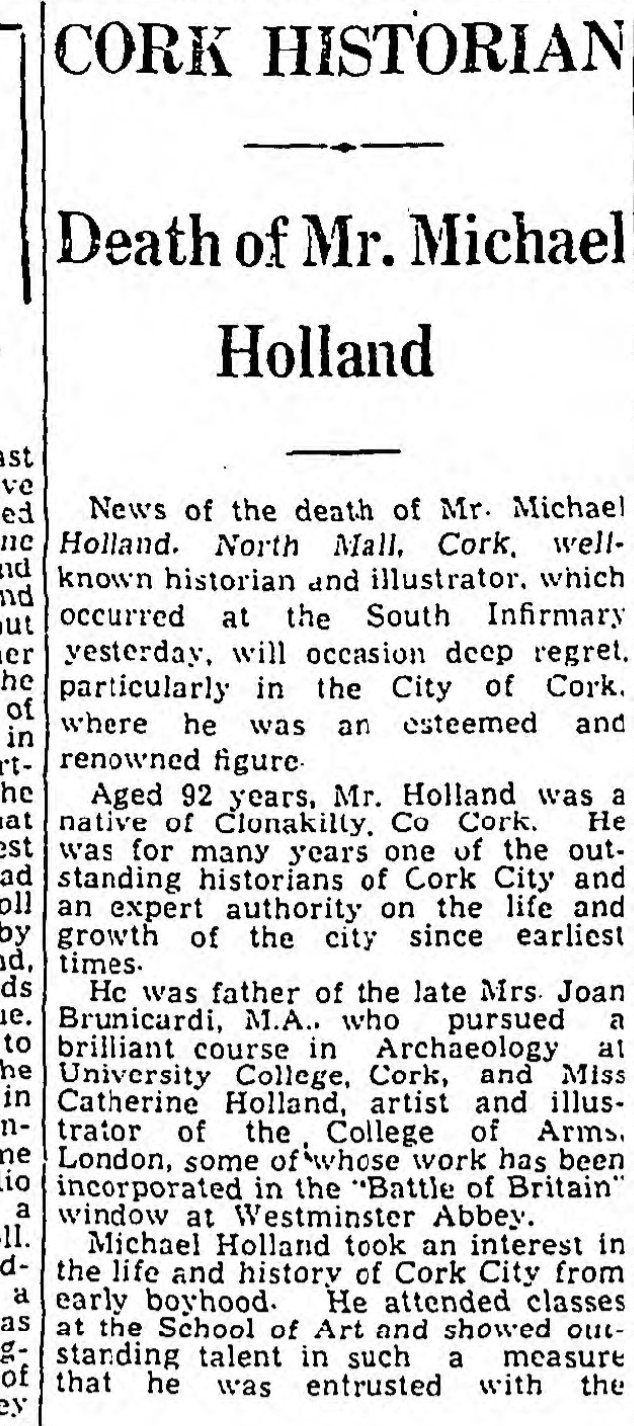
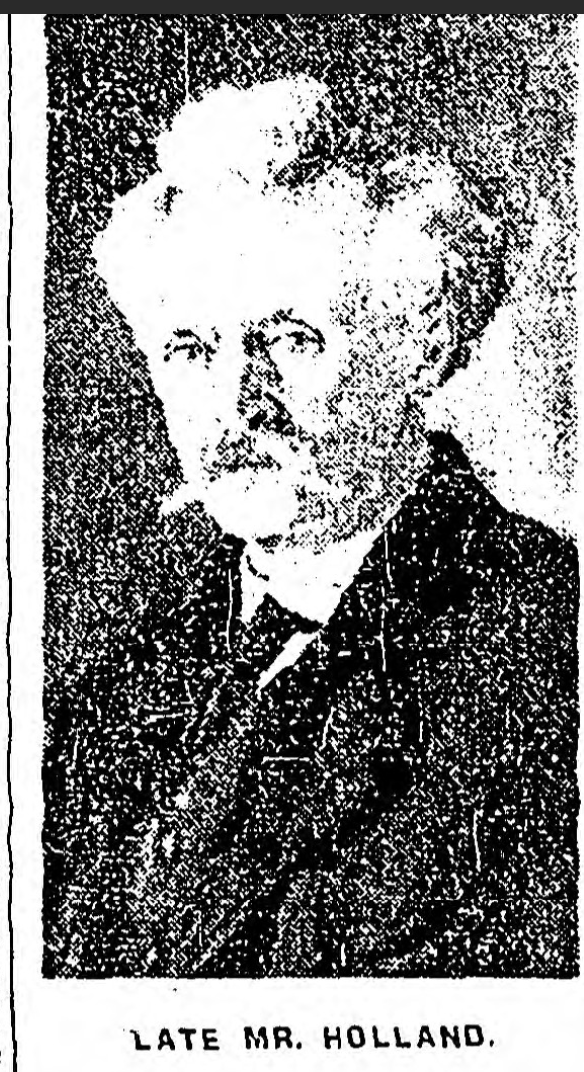
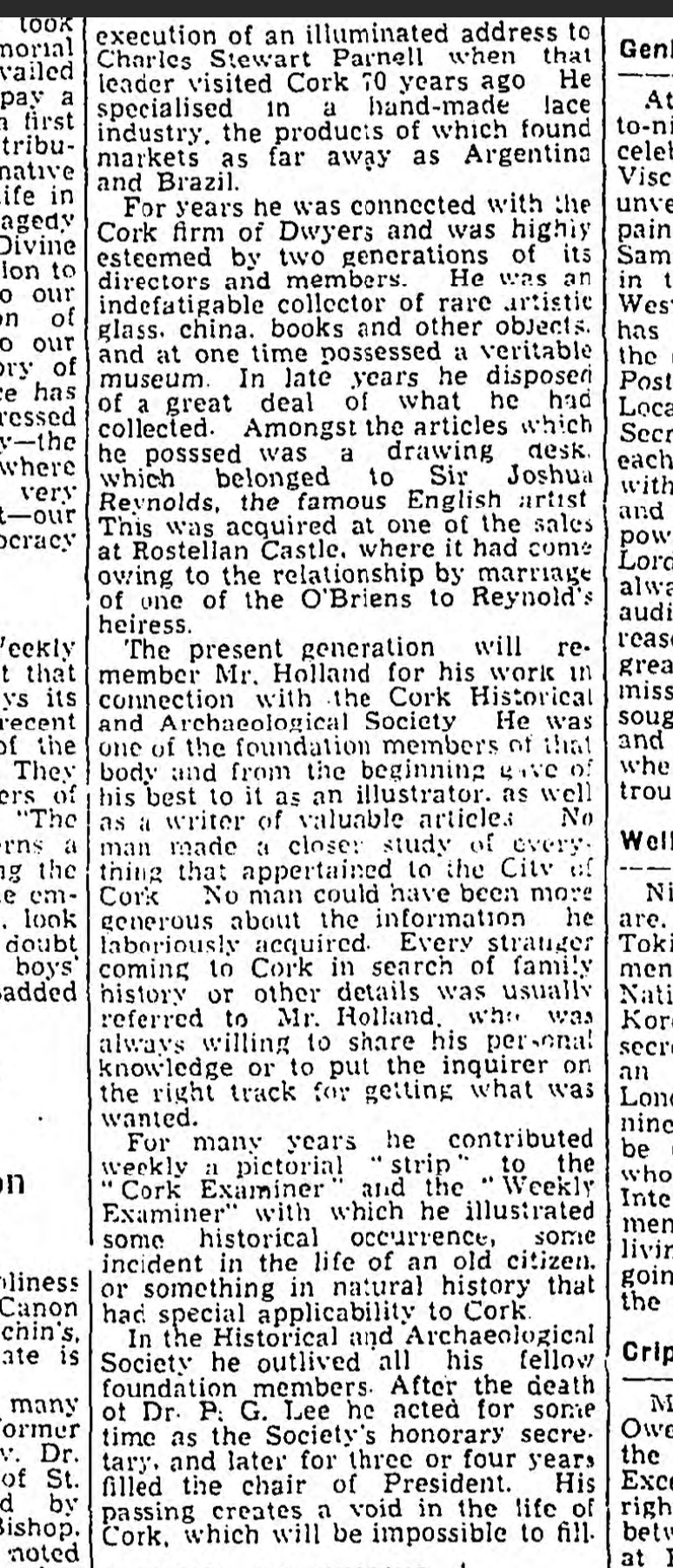
Possibly related to Father Holland, History of West Cork, and if so to late journalist Mary Holland. . He died the same year.
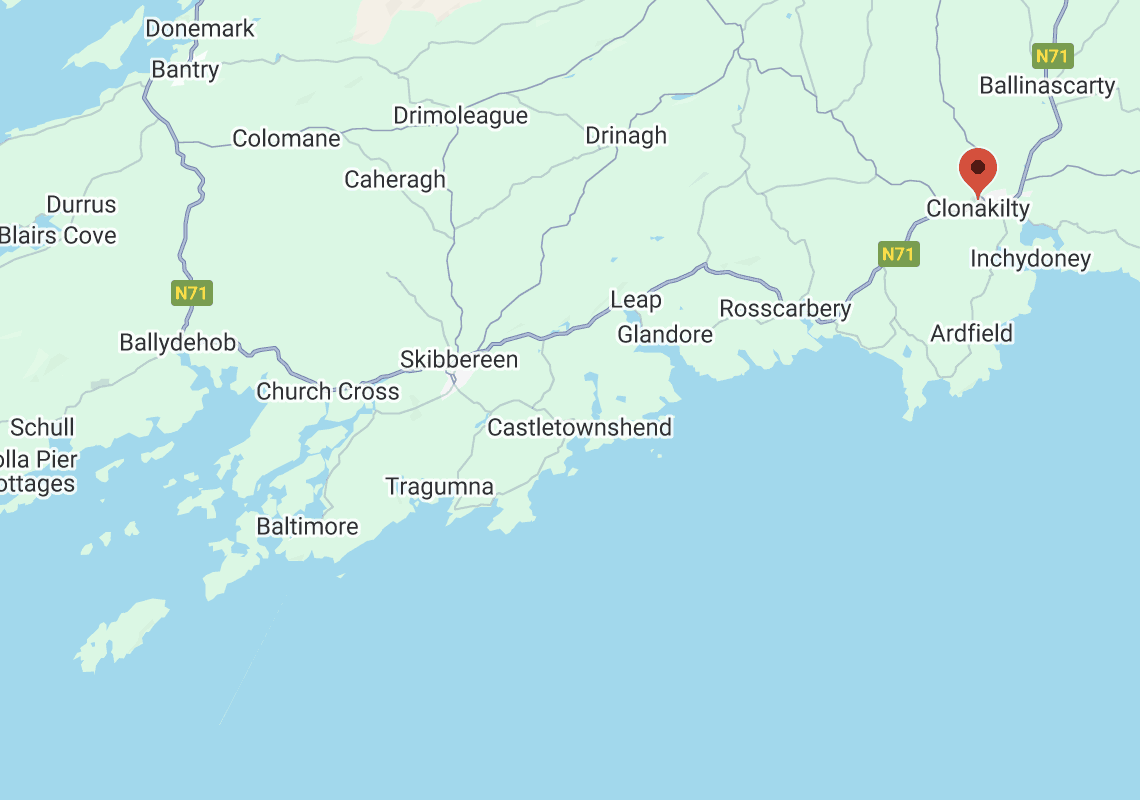
Father William Holland, Ardfield, Clonakilty, (1876-1950). 1949 History of West Cork. Included genealogies of Barrys, De Courceys, McCarthys, O’Crowleys, O’Driscolls, O’Heas, O’Hurleys, O’Mahonys, O’Sullivans.
NAI PRIV/M/4921 is a facsimile copy of a volume of Cork material which includes:abstract 1766 religious census material (to parish level) for all parishes in Cork and Ross diocese1764-5 hearth-tax religious census material for some Cork parishes.
The 5 March 1766 resolution of the House of Lords instructing that a religious census be taken required parish ministers to return lists of the heads of households only. However, the instruction from the Cork and Ross Diocese to its parish ministers to conduct a census must have included a specification that population numbers were also to be returned as nearly all parishes in Cork and Ross provided population data alongside counts of the number of households. Cork and Ross was the only diocese to return both population and household counts as a general rule.
The abstract 1766 population and household numbers in this volume reflect the diocesan summary for Cork and Ross diocese, which was Parliamentary Return number 787 in the Parliamentary Return collection in the Public Record Office.
View PROI PARL 88/30/5/77/2/787 to see additional information concerning this diocesan summary.
The reference to Cotters as Danish in origin may not apply to those from the Dunmanway/Bantry/Macroom districts. DNA suggested they may be a Sept of either the O’Learys or O’Mahonys.
1845 Skibbereen Petty Sessions., 2 Starving Little Brothers. Half Fed Half Clad. Sentenced to 10 Days Imprisonment in Cork County Gaol for Having a Few Bundles of Withered Furze and a Few Rotten Sticks At the Prosecution of the Rev. Thomas Fitzgerald Stephens Townsend Brother and Heir at Law Of The late Colonel John Townsend, Castletownshend
1814, Thomas Godson Agrees at Breenybeg, Kealkil to Sow Furze Seeds and 12 Perches of Lawful Double Ditches
208
BL/EP/B/
yearly rent of £14. 14. 0, payable half yearly on the 29th September and the 25th March. Godson agrees to sow furze seeds and to erect 12 perches of lawful double ditches, failure to do so will incur an additional 12 shillings on the rent. The former lease was held by John Godson (grandfather of Thomas Godson).
878 24 Sept. 1814Renewal of a Lease made between Richard, Lord Viscount Bantry, Bantry, and Thomas Godson (Writing Clerk), City of Cork, subject to a surrender of a former lease, for the lands of Breenybeg containing 4 gneeves, in the Barony of Bantry. It is for three lives renewable, from the [24th] September last, at a878 contd.
From Bantry House Rental Records, Boole Library, UCC.
The Brooks/Brookes of Dromreagh (Drom Riabhach, stripe, grey ridge), Durrus, West Cork coming early 19th century as Weavers from Ryelands, Raphoe, on the Abercorn Estate in East Donegal, some go to New Zealand early 20th century, and 1926 sale of family holding Dromreagh on move to Courtmacsherry, subject to ‘a trifling annuity’ with an acre and a half of furze meadow.
Pounding the furze for the mare in foal.
Pre the mid 1960s the workhorse on Irish farms was literally the horse. The diet was supplemented by furze (whin or gorse in some areas), chopped up with a furze machine. These sturdy machines of cast iron are still around and grinded the plant and then chopped it. Mares in foal have a delicate digestive system and the furze was further pounded to make it palatable.
Farmers would often travel a mile of so to get a cart load of furze. Brakes or waste land of up to a half an acre would often be planted with a harvest within two years
In his book, Farming In Ireland, John Feehan mentioned many registered accounts in legal documents from the 15th and 16th centuries listing gorse being used as animal fodder: “It was especially valued in feeding horses, though cattle throve on it also, either fed on its own or as part of a mixed diet.”
Feeding gorse continued until the 19th century, with many admitting to getting more gorse per acre than they would if they made hay. Feehan also recalls how farmers, in Cork especially, grew a few acres of what was called “furze meadow”. Given current fodder shortages, maybe there’s a lesson there.
This furze machine was sold in 1889 auction as new:
Garbhóg, forked hazel stick used in divining, a furze stick was used by an English artist who bought Sea Lodge in the 1940s to divine for water. The house had no water which was obtained from the nearby priest’s well. The English lady found a small stream near the house
In 1891 Sir John Gorst, Reforming MP, 1891 visited Aughadown and the detailed account in the Southern Star carries description of furze sticks used as fuel:
Comments on use of furze sticks for heating.
.
.
.
,
.
.
.
.
.
.
.
.
.
Generally on Furze from Blog:
welshboy Gorse/Furze Fuel and feed
Just been reading about the capability of gorse as a fuel or feed for cattle/horses.
Apparently it has half the protein of oats and can be harvested at a two year rotation yielding ” 2000 20lb faggots from an acre” so about 9 tons per acre per year. Cattle and horses love it once processed for them.
Furze can be used as fodder for animals. It was said that an acre of furze could provide enough winter feed for six horses. As a fuel it has a high concentration of oil in its leaves and branches, and so catches fire easily and burns well, giving off a heat almost equal to that of charcoal.
‘In France,’ to quote Syme and Sowerby, British Botany, 1864, ‘it is used for burning, being cut down every few years, in places where it grows naturally. In Surrey and other counties, it is used largely as fuel, especially by bakers in their ovens and is cultivated for that purpose and cut down every three years. When burned, it yields a quantity of ashes rich in alkali, which are sometimes used for washing, either in the form of a solution or lye, or mixed with clay and made into balls, as a substitute for soap. The ashes form an excellent manure and it is not uncommon where the ground is covered with Furze bushes to burn them down to improve the land and to secure a crop of young shoots, which are readily eaten by cattle. In some parts of England, it is usual to put the Furze bushes into a mill to crush the thorns and then to feed horses and cows with the branches. When finely cut or crushed, sheep will readily eat it.’ welshboy
Just what somebody does ” I tie the branches of gorse in bundles and hang them up for horses. This is an excellent addition to their winter feed and our Welsh Cobs would always leave their hay until they had finished the gorse. It also takes some time for them to eat as they are careful due to the spines; this again is a real advantage in winter and provides them with something to do. They will peel and eat every strip of bark that they can reach
The bundle of peeled sticks (a faggot) which is what you are left with when the horses have finished with it is great firewood.”
The Duchas Account
The Duchas Irish National Folklore Collection of 1937 provides some fascinating anecdotal information about Billy written by local schoolchildren. This confirms that he lived in the house subsequently owned by the Donovans, but that before this he was the school master in Ardgehane school. This is confirmed by the Commission of Public Instruction in 1835 which states that the school was “kept by William Perrott under the supervision of the Protestant clergyman” and that he lived rent-free in the schoolhouse. The Duchas account indicates that he started from relatively humble beginnings: “When Billy Perrott was teaching in Ardgehane, all he has was one brake of furze … and one cow. He used [to] have a furze spade for bruising the furze for the cow.” However, it seems that once he moved to Abbeymahon and opened his bank then he quickly prospered: “’Twas in the Bank Perrott made all his money. Jer Manoney used to say that one morning after breakfast he took £9 in Interest”. At first he conducted his business from the house, but then “he built a small house (down from his own house) which used to be called the Bank. It had a chimney, and had 3 steps leading to the door, and had shelves on the inside round the walls”.
Memoirs of James Stanley Vickery, Post 1837, written c 1889 Australia.
There were minor forms of industry which kept the good housewife and her assistants well employed. After killing the fattened cow the rough fat was melted and used in the making of candles, usually by the slow process of dipping. A good washing potash lye was made from the ashes of furze or gorse.
200 Years of the Erie Canal, New York, Quarter of the Workforce Irish. Rochester NY, Boomtown Attracting Many Poor West Cork Protestants. The 99 Cousins in Rochester.
Across the Atlantic and in spite of their protestant outlook, Dukelows who immigrated to America are known to have been instrumental in forming an Irish political group in New York called ’99 cousins’. This group was the subject of a newspaper article in Rochester, New York and identified strongly with the historic Catholic experience, the nationalist political agenda, and possibly the more militant republican agenda.
The most compelling piece of evidence comes directly from Richard Dukelow’s grandson, Peter, who scribed some notes on The Committee of Spanish Bondholders letterhead at the beginning of the 1900s. They talk of the Irish Brigade and a peasant called Thomas Parr. The reason for these historical notes is unclear, but suggest an interest in Irish history and the plight of the poor and oppressed. His reference to the Treaty of Limerick and the end of the Irish resistance to William III displays pro-Irish nationalist sympathies. In this regard, he would not have been alone, Irish poet W B Yeats was protestant and also a member of the Irish Republican Brotherhood, a secret oath-bound military organization devoted to achieving an