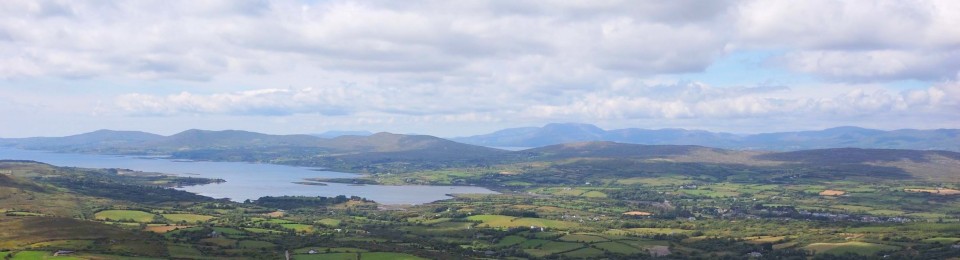

Riggs Falkiner Will
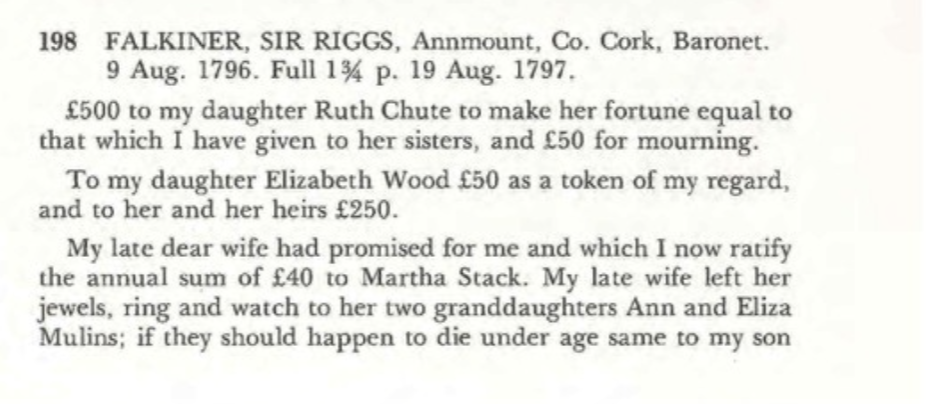
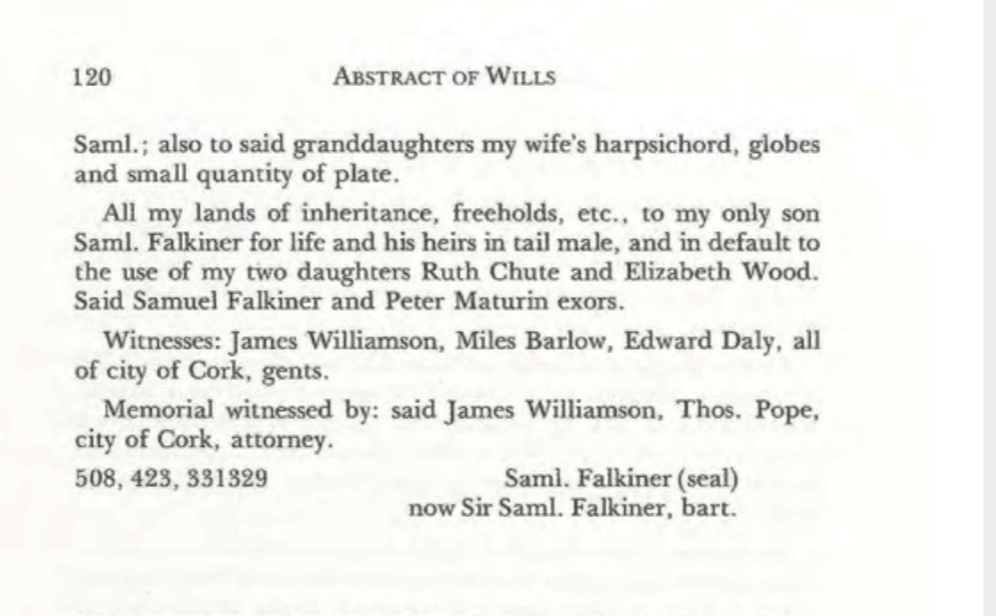
Falkiner and Mills bank
Courtesy: https://niallbrn.wordpress.com/tag/riggs-falkiner/
In about 1760 Riggs Falkiner, merchant of Cork and son of Caleb Falkiner by Ruth, daughter of Edward Riggs, merchant of Cork, established a bank in the city, possibly wishing to follow the example of his uncle, Daniel Falkiner who was a partner in the Dublin banking firm of Burton’s Bank. By 1767 Riggs Falkiner had acquired a new partner in Stephen Mills to become the firm of Falkiner & Mills.[18] On 28th July 1768 the bank of Falkiner and Mills placed an advertisement in the Cork Evening Post saying that a number of banknotes were lost on the road between Cork and Killcreaght. One of the notes was for £50 and dated 15th April 1765 with a serial number of 884 produced by Falkiner and Mills. A reward of five guineas was offered for the return of the banknotes but we don’t know if a successful recovery was made.[19]
The bank of Falkiner and Mills was situated near the Old Custom House in a street called Falkiner’s Lane, now called Opera Lane.[20] The bank was a friend and creditor of the Earl of Shannon and in 1769 Riggs Falkiner became an M.P. for one of Shannon’s borough constituencies, Clonakilty.[21] In 1778 Riggs Falkiner was made a baronet. After Stephen Mills died in 1770, Riggs Falkiner continued the business on his own until 1776 when he went into partnership with John Leslie and Richard Kellett.[22]
Banks established in Cork in the first half of the eighteenth century were partnered by merchants who used their surplus cash from overseas trade to provide bill discounting, remittance services and make short term loans. In 1756 an act of parliament prevented merchants involved in foreign trade to describe themselves as bankers. The firm of Falkiner & Mills kept their merchant associations but also acquired new partners in the landed gentry and. professional sectors of Cork city and county.[23] Among the county gentry, Sir James Cotter, baronet, and Sir Richard Kellet became a partners in the 1780s and 1790s[24] In the 1780s, before his death on 20th January 1786, Doctor Bayly Rogers, doctor of physics, was a partner in the bank which was briefly renamed Falkiner, Rogers, Leslie & Kellet.[25] Bayly Rogers of Floraville came from a strong medical family as he was the eldest son of Joseph Rogers, M.D., of Cork by Margaret, daughter of John Bayly, and in turn Bayly was the father of Joseph Rogers, M.D., of Seaview in Cork.[26]
Falkiner’s bank survived the financial crisis of 1793 when other Cork banks closed their doors. After the death of Riggs Falkiner in 1799 the bank continued under the new name of Cotter & Kellets with some £131,630 banknotes in circulation.[27] Over the next ten years the bank increased its money supply to £447,000 which was £27,000 more than its assets and in June 1809 the bank closed its doors.[28] It would appear that the bank was struggling for a few years as it temporary closed in 1807.[29] The liquidation process continued until 1826 even with an act of parliament in 1820 with creditors only getting about ten shillings in the pound while the lawyers clocked up over £60,000 in fees.[30]
Clonakilty (Cloich na Coillte, meaning ‘stone (castle) of the woods’) was a borough constituency in the Irish House of Commons from 1613 to 1801. As a “pocket borough,” it returned two Members of Parliament (MPs) to the Parliament of Ireland and was largely controlled by the Earls of Cork and later the Earls of Shannon. The constituency was abolished by the Acts of Union. Clonakilty Corporation was a closed, unrepresentative entity that entirely excluded Catholics and became heavily decayed by the early 19th century. Notable figures who represented the constituency included the legal scholar and politician Francis Bernard (from 1692) ancestor of the Earls of Bandon and the Irish MP Thomas Adderley (in the 1790s)
 West Cork History