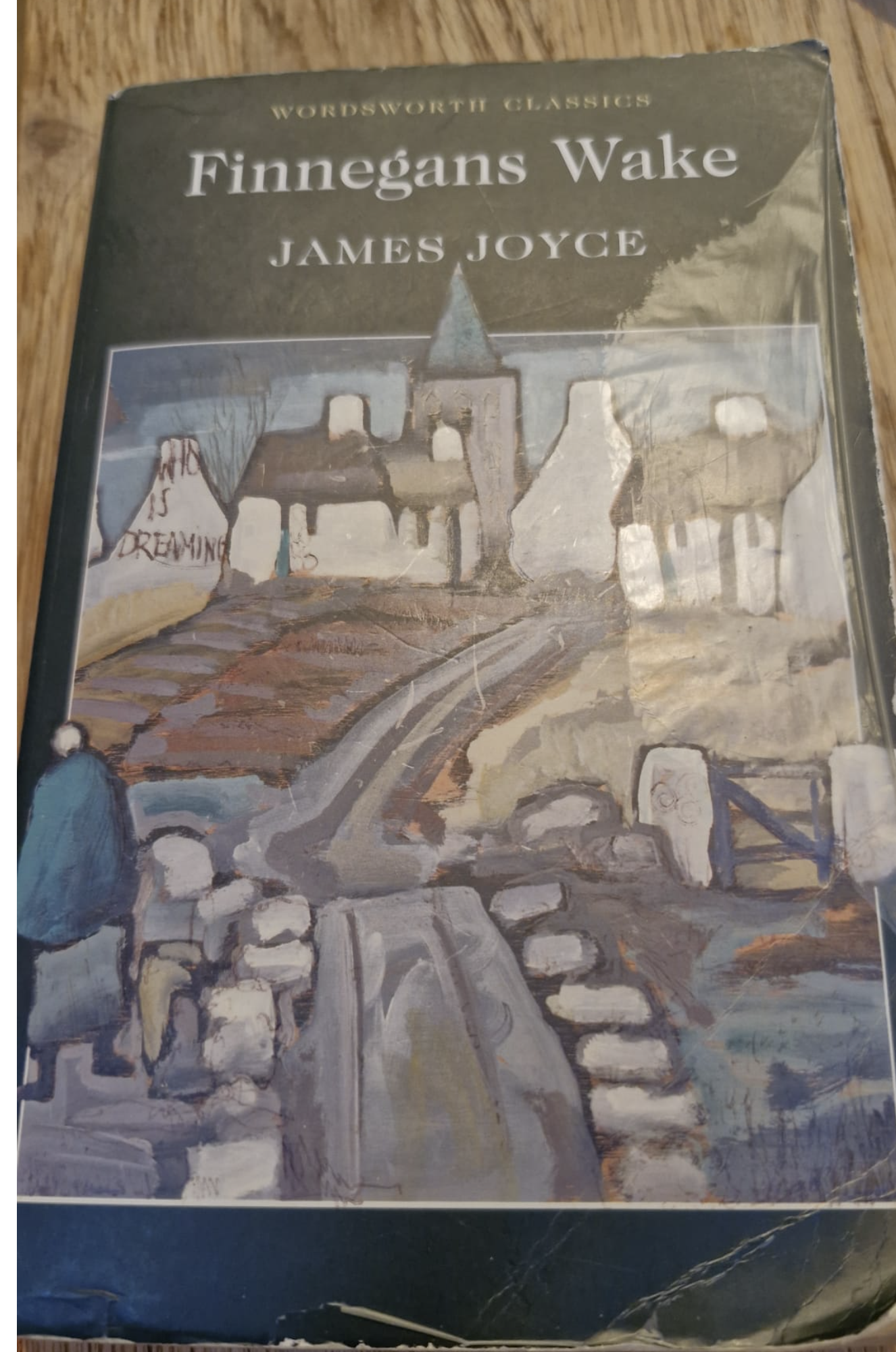
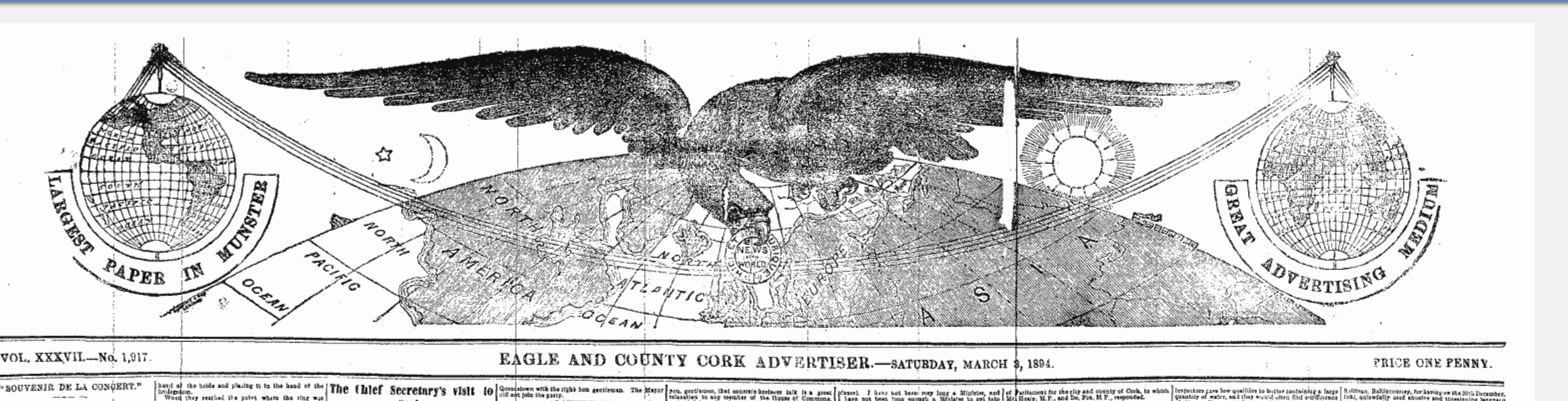
593.5: “Have sea east to Osseania:” HCE to Oceania! On the one hand, Oceania, the eastern sea, being about as distant as possible from Ireland, supports the claim to world-wide coverage. On the other hand, Ireland (the land of Ossian) represents the opposite. Contraries converging, or maybe just plain overweening provincialism: The Skibbereen Eagle once warned the Czar of Russia that it had its eyes on him. Compare Stephen’s sardonic “(European and Asiatic papers please copy” (P 251).
https://johngordonfinnegan.weebly.com/book-iv
Brendan Kilty Joycean scholar and the man who restored the house on Ushers Island, Dublin, the setting for the dea
From the ~Skibbereen Eagle

EXACTLY 125 years ago this year, in September 1898, The Skibbereen Eagle instilled fear into the Russian Tsar, a butterfly effect not replicated until the West Cork fishermen saw off the Russian navy last year.
AD
The eye of The Skibbereen Eagle focused on the Tsar’s success in securing an ice-free warm-water base for the Russian Navy on China’s Yellow Sea.
The Southern Star
Share
00:30
00:00
But only two weeks earlier, in something akin to modern day political sports-washing, Tsar Nicolas II sent an unexpected invitation to every government accredited to his Imperial Court.
The Tsar’s rescript invited these governments to a conference ‘to occupy themselves with the grave problem of excessive armaments.’
In truth it disclosed his military vulnerability dressed up as his pursuit of world peace.
The Tsar told the world that he was keen to ensure to all people ‘the benefits of a real and durable peace, and above all of putting an end to the progressive development of the present armaments.’
With his Chinese warm water naval port now secured, Tsar Nicholas II set out to achieve this worthy ambition ‘by means of international discussion’ at his peace conference.
And it met with great success, for within only a few months the Tsar’s peace conference created the Permanent Court of Arbitration where the arbitration and peaceable resolution of (some) disputes between nations continues down to this day.
The peace conference also developed ‘Rules of War’ for the treatment of prisoners of war. It even banned, for the next five years at least, the discharge of projectiles and deleterious gases from balloons.
Under Bismarck, the plethora of small German states had coalesced as the increasingly powerful German Empire, with the dynamo of its Prussian siege engine massed on its border with Russia.
AD
Acutely conscious that his guns could never match those of his neighbour, Tsar Nicholas II set out to prioritise peace over his inevitable defeat.
Andrew Carnegie, the philanthropist who built 80 libraries across Ireland also funded the construction of the Tsar’s dream home for the Permanent Court of Arbitration at the Peace Palace in The Hague, Netherlands.
The list of signatories to this Peace Convention today reads as an eerie who’s who of hubris and history – powerful people whose memory is neither remembered nor honoured.
It included the Prince of Montenegro and the Prince of Bulgaria and the long-forgotten Kings of Bohemia, Hungary, the Hellenes, Italy, Portugal, Serbia and Siam.
Imperial majesties, such as the Shah of Persia and Her Majesty the Queen of the United Kingdom of Great Britain and Ireland, Empress of India also signed, as did the Emperors of Of course, the ‘Emperor of all the Russias’ also signed up.
In the same month as the Tsar’s call to action in 1898, the son of a Corkman – claiming a connection to Daniel O’Connell – enrolled at Cardinal Newman’s University on St Stephen’s Green in Dublin from where he graduated in 1902. While it seems to scholars that young James Joyce was possessed of a stunning awareness and broad knowledge, much of his texts are derived from or informed by the newspapers of his time.
For the impecunious Joyce, local, national and international newspapers were readily and freely available to read in public libraries.
Today, these same public libraries act as ‘warm banks’ – places to visit to stay warm in the face of impossible domestic energy bills caused by Russia’s invasion of Ukraine.

But Joyce was not the only one reading English language newspapers.
They were being read in Moscow and St Petersburg as well.
We know this from the Tsar’s father, Nicholas I, who boasted during the Crimean War (1853-1856) that he had no need of spies.
He was learning everything he needed to know by reading Dubliner William Howard Russell’s account of the Crimean War published by the Times of London and read by embassies everywhere.
Joyce was nothing if not up-to-date when he weaved the Tsar’s Rescript and notions of world peace and international arbitration into Stephen Dedalus’ conversations with his fellow students at Newman House on St Stephen’s Green where they gathered around the Tsar’s portrait collecting signatures.
They were preparing to send the Tsar a testimonial of gratitude for his pursuit of world peace and the arbitration of disputes among nations. They had every reason to believe that a Tsar name-checked by The Skibbereen Eagle would read the praise of their Testimonial.
Joyce was clearly impacted by the Tsar’s Rescript and The Skibbereen Eagle as he threads the debate about world peace and international arbitration from Stephen Hero, begun in 1903 just after his graduation, to Portrait of the Artist as a Young Man published before World War I and again, after the horrors of that war, to Ulysses, published in 1922.
Clearly, the watchful eye of The Skibbereen Eagle had spawned an imitator in Joyce and a reader in the Tsar.
Perhaps, it is time now for The Skibbereen Eagle to re-send its impactful historic note to the current Tsar.
National and international papers, please copy!

• Brendan Kilty SC is a senior counsel, arbitrator and Joycean.
His human rights book ‘101 Reasons Not to Execute Someone’ is due to be released in 2023.
Dick Adams:
B 1843-1908 Richard (Dick) Adams Journalist, Barrister Inns 1873, Judge County Court Limerick 1892, Down Born Castletownbere, eldest son Brian Port Surveyor, Customs and Excise mother Frances (Fanny) O’Donovan sister of Doctor O’Donovan, Skibbereen. First cousin of Skibbereen O’Donovan family, Doctor Daniel adn his 2 Doctor sons, they are of ‘Isladn’ branch and once owned town of Ross. 1880 Munster Bar, 20 Mountjoy Square, Dublin. Born Castletownbere, eldest son Brian Port Surveyor, Customs and Excise mother Frances (Fanny) O’Donovan sister of Doctor O’Donovan, Skibbereen. First cousin of Skibbereen O’Donovan family, Doctor Daniel Famine Doctor his 2 Doctor sons, they are of ‘Island’ branch and once owned the town of Ross. 1880 Munster Bar, 20 Mountjoy Square, Dublin. “Journalist Cork and Freemans Journal, Defended James Fitzharris in Phoenix Park Murders, noted wit. From James Joyce ‘Ulysses’, ‘Dick Adams (Castletownbere born), the besthearted bloody Corkman the Lord ever put the breath of life in’ Journalist, Barrister, Defender of Parnell, Later County Court Judge Limerick
Ulysses: 7.679-80″ Buried St. Marys, Kensal Rise, London “Courtesy Ruth Cannon: from the Cork Examiner, 6 April 1908, this loving tribute to one of the Irish Bar’s most famous humorists, Limerick County Court Judge Richard Adams (b-l). Adams got much mileage out of his resemblance to King Edward VII (b-r), who he alleged once messaged him in the spa resort of Homburg requesting they dress differently to avoid confusion.
“Those who knew the late Judge Adams well will find it hardest to believe that he is dead. For with his personality, they associate all that was brightest and most vivifying in life.
That said, the future judge does not appear to have greatly distinguished himself in his early days. His first professional calling was that of a bank clerk in the National Bank in Cork. He was entrusted with the duty of opening letters containing bank notes in separate halves, a favourite way of sending money in those days, and then gumming the two halves together. But his lack of acumen for bank business was such that he frequently gummed the wrong halves together – a terrible misadventure in any well-organized bank.
Having regard to this, and a general unsuitability for bank life, Richard Adams decided that he had mistaken his vocation. Accordingly, he subsequently got called to the Bar in Hilary term of 1873. In actions for breach of promise of marriage his services were particularly sought, and it was one of the treats of the Four Courts to hear a speech on that congenial topic from one who was a master of humorous exposition. His admission to the Inner Bar was soon followed by his elevation to the Bench as County Court Judge of Limerick.
While not a profound lawyer, he did not himself at all mind jesting on the subject of his legal knowledge, and would tell how once he came into one of the Dublin Courts after the luncheon interval and heard a well-known solicitor proclaiming from the solicitors’ table to a cluster of minor lights ‘Adams! Oh, he has a fine nisi prius prescendi, but he knows absolutely no law,’ whereupon Adams himself put his genial countenance over the side barrier and said, ‘Look here, that’s slander of me in my business trade and profession, and it is actionable without proof of special damage, so look out for a writ.’ This was of course said with glorious good humour.
Judge Adams loved to go to health resorts on the continent. These sojourns were rendered doubly enjoyable by reason of his resemblance to the present King. ‘When in Homburg,’ he said, ‘the King’s Equerry came up to me and said ‘Mr. Adams, the King commands me to ask you as a personal favour not to be going about in a tall hat and frock coat. It is very embarrassing for his Majesty to be so often whacked on the back, and to be shouted at by gentlemen in Dublin accents, ‘Hello Dick, old man, how are all the boys in Dublin…’’
More stories about Judge Adams here:
 West Cork History