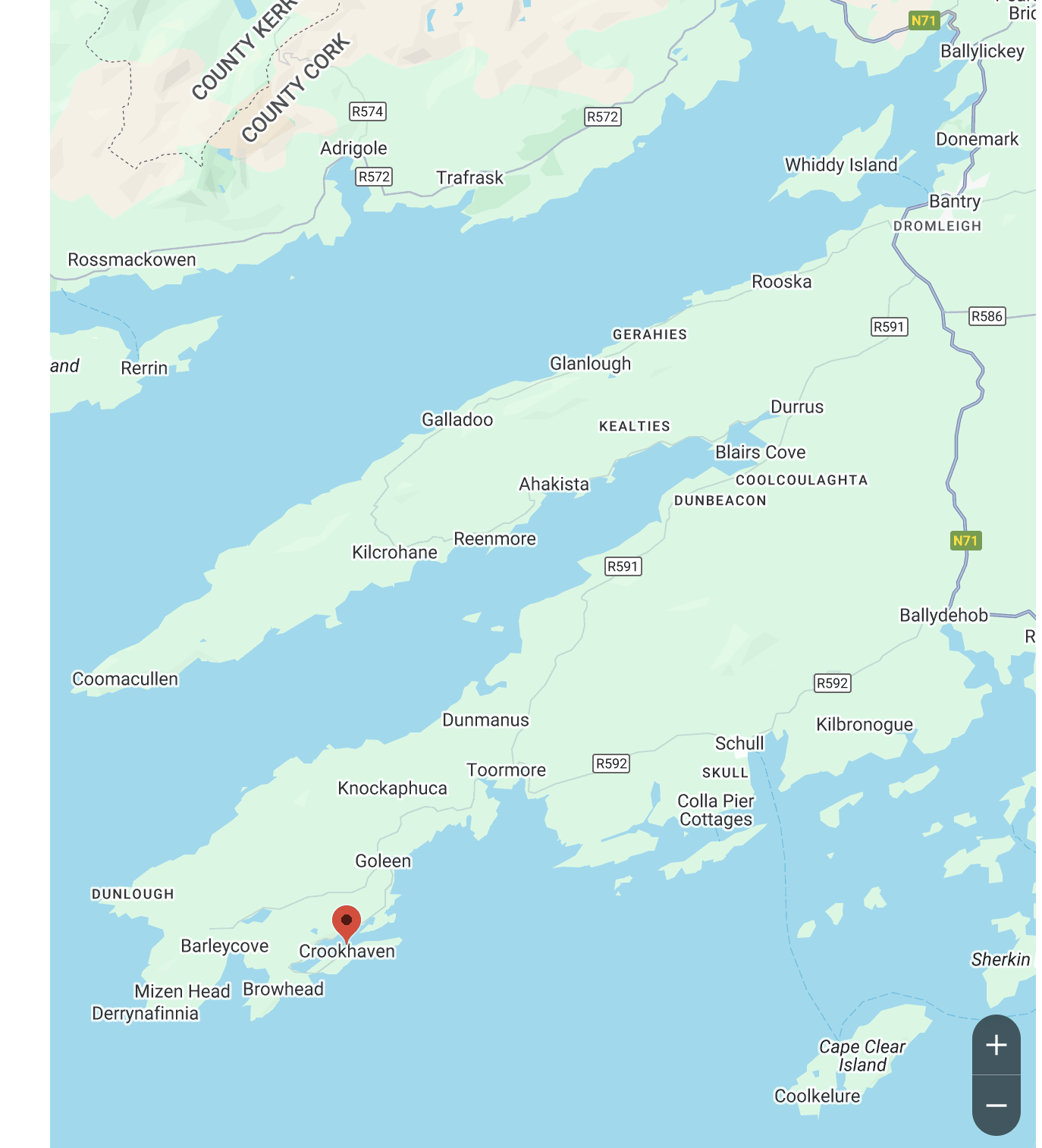
Warrant, by the Duke of Ormond, for the payment, to the Earl of Barrymore, of the sum of twelve pounds sterling, for the building of boats for the Garrison of Crookhaven, &c, Dublin Castle: 9 December 1662
Creator
Edward Edwards (1812-1886)
Level Of Description
Item
Extent And Medium
Copy
Archival History
The Carte Collection (MSS. Carte 1-279) of historical papers was received chiefly by the Bodleian Library, Oxford in 1753-1778. This Calendar (MSS. Carte Calendar 1-75) gives an abstract of every paper in the Carte Collection in chronological order. It was formed by Edward Edwards, a librarian and writer, in 1877-1883 at the expense of the Bodleian Library. In September 2004, the Bodleian Library keyed in 32 of the original 75 volumes of Carte Calendars (Vols. 30-61). This data was shared with, and platformed by, the VRTI in 2024.
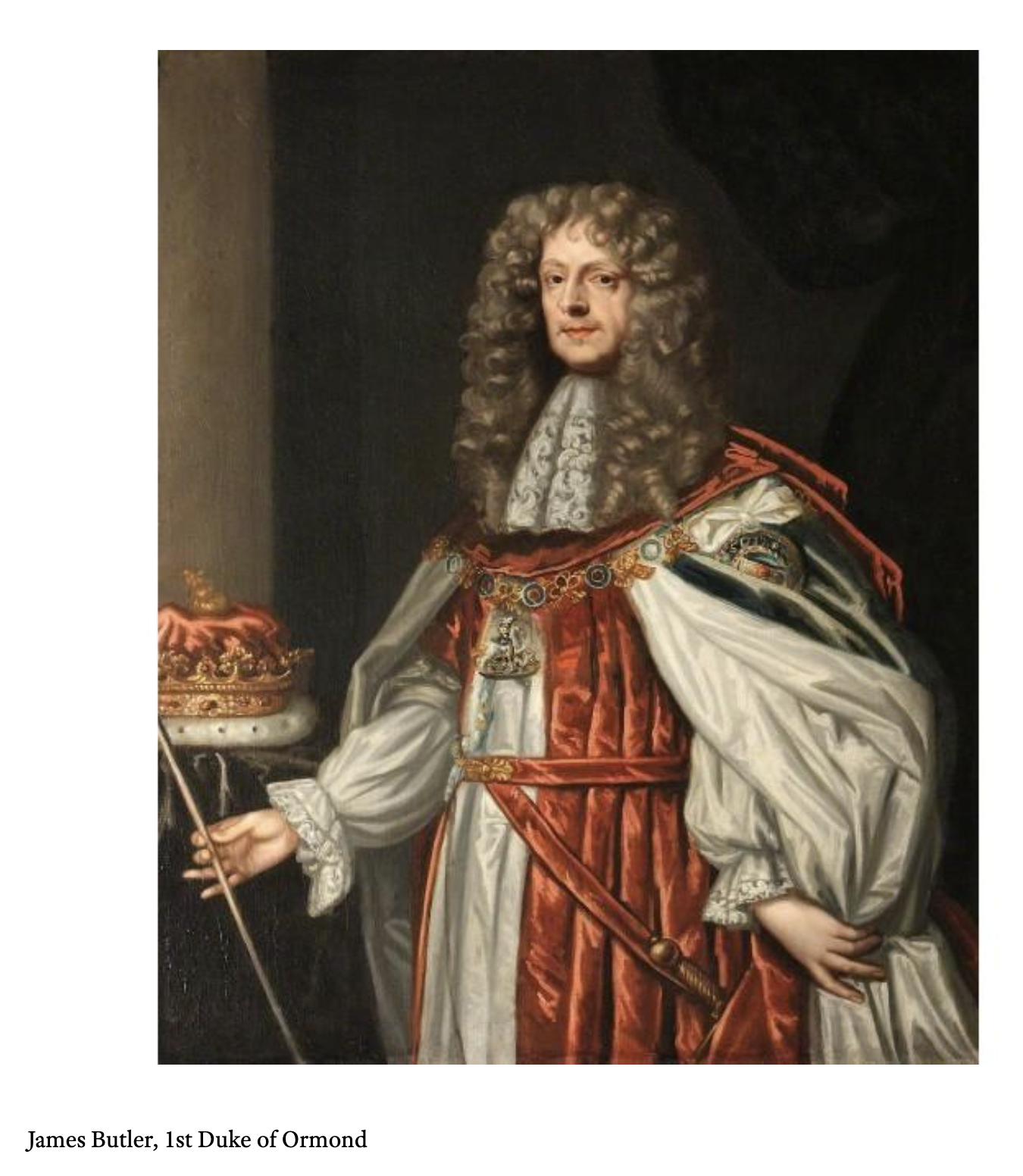
Butler, James (1610–88), 12th earl and 1st duke of Ormond, was born 19 October 1610 at Clerkenwell, Middlesex, England, eldest son of Thomas Butler, Viscount Thurles , and his wife Elizabeth, daughter of Sir John Poyntz, of Iron Acton, Gloucestershire. Thurles was son and heir to Walter Butler (qv), 11th earl, who succeeded to the title in 1614 on the death of his uncle, Thomas (qv), 10th earl, whose one surviving child was a daughter, Elizabeth (qv). The viscount took his family to Ireland, but when returning from a visit to England was shipwrecked and drowned on 15 December 1619, leaving the 9-year-old James as the direct heir to the title. His widow Elizabeth married (a.15 June 1626) George Mathew of Thurles, Co. Tipperary, by whom she had a second family. Youth and marriage The details of James Butler’s youth are mainly derived from Sir Robert Southwell (qv), who presented a brief and laudatory life of the duke to his grandson and successor two months after the first duke’s death. According to Southwell, on his father’s death, Butler’s mother placed him in a school in Finchley to be raised in the Roman catholic faith, to which both parents were committed. However, through the manipulation of the law, James I claimed the young heir as a royal ward and in 1622 put him in the care of George Abbot, archbishop of Canterbury, under whose tutelage he received a protestant upbringing. The religious part of his education made a deep impression on the boy, but in other respects Abbot made little effort to educate his charge, and it was only the intervention of the grandfather that ensured some facility in writing, French, and Irish. His Latin was almost entirely neglected.
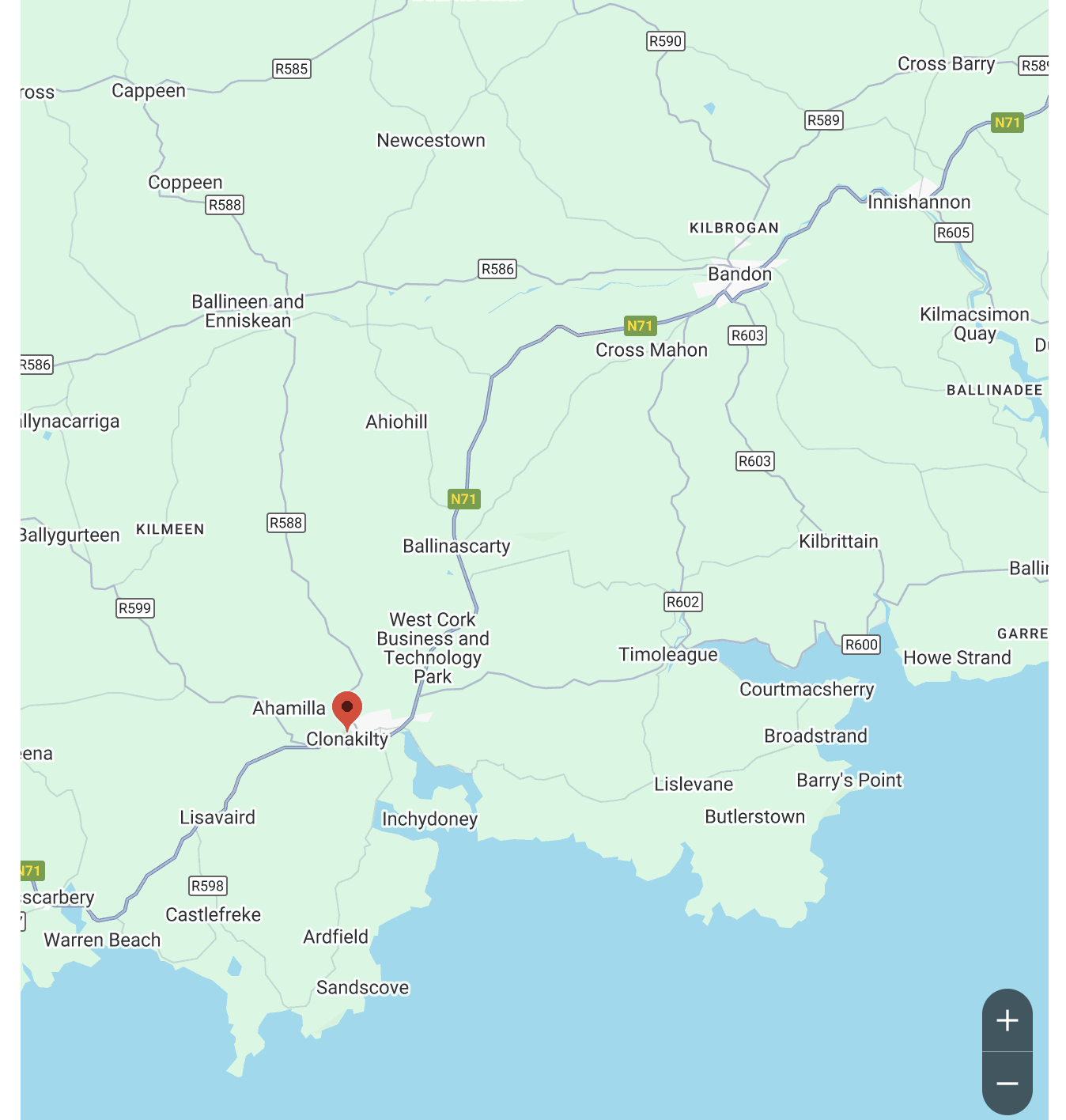
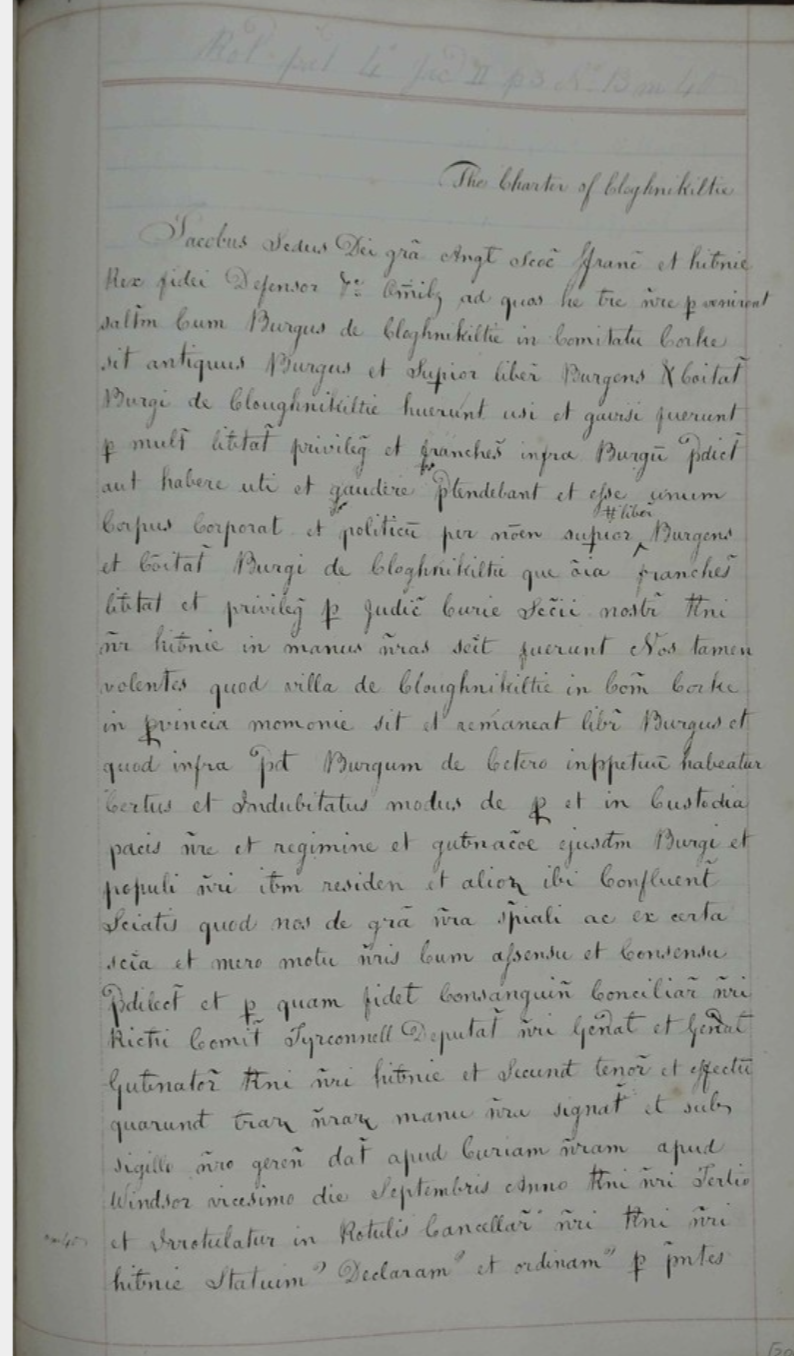
Original charter for the existing town of Clonakilty, County Cork, issued from Hampton Court, to become a borough and appointing Nicholas Barham as first sovereign. The burgesses appointed were Andrew Kettleby, Stephen Coveney, Humphrey Jobson, Edward Bradston, Richard Drew, Nicholas Drew, Thomas Edgecombe (clothier), Abraham Bates, Nicholson, Thomas Harris, Richard Hullet (clothier), Ambrose Hullet (clothier), Richard Ussher (clothier), John Phillips (merchant), John Blake (merchant), Nathaniel Bennet (butcher), Thomas Asden (butcher), Humphrey Fisher (tailor), Theodore Jacob (innkeeper), John Williams (shoemaker), John Harison (mason), John Ward (carpenter), Nicholas Tuxberry (joiner) and Thomas Bartlett (surgeon). Sir Richard Boyle, Lord of the Town, given power to appoint the first three burgesses and administer the oath of Supremacy
Original charter for the existing town of Clonakilty, County Cork, issued from Hampton Court, to become a borough and appointing Nicholas Barham as first sovereign. The burgesses appointed were Andrew Kettleby, Stephen Coveney, Humphrey Jobson, Edward Bradston, Richard Drew, Nicholas Drew, Thomas Edgecombe (clothier), Abraham Bates, Nicholson, Thomas Harris, Richard Hullet (clothier), Ambrose Hullet (clothier), Richard Ussher (clothier), John Phillips (merchant), John Blake (merchant), Nathaniel Bennet (butcher), Thomas Asden (butcher), Humphrey Fisher (tailor), Theodore Jacob (innkeeper), John Williams (shoemaker), John Harison (mason), John Ward (carpenter), Nicholas Tuxberry (joiner) and Thomas Bartlett (surgeon). Sir Richard Boyle, Lord of the Town, given power to appoint the first three burgesses and administer the oath of Supremacy
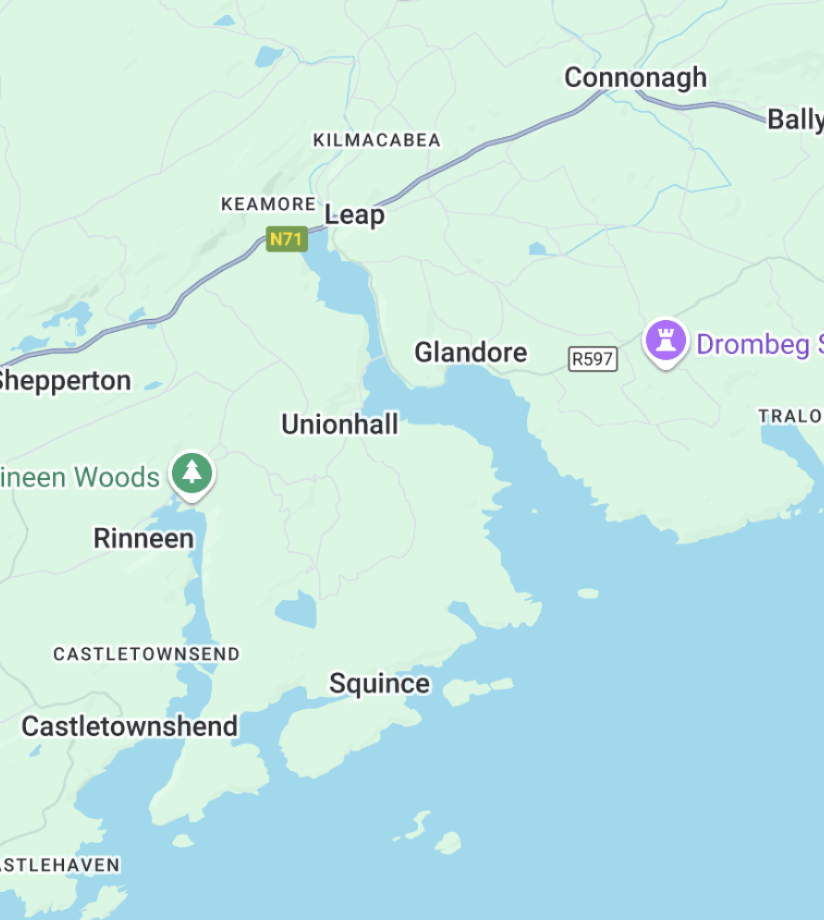
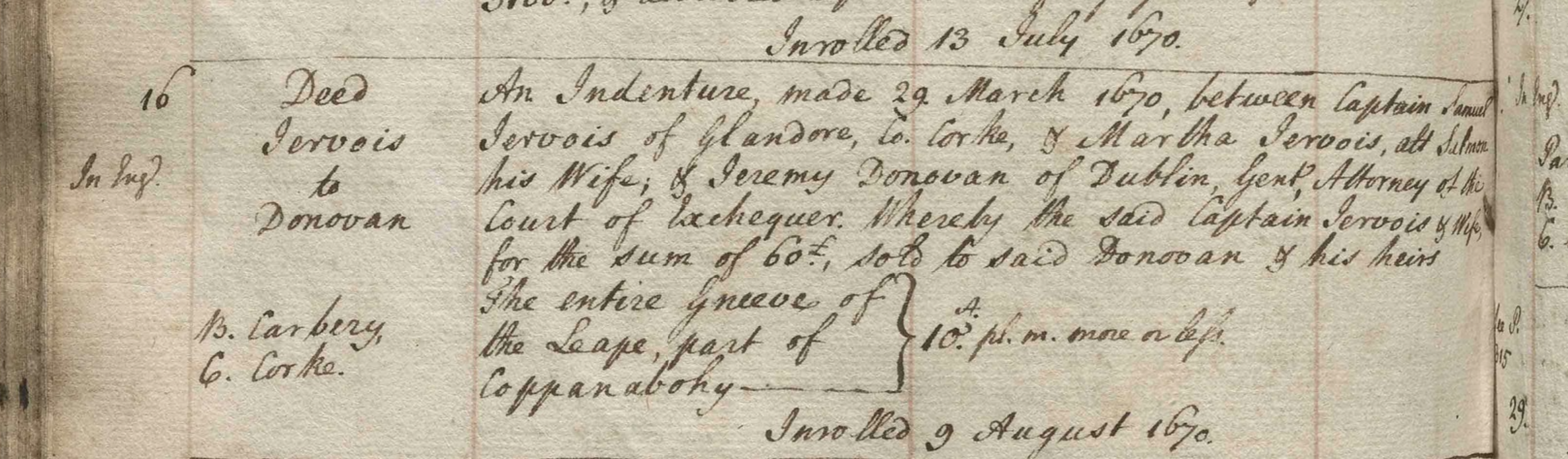
1670 Indenture Captain Samuel Jervois and His Wife sell for £60 the entire Gneeve (Old land measurement a twelfth part of a townland which can vary in size.: https://www.dippam.ac.uk/eppi/documents/11941/page/282490 ) of Leap parrt of Cappanabohy
670 Indenture Captain Samuel Jervois and His Wife sell for £60 the entire Gneeve (Old land measurement a twelfth part of a townland which can vary in size.: https://www.dippam.ac.uk/eppi/documents/11941/page/282490 ) of Leap parrt of Cappanabohy
.
1670 Indenture Captain Samuel Jervois and His Wife sell for £60 the entire Gneeve (Old land measurement a twelfth part of a townland which can vary in size.: https://www.dippam.ac.uk/eppi/documents/11941/page/282490 ) of Leap parrt of Cappanabohy
Samuel Jervois, 1654. Close family connection with Barnstaple Devon. Received land debentures for being a Cromwelian Officer bought other lands. Built Brade House, Leap. Appointed a Commissioner for Transportation 1655 reappointed 1656 to identify those locally suitable for transportation. There are papers extant for the period whereby the church clerk of Castlehaven was to identify local Catholics in particular sons and heirs suitable for transportation. Married Martha Salmon, daughter of Captain Joseph Salmon, Glandore castle. Freeman and Burgess of Clonakilty, Sovereign 1679. Fled to Chester 1688 he reported his income then at £120 per annum. He returned to Brade, 1693, died 1693.
Obtaining letters patent from Charles II, his extensive landholdings were erected into the manor of O’Donovan’s Leap, or the Manor of the Leap, in 1684.
He was also appointed Registrar of the Admiralty in Ireland by James II.
O’Donovan was the son of Daniel Mac Murtogh O’Donovan, Lord of Clan Loughlin. A Protestant, he married in 1686 Elizabeth Tallant, daughter of Oliver Tallant, and they had three children; Jeremiah, John, and Anne.
O’Donovan Lands:
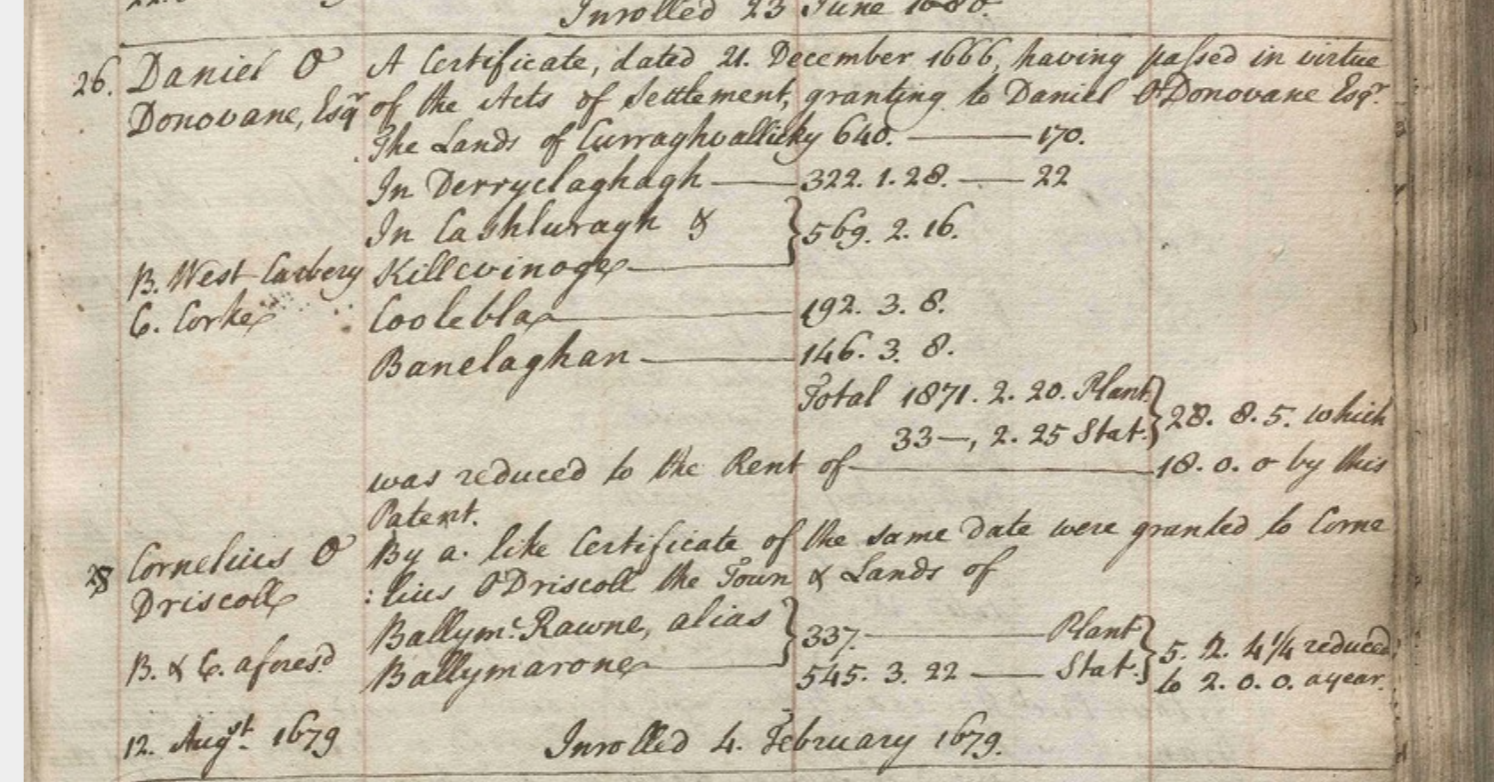
1616. Surrender and Regrant. Patent of James 1 of England.
Court of Pie Powder Reserved to Donnell O’Donovan for Fairs, Ascension Thursday and Townlands Listed from Castledonovan to Castlehaven, Caheragh, Glandore, Squince, Brahalish in Durrus. Manor of Castledonovan Power to Hold Court of Leet and Baron, Friday Market at Rahine, Tuesday market at Drimoleague.
The 1766 religious census return for the Union of Kilmocomoge
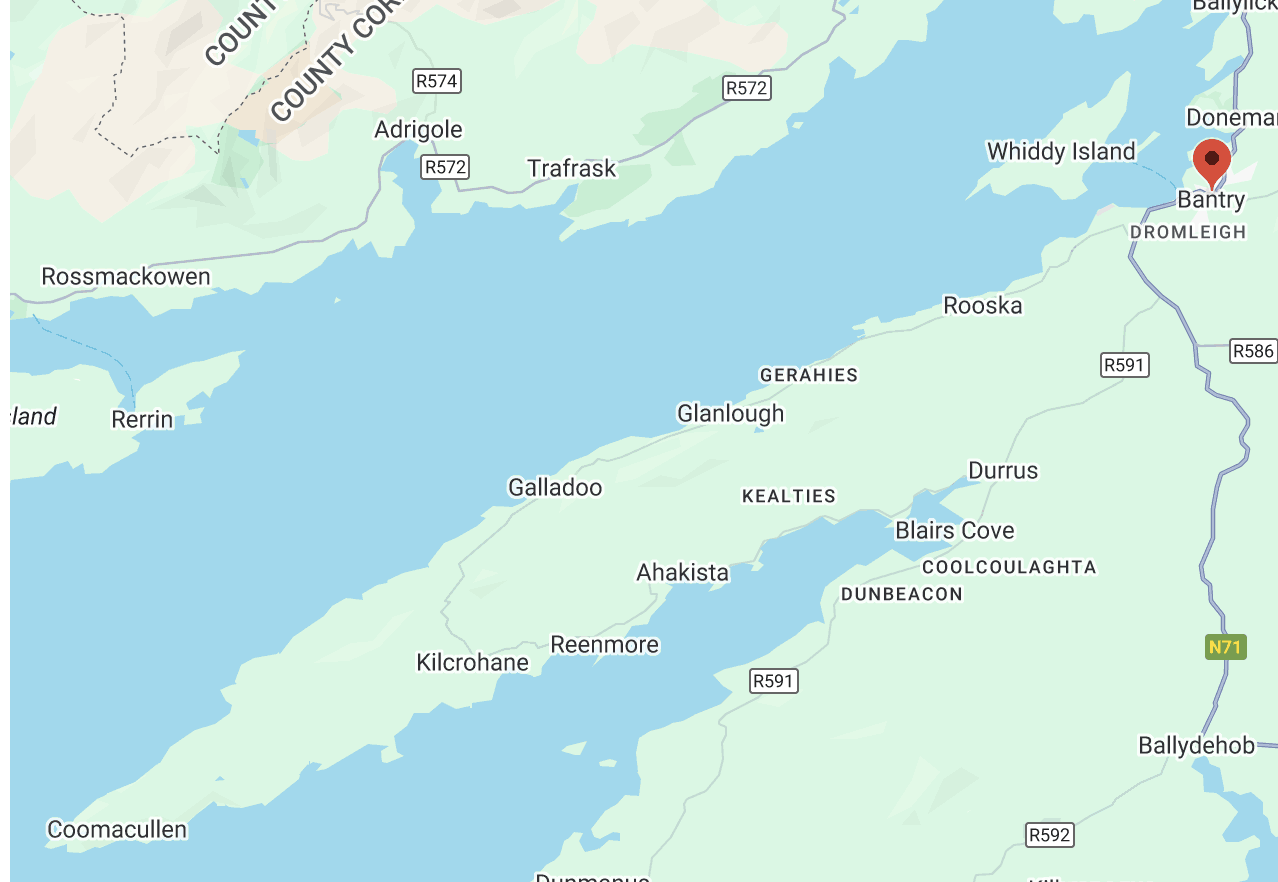
The original return provided a list of householders’ names, as was required by the resolution of the House of Lords (see comment below about list of householders in Bantry), but only household and population numbers have survived.* The parishes in the union were Kilcrohane, Durrus and Kilmocomoge.
The numbers reported by Barry were:
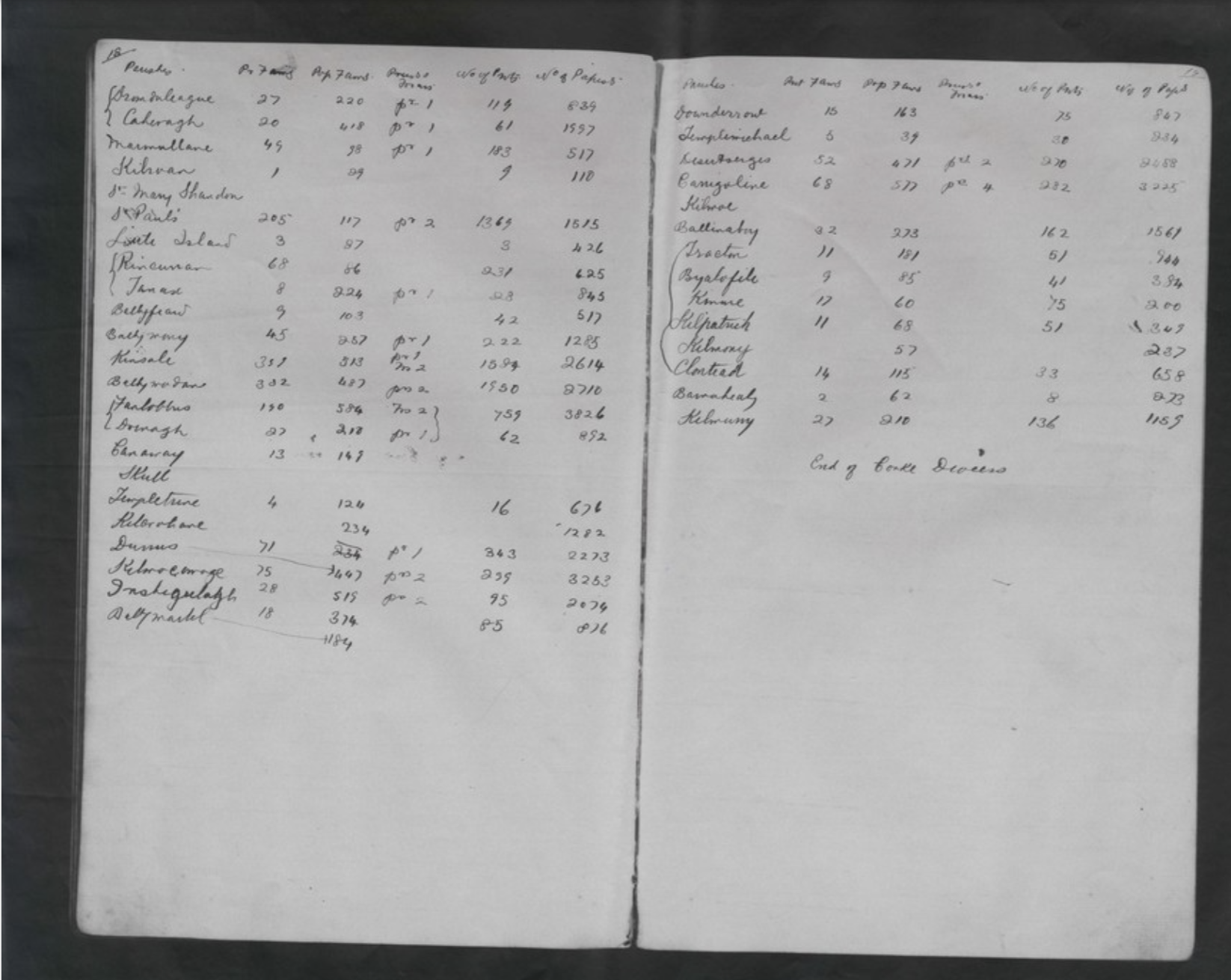
Kilcrohane and Durrus, 71 Protestant households, and 343 Protestant individuals; 681 Catholic households, and 3,555 Catholic individuals.
Kilcrohane, 234 Catholic households, and 1,282 Catholic individuals. Protestant numbers only available with Durrus.
Durrus, 447 Catholic households, and 2,273 Catholic individuals. One resident priest. Protestant numbers only available with Kilcrohane.
Kilmocomoge, 75 Protestant and 519 Catholic households, containing 299 Protestants and 3,253 Catholics. Two priests.
William Carrigan provides the following additional information, which, importantly, confirms that the census provided the names of householders (in bold italics, our emphasis):**
Kilmocomoge: ‘Standish Barry, priest; Denis Doly, coadjutor: and in the list of the householders in “Bantry town & suburbs” we find the name of “Standish Barry, Popish priest for this parish”’.
Durrus: ‘Timothy Crowly, living in Upper Coomkeen is “Popish priest for the parish of Durrus”’.
Kilcrohane: ‘No priest given’.
Census abstracts for the dioceses of Cork and Ross can be found in NAI PRIV/M/4921, pp 16-22. For clerical succession lists for Cork and Ross see W. Maziere Brady, Clerical and parochial records of Cork, Cloyne and Ross (3 vols, Dublin, 1863-4).
* Parliamentary Records Index, vol. ix, p. 1,952 (National Archives of Ireland RC 14/9); Brady, Cork, Cloyne and Ross, i, p. 95.



 West Cork History