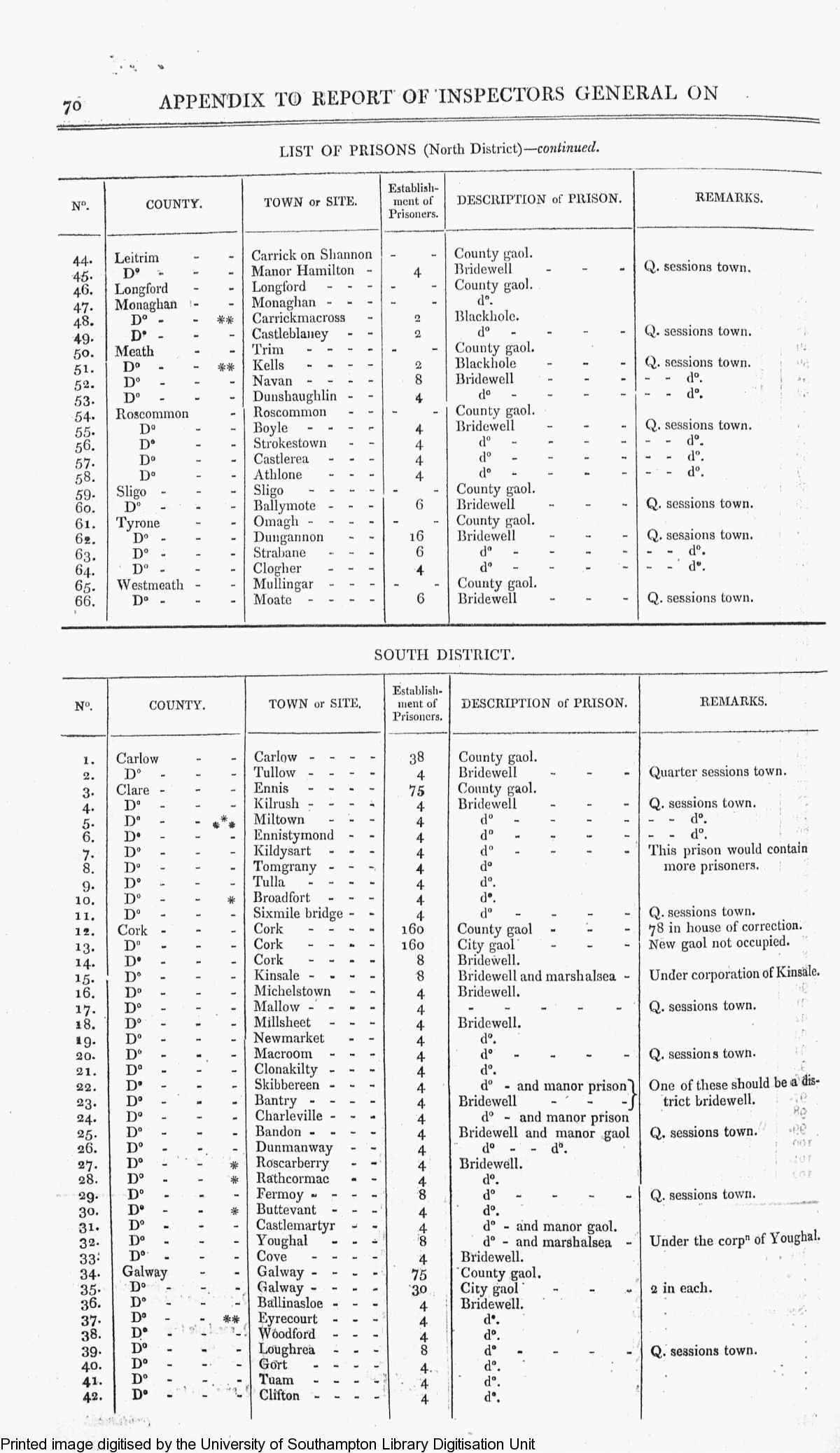
Prisons in Co. Cork 1827, brief description from 1st Report on Prisons
http://www.dippam.ac.uk/eppi/documents/9645/page/212696
02 Wednesday Jul 2014
Posted in Uncategorized
Prisons in Co. Cork 1827, brief description from 1st Report on Prisons
http://www.dippam.ac.uk/eppi/documents/9645/page/212696
02 Wednesday Jul 2014
Posted in Uncategorized
Poor Law Inspectors, Co. Cork, 1847. A number had a retired Military of Medical background.
http://www.dippam.ac.uk/eppi/documents/12348/page/304460 (University of Southampton Digitalisation Project of Irish parliamentary papers)

01 Tuesday Jul 2014
Posted in Uncategorized
Charles Haughey and Roger Hayes a reforming duo at the Department of Justice 1959-1964, the Succession Act influence of the Brehon Laws outrage to the threat to the integrity of the family farm and the threat to ‘Women of certain age’
http://en.wikipedia.org/wiki/Charles_Haughey#Minister_for_Justice
The public sins of Charlie Haughey are well known and ventilated. A lesser episode in the career of this complex character is his tenure at the Department of Justice. Firstly as 2 years as Parliamentary Secretary to Oscar Traynor and as full Minister for around two years from October 1961. There is a road in north Dublin called after Traynor.
Traynor was an elderly cadre veteran like many in FF/FG of the War of Independence and Civil War. Like many of his confreres he ruled a rigid unyielding Department over one of the microstates of Ireland post partition. The Department in the 1950s was involved in holding the line in the IRA 1950s campaign a tame affair compared to what came later.
Haughey as well as having a business degree and being a qualified accountant was a qualified barrister but did not practice. He arrived into the Department and soon made his mark. A later Secretary Peter Berry said that he just got better and better the longer he stayed.
He formed an alliance with Roger Hayes the then Assistant Secretary and encouraged him on the route to Legal Reform. He would later drft many pieces of reforming legislation. He also drafted to civil Liability Act drawing on the work of Glanville Williams which was acknowledged. Hayes was later to become Chairman of the Law Reform Commission.
To get a picture of the legal landscape of 1950s Ireland an article by the Listowel Solicitor Robert Pearse paints a less than flattering picture. He studied law in UCD there were probably no full time Law Lecturers, lectures were at 9 or 5 to suit the practising barristers. His Professor of Criminal Law was Paddy McGilligan earlier Minister for Finance who sponsored the Shannon Scheme.
The Constitution lay dormant Dicey with his book on the ‘unwritten’ English Constitution held sway before John Kelly’s seminal book and Brian Walsh’s Judicial Activism in the 1960s.
There were no Irish Law textbooks and Pease recalls using the then standard English tome on the subject. The chapters of sexual crime were coming up and McGilligan told them to skip those as they never came up in the exams. Some time later in private practice he realised that he and others like him had no knowledge as qualified lawyers of sexual crime.
Before the advent of Wylie on Irish Land Law the only text books were those like Popham in the pre 1926 editions when the Land Law Reforms of England took place. I recall getting a copy of this book in Wildys in London the Law Bookshop.
Haughey was interested in reforming the law on Succession and tried to incorporate aspects of the Brehon Law into the first Succession Bill. As well as making compulsory provision for the spouse which endured there was a provision to provide a third for the children. This and the legal spouse right caused outrage as it was felt it interfered with the right of testator to dispose and could endanger the integrity of family farms. Eventually Haughey left for the Department of Finance and Brian Lenihan steered the diluted Bill through.
On the issue of spouse being gender neutral there were ominous warnings from FG Deputies that it endangering ‘women of a certain age’. It is noteworthy it is the gender neutral phrase of ‘spouse’ that was used.
01 Tuesday Jul 2014
Posted in Uncategorized
Outer reach of Norman Conquest in West Cork, Caheragh in ownership pre 1317 of John de Cogan, cluster of Norman surnames in area Burke, Barrett, Goggin, devolution of Townlands to Monasteries of Youghal and Waterford.
From Maziere Brady’s history of Cork Dioceses online Cork and Present:
Maziere Brady de Cogan Rotated Caheragh Scanned MEE Image
Maziere Brady:
http://www.corkpastandpresent.ie/history/batch2/brady_vol1_cropped.pdf
The Cathedral of St. Finbarrs, in Cork, succeeded in title to some of the old Norman lands including the townland of Letterlickey nearby as well as lands in Schull. Kilcrohane and the Bantry area.
28 Saturday Jun 2014
Posted in Uncategorized
The letting may be apocryphal. Before the opening of the Four Courts, Dublin, in 1796 many of the Superior Courts were located on the first floor of buildings in a quarter of Dublin known as Hell. This was across the River from the present Four Courts in the precincts of Christchurch and had an unsavoury reputation for taverns, brothels and gaming dens. At one stage students of Trinity College risked expulsion if found in the area.
The completed 4 courts with its symbolic Round Hall and Dome was the inspiration for Melbourne Superior Court instigated by Chief Justice Stawell who had practised at the Irish bar and was from Mallow,
http://en.wikipedia.org/wiki/Supreme_Court_of_Victoria
http://en.wikipedia.org/wiki/Four_Courts
http://adb.anu.edu.au/biography/stawell-sir-william-foster-4635
26 Thursday Jun 2014
Posted in Uncategorized
A touch of Spike Milligan’s ‘Puckoon”. life as a young RIC recruit (one of 80,000), collecting the Tillage Census in 1910 rounding up the chickens and avoid half acres, keeping an eye on ‘Returned Yanks’, searching for Poteen on Innismurray island, over policing in Cooloney, Co. Sligo from the Memoir of Jeremiah Mee.
Interestingly he describes the career prospects as superior to that of a National Teacher or Bank Clerk. It was attractive to those liking the outdoor life. The pay in 1910 started at £39 per annum to £70.4s 0. for twenty years service. Clothing and footwear were provided and married men (allowed to marry after 7 years service) got a lodging allowance.
He describes the overpoliceing in Cooloney Co. Sligo 1913, District Inspector with Clerk, Head Constable, two Sergeants, ten Constables. He says the work could be done by two. The regulations were stultifying but in country areas a fantasy world existed of adhering to them. There was at the time little or no crime in country areas.
Mee was one of over 80,000 Irishmen, 90% Catholic who served in the RIC from the early 19th century to 1921. After the Treaty all 80,00 personnel files containing family details, health, wife’s details and posting were removed to Ealing in West London and shredded in 1938, only 4 surviving according to Jim Herlihy RIC historian.
Mee’s memoir has been a big hit among retired Gardaí where they have been able to get a copy.
25 Wednesday Jun 2014
25 Wednesday Jun 2014
Posted in Uncategorized
Progress of Island and Coast Society Proselytising Education activities in West Cork, 1853, Bere Island, Capaneel, (Muintervarra; Doonore, Roskeera, Rooska, Geahies), Dunmanus Bay then Irish speaking, Here Island, Sherkin Island, Cape Clear, Kilcoe.
The Society had its roots in the Religious Controversies within the Church of Ireland in the 1820s and 30s and a reaction against Catholic Emancipation.
Among the figure involved in those times was the Rev. Caesar Otway, a somewhat exotic character combing the role of vigorous Orangeman as well as Antiquarian, Celtic Scholar and editor of the Dublin Penny Journal. He was a patron of William Carleton. He travelled in the 1830s from Schull to Durrus and remarked at the industry of local farmer carrying creels of seaweed up the hill in Dunbeacon before the present Mine Road was built.
https://durrushistory.wordpress.com/2011/10/11/caesar-otway-journey-mount-gabriel-1822/
https://durrushistory.wordpress.com/2012/02/19/caesar-otway-skull-to-bantry-1822/
The Societies activities in Cork involved the Rev. Nagle and probably the Rev. Crosthwaite in Durrus. The Rev. Crosthwaithe was a vigorous Protestant associated with like minded clergy.More generally the Rev. Sullivan brothers were involved.
25 Wednesday Jun 2014
Posted in Uncategorized
Ireland and the Centenary of American Methodism 1866
Ireland and the Centenary of American Methodism 1866.
24 Tuesday Jun 2014
Posted in Uncategorized
Wood Pavement and Construction and Company Limited of Skibbereen, at the Cork International Exhibition 1902-3.
The firm exhibited their patent wood flooring throughout the Exhibition Buildings. They also deployed their ‘granolithic’ concrete used on the steps off the Industrial Hall. This material had been invented by Mr. Wood and was made from ‘a superior hard whinstone’ like whin or basalt.
it is not known how the firm fared afterwards.
 West Cork History