Historical Notes 1185-1950 on Durrus/Carrigbui/Four Mile Water District West Cork
11 Saturday Jan 2014
Posted in Uncategorized
11 Saturday Jan 2014
Posted in Uncategorized
11 Saturday Jan 2014
Posted in Uncategorized
09 Thursday Jan 2014
Posted in Uncategorized
His grave is on the Skibbereen Heritage site:
http://www.graveyards.skibbheritage.com/Gravestone.aspx?GravestoneID=655
He died in Ballydehob, in early years he was lucky to escape to America where he rose to be a Judge of the Marine Court of New York. He died immensely wealthy. He was a Pallbearer at the funeral of Addis Emmett another Cork born New York lawyer and brother of Robert Emmett
On the tomb is buried his sister married to Nathaniel Evanson of Friendly Cove, Durrus, (House still overlooking Dunmnnus Bay), she died in childbirth.
His grave is one of the very few prior to c 1895 with an inscription in Irish:
‘Do ghradhaigh sé na Gaedhil agus an Ghaeilge’ (He loved the Gael and the Irish Language)
Swantons, Ballydehob:

William Swanton & Mary Radcliffe
barrybradfield added this on 22 Nov 2013
This marriage goes back a generation and took place in 1717.Source: Dublin Castle Report. http://www.ginnisw.com/SWANTON%20FAMILY%20HISTORY%20WORLDWIDE/Dublin%20Castle’s%20Report/Thumb/DCR%20A2.htm This William is almost certainly a son of John Swanton of Lettertinlish (near Skibbereen) who died in 1717. You often notice marriages taking place shortly after a death and the resulting inheritance. This William appears to have lived in nearby Aghills and he died in 1750. He is the strongest contender for the ancestor of the next generation which includes amongst others Samuel who had a child baptised in Kinsale in the 1740’s and Ellen who was married to James Hawes by 1750 when John Wesley visited Bandon. Ellen/Ellinor would have been born say 1730 and died in 1806. She was the aunt of Judge Robert.
09 Thursday Jan 2014
Posted in Uncategorized
I was chatting to a fiend recently and she bewailed the loss of the buailteach/seamhú, the little dot over several letters in Irish to denote a ‘h’. With the introduction of the Roman script this is replaced by ‘h’ She says it has the effect of deadening a page while reading giving a stress not intended in the oral language.
Apparently there are now excellent software packages for about €50 giving a variety of fonts in the old Gaelic script easily usable on I Pads, smartphones, etc.
You forget the pure beauty of the old script. I enclose the notebook of William Smith O’Brien transcribed by him about 1860 and the calligraphy is superb. It could easily be replicated hi-tech and would be distinctive and visually beautiful.
http://en.wikipedia.org/wiki/Irish_orthography
Gaelic Type:
http://en.wikipedia.org/wiki/Gaelic_type
Mortgage Deed in Irish 1608, William Smith O’Brien, West Cork list of phrases:
https://plus.google.com/photos/100968344231272482288/albums/5960693160376226161
09 Thursday Jan 2014
Posted in Uncategorized
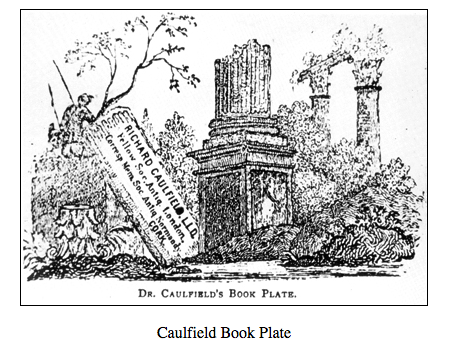
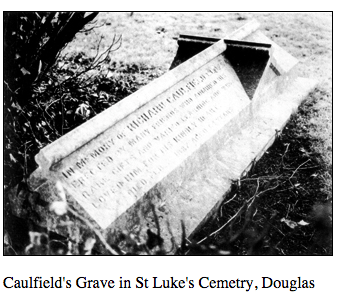
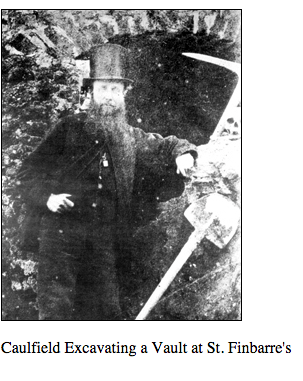
People worldwide with Cork connections owe an eternal debt of gratitude to Richard Caulfield. His career is dealt with here:
http://en.wikipedia.org/wiki/Richard_Caulfield
Many of the Church of Ireland records from the Cork Churches were transcribed by him and the originals went up in a few seconds with the detonation of explosives placed by the Anti-Treaty IRA in the Public Records Office of the 4 Courts Complex in 1922. At the time the Public Records Office was regarded as among the best in the world.
The RCB Library in Orwell Road, Dublin have some of his original transcripts, the industry involved is apparent from his comments.
‘Reverend L.O.Madden lent me the Registers on the 30th June 1877, Saturday 1.30 commenced 8.30 (coden sie)’
In the middle of the transcription between different sections from Births to say Deaths he has inserted in his own hand.
” The entry of burials between the 19th April 1748 and the 11th February 1764 have been cut out of this Register. I am sorry to have to record here the Register of Christ Church Cork are a lasting disgrace to the clergy of the last century who had custody of them.
They are wantonly mutilated in several places the leaves loose, having been torn out, and the entries made (at least to 1784) by some of the most disorganized incompetent person, as would appear by by the spelling of the most common names.
Richard Caulfield LDOFSA, Cork August 1877.
His comments were echoed in the 1820s by probably the greatest Irish scholar of all time Dr. John O’Donovan in his travels around the Northern Counties in connection with the writing of the Ordnance Survey Letters. An absolute treasure trove of each townland, customs, personalities, traditions, and historical associations. He found the state of record preservation deplorable. Unfortunately his work in that area was stopped.
Maziere Brady in the 1850 compiling th History of the Dioceses of Cork Cloyne and Ross says the same.
Christ Church records transcribed 1940s:
https://plus.google.com/photos/100968344231272482288/albums/5936179282398243713
Memorial St. Finbarrs Cathedral:
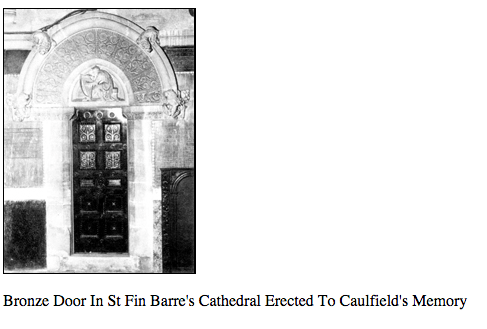
The memorial took the form of a bronze door inlaid with silver erected at the south side of the ambulatory at a spot which would have made it the entrance to the organ had this not been moved to the north. It is now the doorway to the tower stairs. Over it is a tympanum with a carving of David playing the harp and for this reason it is known as the David Door. In marble on the wall beside it is an inscription recording its dedication to the memory of Caulfield. An inscription on the door bears the date 1889. Rev. Canon A.C. Robinson in his Handbook of the Cathedral published in 1898 points to the existence of a colourful tableau representative of Caulfield’s friends and work captured by the positioning of the tombstone of the Rev. Rowland Davies in the floor on the first storey of the central tower reached through Caulfield’s door, while past the door and set in the ambulatory wall is a tablet of white marble commemorating Bishop Isaac Mann. Caulfield was instrumental in having the remains of Bishops Peter Browne and Isaac Mann brought from the chapel of Bishopstown House to the Cathedral in 1865. (39) Beyond the tablet lies the south transept with marble-lined walls dedicated to the memory of Dean S.O. Madden.
03 Friday Jan 2014
Posted in Uncategorized
Jim Herlihy was a neighbor of mine in Cork, he recently retired from the Garda Siochána. He is well known as the historian of the RIC and has done extraordinary work in this regard. This is a lecture he gave in September 2013, it is over an hour but fascination. He has have listed all of the RIC men who volunteered for service in WW1 for publication later this year to coincide with the WWI Commemorations.
Among the nuggets:
Over 85,000 men passed through the force
You had to be 5’9” and 19 to join, but if your father was in the force this was reduced by an inch and a year.
You were not allowed marry until you had 7 years service you could give notice after 5 years. In the early years many were dismissed for breaching this rule. There was a tradition of marriage within the force i.e. constables marrying the daughters of other men.
The overwhelming majority of the men were catholic with some in the Officer Corps
It was regarded as the best police force in the world and was the model for Colonial Police Forces. Many from these forces trained in the Depot in the Phoenix Park and attended the 4 Courts in their exotic colonial uniforms.
One of the Forces modeled on them is the Newfoundland Police. Their buttons are in Irish and the Police band is known as ‘Siochána’.
On disbandment in 1922 a man with 12 years service was given an extra 10 years of added service to retire.
The Dublin Metropolitan Police was unarmed and subsumed into the Garda in 1925.
of the 85,000 personnel files only 4 have survived. The files dating from 1815 would contain a birth cert (official registration generally only started in 1865), a sketch of the recruit, his background, letters of recommendation, medical history, his wife’s details and his postings. Post Treaty in 1922 the flies were removed to Ealing outside London and were shredded in 1938.
https://plus.google.com/u/0/102762529302366057895/posts/TBKmh8R1REc?cfem=1
Included below also are some details of West Corkmen who served in various Police Forces, this is a work in progress and any amendments and additions are welcome at pat25a@gmail.com
02 Thursday Jan 2014
Posted in Uncategorized
Courtesy Peter Mayberry’s site
Bandon:
http://members.pcug.org.au/~ppmay/cgi-bin/irish/irish.cgi
Bantry:
http://members.pcug.org.au/~ppmay/cgi-bin/irish/irish.cgi
Kinsale:
http://members.pcug.org.au/~ppmay/cgi-bin/irish/irish.cgi
Skibbereen:
http://members.pcug.org.au/~ppmay/cgi-bin/irish/irish.cgi
Cork Generally can be trial venue, birth or reference:
 West Cork History