1495 Diarmuid Ó Donnagáin Canon, Corab and Ernach at Church in Ross. Ernach dispensed some Brehon Legal matters Papal application for recognition of reight to land at Kilnamangh, Beara, in 1512 Ballydonegan recognised as O’Donegan territory. Papal Records


1495 Diarmuid Ó Donnagáin Canon, Corab and Ernach at Church in Ross. Ernach dispensed some Brehon Legal matters Papal application for recognition of reight to land at Kilnamangh, Beara, in 1512 Ballydonegan recognised as O’Donegan territory. Papal Records

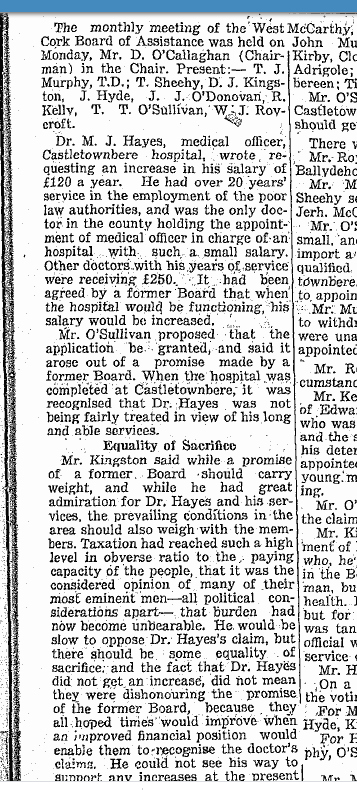
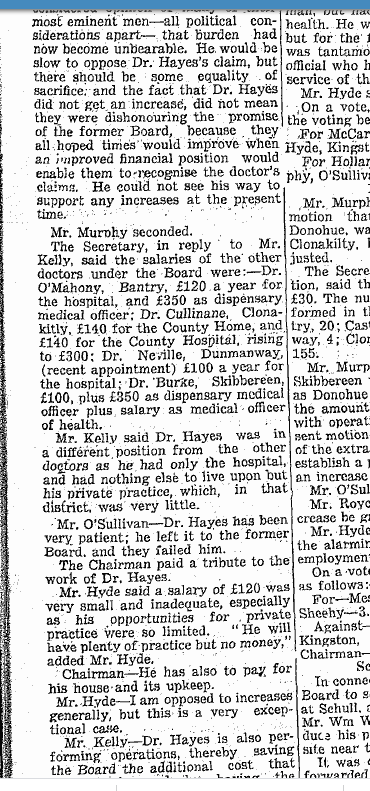
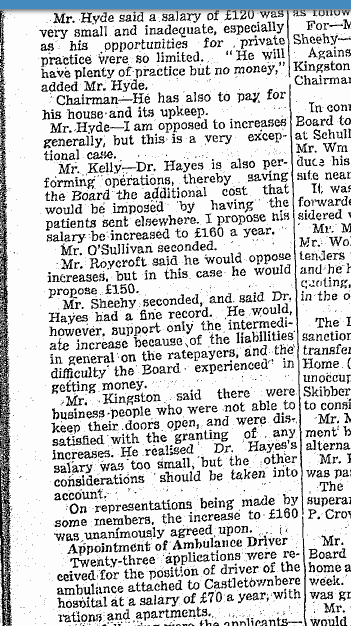
1934 Doctors Pay West Cork, other West Cork Doctors


By way of background it might be remembered tht the Economic War with Britain was raging at the time and the was widespread distress.

https://wordpress.com/block-editor/post/durrushistory.com/37255

https://wordpress.com/block-editor/post/durrushistory.com/37093

https://wordpress.com/block-editor/post/durrushistory.com/37047

https://wordpress.com/block-editor/post/durrushistory.com/34988

https://wordpress.com/block-editor/post/durrushistory.com/28636

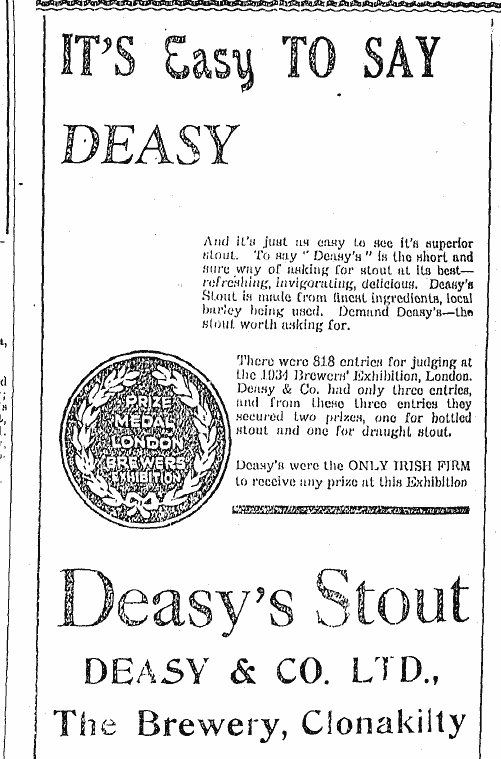
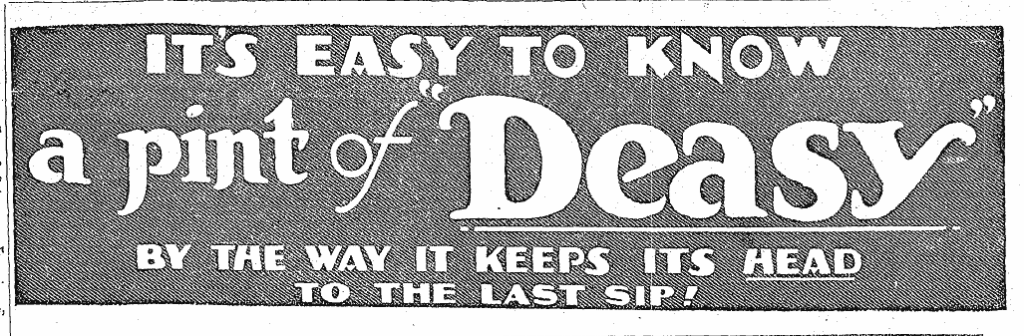
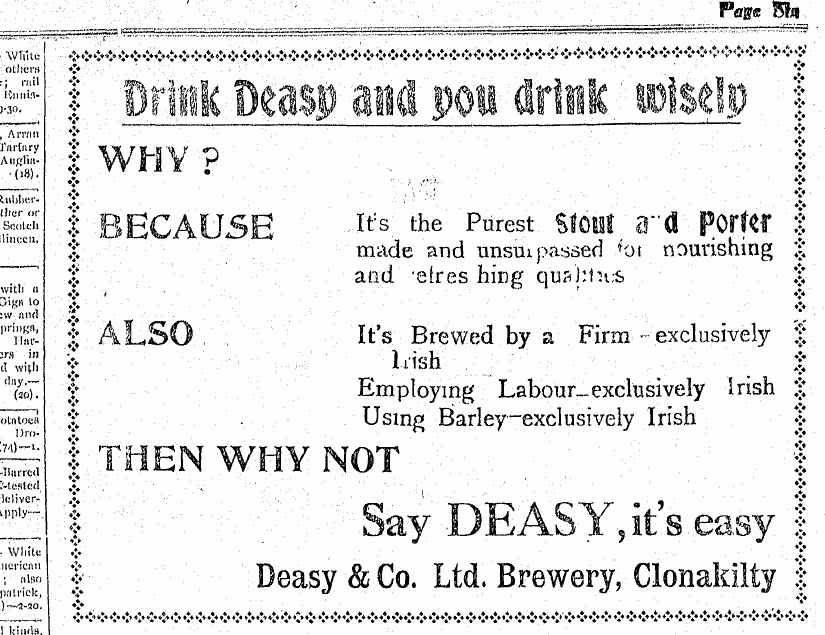
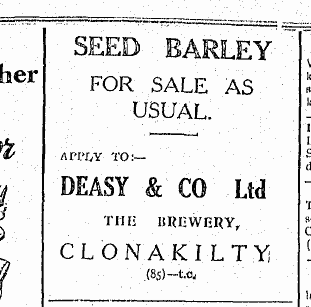
1934 Deasys Stout, Clonakilty, Out of 818 Entries at the Brewers Exhibition London in Deasys secured 2 Prizes.


1934 Deasys Stout, Clonakilty, Out of 818 Entries at the Brewers Exhibition London in Deasys secured 2 Prizes.

Allman Dowden, Special Stout Brewed from Home-Made, Malt and Hops, Bandon, Famous Stout, Throughout West Cork

https://wordpress.com/block-editor/post/durrushistory.com/37855

1835 Called to Bar and Sworn before Lord Chancellor Richard Deasy, Clonakilty (Brewing Family) Later Attorney General for Ireland, Luke Shea, Gort Gurrane, Kinsale Gentlemen Whose Names to Whom Asterisk is Attached are Roman Catholics.

https://wordpress.com/block-editor/post/durrushistory.com/22016

https://wordpress.com/block-editor/post/durrushistory.com/17174

Lease of 1795 from Bantry Estate to Maurice Spillane of 87 acres at £15 per annum with a covenant ‘To buy all his malt and beer at brewery to be approved by lessor under penalty of 10s per barrel of malt and 5s per barrel of beer’

https://wordpress.com/block-editor/post/durrushistory.com/10626

Eugene O’Keeffe 1827-1913 (Baptised Bandon 1827 Owen Keeffe), Canadian Banker, Brewer and Beamish and Crawford Brewery Cork.

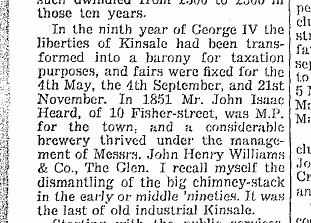
Kinsale Brewery

1932

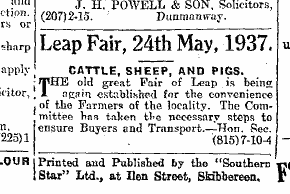
1937 Old Fair at Leap Being Re Established


https://wordpress.com/block-editor/post/durrushistory.com/33720

https://wordpress.com/block-editor/post/durrushistory.com/33720

The Spread of Trade, Fairs in West Cork, Aughadown, 1661, Ballydehob, 1620, Ballygobane alias Oldtown, Bantry, 1679, Bantry 1700,  Bawnlahan and Rahine and Drimoleague 1615 (O’Donovan of Castledonovan),  Clonakilty 1620, Drimoleague, 1768, Enniskeane 1620, Kilbrrah, Ballyhallow, (Dunmanway), 1615, New Stapletown (Skibbereen), 1675, Bridgetown (Alias Cornea) Skibbereen, 1676,

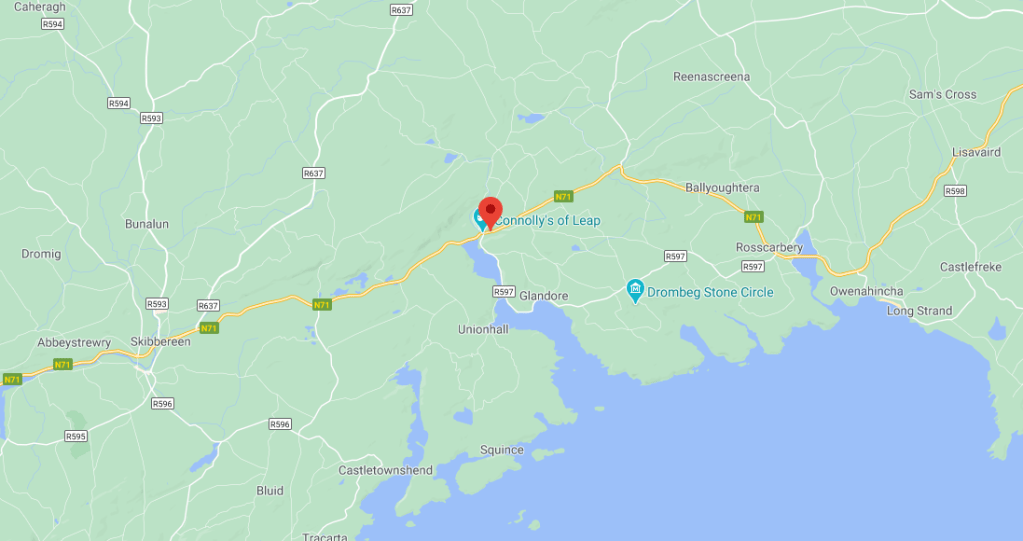
Ancient Bawnlahan, Leap, Fair Day, Ascension Thursday.

https://wordpress.com/block-editor/post/durrushistory.com/32070

..

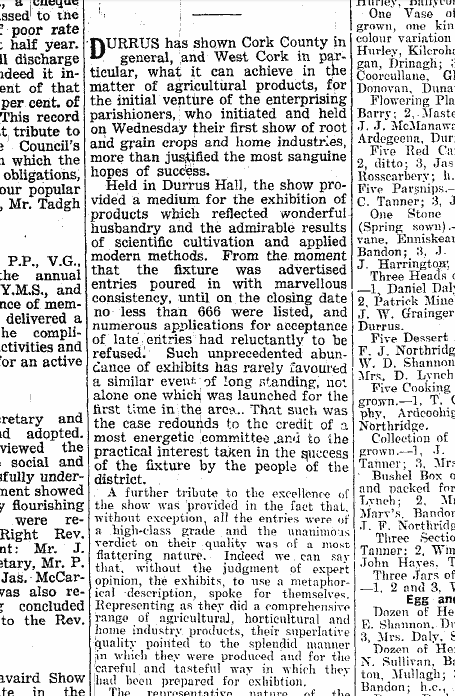
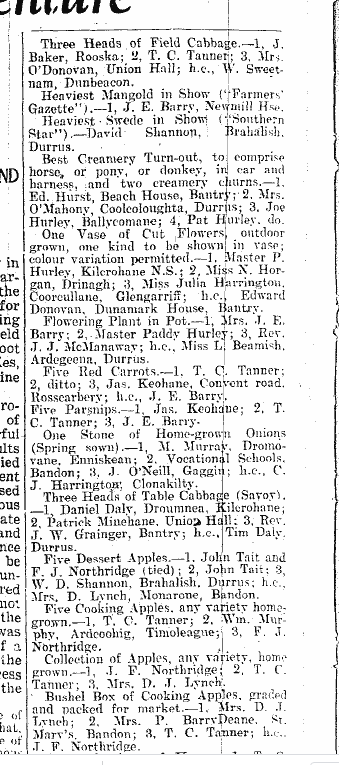
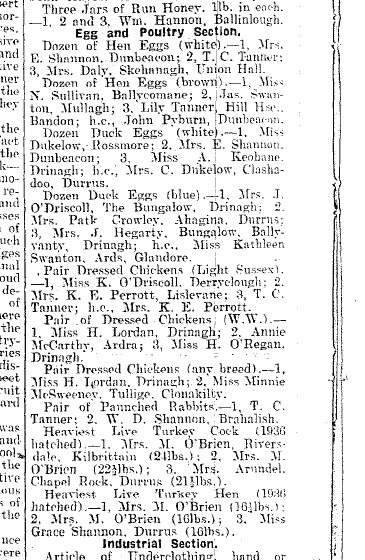
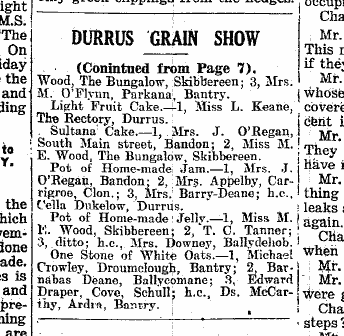
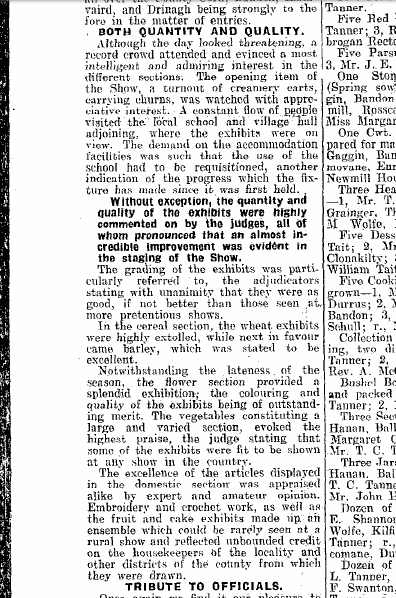
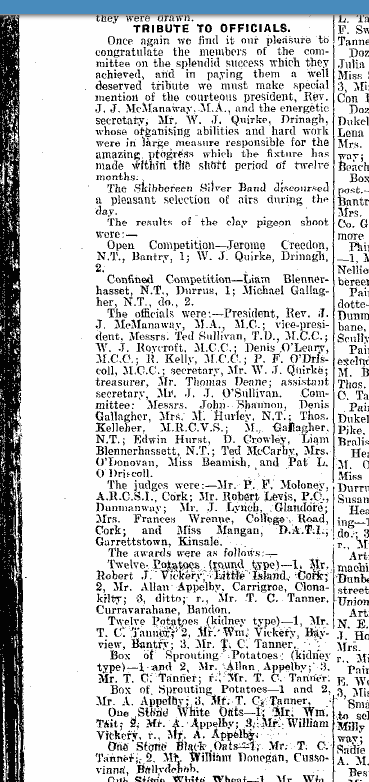
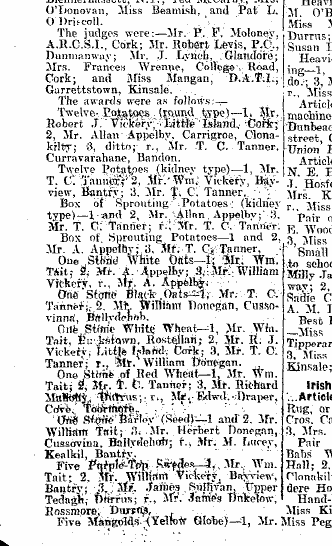
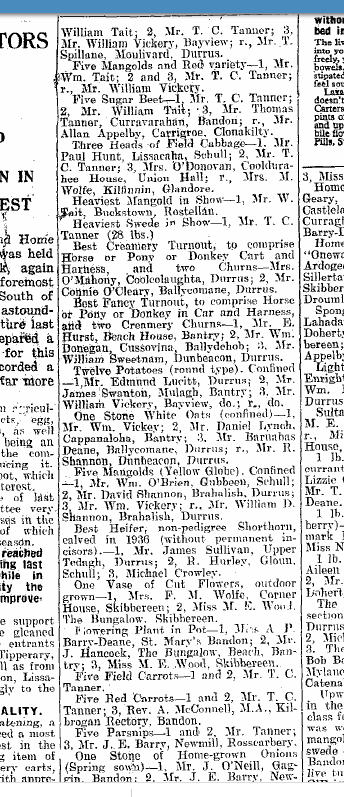
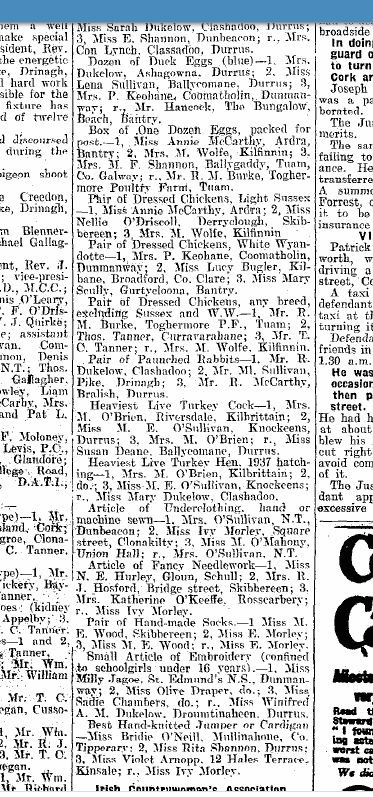
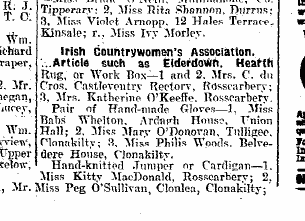
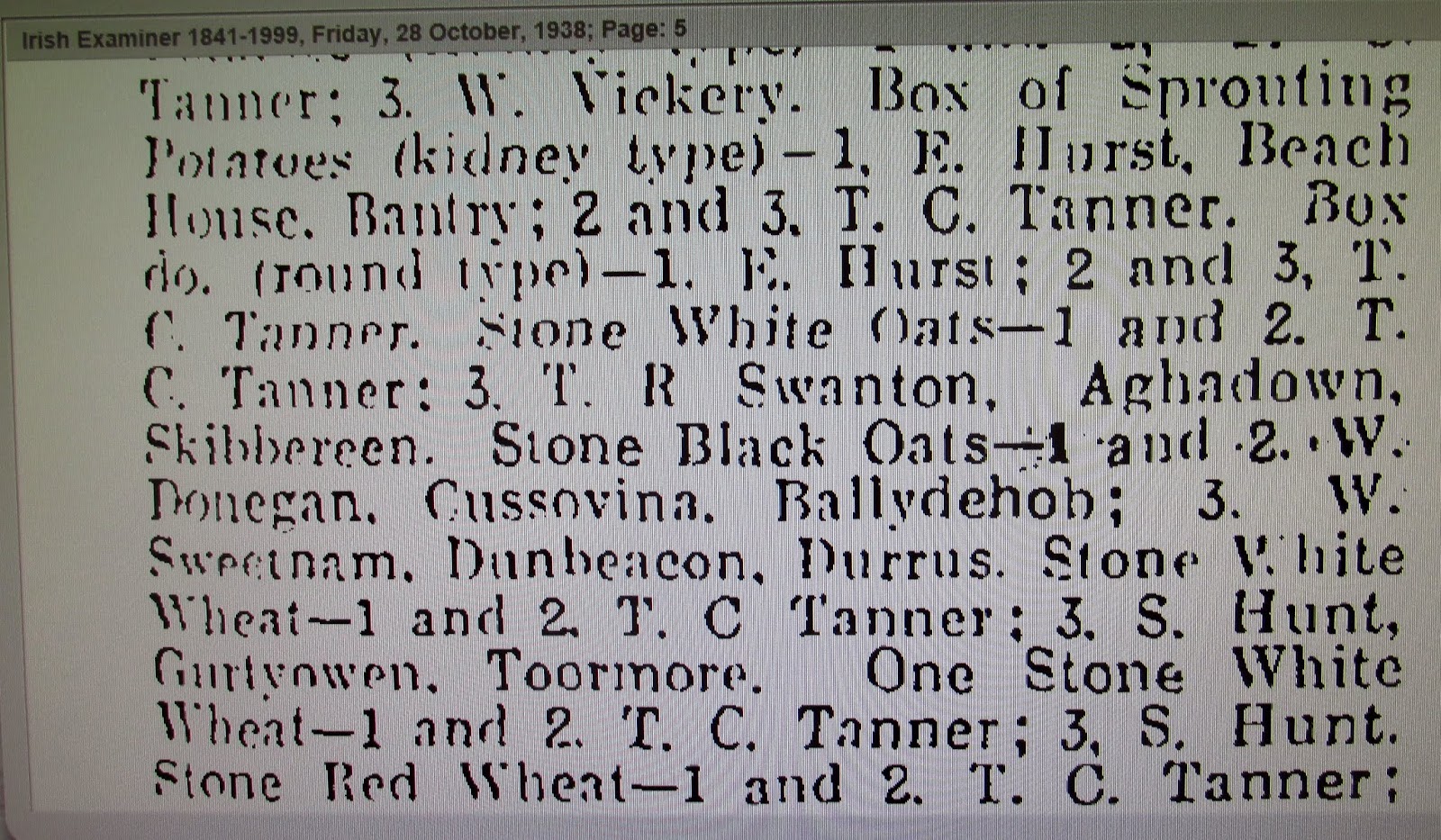
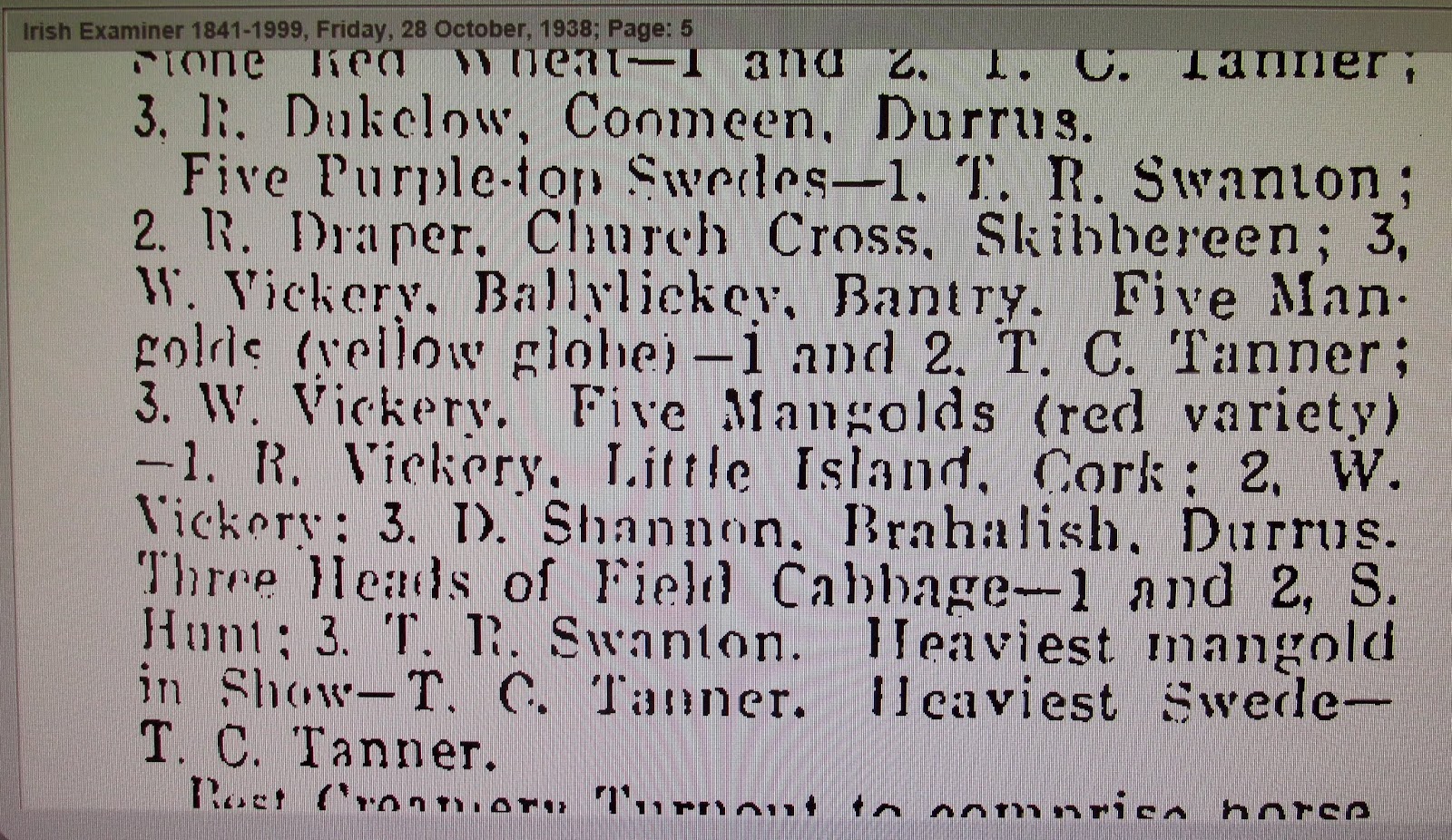
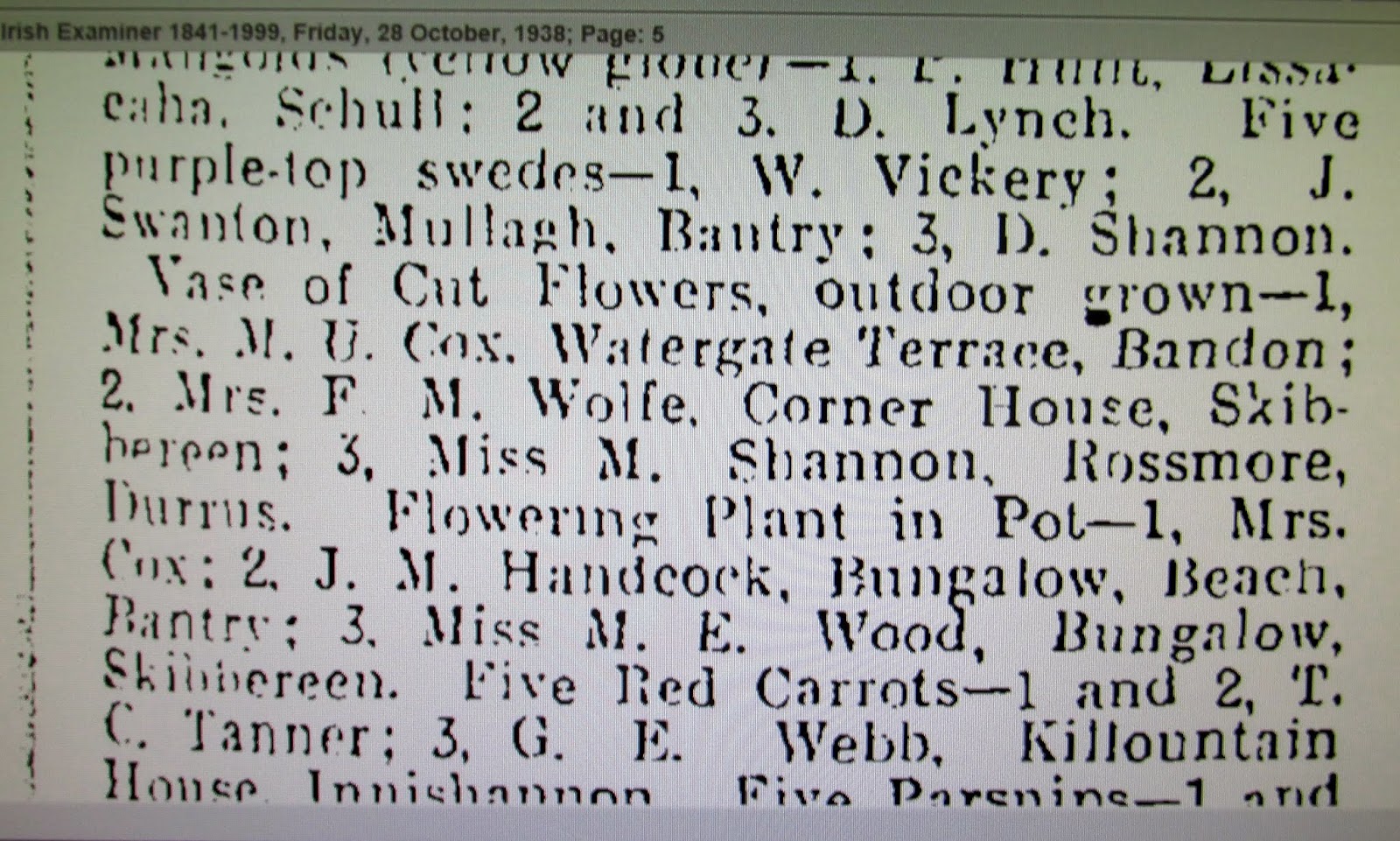
1936 and 1937 Durrus Agricultural Shows, 700 Entries


1936.  Durrus Agricultural Show

.

.

One of the features is that people in other parts of Co. Cork exhibed many with links to the area such as the Vickeries of Little Island who have Durrus/Bantry connections.

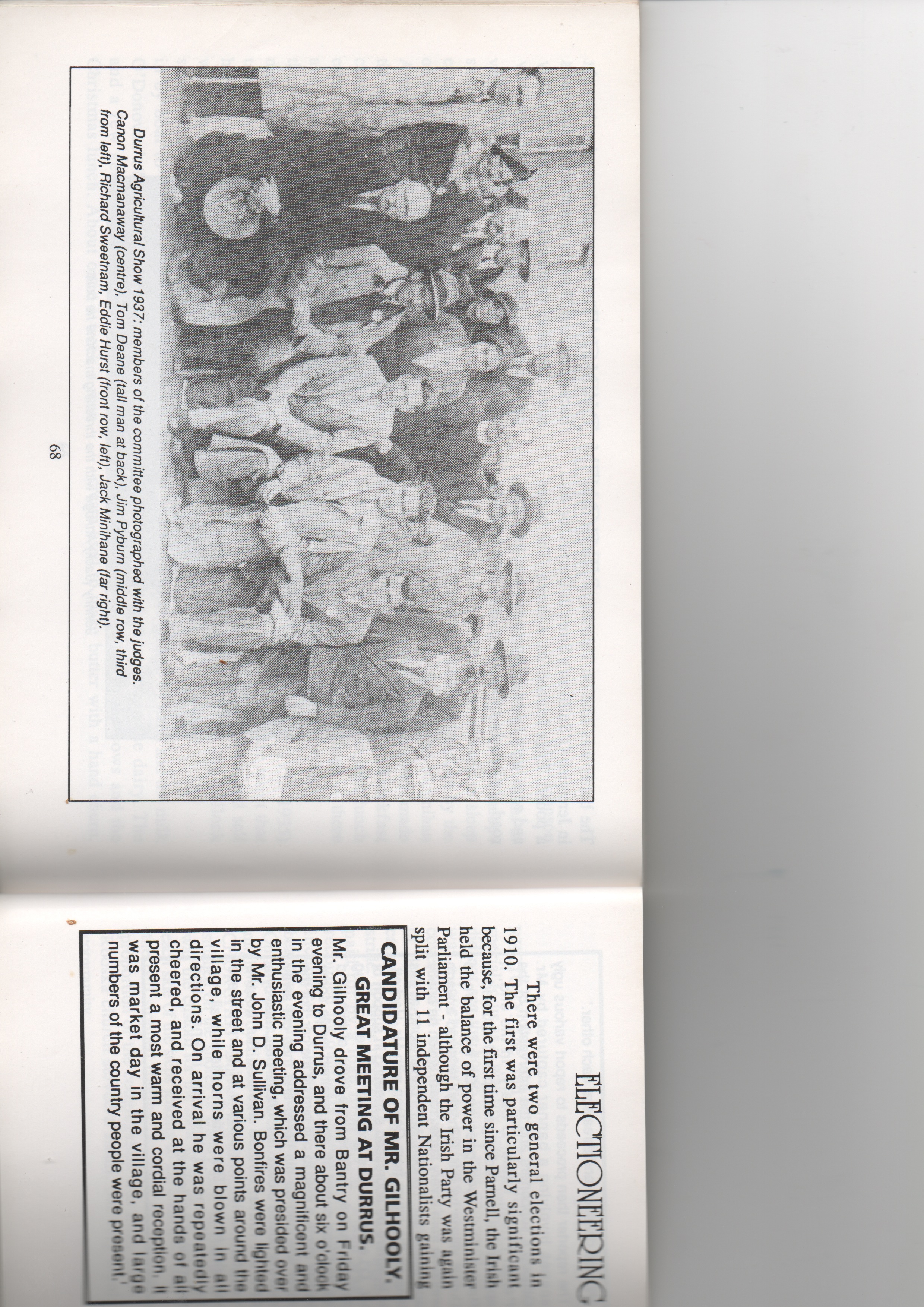
Photograph Committee Durrus Agricultural Show 1937, West Cork.

Held in the vicinity of school.

1937 Durrus Agricultural Show, 700 Entries

One of the features is that people in other parts of Co. Cork exhibed many with links to the area such as the Vickeries of Little Island who have Durrus/Bantry connections.

Photograph Committee Durrus Agricultural Show 1937, West Cork.

Held in the vicinity of school.

Scan 1692

Centre Canon McManaway a driving force in getting the creamery established, the new road over the hill from Coomkeen to Bantry, the first Church of Ireland School at Ahagouna in the Free State

Tom Deane, tall at back, former Dublin Metropolitan Police, Crottees he was so tall the Police had to have a special bicycle made for him.  Community activist, member Church of Ireland Diocesan Synod.

Jim Pyburn, Dunbeacon, middle row, third from left.

Richard Sweetnam, Dunbeacon.

Eddie Hurst (front row, left), model farmer, Beach House Bantry now the property of the Wagner family married to Shannon, Clashadoo also model farmers, father of Hazel Vickery, Bantry.

Jack Minihane (far, right)

Courtesy St. James’ Durrus. A Parish History.

Meeting Durrus Agricultural Show Committee, 1938

https://durrushistory.com/2015/03/01/john-rye-macroom-co-cork-early-agriculturalist-1730-on-the-burnng-of-lime/https://durrushistory.com/2014/11/24/minutes-of-balineen-co-cork-agricultural-society-1845-7-ordered-that-pamphlet-on-turnips-be-translated-into-irish-for-some-of-the-protestant-famers-turnips-flax-growing-plight-of-labourers-att/

Bantry, West Cork, Agricultural Show (Taisdáeantas Cuireadgineachta Bheantraí), 1947 names and addresses of competitors, Curriculum of Vocational Educational Committee Day and Evening, Kingdom Show Band in the Stella Ballroom

..

..

..

Cork Examiner

1937 Durrus Show

.

Historical Maritime Input to West Cork Economy


All comments welcome. Part of the reason a small area pre the Irish Famine 1845-7 had one of the world’s highest rural population densities was the availability of marine resources, sea sand, seaweed. As early as 1820 there were favourable comment by (Kerry born), Dublin Attorney Orpen at how developed West Cork was with shipping to Spain, Portugal, France, roads, harbours. He was related to local families such as the Durrus Hutchinsons, landlords, Swanton of Ballydehob and indirectly to the O’Sullivans of Ballaghadown, Caheragh. William Orpen is of this family.

Click here:

https://docs.google.com/document/d/1XBm66v2Qo6oOyp6SXIySijiNXnlUgSogDUHaMTp5oH8/edit

Pilchards, p. 2

Baltimore, p.5

Port of Baltimore 1691-1693, Customs and Excise, Statistics, p.6

Bantry and Durrus, p.10

Ballydehob/Carrigmanus/Castlehaven/Crookhaven/Skibbereen, p. 59

Lobster Boats of Hehir Islands and Roaring Water Bay by Cormac Levis, p.

Clonakilty, p. 118

Courtmacsherry, p. 79

Kinsale, p. 80

Grand Jury Presentments Sea sand roads, p. 127

Ropemakers, Nets

Sea Sand, Sand Quays, p.125

Sand Boats, Coal Trade to Ballydehob, Sea Sand on River Ilen Skibbereen,  p. 134

The Puxleys Copper Mines, Allihies, Shipping 1812-1884, p. 132

Steamship Service, Cork to Dingle via  Castletownbere 1850-1940, p. 177

Piracy/Smuggling, p. 178

Ropemakers, Nets, p. 197

Shipping, Lloyds Agents, p. 179, 198

Skibbereen to Crookhaven Road 1822, p. 183

Boatbuilding Kinsale, Skibbereen area late 19th/20th century. P.192

Harbours, Lighthouses, p. 196, 278

Proposed railway to Glandore Harbour, p.207

Wrecks, p. 198, 221

Fishing By Laws, Bantry 1870,  Bandon 1871, Glandore 1871, Ardigeen (Clonakilty) 1877, River Ilen (Skibbereen) 1878, from Crown Solicitors Papers, p. 224

Pilchard Palaces, p. 243

Dr. Arthur Went on Pilchard Industry, p. 244

Maps and some Du Noyer sketches, p. 221

1812-1825, Admiralty Court, West Cork, Wrecks, p. 221

Royal Navy Press Gangs Operating off Cork Coast, 1755-1812, p. 215

British Navy Base, Bere Island, p. 217

Piracy, p. 247

1822 Local Fishery Committees, Irish Fisheries Board, p. 266

Clio Salvage Litigation, 1825, p. 269

1837, statistics, boats, fishermen, coastguard, p. 275

1920s Jack Attridge, Durrus, self built boat, p.277

Kinsale  Hookers from 1671, p.311

English  navy records 17th century timber extraction from Bantry and supplies to Kinsale, p.300

1755 Lisbon Tsunami, Kinsale and  Crookhaven, p.286

Coastal Shipping, p. 297

Pilchard Fishery Bantry, p. 298

Index to Journal of Cork Historical And Archaeological Society reference to pilchards, p.302

1893, Baseline Report of Redmond Roche Inspector, Congested District Board, Castletownbere, Sheepshead, Schull, Baltimore, p. 316

s

1758, Lease Renewal of Ballylickey, Bantry to Thomas Hutchins. Carries on a Great Trade in Cod, Herring, Ling, Oysters, Father A Major Smuggler and Hutchins Magistrates.


durrushistory's avatarWest Cork History

1758, Lease Renewal of Ballylickey,  Bantry  to Thomas Hutchins. Carries in a Great Trade in Cod, Herring, Ling, Oysters, Father A Major Smuggler and Hutchins Magistrates.

Thomas Hutchins, Bantry, West Cork, being paid for Impressing Beara Seamen for British Royal Navy 1746.

Hutchins Magistrates:

Arthur Hutchins, Ballylickey or Ardnagashel. Visited by reformer  Sir Francis Burdett  1817.  Present at enquiry Skibbereen 1823 into enquiry into fatal affray at Castlehaven caused by Rev. Morritt’s tithe extraction.  Notified as Magistrate of Catholic meeting in Bantry re loyalty to King 1825. Signed public declaration to Alexander O’Driscoll on his removal as Magistrate 1835 with Lord Bantry, Simon White, John Puxley, Thomas Baldwin, Samuel Townsend Junior and Senior, Hugh Lawton, Thomas Somerville, Richard Townsend Senior, Rev. Alleyn Evanson, Timothy O’Donovan, Richard Townsend, Lyttleton Lyster.

Arthur Hutchins, 1855, Ballylickey, Bantry, Resident, £60. Attending 1840 Great Meeting Bantry re Poor Law. Assisting 1848 Henry J…

View original post 677 more words

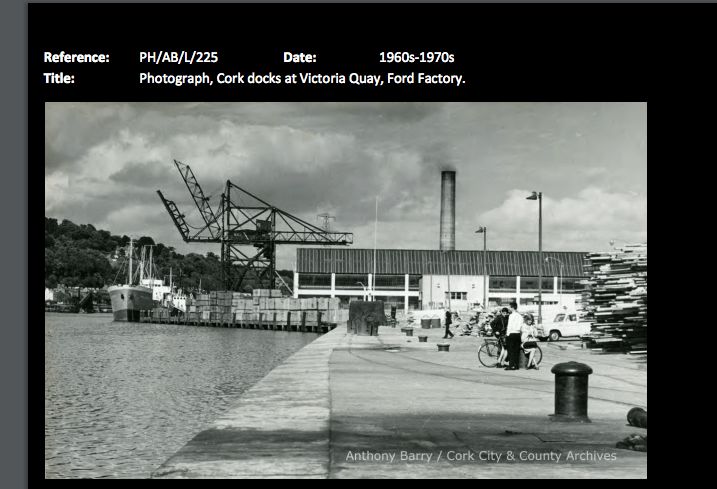
1912, Henry Ford of Detroit in Vickery’s Hotel, Bantry. Famous Visitors to Vickery’s Hotel.


From Hazel Vickery who donated Vickery papers UCC, Boole Library:

https://libguides.ucc.ie/ld.php?content_id=32363594

In 1912, Willie’s cousins, Herbert & Tommie Vickery, sons of George J. Vickery, of Vickery’s Hardware Shop,opened a motor repair garage behind the hotel. As they were Ford dealers, they needed a showroom on the street. This was in the new hotel building between the front door and the archway, with petrol pumps on the footpath. The hotel was used by the Cork Ford Company for regional meetings and Henry Ford, his wife Clara and daughter stayed in the hotel on the night of the 10th August 1912.

Corktown, Detroit, Michigan being Revitalised by Henry Ford The Third.

https://wordpress.com/block-editor/post/durrushistory.com/35978

Henry Ford, Madame, Ballinascarthy, West Cork and the Uilleann Pipes

https://wordpress.com/block-editor/post/durrushistory.com/699

Famous Visitors to the Hotel:


Noel O’Sullivan a porter in 1940 wrote that he remembered opening the door for the then, Taoiseach, Eamon de Valera; General Tom Barry; Dan Breen, Eoin O’Neill, Dr Noel Browne, the singer Delia Murphy and actresses
Kathleen Ryan and Hermione Badderly. In 1961, during the making of the film “I Thank a Fool” on the Mizen Head Peter Finch stayed with his wife Yolande. Susan Hayward and Diane Cliento who were starring in the same film were regular clients for meals at that time. Trevor Howard, Cyril Cusack and Geraldine Plunkett (Glenroe) visited when making a film in Baltimore. Trevor was so pleased with one of the photos of him taken by Ian that he ordered 100 copies to use as a publicity photograph. Maureen O’Hara and her husband Charles Blair stayed when looking for property in the area which they eventually found in Glengarriff. She became a regular client as was Christy Moore when he had a house in Durrus – much to excitement of the staff. Before the private sitting-room/guest lounge became
the dining room I have fond memories of great sing-songs with various friends and guests playing the baby grand piano which had come from Elsie and Ian’s home in Reenmeen, Glengarriff after it was sold. Pianists included Donal Crosbie of the Cork Examiner family, Joe Lynch (Dinny in Glenroe), Maureen Potter and Jimmy O’Dea who stayed when they were staging their revues in the Parochial Hall. Later the old bar became the venue for the Young Musicians’ Platform during the West Cork Chamber Music Festival until they outgrew the room.

1914-1919, Gardens at Garretstown House, Kinsale, Grapes, Peaches, Lemons, Oranges


1914-1919, Gardens at Garretstown House, Kinsale, Grapes, Peaches, Lemons, Oranges

Courtesy Kinsale Historical Society (2016, Vol 24, P. 19)

Lost demesne and historic gardens of Ballintubber near Ballinhassig, Co. Cork built by Lt-Colonel William Meade c 1650 and home of Samuel Thomas Heard creator of Rossdohan Gardens.

Gumbelton Estates including areas of Kilcrohane and Durrus West Cork, William Edward Gumbleton (1840-1911) garden at Belgrove, Great Island, Cobh, Co. Cork and donation of Botanic library to Botanic Gardens at Glasnevin.

https://wordpress.com/block-editor/post/durrushistory.com/17499

Samuel Thomas Heard (1835-1921), of Ballintubber, (late 17th century formal gardens), Kinsale, Co. Cork, East Indian Army Surgeon Major, inspired by Madras Horticultural Gardens he created Rossdohan gardens in Kenmare, Co. Kerry in 1873 utilising Furze as sea shelter emulating Lord Carbery at Castle Freke and son’s plant collecting in Abyssinia.

https://wordpress.com/block-editor/post/durrushistory.com/17490

Inventory of plants grown by Gaelic Irish 1620 prepared by Philip O’Sullivan Bere, and early 19th century cultivation of grapes and pineapples by Timothy O’Donovan Magistrate of O’Donovan’s Cove, Durrus, West Cork.

https://wordpress.com/block-editor/post/durrushistory.com/6139

Present by Daniel Sullivan, Berehaven, West Cork, to Richard Boyle, The Great Earl of Cork, c 1636 of Harvey Apples, Bon Chretien and Bergamotte pears, Arbutus for his new garden at Stalbridge Park, Dorset and Ireland’s first horticultural export The Strawberry Tree’ (Arbutus unedo) from 1580s.

https://wordpress.com/block-editor/post/durrushistory.com/6139

1893, Baseline Reports for The Congested District Board, West Cork


https://www.academia.edu/s/9a05a2014a?source=created_email

Courtesy Cormac Levis and Folklore Department, University College Dublin.

Agricultural Improvement, County Premium Boars, Premium Bulls, Extra Premium Bulls, Stallion Asses, Barony of Bantry and Bere, Carbery.

This is part of the Congested District Board and Department of Agriculture and Technical Instruction effort to improve agriculture.   Many of the same families appear from the 1850s winning prizes in agricultural shows and some of their present day descendants are still involved.

https://wordpress.com/block-editor/post/durrushistory.com/25053

From James Morrissey

https://www.irishtimes.com/news/on-the-verge-of-want-1.313466

Apparently in 1890, Arthur Balfour, Chief Secretary for Ireland, visited the west of Ireland to witness for himself the appalling conditions.

In a speech delivered in Liverpool, he declared: “The general impression left upon the casual traveller is that you are dealing with a population not congested in the sense of being crowded, but congested by not being able to draw from their holdings a safe and sufficient livelihood for themselves and their children, whose condition trembles constantly on the verge of want, and when the potato crop fails, goes over that margin and becomes one of extreme and even dangerous destitution.”

Balfour decided that action was needed in the form of a new entity to bring about an improvement in conditions. And so the Congested District Board was established by the Land Act of 1891.

Areas were designated “congested” if the total rateable value, when divided by the number of population, was “less than one pound ten shillings for each individual”. The prime objective was to “help the people to help themselves” but before any assistance was given, Balfour wanted the board to ascertain in detail the circumstances which prevailed in the eight counties (Donegal, Sligo, Leitrim, Roscommon, Mayo, Galway, Kerry and Cork).https://tpc.googlesyndication.com/safeframe/1-0-37/html/container.html

On November 6th, 1891, he told his fellow board members: “I would suggest… that a careful study be made of the whole region from north to south with which we have to deal.”

Balfour recommended the study should include “a minute examination into the existing condition of the inhabitants… their means of livelihood, the quality of the soil, the amount of land (if any) now available for extension of holdings, the fishing accommodation in existence, the possibility of increasing it, the number of migratory labourers and the character and extent of local industries.

“It would also be very desirable among the results of this survey to find a place for some account of the general character of the dwellings in which the people live, and the actual items of their annual receipts and expenditure.”

A team of inspectors was subsequently appointed to conduct the study and in their letters of appointment, W. L. Micks, the first secretary of the board, emphasised the confidentiality of their work.

A search for these board reports took me to the early printed books section of Trinity College. My greatest curiosity was reserved for what the “confidential study” had to say about Kiltimagh. Henry Doran, the inspector who filed his report on May 6th, 1892, declared that “the land is very badly cultivated and rotation of crops is not followed.” Dwellings, he found, were “divided into two apartments, one used as a living room, and at one end of it the cattle are usually kept… the children of both in the other apartment, and the milk and butter are kept there”.

Despite the cramped conditions, Doran was impressed by the inhabitants: “Reflecting on the habits of the people of this and neighbouring districts, who are born and reared in the same room as their cattle; where brothers and sisters occupy the same sleeping apartment, insensible of any violation of human decency; living in such foul surroundings, in such close association as the brutes of the field, I have often marvelled how they are so moral, so well-disposed and so good in many ways as they generally are.”https://tpc.googlesyndication.com/safeframe/1-0-37/html/container.html

Clearly the families were poor. The estimated annual income for a family of six was £25. 7s. with the sale of two pigs yielding the highest return (£6) while the expenditure was just four shillings less at £25. 3s. One quarter of the spending went on the purchase of Indian meal, which was consumed by the family for breakfast and supper and by the pigs and poultry.

The poverty picture was broadly similar all along the western seaboard. In Fanad, Co Donegal, F.G.Townsend Gahan, the inspector, remarked: “To look at the land generally one is inclined to say that, comparatively speaking, these men are fairly well off, but again to look at the houses one feels inclined to say they are very poor”.

In Cahirciveen, J.E.Butler recommended that the number of public houses be halved and that whiskey should not be sold in the same shops with meal, flour and other goods.

“I would prevent a concoction of vitriol etc. being sold as whiskey which maddens the drinkers and helps to fill Killarney asylum with lunatics, now numbering over 400.” It became very clear to all the inspectors that a range of improvements was required to alleviate the plight of the people. Better methods of farming, the introduction of agriculturalists, more modern equipment and boats for fishing, new piers, roads and bridges and radically improved housing were all deemed essential.

“I have no faith in itinerant instructors,” wrote Doran. “The agricultural instructors should be resident in the district and be in daily communications with the people and have some land which should be managed in a manner that would demonstrate the advantage of his skill and knowledge. If he cannot practise what he preaches, who can have faith in him?”

The Congested Districts Board embarked on a range of worthwhile initiatives until its dissolution in 1923. For example, the improvement of housing resulted in 28,267 dwellings either being constructed or improved. New farming methods were introduced and a range of cottage industries developed. The success of such projects depended greatly on the level of support.

A real measure of improved circumstances was seen in the level of deposits in post-office savings accounts in the eight counties. Some years before the board was established, these stood at about £243,000. By 1912, 21 years later, savings had risen to £2.26 million.

Micks witnessed tangible evidence of the improved conditions in and around Kiltimagh: “I have accompanied Father Denis through the numbers of clustered hovels in which people lived on their rundale holdings (farms comprised of numerous isolated plots) before the board’s real land work began; and afterwards I have seen the comfortable detached houses and improved compact holdings”.

On the Verge of Want is compiled and edited by James Morrissey (published by Crann≤g Books, £23.60)