The Flying Snail


Finola's avatarRoaringwater Journal

Iarnród - between Ballydehob and Schull 1939Iarnród – between Ballydehob and Schull 1939

In the heydays of transport by rail, the south of Ireland was served by a network of lines radiating out from Cork. Most of these were scenically picturesque – the nature of the countryside saw to that – and all were imbued with Stories, still recounted with relish by the local people who remember them, or whose mothers and fathers remembered them. Here’s one of the stories – told about the Chetwynd Viaduct, coming out of Cork on the way to Bandon.

Chetwynd Viaduct today - a scheduled monumentChetwynd Viaduct today

This structure was designed by Charles Nixon, a pupil of Isambard Kingdom Brunel, and built between 1849 and 1851. It’s still in place today, passing over the main  N71 road from Skibbereen, and is a scheduled monument. The railway, track and track bed have all gone. For quite a while after its construction it was known as “The Bowlers’…

View original post 484 more words

Goats, Bees and Spies on the Sheep’s Head


Finola's avatarRoaringwater Journal

The Weather Rolls in around KilcrohaneThe Weather Rolls in around Kilcrohane

White GoatsI’ve just finished reading White Goats and Black Bees by Donald Grant. Donald and Mary Grant, a couple of journalists based in New York, impulsively decided to jump off the career treadmill and become farmers in Ireland in the 1960’s. They bought a small acreage on the Sheep’s Head, where they raised goats and ducks, cultivated an enormous vegetable garden, and by degrees and sheer hard work turned themselves into ‘peasants’.

This out-of-print book was drawn to my attention by my friend, Aideen, whose father, while in New York, had encouraged the Grants to consider West Cork. Aideen visited the Grants as a young woman and still has memories of their gorse wine.

As a Back to the Land narrative, this is a classic. Earnest urban professionals consulting Department of Agriculture pamphlets, conducting slug patrols, keenly observing the social structure of their goat herd…

View original post 362 more words

Music Mad


Finola's avatarRoaringwater Journal

site

When we set off to find the Road Trotting we travelled roads we had never seen before: out to the east of Bantry. We were intrigued by a sign to ‘Tralibane Memorial’ and duly diverted to investigate. Up the hills and around a sweeping bend in the road: the first thing we saw was Mary, looking down over her modest garden – but that wasn’t the memorial; we found it a little further on. Our immediate view was a man playing a flute on top of a rock, approached by an ornate staircase. As we took in the whole site we had the impression of a huge plateau carved out of the hill summit – somewhere you could park a hundred cars or assemble a mighty crowd. It had the feel of a place where a Pope might come to give the Mass: there is an ornate Commemorative Wall surmounted…
View original post 319 more words

The Tailor and Ansty


Finola's avatarRoaringwater Journal

The-Tailor-and-Ansty

Travel up to the north of County Cork, into the high country which is still not quite part of the Kingdom of Kerry: make your way to the windings of the youthful River Lee just before it rises in the fastness of the Shehy Mountains, and you will find yourself in a magical place.

Gougane Barra LakeThe Lake in the Mountain – Gougane Barra

You are in Múscraí (West Muskerry), one of the Gaeltacht districts of Ireland – areas where Irish is still spoken as the predominant native language. These districts were first defined when the Irish Free State was set up as part of the new government’s policy to restore the Irish language. Finola will confirm that everyone who grows up and is educated in Ireland today studies Irish in school. Sadly, the maps below show how native Irish speakers have declined since an Ghaeltacht was set up in 1926, partly…

View original post 1,144 more words

Gobnait


Finola's avatarRoaringwater Journal

Right: Harry Clarke's St GobnaitRight: Harry Clarke’s St Gobnait

  • With all the excitements of the hurricanes this week bringing down trees and taking out power and telephones, we almost forgot to celebrate Saint Gobnait’s Day.
  • Saint who?
  • Saint Gobnait – 11th February.
  • But what sort of a name is Gobnait?
  • It sounds like Gubbnet. Not an unusual girl’s name in Ireland: Finola went to school with one. She seemed happy enough with it.
  • But imagine calling a little baby Gobnait… What does it mean, anyway?
  • Er, not sure really: there’s a suggestion that it’s similar to Deborah. That means Honey Bee. Also there’s an Irish word Gabhan which means Blacksmith, and our Saint is supposed to be the patron of ironworkers.
  • So what’s the story of Saint Gobnait?
  • Um, there isn’t one. There’s no history or hagiography about her… But she is mentioned in the ‘Lives’ of St Abban…

View original post 644 more words

Ból an bhóthair


Finola's avatarRoaringwater Journal

bowling

A damp, grey, Sunday afternoon seemed as good a time as any to find out about a strong West Cork tradition – Road Bowling – the title of this post is the Irish for that. I had come across this ancient sport on a previous visit to Ireland and was intrigued. Friends enlightened me that it was a traditional local pastime which has spread to Armagh and, through emigration, to London and the United States – while other versions of the game exist in Holland and Germany. But the county of Cork – and particularly our western part of the county – is its true home.

bowling2A notable merit of the sport is that it requires absolutely minimal equipment and facilities: an iron ball (or ‘bullet’) weighing 800 grams and 18cm in circumference (note: Ireland is fully up to date with its metrification – miles and ounces have vanished along with the…

View original post 460 more words

Place Names – and PRIZES!


Finola's avatarRoaringwater Journal

View from Cappaghglass

Several of my Canadian readers have asked me to do a piece on place names. As a Canadian, it’s hard to fathom that the address ‘Finola Finlay, Ard Glas, Greenmount, Ballydehob, Co. Cork, Ireland’ could actually get to me – “What?” you say, “No street address? No postal code? And how on earth do you pronounce Ballydehob?” (Actually, just Ballydehob, Ireland, would probably make it to me.)

When Ireland was mapped by the Ordnance Survey in the 1820’s to 1840’s, place names were Anglicised mostly by trying to reproduce the Irish names phonetically. With some basic knowledge of Irish it is possible to winkle out the meaning of many place names. The smallest unit of land recorded on the maps is the ‘townland’. This being Ireland, the term ‘townland’ has nothing to do with a town but is a defined geographical area, probably based on very ancients divisions…

View original post 260 more words

Mizen Magic


Finola's avatarRoaringwater Journal

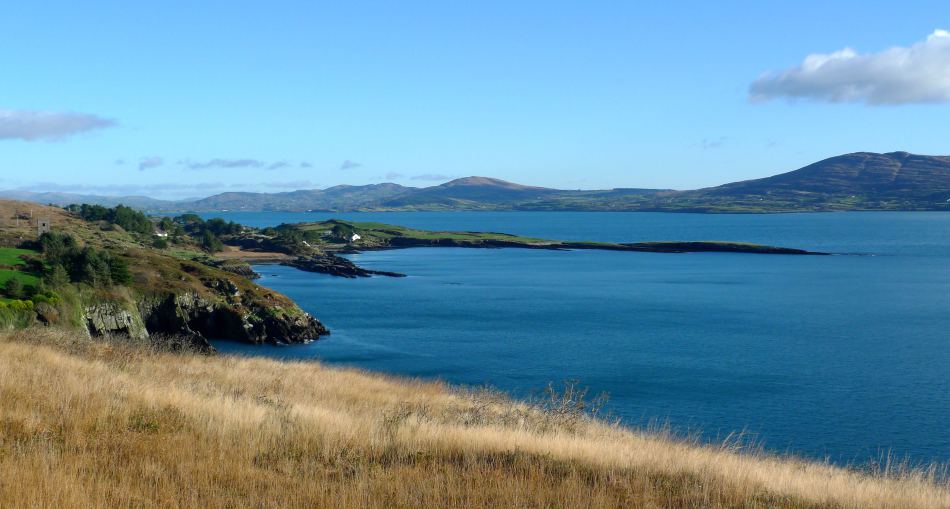
We’ve done several posts on the Sheep’s Head and the marked hiking trails that crisscross that peninsula. But we actually live on a different peninsula, The Mizen, and it is just as glorious and wild and beautiful.

Map of Mizen and Goleen

The road to the Mizen Head starts at Ballydehob, runs along the southern side of the peninsula through Schull and Toormore and on to Goleen and Crookhaven. At the far or western end are the beaches of Barley Cove and the Mizen Head Lighthouse and Visitor Centre. There are no villages on the northern side of the peninsula until you reach Durrus, which also marks the start of the Sheep’s Head Peninsula. It is bounded on the south by the waters and islands of Roaringwater Bay and on the north by Dunmanus Bay. The whole peninsula is rich in history and archaeology and we plan future posts about many aspects of life here.

View original post 31 more words

Mizen Magic 2: The North Side


Finola's avatarRoaringwater Journal

A pet day on The MizenA pet day on The Mizen

We are once again being battered by Atlantic storms, but on a sparkling day earlier this week we drove, on a whim, to Durrus for breakfast. The day was so pure and sunny that it seemed a crime to go home again, so we set out to drive along the north side of the Mizen Peninsula.

Dunbeacon CastleDunbeacon Castle

What a day! We rambled down to the shore to investigate the 15th Century Dunbeacon Castle. There’s nothing left except one tall wall, standing sentinel against the wind, facing down the length of Dunmanus Bay. Its commanding position would have given its builders, the O’Mahonys, a strategic advantage in protecting and controlling their territory from adventurers arriving from the Atlantic.

Not much left Not much left

Further along we explored an abandoned cottage, and found one of the water pumps that were once ubiquitous in the irish countryside…

View original post 507 more words