Letter From Father Tim Mahony
Timothy “Father Tim” J. Mahony was born in Brasher, New York. A distant cousin of mine, he was ordained in Louvain, Belgium, July 15, 1901. While studying for the priesthood, Father Tim visited West Cork where he met many relatives, including my own great-great grandmother, Julia Lantry McCarthy from the Parish of Tullough, Inchigeelagh. This letter was given to me by Lois Lantry Steffey of California. Father Tim, Lois and I are all descended from Barnaby Lantry, who was born in the Parish of Caheragh, County Cork approximately 1745-1753. He married Hanora O’Leary of Inchigeelagh, a Catholic, and allowed his nine children to be raised Catholic. Barnaby eventually converted to Catholicism. Father Tim’s letter was one of the first introductions to Ireland for his family. Years later we followed his path and visualized the land our ancestors left. The letter is his testimonial to our family.
Louvain, Belgium
Oct. 16, 1900
Dear Sister and all hands:
Pretty late to write about my vacation, but “better late than never.”
Well, I left Louvain August 5th in company with a Buffalo chap, and we spent two weeks together having a peep at the Exposition and seeing something of London. In London we separated; and I went on to Ireland by way of Manchester and Liverpool, arriving in Dublin August 21st. The next day I went to Cork and the same evening to Monkstown on Queenstown Bay. I was received by a man of 64 years of age, a very strong built man of over average height. Well, this man proved to be Canon Lyons and a finer, kinder or more hospitable man I have never met. He did everything possible for me and at the end of five days I was really lonesome leaving him.
The second day he took me out to Dunmanway and from there we drove out to Lagher where I remained all night. [The next day] Canon Lyons and myself walked over to Droumdeegy where Grandpa Lantry lived, and if in former times the place as as it is today, I do not wonder that the family emigrated. There is a man Hurley living there at present, and perhaps he may be unusually shiftless, but at any rate, you people cannot imagine the filth of that place. The hens and pigs were making themselves right at home around the turf fire and they seemed to be on the best of terms with three of the rosiest, healthiest looking little children that you would care to see, while on the rafters were hanging big hunks of pork to dry and smoke. I have been considering the matter since, and I have come to the conclusion that it was the dirtiest place I saw in Ireland, and I saw some pretty bad cases of filth. When I came out of the place my head began to reel and my pride to tumble way down. However, I understand that it was in better condition when grandfather Lantry lived there.
That evening Canon Lyons went back to Dunmanway and I remained with the Murphy family. Mr. Murphy and I drove over by Coolmountain toward Pipe Hill in the Inchigeelagh direction to see a Mrs. Charles McCarthy, whose name was Julia Lantry, a daughter of Thomas Lantry, who was a first cousin of Mother, and son of Charles Lantry, our grand-uncle. She and her daughter were in a field binding grain. Two of her sisters, who were very beautiful, are in Cork City. They married Protestants and are widows today. She has brothers in Jersey City and sons and daughters in that city and Chicago. Her daughter who was working in the field with her was a fine looking girl also. In fact the Lantrys were quite genteel people, fond of fine dress and fine manners, and generally to be seen in more genteel society than their neighbours.
The next morning one of the Murphy boys drove me on towards Ballyvilone, and we met Canon Lyons on the road after we had walked five Irish miles, so you see he is a strong active man. In fact he gave me many a hard push across country, and I am considered an A-1 walker. We called on several very old men on the road to Ballyvilone, but they all appeared to have forgotten grandpa Mahony except a James Nynan who directed us to Drumfean where grandpa Mahony and his brother John lived together, and were Pa was born and lived. This James Nynan, who is a man closing onto ninety years, directed us to the home of the last Mahony in that part of the country.
On the road to Enniskeane we passed by a little thatched hut about half the size of our hen-house and there lived the last Mahony Leader in Ireland. A sorry sight he is. His name is Tom Mahony and as near as I could make out, he is a second cousin of ours. His hut is built right on the road and there is not a foot of land with it, and the Lord only knows how the old couple lives. In the evening we returned to Cork and Monkstown.
I then – on leaving Monkstown – went out of Kilmurry and met the Misses Bride and Ann O’Mahony. Connor O’Mahony was attending the National Synod at Maynooth, so I was deprived the pleasure of meeting the most talented man in Ireland. His sisters are very intelligent and ladylike, and also very entertaining. They received me as one of their own, and I had a grand old time there for three or four days. Miss Ann is an O’Mahony through and through and they both took great pleasure in talking about the past history of the family. We worked out the degree of relationship as follows:
CONNOR O’MAHONY
Connor ———–brothers———–John (probably)
John Tim
James James (grandpa)
[Fr] Connor, Ann, Jeremiah & Bride Tim (father)
James (little boy) Ourselves
This old Connor O’Mahony with five brothers fought in the Battle of Aughrim in 1691. His five brothers were killed on the field. The O’Mahonys were always great fighters since the time of Brian Boru, and at faction fighting they never met their equals. Before Cromwell’s time and Penal Laws the family was very well off and so powerful that the English determined to drive every one of the name in Cork “to hell or Connaught”.
But they went neither place but settled down in Kerry and earned their livelihood by teaching Latin and Greek.
You must not let your heads get too big when you read this and as a preventative I would suggest that you now and then think of that old Tom Mahony whom I ran across near Enniskeane. I left Kilmurry for Bantry.
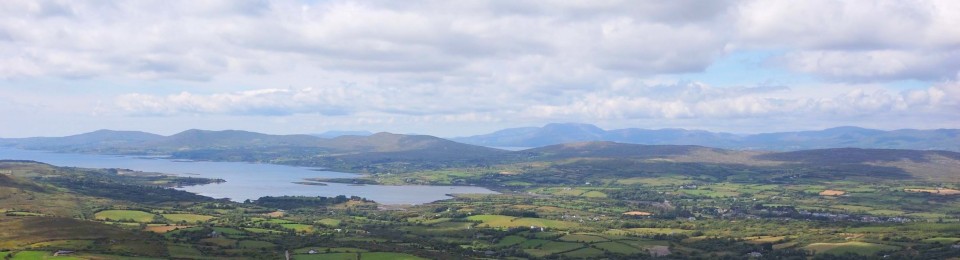
In the afternoon two Australians and myself climbed to the top of a mountain and obtained the most extensive view that I have so far seen. The whole of Bantry Bay lay at our feet, and we could see far out into the ocean, besides a great part of the Co.Cork and the mountains of Kerry. This is a beautiful place as far as natural scenery is concerned, but a herd of goats would starve here. Yet, quite a population exists there. How, I can’t imagine. Next morning we started on our party mile drive to Killarney.
[While] in Dublin I looked up Mr. Barnaby Lanktree, a son of Henry Lanktree, who was a first cousin of Mother’s. He has a splendid position in the Metropolitan Police Force, being Supt. of the Dept. of Detective. Personally he is a tall handsome man and a Lantry through and through, being just a little addicted to bragging, but in a very pleasant way. He has a brother, Charles, in London acting as Inspector of Police; also a sister, Charity, and two brothers in the Argentine Republic, South America; also a sister Mother Superior of a Convent in New Zealand. He is very well posted on the past history of the family.
The Lantrys formerly came from Devonshire, England in the time of Cromwell and settled on land taken from the Irish. They were all Protestants until our great-grandfather was converted four years before his death at the age of ninety-eight. He is buried in the Protestant Cemetery at Dunmanway beside his brother, who died the same week but who was eight or ten years the elder. There is not a Lantry living in Co. Cork today, but there are two other branches of the original stock in northern Ireland. One a Protestant family, Langtry in Belfast; another Catholic family, Lanktree in Westmeath. It is rather strange to think that the Lantrys were not only Englishmen but also Cromwellians and Puritans. But a mixture of blood strengthens the race, ‘tis said. Well, I saw Dublin quite thoroughly and I think it ranks next to Paris and Brussels –a beautiful city. I then crossed the Irish Sea once more and landed in Liverpool where I remained a few hours. England is a rich and beautiful country, but “the bloody bloke of an Englishman” did not take my fancy. He is too reserved, “don’t you know.”
On my return I remained a few days in London to get a better idea of the Metropolis.
I assure you I enjoyed my vacation very much and it was principally owing to the liberality of you people in America and the kindness of friends in Ireland.
Love and greetings to all,
T. J. Mahony


 West Cork History