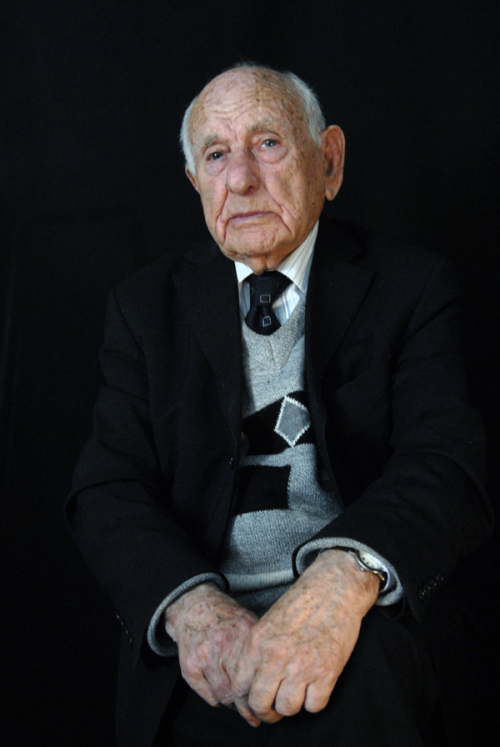
Max Levitas : 100-year-old Jewish Dubliner and Working Class hero


Sam's avatarCome Here To Me!

[Note: Special thanks to Manus and Luke O’Riordan for their photographs, knowledge and continuing friendship]

Max Levitas celebrated his 100th birthday this year surrounded by family and friends in Whitechapel, East London. At the end of the festivities, he called for the crowd to offer up a collection for the Morning Star newspaper. This minor incident symbolises Max’s absolute generosity and unbroken commitment to progressive, left-wing politics going back over 80 years.

Max, 2011. Photo -Spitalfieldslife.com. Max, 2011. Photo -Spitalfieldslife.com.

Born in Portobello, Dublin 8 over a century ago, Max visited his native city last weekend. This article looks at his family background, his long political life and brings together pictures and stories from his recent trip to Dublin.

Family background:

Max’s parents, Harry Levitas from the Lithuanian shtetl of Akmeyan and Leah Rick from the Latvian capital of Riga, fled the anti-Semitism of Tsarist Russia in 1913 to join relatives already residing in…

View original post 1,525 more words

Life in an early Irish Methodist society – Bandon.


jrirish's avatarIrish Methodist Genealogy

TheLife of Rev John Murray provided insights into the development of an early Irish Methodist society. ‘The Methodists in this [Bandon], as in every other place where they sojourned, by degrees established a permanent residence. They first preached in the streets, practised much self-denial, and mortification, inveighed against the standing religion of the country, as impious and hypocritical, declaring the new birth only to be found among them.’ ‘They gained many proselytes; it became the fashion for multitudes to become religious; and it is in religion as in everything else, where once it is followed by a multitude, multitudes will follow. A meeting-house was speedily obtained, a society was formed, and classes of every description regularly arranged.’

‘Three classes [types] of the people were denominated Methodist: the congregation, who, as outer court worshippers, were only hearers and seekers; members of the society, who were classed; and members of the…

View original post 221 more words

Postcards from..


The Silver Voice's avatarA SILVER VOICE FROM IRELAND

Some of the most popular and viewed posts I put on this site are in the series ”POSTCARDS FROM…”where I post snaps from places I happen to visit or pass through. These are mostly places in Ireland where I live. Many of them are a little off the beaten track, almost in a hidden Ireland but all are ‘Real’ Ireland.

I have created a new page on my site where I will place links to the posts in the series. The list will be added to from time to time. I hope you will enjoy!

The link to the page is HERE , but below is a list of all the places so far!

Places in Ireland 

Newcastle West, Co Limerick August 2013
Moneygall, Co. Offaly, ancestral home of Barack Obama. August 2013
Dublin September 2013.
Kells Co Meath January 2014
Bunratty, Co Clare, May 2014
Dun Laoghaire, Co…

View original post 39 more words

Henry Bryan, and Extended Dukelow, Durrus family, from Knockeenboy, Dunmanway, West Cork, 1855-1930 was a fluent Irish speaker, musician and folklorist. He moved to Glenville in 1892 and his house became a mecca for travellers from other parts of Ireland for folklore and Irish stories.


durrushistory's avatarWest Cork History

He was a descendant of the marriage of Michael O’Sullivan, Bantry, (Heart Tax Collector and land Owner and reputed descendant of O’Sullivan Bere) and Mary Vickery, Whiddy Island.

From Ron Price a descendant of the extended family:

Between 1981 and 1990 I made notes immediately after speaking to various Co Cork people about my Cork ancestry. I now wish to make those notes available to anyone interested. Any clarification comments added at this stage are in square brackets. I would welcome any questions or comments.

Source: Thomas (Tommy) Bryan (b 1930) of Ballybrack, Glenville, Co Cork

Notes from conversation on 8 May 1989

– Definitely heard that William Dukelow was relatively prosperous. As well as his 5 sons who worked on the farm he had 2 hired men working from first thing in the morning. Mrs Roberts views, which are slightly anti-William perhaps influenced by his heavy drinking – she…

View original post 628 more words

DNA evidence questioning how many of the O’Mahonys, McCarthys, O’Donovans migrating to West Cork c 1250 AD are of the families.


DNA evidence questioning how many of the O’Mahonys, McCarthys, O’Donovans migrating to West Cork c 1250 AD are of the families.

Recent advances in DNA is calling into question the presumptions of genealogy. In essence families such as the above were displaced by the Normans from South Tipperary and Limerick and migrated to West Cork.
Everybody with the name assumed that they are of the migrating families. Looking at the genetic evidence it appears as if some if not a lot ave marked more associated with the pre existing population in West Cork.

What may have happened is that the migration did take place but perhaps of an elite in the manner of the Celts. The local people where they med to them emulated them taking on their names.

Patterns of intermarriage between Affluent Crypto-Catholic Families in 18th Century Cork.


Patterns of intermarriage between Affluent Crypto-Catholic Families in 18th Century Cork.

A diverse group of Cork families such as the Galweys/Galways, Meads, Roynanes, Cotters, Coppingers, Terrys, Skiddys, from a diverse background including Gaelic, Hiberno-Norse, Norman as Catholic would appear to have lost all in the upheavals of the 17th century. These families were either merchants in the city or landowners in the county excluding West Cork.

Many of the families had branches when in the course of the 18th century conformed to the Church of Ireland and embraced Protestantism and renounced the ‘Errors of Popery’.

There were contemporaneous complaints from enforcers and supporters of the Penal Laws of the activities of ‘Crypto-Catholics’ who used the fig leaf of conformity for conveyancing and professional purposes. In Dublin in the Legal Profession in particular, there were complains that prominent lawyers had wives who had chapels in the house and priest openly calling.

The Convert Rolls still extant probably underestimate the numbers conforming. Looking at some of the names the conformity is often concurrent with the dating of wills:

https://docs.google.com/spreadsheets/d/12-TQFfRKt_p6AGtxLaHODge_ReszztDcE-NFF1626_c/edit#gid=0

It is possible to broadly track families such as the Galweys from 1250 and it is remarkable how prevalent the family and others are to the present day in land ownership, the legal profession and as merchants.

In West Cork certain Protestant families acted as trustees to hold Catholic lands including the Townsends for the O’Heas and the O’Donovans were also such beneficiaries. In Cork City the Tuckeys acted for Nagle in respect of Blackrock lands in the tithe books of St. Finbarr’s Cathedral in the 1780s Tuckeys Land appears as a townland in Ballinure.

In Dublin there were a number of Attorneys who used the actual legal provision of the Penal Laws to circumvent the in conveyancing. Among those from a legal background who had fathers who conformed were Edmund Burke and Lord Clare (Jack Fitzgibbon).

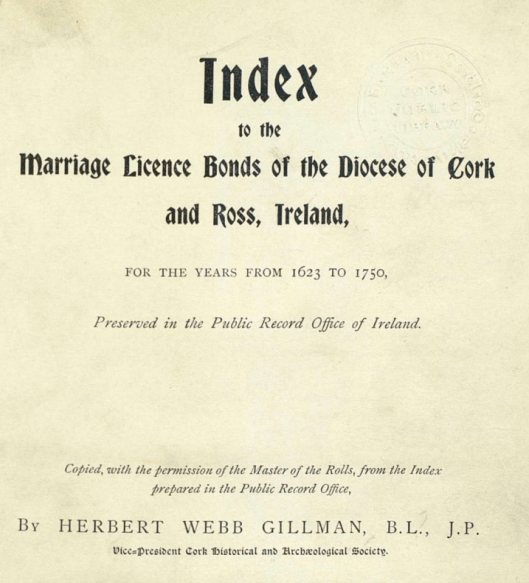
Looking at Herbert Gillman’s marriage index it is apparent that many of the families mentioned continued to intermarry:

https://drive.google.com/drive/my-drive

It is also interesting that many of the Planter families have a line of ancestor which is Gaelic or Norman even if Protestant, such as the McCarthys to the Bandon Bernards and Dunmanway Shouldhams and Ballineen Welbys, The O’Donovan/Beecher connection, Galwey/Townsend. From early on the O’Sullivans are intermarried everywhere especially in Bandon and Cork City.
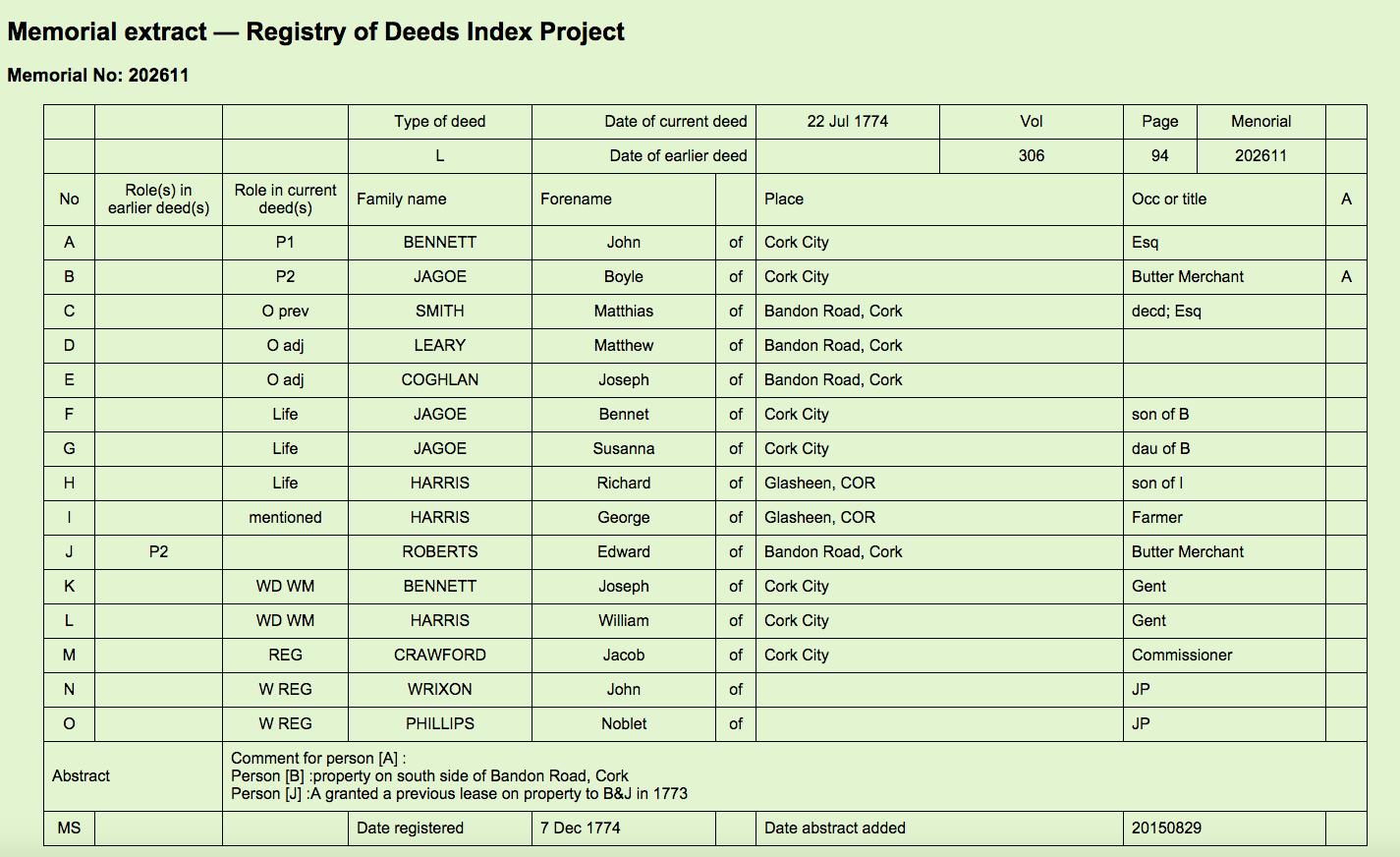
West Cork Colony 1774 in Bandon Road, Cork City.


https://www.google.ie/maps/@51.8925248,-8.4837764,17z

It is interesting loking at this abstract.

The church records which have survive for St. Finbar’s Cathedral and St. Peters Church of Ireland are replete with names originating i West Cork. Time and again you come across Jagoes, Attridges etc. It also seemed to be common for couples to come to Cork to marry and presumable spend a few days of a honeymoon there.

Re butter making, John Jagoe of Bantry whose father was from Dunmanway reputedly ran a shop for a while in Bandon Road/Barrack St.

Evidence of John Jagoe, (Grandfather of Mother Benigna, Australia and Father of John Jagoe BL), Bantry, Co. Cork, 1837 re Manor Courts to Parliamentary Commission.

Another name that keeps cropping up is the O’Leary family of Glasheen. Though Protestant they are most likely to be the same line as the Art O’Leary rebel of Raleigh, Macroom also lawyers.

Up to recently the area to the west of the city was the first pot of call for people from the west.

Richard Caulfield, (1823-1887), Cork Antiquarian, Scholar and the Transcription of Burials from the 1748-1764 and 11th February 1764 of the Church Records, Cork City, 1877

Dr Richard Caulfield, Antiquarian Librarian of Queen College now UCC, Cork mother Catherine Gosnell probably from Schull by J.P. McCarthy 1987:

Screen Shot 2015-09-29 at 20.26.27

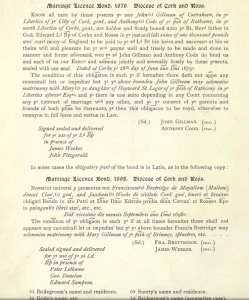
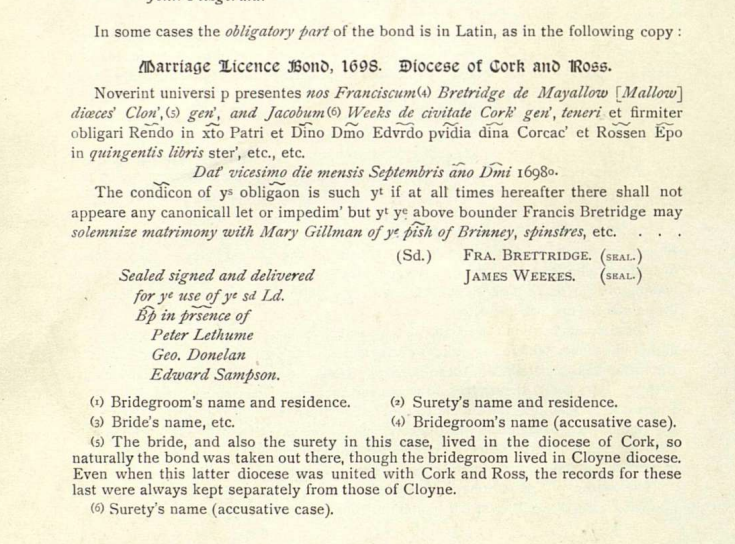
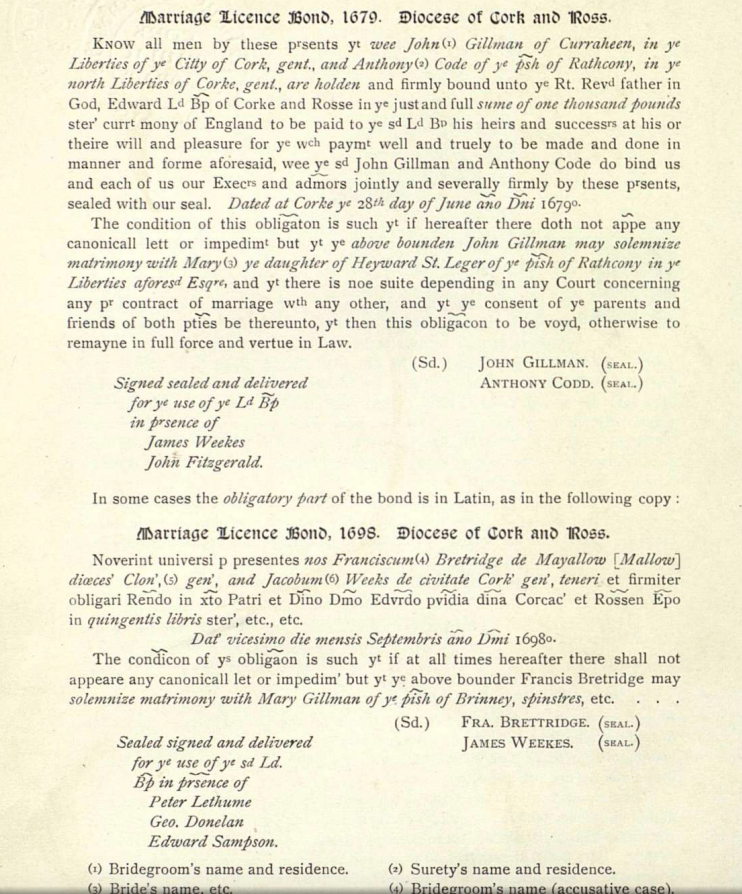
Marriage License Bonds of 1679 and 1698 from Dioceses of Cork, Ross and Cloyne Mid 18th Century Marriage Litigation Arising from marriage of two Protestants: White (of Bantry) and Miss Dillon (Bantry) Married by Popish Priest.


Up to 1870 the (Protestant) Church of Ireland was the Irish State Church. Apart from religion it administered legal functions such as Probable and the regulation of marriage with its own internal legal system.

The format for Marriage was an application for a Marriage License Bond. Some Catholics applied for MLBs for legal purposes or because of the Penal Laws and may have got married in Protestant Churches. There are a very large number of ‘Catholic’ names in the surviving registers.

This was expensive and as most Cork Protestant were labourers, artisan or small farmer the popular method was Bans where the proposed marriage was read out three times at service.

Of the  jurisdiction of Cork Consistory Court:

https://docs.google.com/document/d/1FWBV3gRAeVpYqD5Nlq9j4by9xQGww9Y141pT1mZshpA/edit

The litigation arose from the marriage of White/Dillon. Presumable he impregnated her and went through a marriage ceremony. He then applied to re marry and her legal advisors issued a caveat at the Cork Consistory Court to prevent the purported bigamous marriage. A Case to counsel was prepared. The case would have major implication as the proper entitlement of heirs was at stake. This will be posted shortly.

The Dillons were influential in Bantry/Durrus the main line was Catholic. There is a very large tomb in Moulivard Graveyard (Durrus East).  One was Master of the workhouse, another Thomas a Poor Law Guardian and Council member the funeral of his wife nee Roycroft in 1892 was enormous:

1892. Immense Funeral of Mrs Thomas Dillon, nee Roycroft, Husband Thomas Poor Law Guardian (PLG) Bantry, Obituary a Who’s Who of West Cork.

The vast bulk of the records were destroyed in the Public Records in 1922.

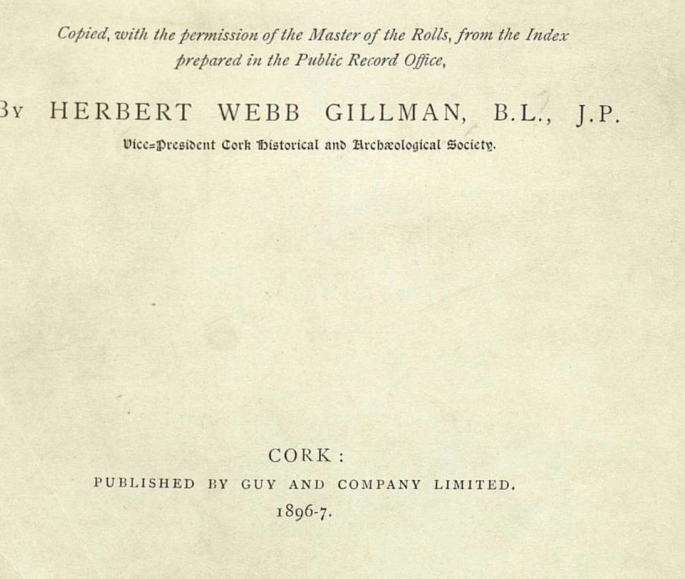
However the great Australian born, Cork antiquarian Herbert Gillman (1832-98):

Herbert Webb Gillman, BL, JP, Cork Antiquarian, in 1892 ‘The writer takes the opportunity of expressing his opinion that the greater part of our County Histories in Ireland can be, and indeed ought to be, rewritten in the light of the documents of late being made readily available by the Public Record Office. It is a Department of which any Nation ought to be justly proud; and the work done in arranging, indexing and editing by the able officers engage there, so well by their courtesy and ready help, afforded freely to all comers are beyond praise.

Herbert Webb Gillman (1832-1898), Clonteadmore, Coachford, Co. Cork, Judge Ceylon, Antiquarian, Authority on Castles of Co. Cork and Author of Index to the Licence Bonds of Cork and Ross.

copied the abstract before destruction and they are reproduced here

https://drive.google.com/file/d/0B6hnQGE3ANjzaE5yemFTbEZTMkk/view?ts=560a8f7a

..Screen Shot 2015-09-29 at 10.19.42

Screen Shot 2015-09-29 at 00.07.55


..
:

Screen Shot 2015-09-29 at 00.08.23

Screen Shot 2015-09-29 at 00.07.55


Screen Shot 2015-09-29 at 10.19.24