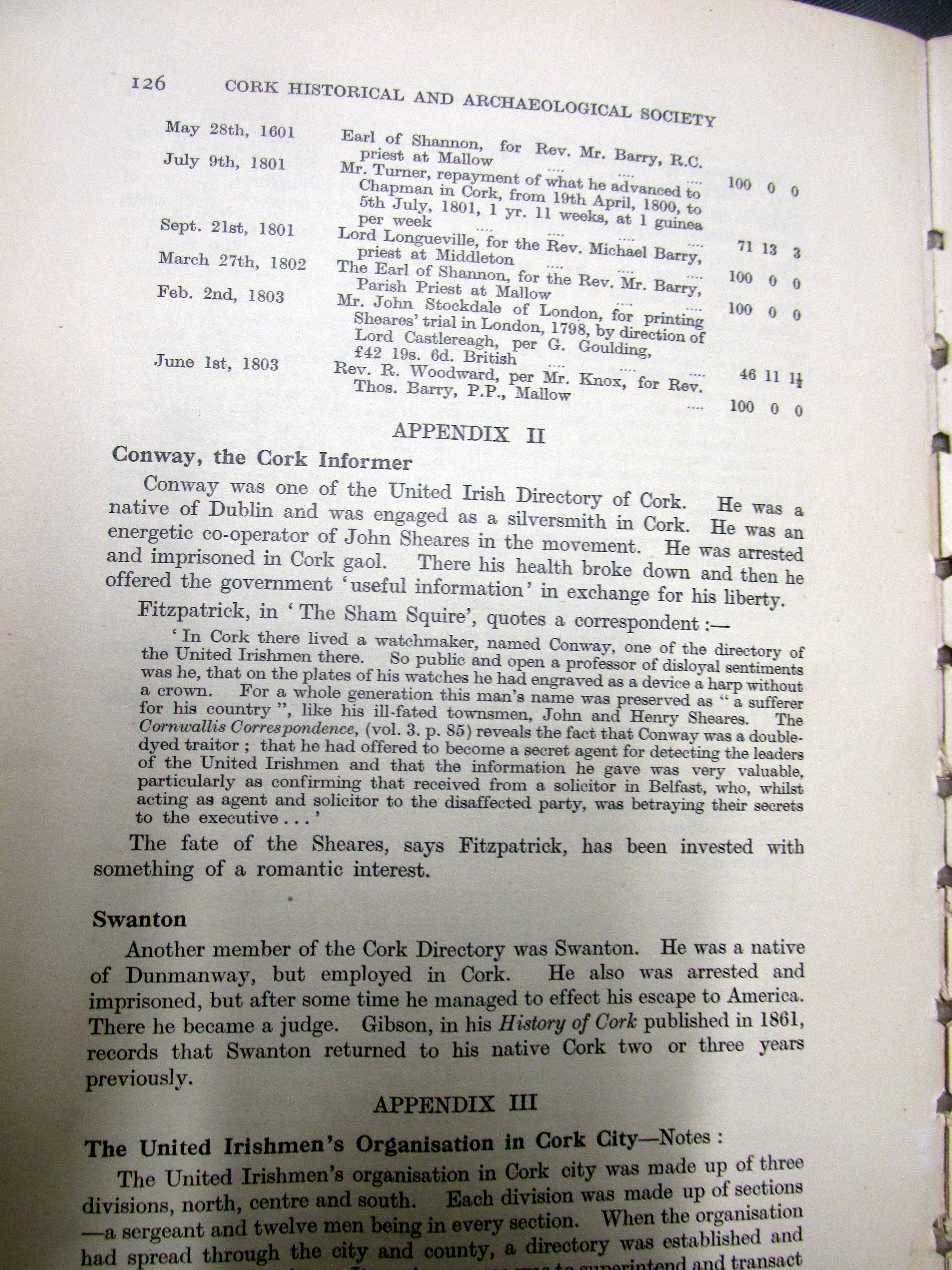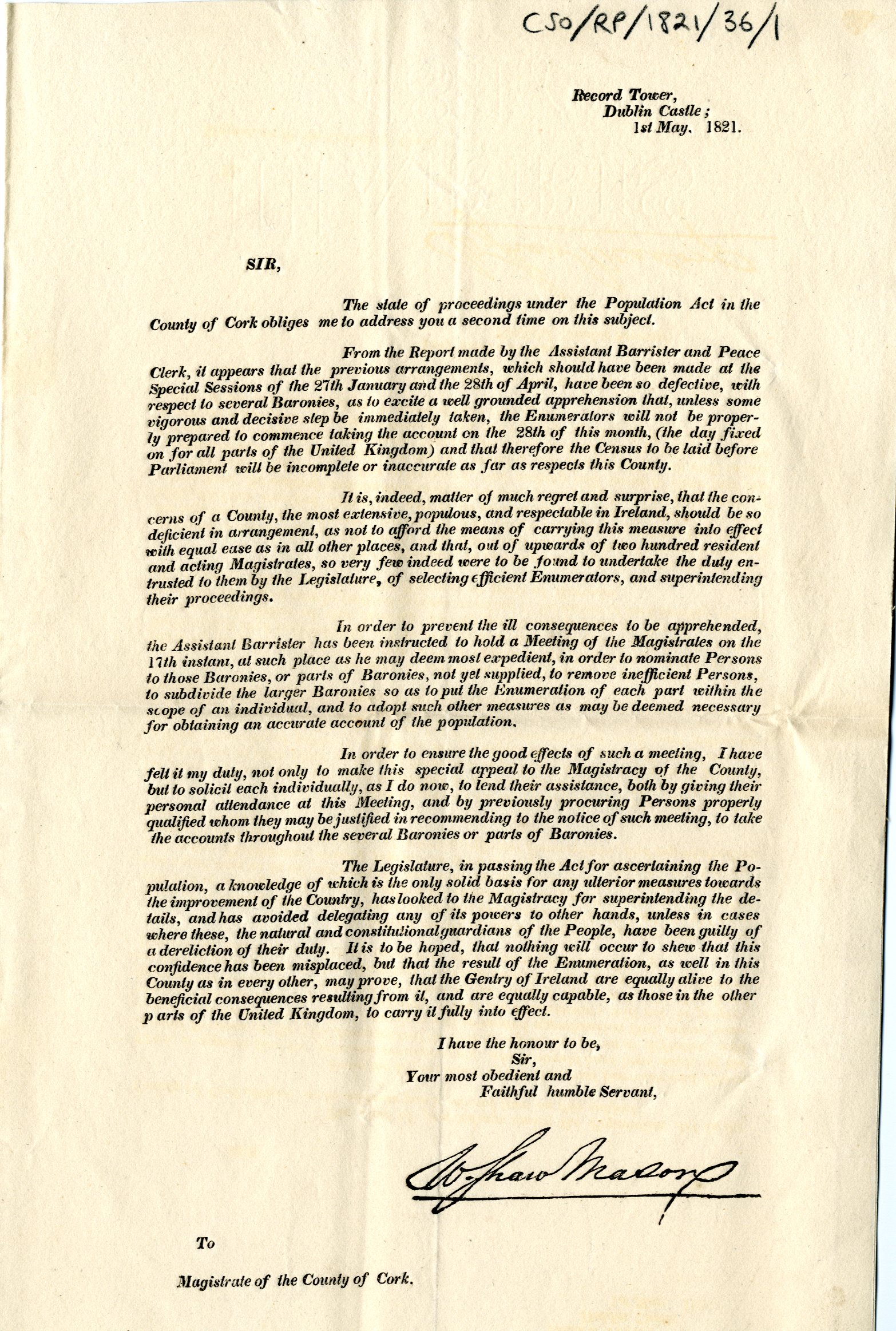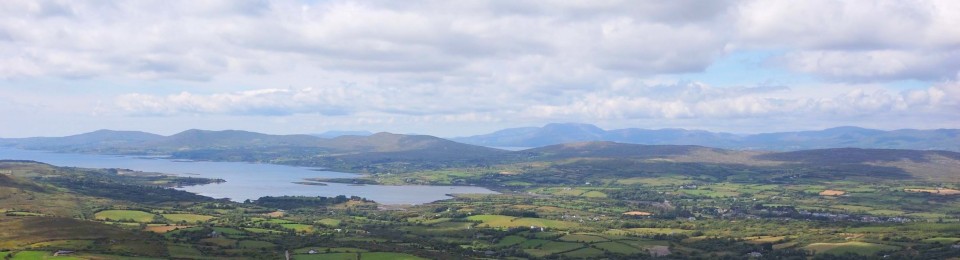
The men from Muintervara (Durrus/Kilcrohane)who have the distinguished honour of being the first Western district to have given the death blow to the Tithe system, proceeded under the conduct of Richard O’Donovan Esq of Tullagh and Timmy O’Donovan Esq at Monster Meeting Mount Gabriel 1832


The men from Muintervara (Durrus/Kilcrohane)who have the distinguished honour of being the first Western district to  have given the death blow to the Tithe system, proceeded under the conduct of Richard O’Donovan Esq of  Tullagh and Timmy O’Donovan Esq at Monster Meeting Mount Gabriel 1832

Most of the tithes of the Dioceses of Cork were acquired by underhand means by Richard Boyle, The Great Earl of Cork in the early 17th century.

For Durrus/Kilcrohane they were acquired by Nathaniel Evansons and share between him and the local Church of Ireland Minister aided by Tithe Proctors

The Tithes in 1833: ‘The year’s tithe due to Mr. Alcock, the Rector Durrus, was nearly collected in one day. The summary collection was effected by the police who act as drivers. In the case referred to the determination to to obtain ‘Tithe Distress’ was so great that I have been informed that the house where the parish priest the Revered Quin was saying Mass was forcibly entered and a bed the only item of value would have been taken but for the suggestion of some Protestant who objected to that mode of insult to a Clergyman.

Charles Evanson Esq., Lord Mayor of Cork, Born, Gearhameen, Durrus, Benefactor, 1826, to Father Quin’s Church at Rosnacaheragh, Ahakista, Presentation of Silver Tray, ‘George 3 Irish Silver with two maker’s marks for Robert Breading adn Clerk and West , Dublin, c 1805 inscribed ‘As A Requisition from the Court of D’Oyer Hundred to the Mayor, Sheriffs, and Common Council of the City of Cork, to Confer a Mark of Public Approbation upon the Conduct of Charles Evanson, Esquire, Later Mayor of the City living at Ronayne’s Court, former Treasure to Cork wide Street Commission.

The O’Donovans referred to were a major force in politics at the time:

https://docs.google.com/document/d/1eq_IayaxdUyWZWbpDf6LWlLNg7o-3tNJiqPGYIALy80/edit

The following is an extract from the southern report of the Cork Commercial Courier of the 19th July, 1832 in relation to an anti-tithe meeting on Mount Gabriel:

Anti-Tithe Meeting at the foot of Mount Gabriel

It is no longer a figure of speech to say that the voice of the Irish people has resounded from one extremity of the end to the other in reprobation of the tithe system. A meeting of the Tithe pairs of Kilmoe, Muintervara and Schull was held on Monday, the 9th July, 1832 at the base of Mount Gabriel  immediately opposite the island of Clear (Cape Clear). Although the day was wet and gloomy it only  gave a sterner and loftier character to the features of the scene which was rendered particularly  impressive and interesting from the vast and imposing array of pedestrians and equestrians (chequered with flags and banners of various colours and devices), which people did solitude on this occasion. The magnificence of the ocean view, which expanded indefinitely before the eye of the  spectator, was considerably increased by the heavy clouds which occasionally rolled over the waste of  waters. Literally girded with whirlwind and storm unredeemed by a single gleam of sunshine, and  greeted by the whaling voice of the blast, led the cold dirge of some unhallowed spirits, it appeared to  scowl darkly and ominously on the proceedings of the day. But the scene did not want its gay and  animated features, as indeed how could it be with such an immense multitude of Irish faces and Irish  towns in its immediate neighbourhood

That went in doors, windows and chimney tops of the houses and the village of Schull and   surrounding country, but the very rocks were festooned and ornamented with wreaths and garlands of   the most fantastic and beautiful kind. It might be said, without a figure, that the desert bloomed with   joy – that the rocks exulted and the hills lifted up their voices with delight. Nor was the aid of human   minstrelsy wanting on the occasion, the fiddle and bagpipe and the drum finding the expression of the  most obstreperous merriment and were responded to by such a cold symphony of yells, cheers, and sympathetic flourishes of the voice as to extend the combined efforts of the “Russian horn hand” and  the “bohemian brothers” and cause our ears to tingle with the glorious confusion of folk with an  instrumental music.

But this expression of triumph was not, as amongst our phlegmatic fellow citizens confined to a  solitary order, it engrossed the entire man, and the kindling eye, the blushed check but above all  the exotic sound in the air, which simulated more to the evolution of the aeronaut, than the sluggish  efforts of an earth born mortal to attempt the “empyrean” heights bore down the most striking evidence  to the cordiality which hailed the downfall of the publicans and sinners by whom the country had been   so long oppressed.

The languid countenance of the lowest palatine – the dark but intelligent features of the huginau, as  well as the strongly marked and impassioned aspect of the Miguizien Tied pair brightened up under  the influence of the general joyful. The procession of both in the neighbouring islands, with gaze  streamers flapping in the breeze, was particularly interesting being conducted with considerable taste   and skill. On entering the harbour at Schull they formed a line bright with the variegated hues of flags and pennants which to a distant spectator would appear to form an extreme boundary of the meeting.

The men from Muintervara who have the distinguished honour of being the first western district to  have given the death blow to the system, proceeded under the conduct of Richard O’Donovan Esq of  Tullagh and Timmy O’Donovan Esq of Ardahill (Kilcrohane) (this may be incorrect most likely Timothy O’Donovan, JP, O’Donovan’s Cove, Durrus) accompanied by the Reverend Messrs. Quin and   Kelleher with music and decorated banners. Paddy Murphy’s celebrated steed tastefully caparisoned  and bearing evidence of its branded hide of the proctor’s defeat and the people’s triumph was  conscious in the procession – the Tithe pairs of Ballydehob congregated from hill  and dale (Protestant  and Catholic) whole lights and new lights the children of call, the descendants of the huginau (Huguenot local families Dukelow, Camier, Connell (Quesnell), Levis) joining  heart and hand for the removal of a common grievance and made a very respectable appearance.

On entering the village of Schull with flaunting banners and music preceded by J. Barry and D. Welpley Esq and accompanied by the Reverend Messrs. Barry and Walsh, they were met by the  Reverend Lawrence O’Sullivan P.P. of Kilmoe (Ballydehob) and the Reverend T. Barry P.P. of Bantry. Here the  cavalcade presented a most attractive spectacle with its respectable numbers and made the firm earth  tremble as with the voice of victory.

The men of Crookhaven, under the direction of J. Coughlan, and accompanied by the Reverend Mr.  Begley were distinguished by their characteristic order and regularity. Nothing could be more  gratifying than the spirit and independence manifested in their appearance and conduct about the hour  of two o’clock. Richard O’Donovan Esq of Tullig (outside Ahakista) was called to the chair and the acclamations  of the assembled thousands. In a brief but energetic speech he explained the object of the  meeting, the mode by which they proposed to attain that object and a necessity of yielding the  most implicit obedience of the laws for the purpose of securing the attainment. His address  was received with reiterated enthusiastic cheers.

Messrs. Welpley, Barry and Jagoe followed in eloquent and stirring speeches, the latter a respectable  Protestant gentleman of distinguishing liberality.

The Reverend Messrs. Barry, Quinn, Walsh and Begley also spoke with great ability and effect to the  object of the meeting and impressed upon the minds of their auditory the justice as well as the  necessity of rendering a prompt and cheerful submission to the laws.

Magistrates:

Richard O’Donovan 1818, Fort Lodge, Durrus listed 1838 , son Richard Esq. O’Donovan Cove, and Jane d Alexander O’Donovan, Squince.  Father of Richard O’Donovan JP History  Brother of Timothy and Dr. Daniel O’Donovan JP  He married Maria O’Sullivan on the 15th October 1833, her father was Murty Og, of Ceimatringane House, Castletownbere. She died at Fort Lodge, aged 52, voted 1850 for Denis Galwey as High Constable for Ibane and Ballyroe (Clonakilty). Lease Richard O’Donovan, Magistrate,  of Glanlough, Cork Esq. and Francis Lisabe of Balyshannon, Co. Donegal, civil engineer, of a slate and a flag quarry, and 2 acres of land near the slate quarry in Gouladoo in the parish of Kilcrohane, West Cork, 6th Feb. 1854, Socicitor Desmnd, Son-in-Law of John Jagoe, Fishery Commissioner and father of Mother Beninga Townsville, Australia.Land record, in Chancery as ‘Donovan’ 1870, 205 acres. Land record, Carrigboy,1870, 193 acres. Member election at Ahakista committee McCarthy Downing, Skibbereen, 1868.  

Timothy O’Donovan (1790-1874), 1818, O’Donovan’s Cove, in ruins 1875, Durrus, listed 1838, son of Richard Esq. and Jane d Alexander O’Donovan, Squince.  Present at enquiry Skibbereen 1823 into enquiry into fatal affray at Castlehaven caused by Rev. Morritt’s tithe extraction. Correspondent with Antiquarian Dr. John O’Donovan re O’Donovans of Carbery.  Brother of Dr O’Donovan and Richard O’Donovan JP and uncle of Richard O’Donovan JP. His son’s wife is grand daughter to Daniel O’Connell, the mother of his wife was a Miss Lavellan, Co. Limerick, a daughter of Philip Lavellin of Water Park in the County of Cork.  Her sister was married to Mr. Puxley of Dunboy Branch. The grandson the present (1860) Mr. Puxley is a man of immense wealth the principal owner of the famous Allihies Mines in the Barony of Bere.  Signed public declaration in Skibbereen to Alexander O’Driscoll on his removal as Magistrate 1835 with Lord Bantry, Simon White, John Puxley, Arthur Hutchins, Thomas Baldwin, Samuel Townsend Junior and Senior, Thomas Somerville, Richard Townsend Senior, Rev. Alleyn Evanson, Richard Townsend, Lyttleton Lyster. 1835 Subscriber Lewis Topographical Dictionary of Ireland 1837.  In 1838 in the Liberal interest where at Bantry voter registration 15 were registered as opposed to 6 ‘Orangemen’ the tenants of Timothy O’Donovan JP were chiefly among those who registered.  Among these were probably McCarthys of Tulig later prominent in Nationalist politics of whom John Mccarthy (1859-1931)became a leading  in Nebraska and wrote a poem in praise of Timothy O’Donovan.  Attended Great Meeting in Bantry 1840 re Poor Laws.  Chaired 1846 distress meeting Bantry on proposition of Father Michael Barry PP Bantry. Landlord and political organiser. Member Election Committee, Rickard Deasy, Clonakilty (later Attorney General) 1855  Member election committee McCarthy Downing, Skibbereen. Juror Cork Spring Assizes 1863.   Land record, 1870, Kate O’Donovan, O’Donovan’s Cove, 1,940 acres and Reps Timothy O’Donovan 1,940 acres. 1874, Death at 85 of Timothy O’Donovan, J.P., Esq, O’Donovan Cove, Durrus, West Cork, The Last Survivor of the Ancient House of O’Donovan Bawn or Clann Cahill, Justice of the Peace since 1818 Probate to daughter Mrs Anne Barry, widow, effects £2,000, attended 8, Grand Jury Presentments

 

Cork Commercial Courier of the 19th July, 1832 in relation to an anti-tithe meeting on Mount Gabriel, Schull


The following is an extract from the southern report of the Cork Commercial Courier of the 19th July, 1832 in relation to an anti-tithe meeting on Mount Gabriel:

Anti-Tithe Meeting at the foot of Mount Gabriel

It is no longer a figure of speech to say that the voice of the Irish people has resounded from one extremity of the end to the other in reprobation of the tithe system. A meeting of the Tithe pairs of Kilmoe, Muintervara and Schull was held on Monday, the 9th July, 1832 at the base of Mount Gabriel  immediately opposite the island of Clear (Cape Clear). Although the day was wet and gloomy it only  gave a sterner and loftier character to the features of the scene which was rendered particularly  impressive and interesting from the vast and imposing array of pedestrians and equestrians (chequered with flags and banners of various colours and devices), which people did solitude on this occasion. The magnificence of the ocean view, which expanded indefinitely before the eye of the  spectator, was considerably increased by the heavy clouds which occasionally rolled over the waste of  waters. Literally girded with whirlwind and storm unredeemed by a single gleam of sunshine, and  greeted by the whaling voice of the blast, led the cold dirge of some unhallowed spirits, it appeared to  scowl darkly and ominously on the proceedings of the day. But the scene did not want its gay and  animated features, as indeed how could it be with such an immense multitude of Irish faces and Irish  towns in its immediate neighbourhood

That went in doors, windows and chimney tops of the houses and the village of Schull and   surrounding country, but the very rocks were festooned and ornamented with wreaths and garlands of   the most fantastic and beautiful kind. It might be said, without a figure, that the desert bloomed with   joy – that the rocks exulted and the hills lifted up their voices with delight. Nor was the aid of human   minstrelsy wanting on the occasion, the fiddle and bagpipe and the drum finding the expression of the  most obstreperous merriment and were responded to by such a cold symphony of yells, cheers, and sympathetic flourishes of the voice as to extend the combined efforts of the “Russian horn hand” and  the “bohemian brothers” and cause our ears to tingle with the glorious confusion of folk with an  instrumental music.

But this expression of triumph was not, as amongst our phlegmatic fellow citizens confined to a  solitary order, it engrossed the entire man, and the kindling eye, the blushed check but above all  the exotic sound in the air, which simulated more to the evolution of the aeronaut, than the sluggish  efforts of an earth born mortal to attempt the “empyrean” heights bore down the most striking evidence  to the cordiality which hailed the downfall of the publicans and sinners by whom the country had been   so long oppressed.

The languid countenance of the lowest palatine – the dark but intelligent features of the huginau, as  well as the strongly marked and impassioned aspect of the Miguizien Tied pair brightened up under  the influence of the general joyful. The procession of both in the neighbouring islands, with gaze  streamers flapping in the breeze, was particularly interesting being conducted with considerable taste   and skill. On entering the harbour at Schull they formed a line bright with the variegated hues of flags and pennants which to a distant spectator would appear to form an extreme boundary of the meeting.

The men from Muintervara who have the distinguished honour of being the first western district to  have given the death blow to the system, proceeded under the conduct of Richard O’Donovan Esq of  Tullagh and Timmy O’Donovan Esq of Ardahill (Kilcrohane) (this may be incorrect most likely Timothy O’Donovan, JP, O’Donovan’s Cove, Durrus) accompanied by the Reverend Messrs. Quin and   Kelleher with music and decorated banners. Paddy Murphy’s celebrated steed tastefully caparisoned  and bearing evidence of its branded hide of the proctor’s defeat and the people’s triumph was  conscious in the procession – the Tithe pairs of Ballydehob congregated from hill  and dale (Protestant  and Catholic) whole lights and new lights the children of call, the descendants of the huginau joining  heart and hand for the removal of a common grievance and made a very respectable appearance.

On entering the village of Schull with flaunting banners and music preceded by J. Barry and D. Welpley Esq and accompanied by the Reverend Messrs. Barry and Walsh, they were met by the  Reverend Lawrence O’Sullivan P.P. of Kilmoe (Ballydehob) and the Reverend T. Barry P.P. of Bantry. Here the  cavalcade presented a most attractive spectacle with its respectable numbers and made the firm earth  tremble as with the voice of victory.

The men of Crookhaven, under the direction of J. Coughlan, and accompanied by the Reverend Mr.  Begley were distinguished by their characteristic order and regularity. Nothing could be more  gratifying than the spirit and independence manifested in their appearance and conduct about the hour  of two o’clock. Richard O’Donovan Esq of Tullig (outside Ahakista) was called to the chair and the acclamations  of the assembled thousands. In a brief but energetic speech he explained the object of the  meeting, the mode by which they proposed to attain that object and a necessity of yielding the  most implicit obedience of the laws for the purpose of securing the attainment. His address  was received with reiterated enthusiastic cheers.

Messrs. Welpley, Barry and Jagoe followed in eloquent and stirring speeches, the latter a respectable  Protestant gentleman of distinguishing liberality.

The Reverend Messrs. Barry, Quinn, Walsh and Begley also spoke with great ability and effect to the  object of the meeting and impressed upon the minds of their auditory the justice as well as the  necessity of rending a prompt and cheerful submission to the laws.

1832: The Reverend Messrs. Quin and Kelleher, the Roman Catholic Clergy of Muintervara, West Cork, were arrested on Saturday, the 15th September or having attended at a Tithe meeting. Bail was immediately procured in the person of Richard O’Donovan Esq, the Chairman of the late anti-tithe meeting in the parish and Timothy O’Donovan Esq at Ardahill, Kilcrohane.


https://www.academia.edu/s/7599bddb58?show_pending=true

Note from the southern report from the Cork Commercial Courier dated the 29th September 1832.

1832: The Reverend Messrs. Quin and Kelleher, the Roman Catholic Clergy of Muintervara, West Cork,  were arrested on Saturday, the 15th September or having attended at a Tithe meeting. Bail was immediately procured in the person of Richard O’Donovan Esq, the Chairman of the late Anti-Tithe meeting in the Parish and Timothy O’Donovan Esq at Ardahill, Kilcrohane.

Rev Richard Quinn P.P. 1818-1849, Incardated from Dioceses of Cashel, commenced registration of births and marriages, built church at Ahakista 1828 and Kilcrohane 1820. One of a number of priests assigned to Cork from tipperary including Fathers Dore, Caheragh, Ryan Drimoleague and Doheny Dunmanway all reformers adn politically active. List of names who subscribed to church in 1826 included a major contribution from Lord Carbery and various members of the Evanson/Beamish families.  Involved in famine relief in 1822 with the Earl of Bantry and the Rev Alcock.  In the Ordnance Survey house books his house in Clashadoo was one of the few slated.  In  1832: The Reverend Messrs. Quin and Kelleher, the Roman Catholic Clergy of Muintervara, West Cork,  were arrested on Saturday, the 15th September or having attended at a Tithe meeting. Bail was immediately procured in the person of Richard O’Donovan Esq, the Chairman of the late Anti-Tithe meeting in the Parish and Timothy O’Donovan Esq at Ardahill, Kilcrohane.1833 the Rev Edward Alcock’s Tithe Proctors attempted to seize his bed for non payment of tithes only the intervention of local Protestant neighbours prevented this.  They may have been sent by Nathaniel Evanson who owned most of the tithes.  Active in O’Connell Tribute with curate Rev. Simon Murphy major contributors Tobin family.  1840 calling for Testimonial to late William Crawford Cork benefactor.

Richard O’Donovan 1818, Fort Lodge, Durrus listed 1838 , son Richard Esq. O’Donovan Cove, and Jane d Alexander O’Donovan, Squince.  Father of Richard O’Donovan JP History  Brother of Timothy and Dr. Daniel O’Donovan JP  He married Maria O’Sullivan on the 15th October 1833, her father was Murty Og, of Ceimatringane House, Castletownbere. She died at Fort Lodge, aged 52, voted 1850 for Denis Galwey as High Constable for Ibane and Ballyroe (Clonakilty). Land record, in Chancery as ‘Donovan’ 1870, 205 acres. Land record, Carrigboy,1870, 193 acres. Member election at Ahakista committee McCarthy Downing, Skibbereen, 1868.  

Timothy O’Donovan (1790–1874), 1818, O’Donovan’s Cove, in ruins 1875, Durrus, listed 1838 , son Richard Esq. and Jane d Alexander O’Donovan, Squince.  Present at enquiry Skibbereen 1823 into enquiry into fatal affray at Castlehaven caused by Rev. Morritt’s tithe extraction. Correspondent with Antiquarian Dr. John O’Donovan re O’Donovans of Carbery.  Brother of Dr O’Donovan and Richard O’Donovan JP and uncle of Richard O’Donovan JP. His son’s wife is grand daughter to Daniel O’Connell, the mother of his wife was a Miss Lavellan, Co. Limerick, a daughter of Philip Lavellin of Water Park in the County of Cork.  Her sister was married to Mr. Puxley of Dunboy Branch. The grandson the present (1860) Mr. Puxley is a man of immense wealth the principal owner of the famous Allihies Mines in the Barony of Bere.  1835 Subscriber Lewis Topographical Dictionary of Ireland 1837.  In 1838 in the Liberal interest where at Bantry voter registration 15 were registered as opposed to 6 ‘Orangemen’ the tenants of Timothy O’Donovan JP were chiefly among those who registered.  Among these were probably McCarthys of Tulig later prominent in Nationalist politics of whom John McCarthy (1859-1931) became a leading  politician in Nebraska and wrote a poem in praise of Timothy O’Donovan.  Attended Great Meeting in Bantry 1840 re Poor Laws.  Chaired 1846 distress meeting Bantry on proposition of Father Michael Barry PP Bantry. Landlord and political organiser. Member Election Committee, Rickard Deasy, Clonakilty (later Attorney General) 1855.  Member election committee McCarthy Downing, Skibbereen.  Land record, 1870, Kate O’Donovan, O’Donovan’s Cove, 1,940 acres and Reps Timothy O’Donovan 1,940 acres. 1874, Death at 85 of Timothy O’Donovan, J.P., Esq, O’Donovan Cove, Durrus, West Cork, The Last Survivor of the Ancient House of O’Donovan Bawn or Clann Cahill, Justice of the Peace since 1818 Probate to daughter Mrs Anne Barry, widow, effects £2,000.

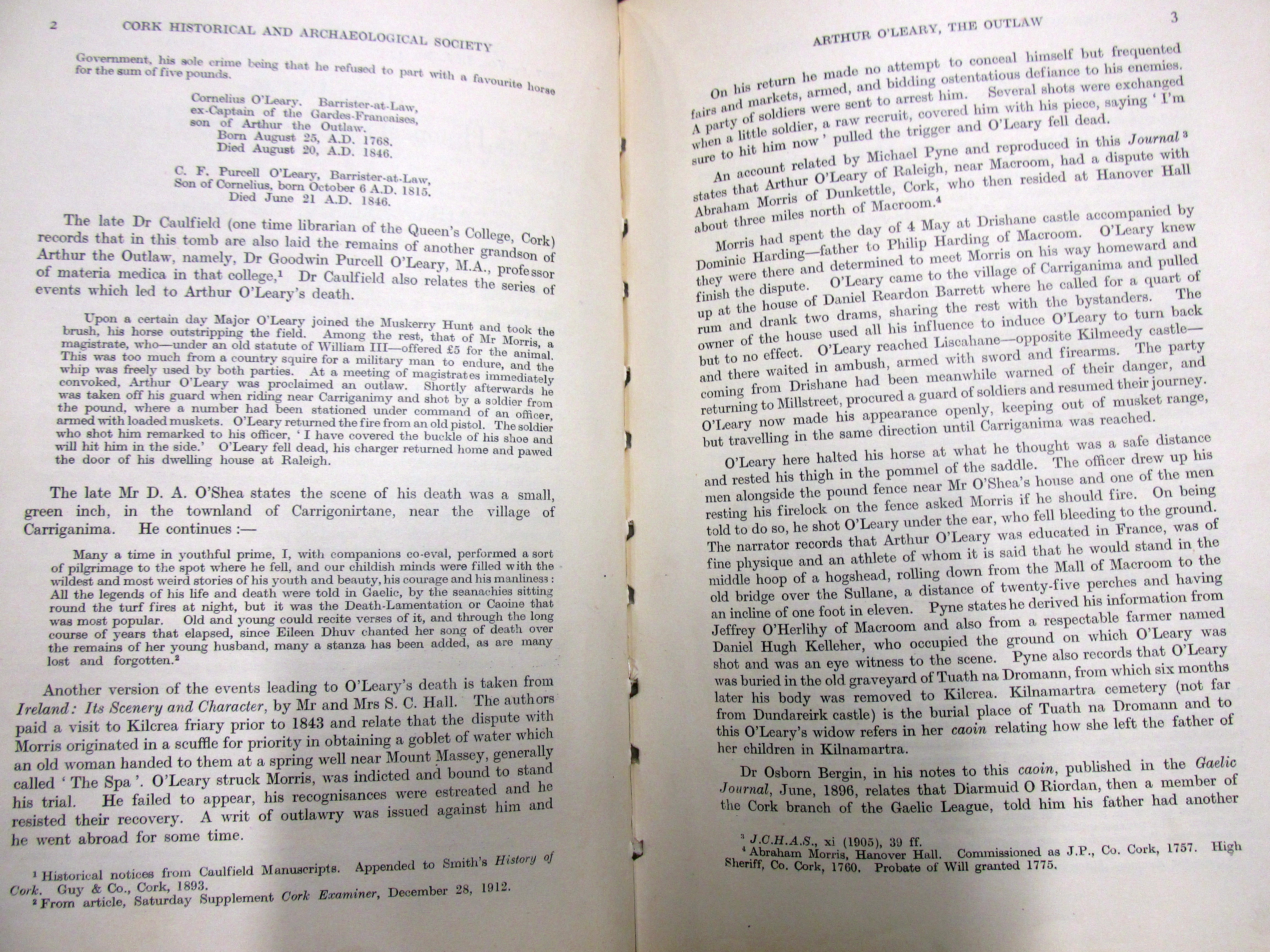
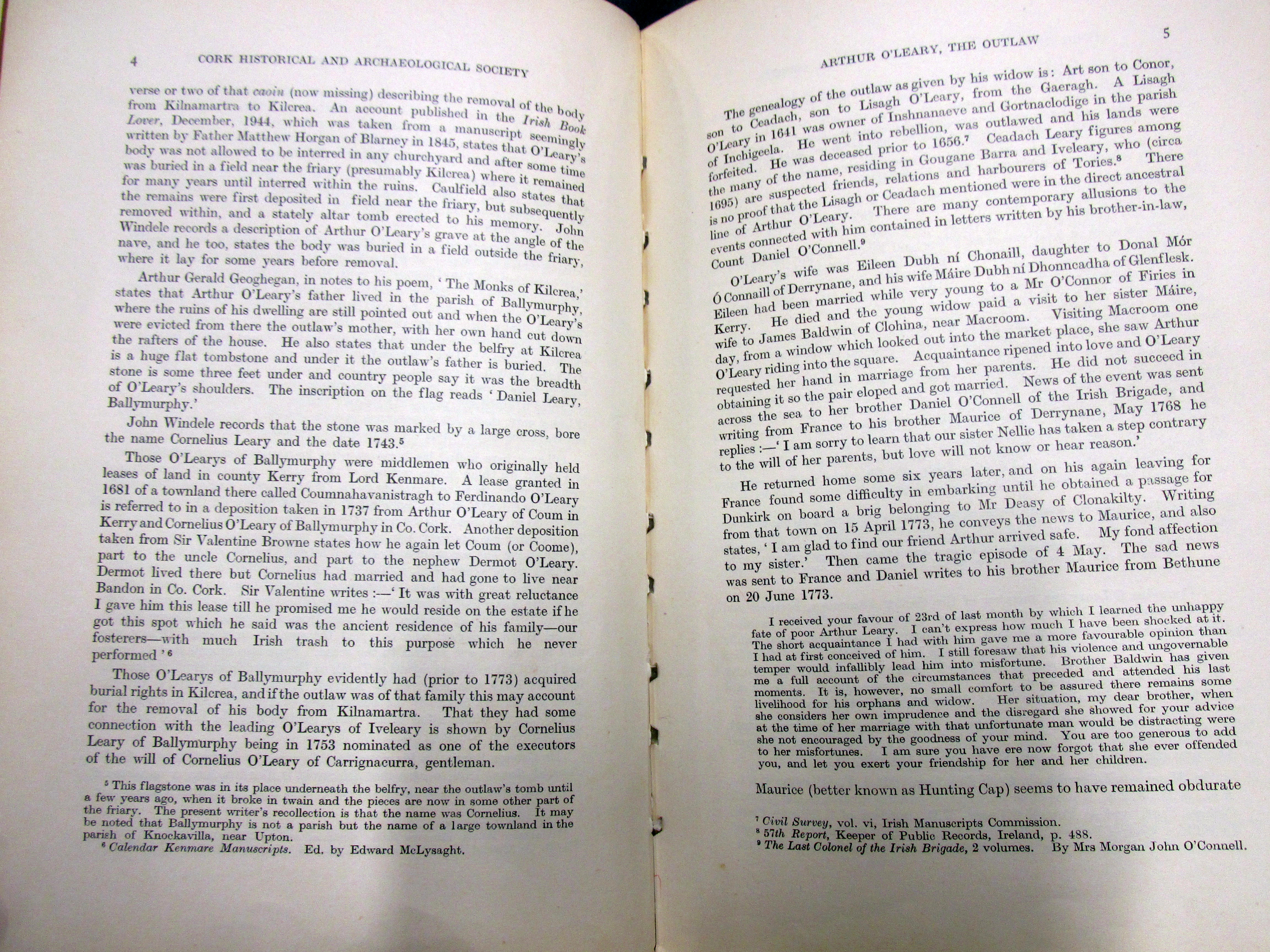
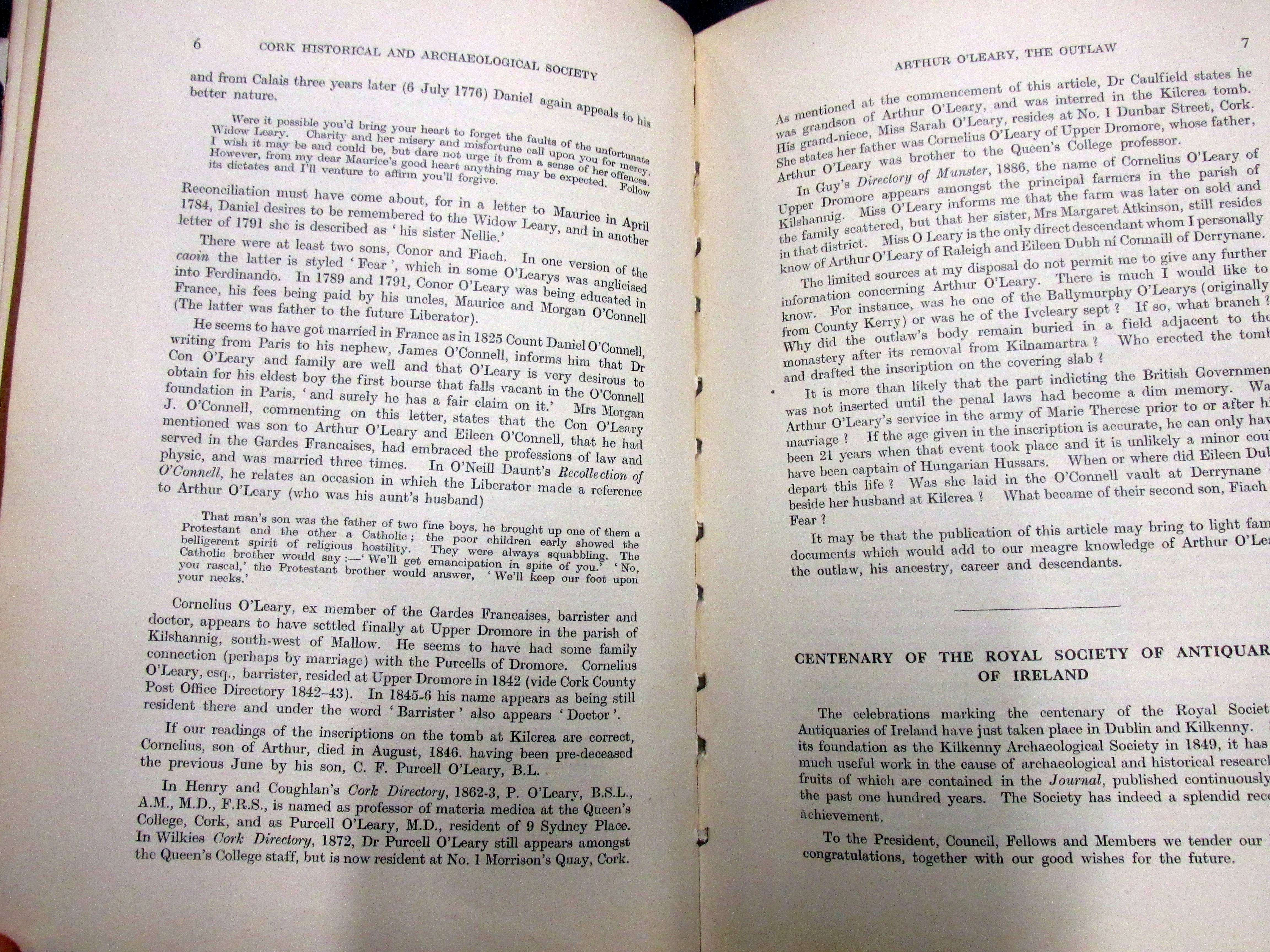
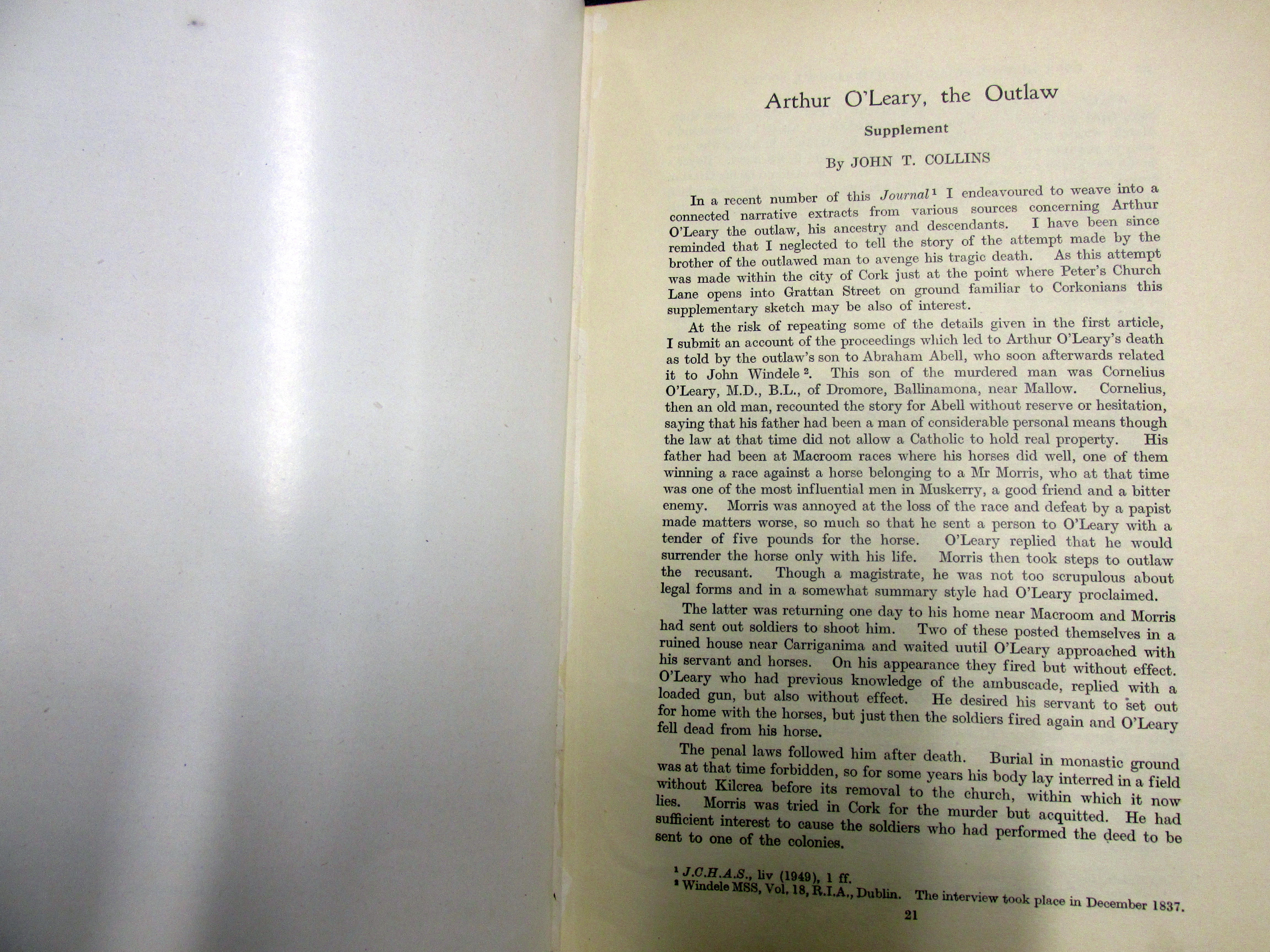
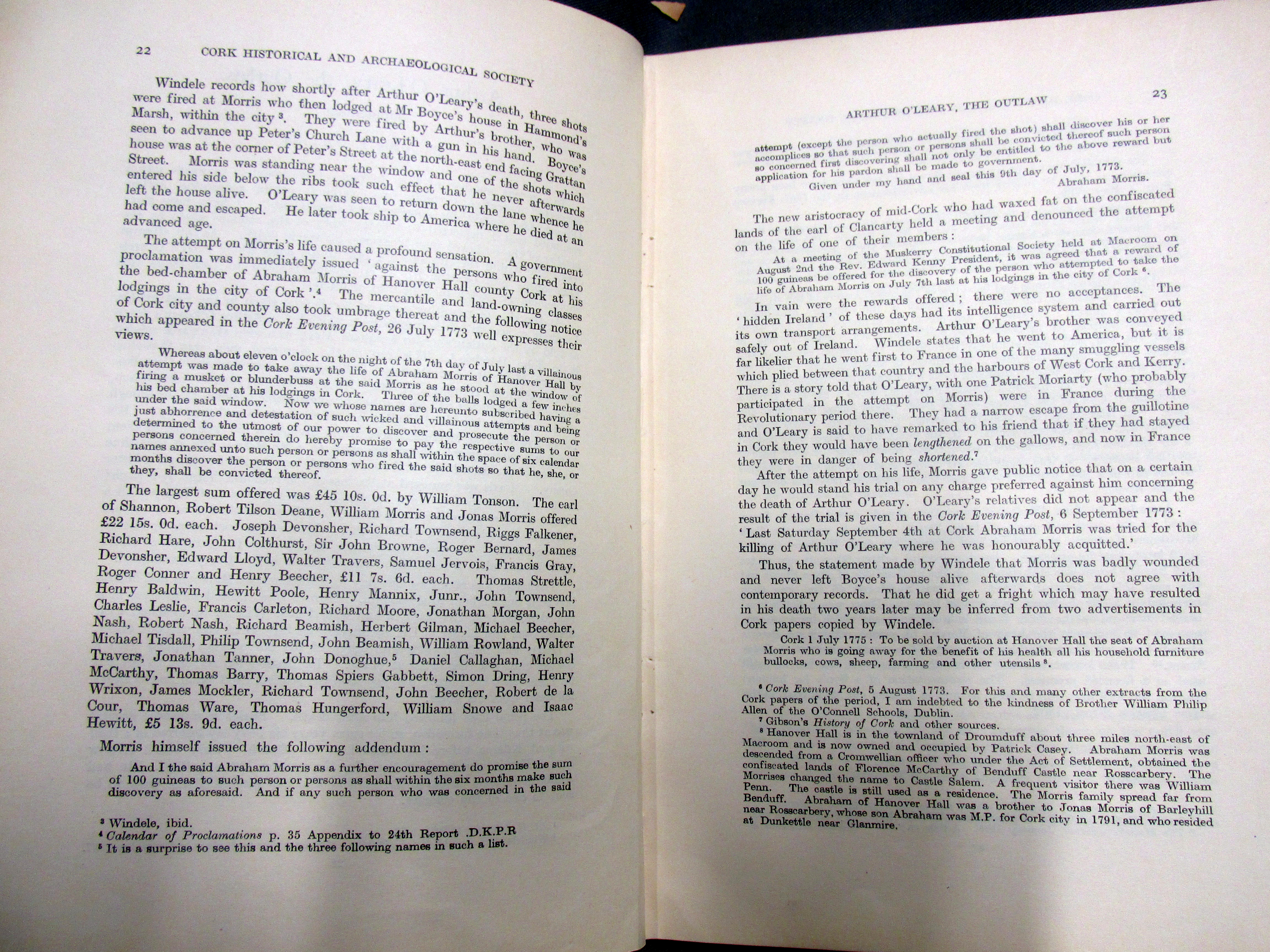
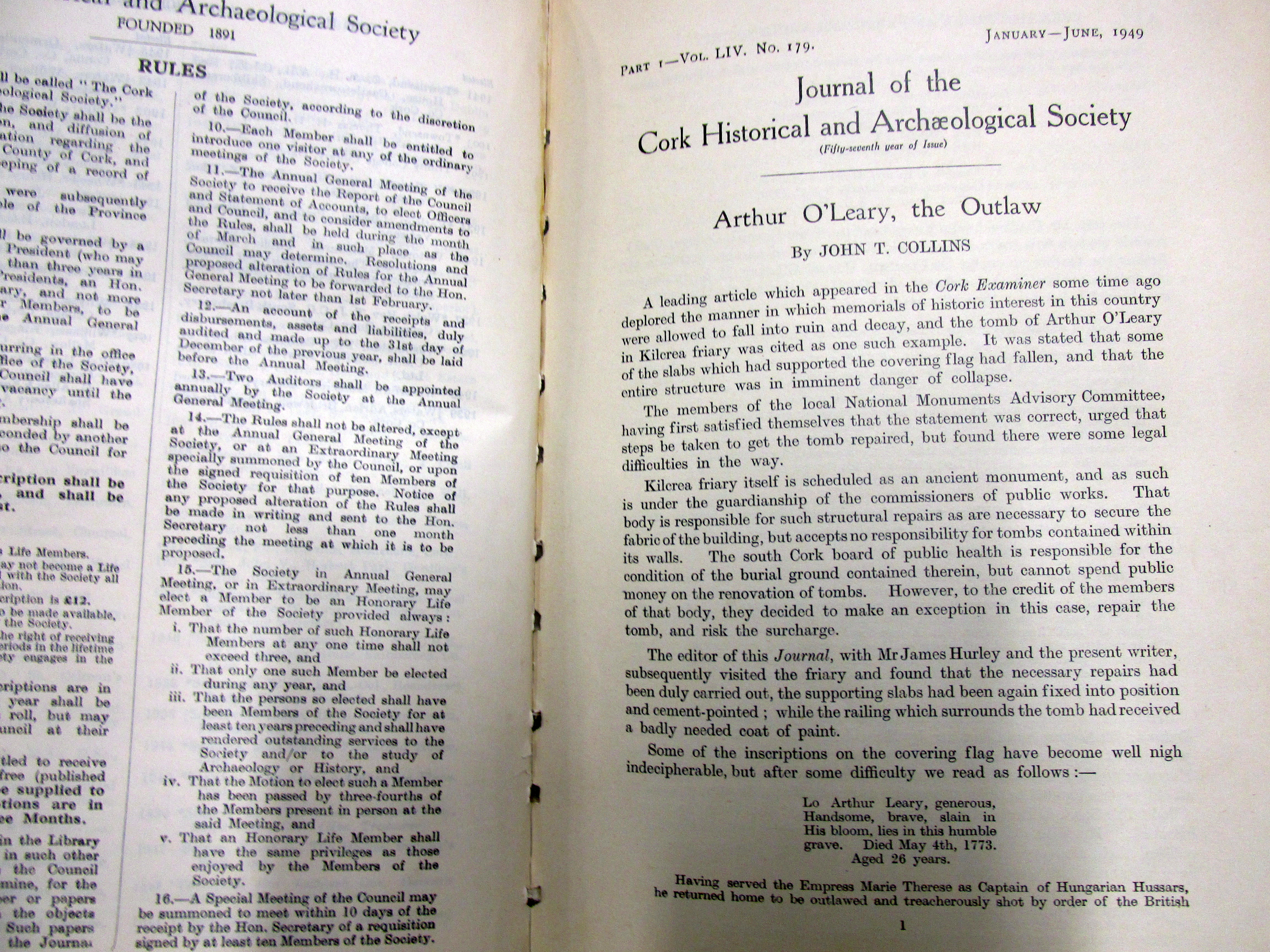
Art O’Leary, French Educated, Captain of The Hungarian Hussars, refused offer for his winning horse of £5 under Penal Laws by Abraham Morris, proclaimed an outlay, killing at age of 26, his wife an aunt of Daniel O’Connell ‘Caoineadh Art Uí Laoighre.


durrushistory's avatarWest Cork History

Art O’Leary, French Educated, Captain of The Hungarian Hussars, refused offer for his winning horse of £5 under Penal Laws by Abraham Morris, proclaimed an outlay, killing at age of 26, his wife an aunt of Daniel O’Connell ‘Caoineadh Art Uí Laoighre.

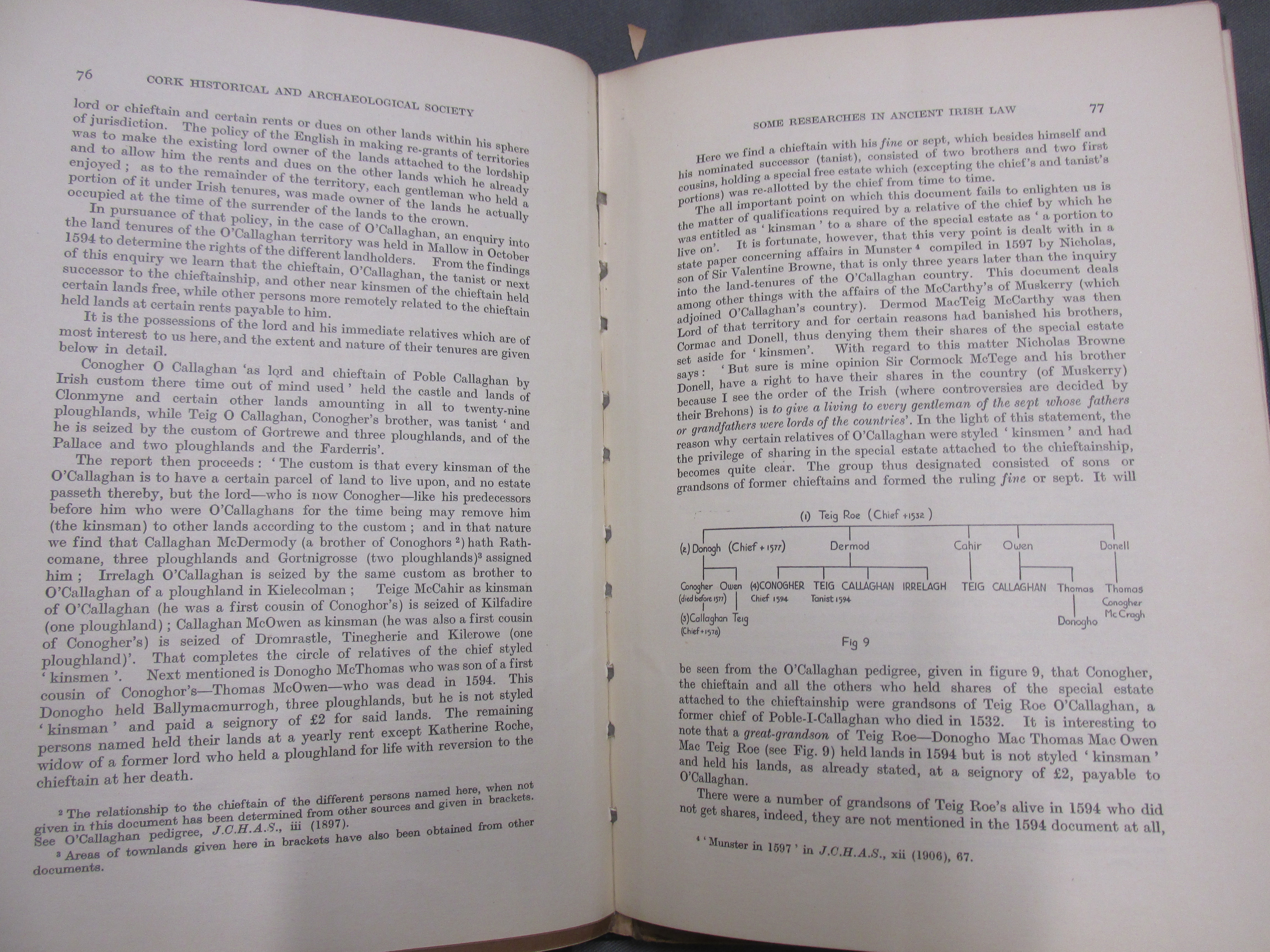
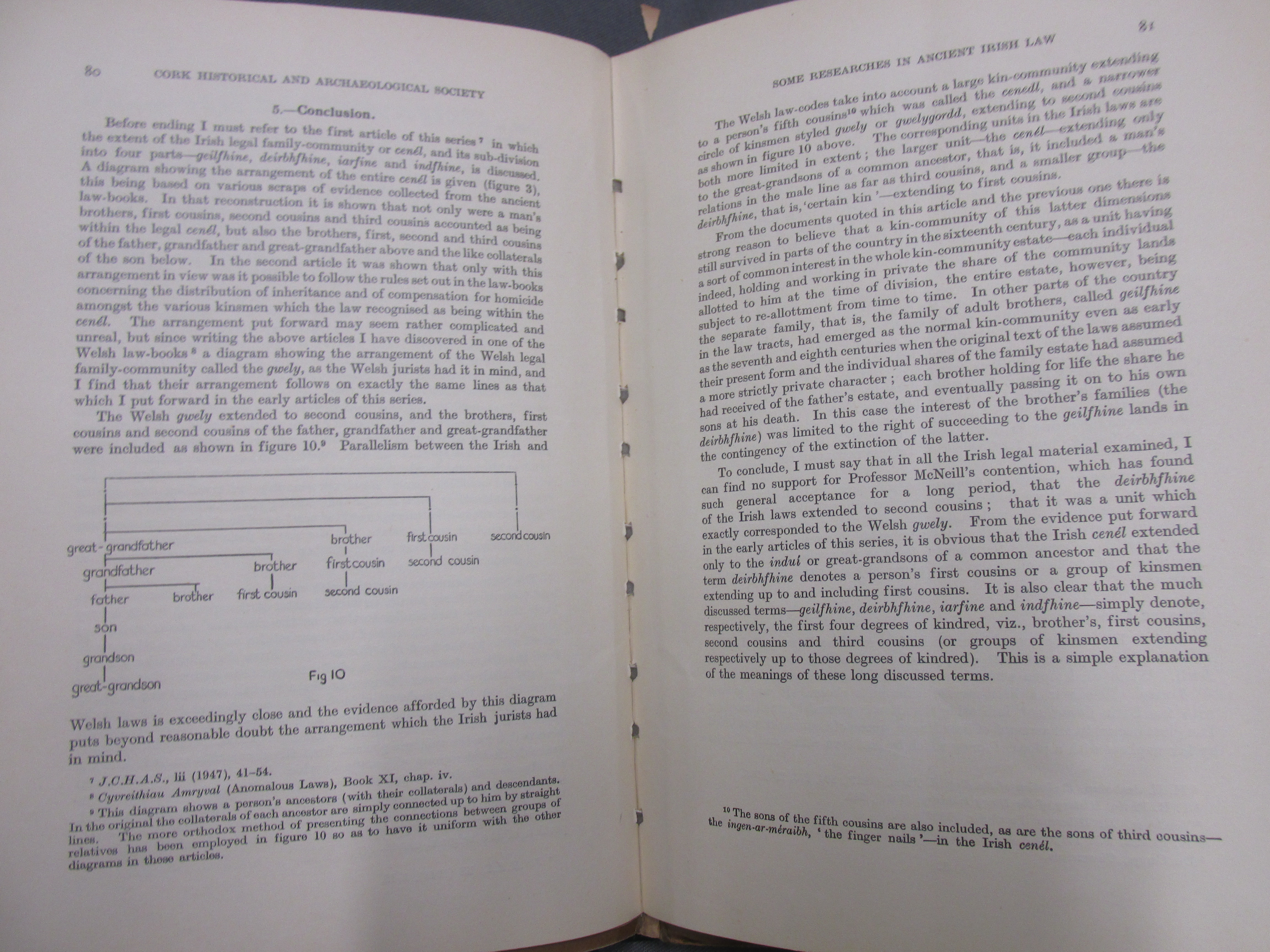
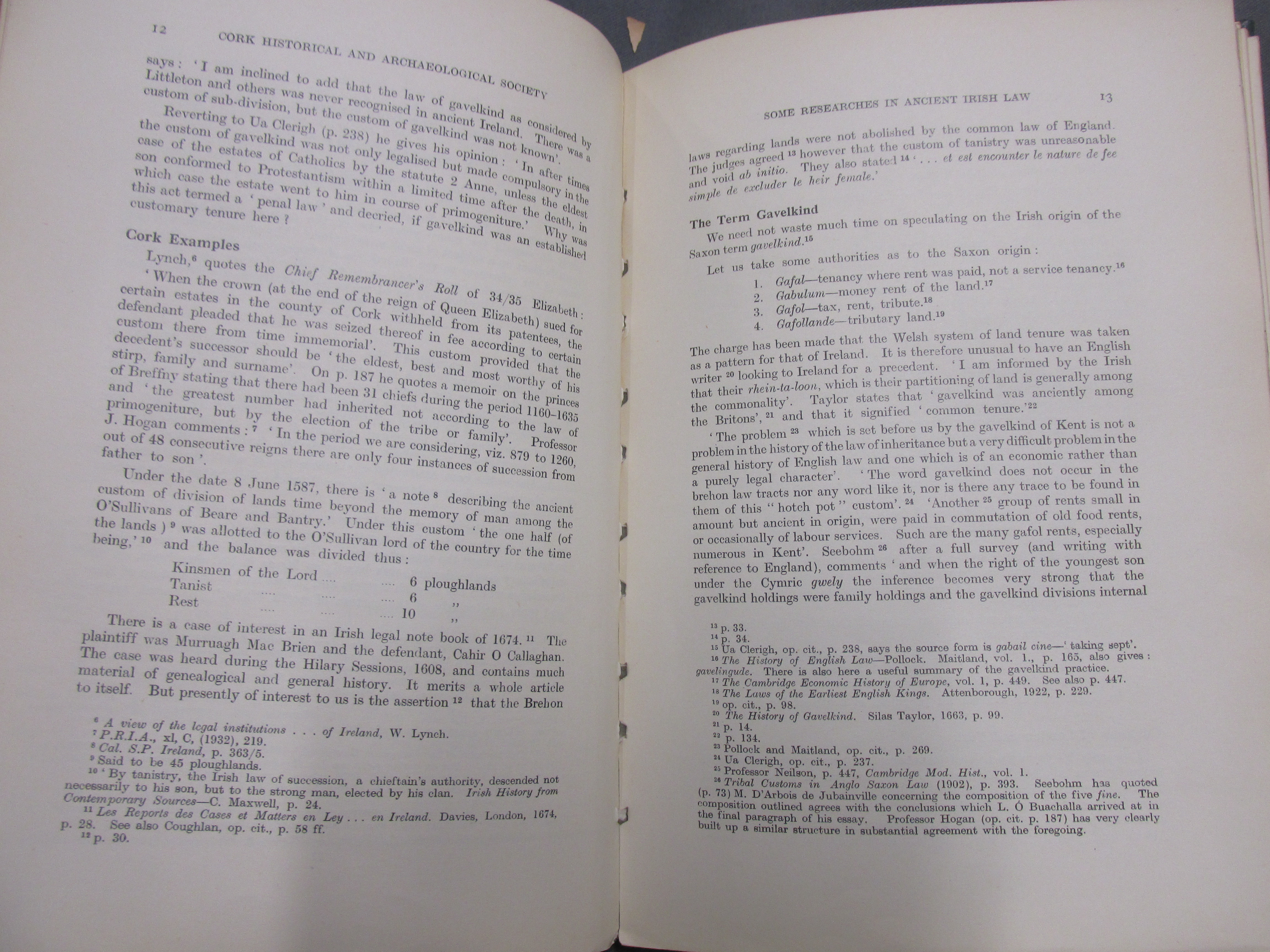
Article John T Collins, Cork Historian, 1949.

Courtesy Cork Historical and Archaeological Society.

https://durrushistory.wordpress.com/2014/02/07/lo-arthur-leary-generous-brave-handsome-slain-in-his-bloom-lies-in-this-humble-grave-died-the-4th-may-1771-aged-26-years-having-served-the-empress-maria-teresa-as-captain-of-the-hungarian-hussars-he-r/

1-IMG_6587

01-IMG_6588

02-IMG_6589

03-IMG_6590

04-IMG_6591

05-IMG_6592

06-IMG_6593

07-IMG_6594

08-IMG_6595

09-IMG_6596

10-IMG_6597

11-IMG_6598

12-IMG_6599

From Father Holland’s History of west Cork, 1949:

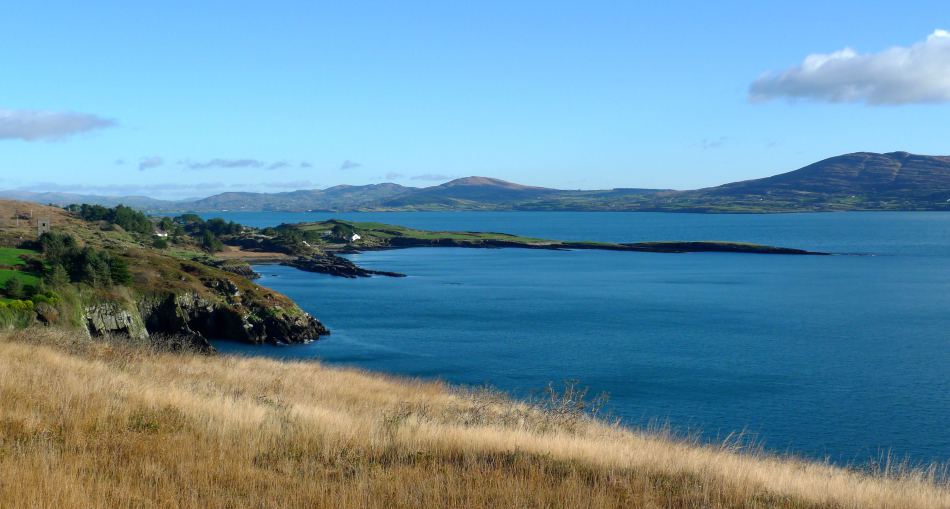
St Martin's Summer: late November on the Sheep's Head

View original post

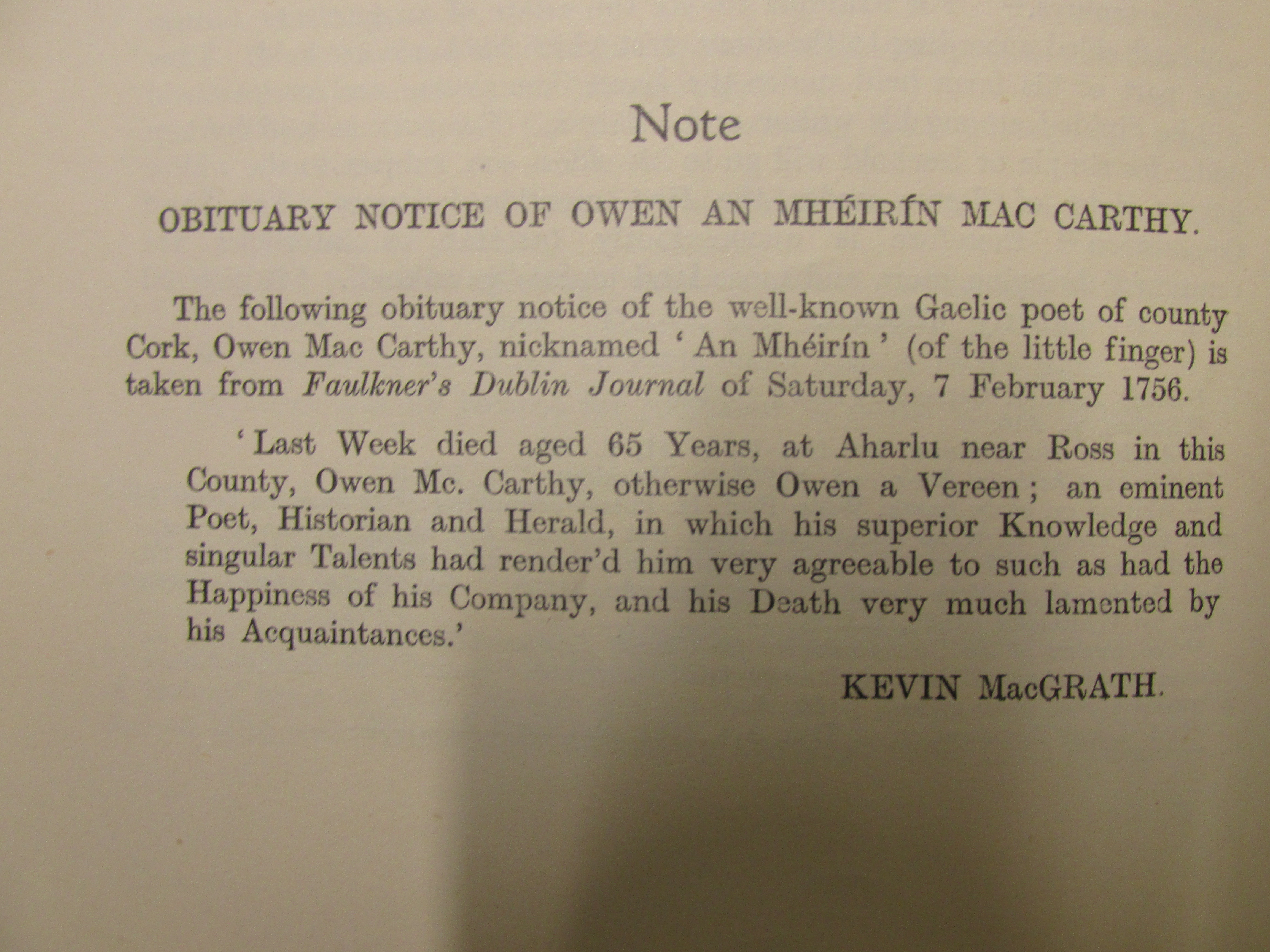
Obituary, Faulkiner’s Dublin Journal, 7th February 1756, Owen An Mheirín (The Little finger) McCarthy, at Aharlu, near Ross, Co. Cork, Well Known Gaelic Poet, Historian and Herald, in which his Superior Knowledge and Singular Talents had rendered him very agreeable to such as had the Happiness of his Company.


durrushistory's avatarWest Cork History

Obituary, Faulkiner’s Dublin Journal,  7th February 1756, Owen An Mheirín (The Little finger) McCarthy, at Aharlu, near Ross, Co. Cork, Well Known Gaelic Poet, Historian and Herald, in which his Superior Knowledge and Singular Talents had rendered him very agreeable to such as had the Happiness of his Company.

1-IMG_6602

1-IMG_6602

View original post

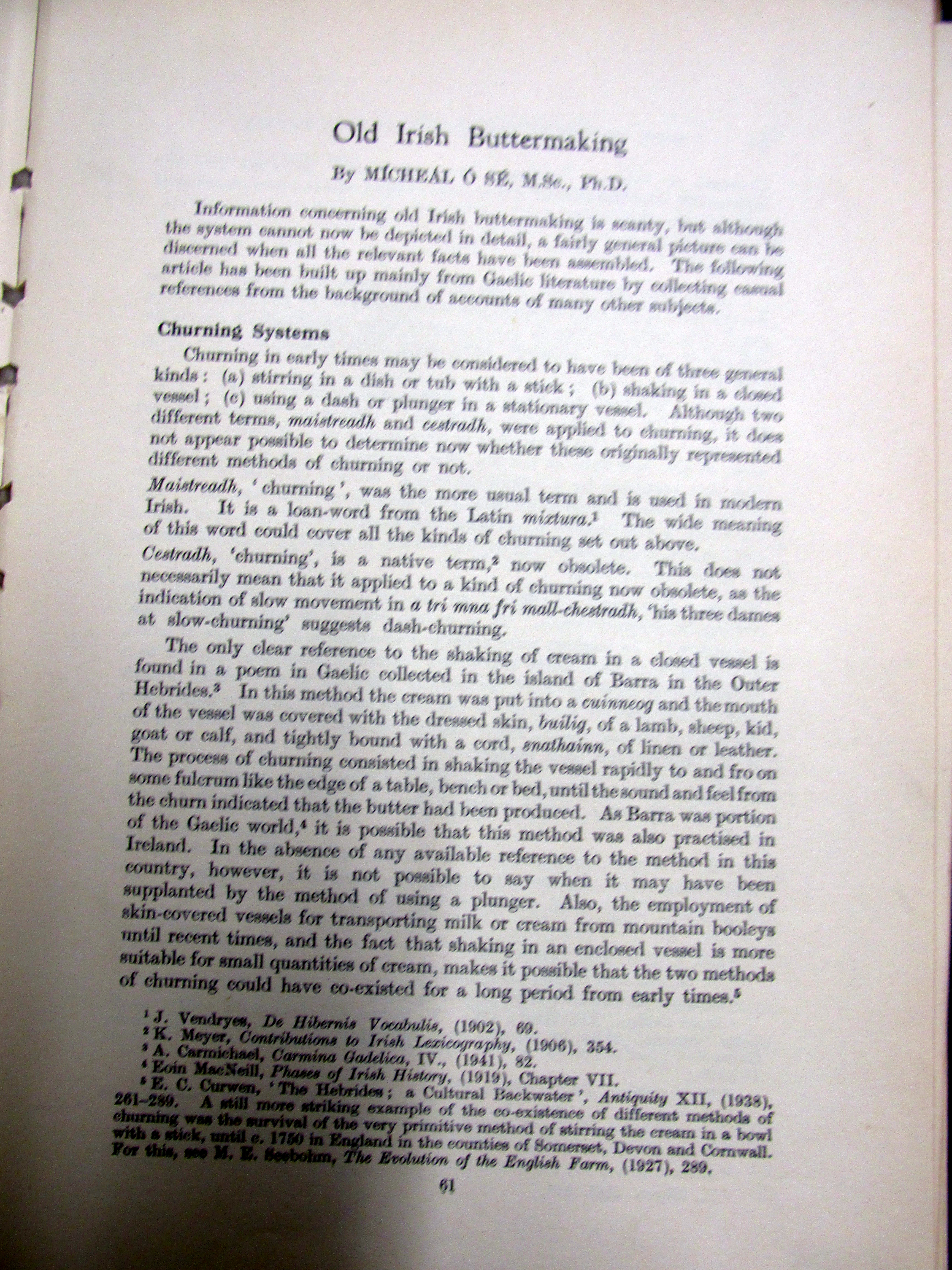
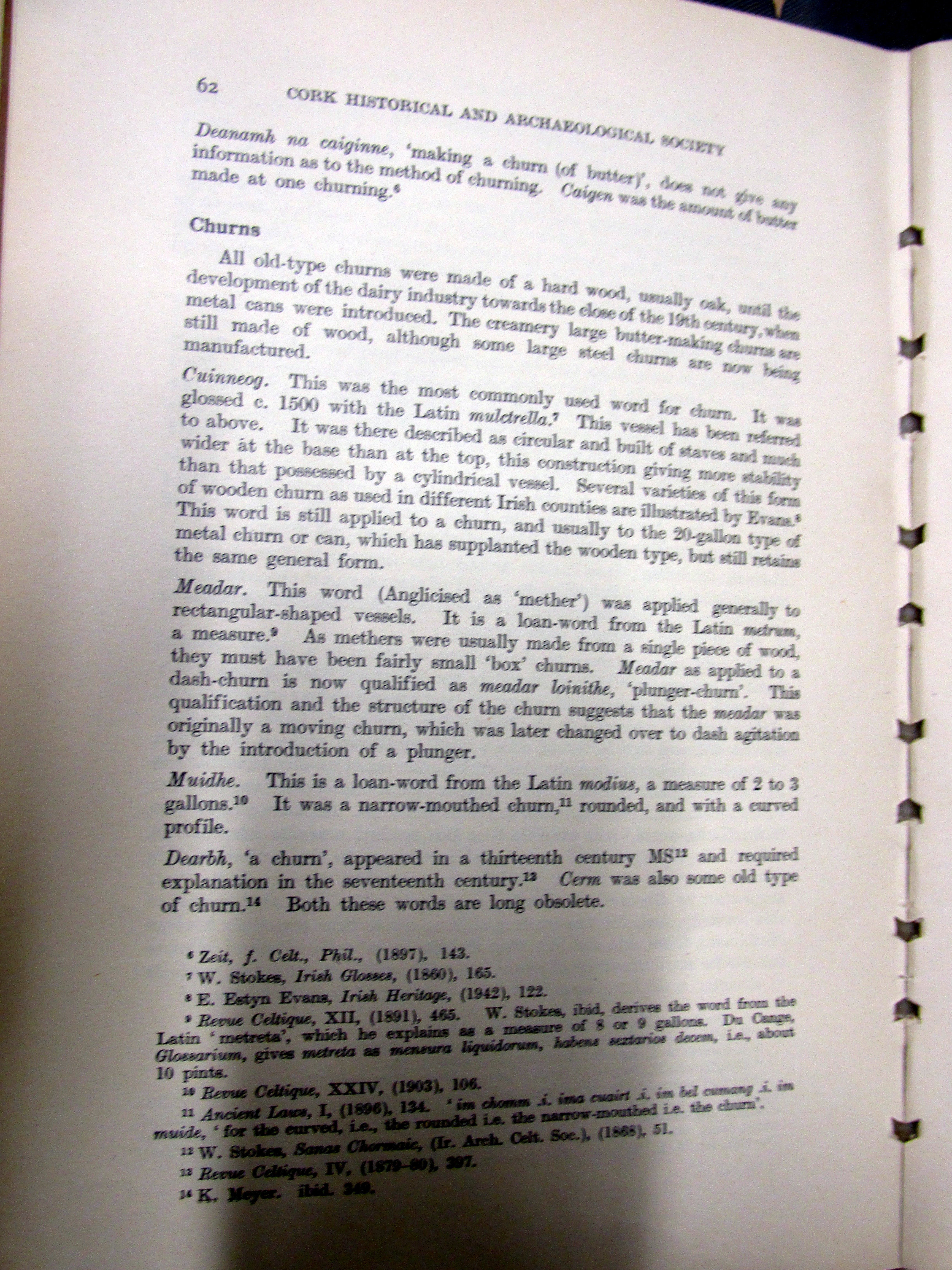
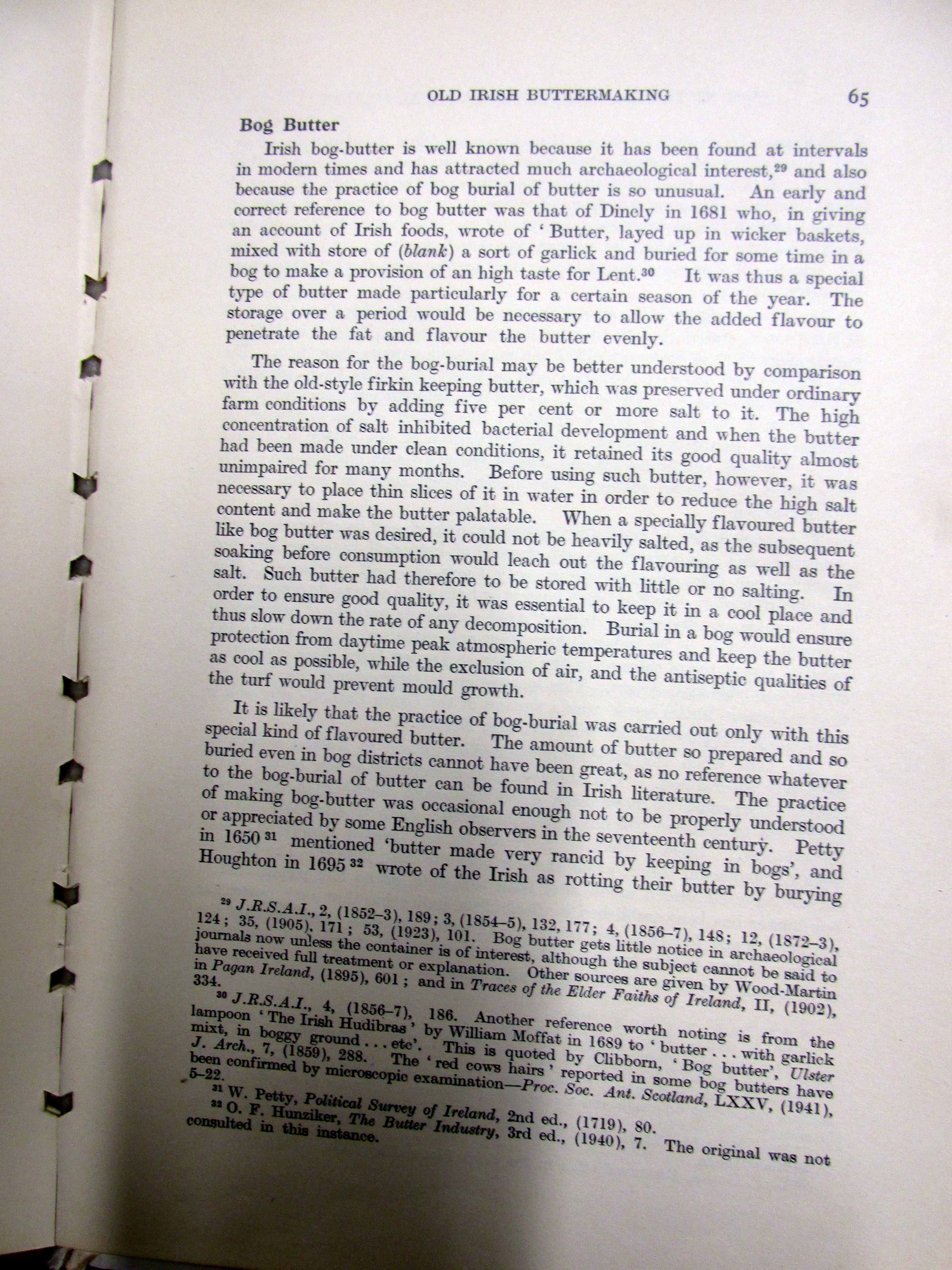
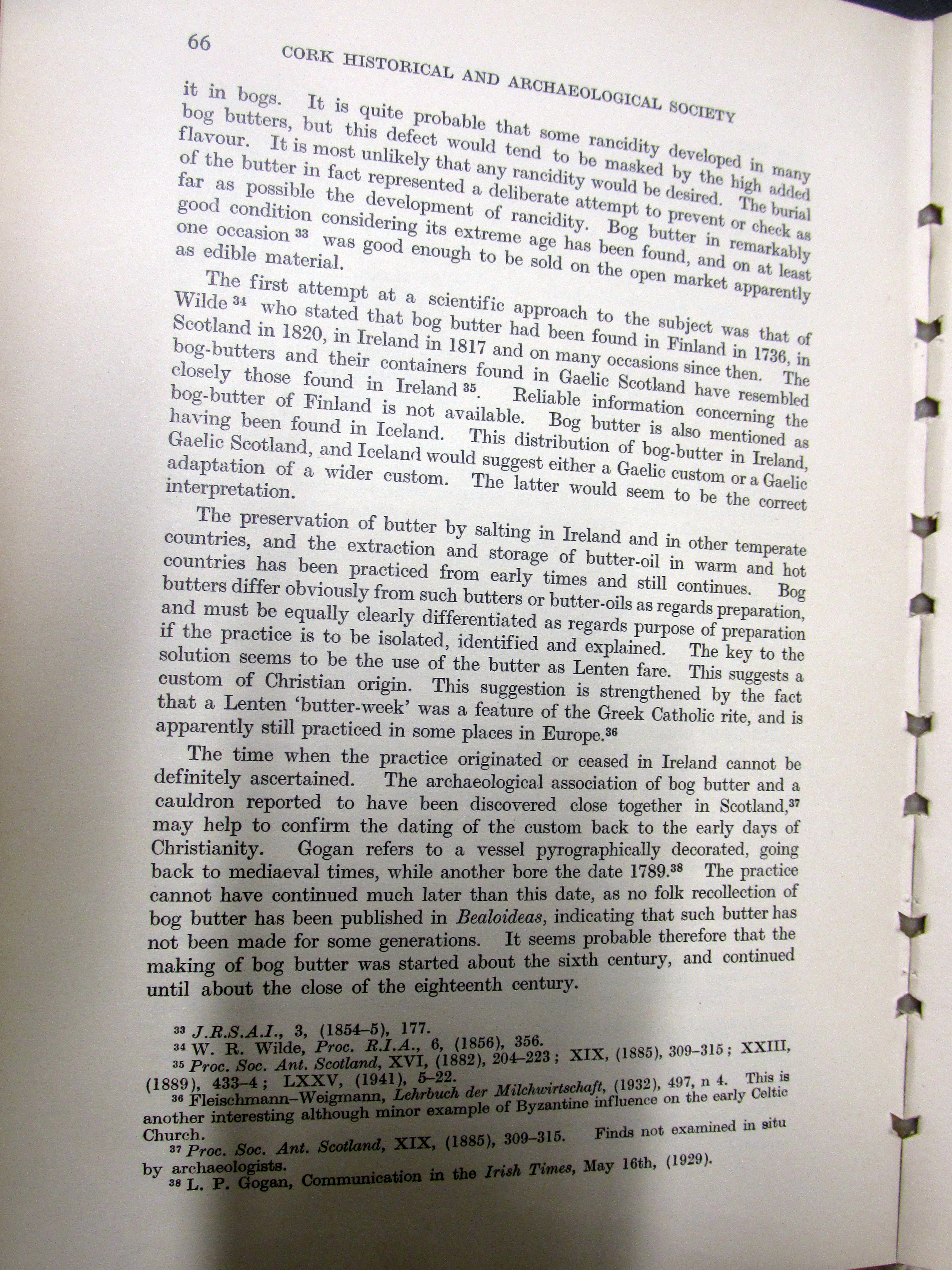
Ancient butter making, Líam English 18th century poet, Miosgan of buter, Bog Butter, 18th century Christian and Pagan incantation on butter making


durrushistory's avatarWest Cork History

Ancient butter making, Líam English 18th century poet, Miosgan of buter, Bog Butter, 18th century Christian and Pagan incantation on butter making

By Dr. Micháel Ó Sé

1949 Courtesy JCHAS

1-IMG_6613

2-IMG_6614

3-IMG_6615

4-IMG_6616

5-IMG_6617

1-IMG_6618

2-IMG_6619.

https://durrushistory.wordpress.com/2014/11/13/old-irish-cheeses-including-use-of-mothan-bog-violet-variety-mulchas-from-1500-article-1945-by-dr-michael-se-msc/

By Dr. Micháel Ó Sé

1949 Curtesy JCHAS

View original post

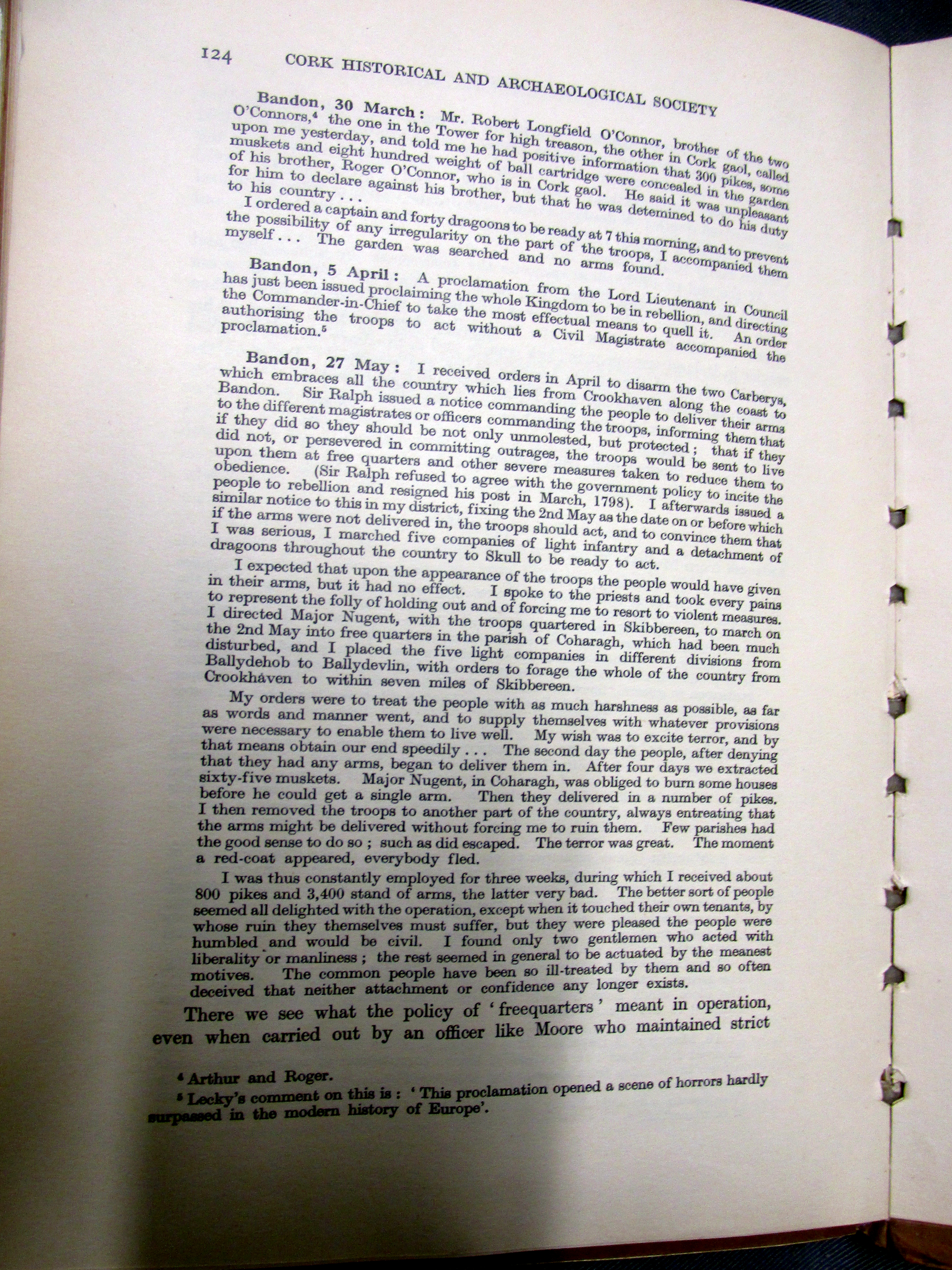
Robert Swanton, (1764-1840) Ballydehob, West Cork, member United Irishmen Directory arrest, imprisonment escape to New York where he was active in US Politics and became Judge of Maritime Court.