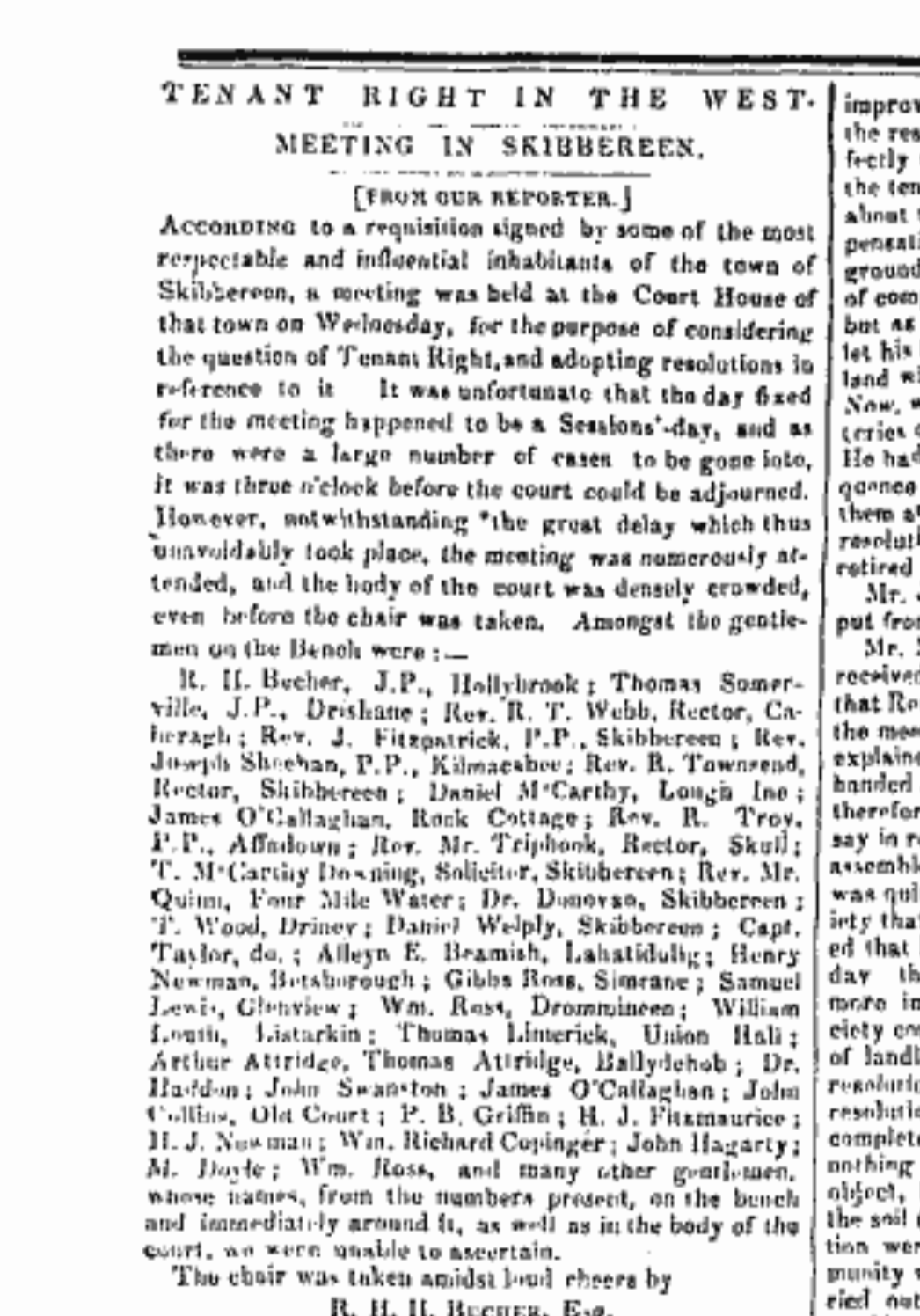
Election Committee of McCarthy Downing, Solicitor and landlord, Skibbereen, West Cork . He was a very influential figure in West Cork mid 19th century. It was reported that he was angling to be elevated to the House of Lords. A major purchased of distressed estates post famine.
1942 Patrick W. O’ Donovan, Solicitor, Clonakilty aged 74, Funeral. Came of Old Stock.
Taught by Master Madden, at The Mountain, Ardfield, who also taught Michael Collins, Sam Maguire.
Oillscoilan t-Sleigh, The Academy of Master Madden late 19th century, Ardfield, Clonakilty to Prepare Boys for the British Civil Service Exams. Pupils included Michael Collins and Sam Maguire.
Master Madden ancestor was a hedge school master who was offer employment as a Teacher in the new National schools c 1830 at a salary of £29 per annum. The family still have the letter of appointment.
Up to the mid 1960s the opportunities for second level education even for families with a degree of comfort was limited. In the 19th century as an alternative to home farming or going to America the prospect of the Imperial Civil Service was attractive.
One of Master Madden’s great grand sons taught at second level in Dunmanway in the 1960s.
Apart from Sam Maguire and Michael Collins another pupil was Séan Hurley from Durrus. He went to work in the Chinese Customs in Shanghai and assisted Chinese Revolutionaries. The first Irishman to be given an honorary Chinese passport.
Apprenticed to Henry Thomas Wright, Crown Solicitor whose Practice he Acquired.
Maurice Healy’s Memoir of the Old Munster Circuit he refers fondly to the 3 Clonakilty Wright brothers of Fern Hill, it is possible they descent from a branch of the Dunmanway Protestant O’Sullivan family, suggestive of them being Landlords in Dunbeacon, Durrus.
1850-1937, 1898, 1901 Henry Thomas Wright, TCD Crown Solicitor to 1912, Bankruptcy Judge Fern Hill, 1901 Clonakilty Agricultural Show. Geraldine Wright, Clonakilty, Daughter of Henry Thomas Wright, Mother Ethel Hungerford, Crown Solicitor, wife of the Baron de Penaranda, Bruges. 1888 application to Dublin Castle for special duty claim. Attending 1898, enormous funeral of Dan O’Leary, JP, aged 71, Clonakilty, probably draper Carbery Agricultural Show, Skibbereen 1893
1847-1913), 1911 George Wright, TCD Called to Bar 1871, took Silk 1884, High Court Judge At TCD, boat club. Fitzwilliam, Dublin ” George Wright (1847 – 15 May 1913) was an Irish lawyer and judge. Wright was born in Clonakilty, County Cork, son of Thomas Wright. [1] His father and brothers practiced as solicitors in Clonakilty: one of his brothers was H.T. Wright, Clerk of the Peace for Cork.[2] He married Mary Barrington in 1881. His family owned Fernhill House, Clonakilty, which is now a hotel. He was called to the Bar in 1871, took silk in 1884, and served as Solicitor-General for Ireland from January 1900[3] to 1903 in the Unionist government headed by Lord Salisbury. He was appointed to the Queen’s Bench Division of the Irish High Court in 1903 where he served till his death.[4] He was immensely popular with his colleagues and greatly respected as a lawyer. A colleague humorously described him as a man who is “”on the borderline of genius but never trespasses””; a popular verse hailed him as Judge Wright, who’s never wrong!””[5] Wright died 15 May 1913.[6] ” Probate £20,470 buried Mount Jerome Dublin
1855- ,1876, 1911 George Wright, A. B. TCD Middle Temple 1871, Barrister, 1911 County Court Judge, Co. Louth “2nd son of Thomas Wright, solicitor, Fern Hill. Dublin, Lower Baggot St., Subscriber Dr. Daniel Donovan ‘History of Carbery, 1876. ” “1901 Richard Wright Waterford District Probate Registrar, Barrister Born Co. Cork, 57 “”1843, 1844, 1845, 1847, 1858, 1860, 1865 Thomas Richard Wright Solicitor Fern Hill sons Henry Thomas 1850, Thomas William 1859, Solicitor. Signed Testimonial to Resident Magistrate, John Gore Jones, Bantry, 1844. Assistant 1879 Michael David Kennedy. Also agents for Durrus Estates. Subscriber memorial John O’Hea JP, Clonakilty, 1847. Probate 1880 to widow eliza £12,000. Standard Life Agent 1844 “” ” “s children and Rev. Richard Walton Marmion Standard Life Agent 1844 “
1843, 1844, 1845, 1847, 1849, 1858, 1860, 1865, died 1880 Thomas Richard Wright Solicitor. Land Agent to Lord Charles Pelham-Clinton, 1863, 13,600 acres. Fern Hill sons Henry Thomas 1850, Thomas William 1859, Solicitor. Signed Testimonial to Resident Magistrate, John Gore Jones, Bantry, 1844. Assistant 1879 Michael David Kennedy. Also agents for Durrus Estates. Subscriber memorial John O’Hea JP, Clonakilty, 1847. Probate 1880 to widow eliza £12,000. Thomas Richard Wright of Fern Hill, died 1880 he mentions his children and Rev. Richard Walton Marmion Standard Life Agent 1844. 1857 dinner for departing manager of National Bank, P.D. Griffin. Gave evidence Parliamentary Commission tht he persuaded Lord Shannon to withdraw his objection to railway coming to Clonakilty 1887 Chancey Court case involving recovery of seaweed at Friendly Cove, Durrus. Beamish v Crowley. Appearing for Beamish was Bewley Q.C., Trench Q.C., … Tuckey, instructed by John White. For Crowey, Piece White Q.C., , The McDermott, Q.C., Richard Wright, instructed by W. T. Wright , Clonakilty. The Crowleys are McDermotts descendant of Niall of the Nine Hostages who migrated from Roscommon post 1200, to about 1600 often known as McDermott (as in Elizabeth Fiants) with a leas ainm (nickname) Crua Laoich (tough warrior) which supplant the McDermott. DNA confirms connection.
1843, 1844, 1845, 1847, 1858, 1860, 1865 Thomas Richard Wright Solicitor Fern Hill sons Henry Thomas 1850, Thomas Willam 1859, Solicitor. Signed Testimonial to Resident Magistrate, John Gore Jones, Bantry, 1844. Assistant 1879 Michael David Kennedy. Also agents for Durrus Estates. Subscriber memorial John O’Hea JP, Clonakilty, 1847. Probate 1880 to widow eliza £12,000. Standard Life Agent 1844
1887 Chancey Court case involving recovery of seaweed at Friendly Cove, Durrus. Beamish v Crowley. Appearing for Beamish was Bewley Q.C., Trench Q.C., … Tuckey, instructed by John White. For Crowey, Piece White Q.C., , The McDermott, Q.C., Richard Wright, instructed by W. T. Wright , Clonakilty. The Crowleys are McDermotts descendant of Niall of the Nine Hostages who migrated from Roscommon post 1200, to about 1600 often known as McDermott (as in Elizabeth Fiants) with a leas ainm (nickname) Crua Laoich (tough warrior) which supplant the McDermott. DNA confirms connection.
Admitted a Solicitor 1891. President West Cork Bar Association. 1903 One of the 3 Founders of Clonakilty Agricultural Society, Honorary Treasurer of Carbery Hunt and Race Committee. Tourism Pioneer. Built Inchydoney Hotel 1932.
Connecting through the Wrights to Lord Atkin:
Robert Travers Atkin, (1841-1871), born in Fernhill, Clonakilty, the son of William Francis Atkin and his wife Alice Hungerford (née Stewart). In 1863, he emigrated to Queensland, Journalist Member Queensland Assembly. Father of Lord Atkin, Judge 1932 in Landmark Case on Law of Negligence Donoghue v Stevenson. Died of T.B. A monument was erected to his memory by the members of the Hibernian Society of Queensland, of which he was vice-pres. Relative of Thomas Davis. The Wright Brothers of Fernhill, Clonakilty, Lawyers and some Landowners.
In 1932, as a member of the House of Lords, he delivered the leading judgment in the landmark case of Donoghue v. Stevenson concerning the alleged adverse effects from an alleged snail in a bottle of ginger beer served in a café in Paisley. The case established the modern law of negligence in the UK and, indirectly, in most of the rest of the common law world.
French DNA Laws Impede Genealogical Research Genealogy of West Cork People With Huguenot Ancestry.
Quite a number of people of all religions in West Cork or among the diaspora have Huguenot ancestry.
From a friend who has Levis ancestry Amongst my TV viewing recently was an episode of ‘DNA Family Secrets’, and one of the things mentioned was surprising news to me. Until I had seen this programme, I was completely unaware that is illegal for anyone in France to do a DNA test, I remember asking one of my Levis relatives if his DNA test had shown up his French heritage in his ethnicity background, which brought the response that it did not, which I was struggling to understand. But now I know about the fact that the population of France are not allowed to take DNA tests then this I feel explains the lack of any French heritage showing up in the Ancestry DNA tests! I have since Googled to see why this is and I have pasted in one of the items on this subject – Why is DNA testing illegal in France? Private DNA paternity testing is illegal, including through laboratories in other countries, and is punishable by up to a year in prison and a €15,000 fine. The French Council of State has described the law’s purpose as upholding the “French regime of filiation” and preserving “the peace of families.” Maybe you were aware of this issue but I was definitely taken aback by this news. Things of course may change in the future, but at the present the law is banning the tests being done in France, unless there is a medical, judicial or scientific reason but definitely not family history
Durrus, Mizen, Caheragh, Bandon, Kinsale West Cork Huguenot Families
Genealogy of Cork Huguenot Madras family post 1750 from Amsterdam to Cork 1735 by letter from India Office 1939, interconnected families Longfield Connor Fort Robert, Evanson Durrus, Travers Butlerstown, Baldwin Curravody, Alleyn
1862 Testimonial to Dr. Mathew Lefebure, M.D. on Leaving Berehaven after 21 years of Service to the Poor, His wife Angelina Coppinger O’Donovan. The Lefebure family.
Might find of interest an enormous listing some of the names may be familiar. His son Robert in particular has a world wide reputation in medical science.
Dr. O’Meara was in a mixed marriage and it seems the children were brought up as Catholics . At least in the case of his son Robert Allen Quain O’Meara the parents followed the Church of Ireland tradition of assigning as one Christian name the mothers maiden name always very helpful in genealogical research.
These funeral listings capture a moment of time locally showing power structures, family networks and local hierarchies. The funeral attendance follows a regular formula. A huge attendance presumably the funeral director supplied the names. The hierarchy is the immediate family then in order of importance locally. Interestingly, there are a huge number of all religions in the area. People from different religious background tended to lead lives a little separate from each other but came together on communal occasions such as funerals
A strong representation of Catholic clergy as well as local Church of Ireland and Methodist clergy.
Magistrate, p. 1
Medical and local career, p. 1
1938 Funeral of Dr. O’Meara Skibbereeen., p.3
Dr. Robert Allen Quain O’Meara, p. 16
Dr. Major F. J. (Frank) O’Meara, p., 18
1938 Funeral of Dr. O’Meara Skibbereeen.
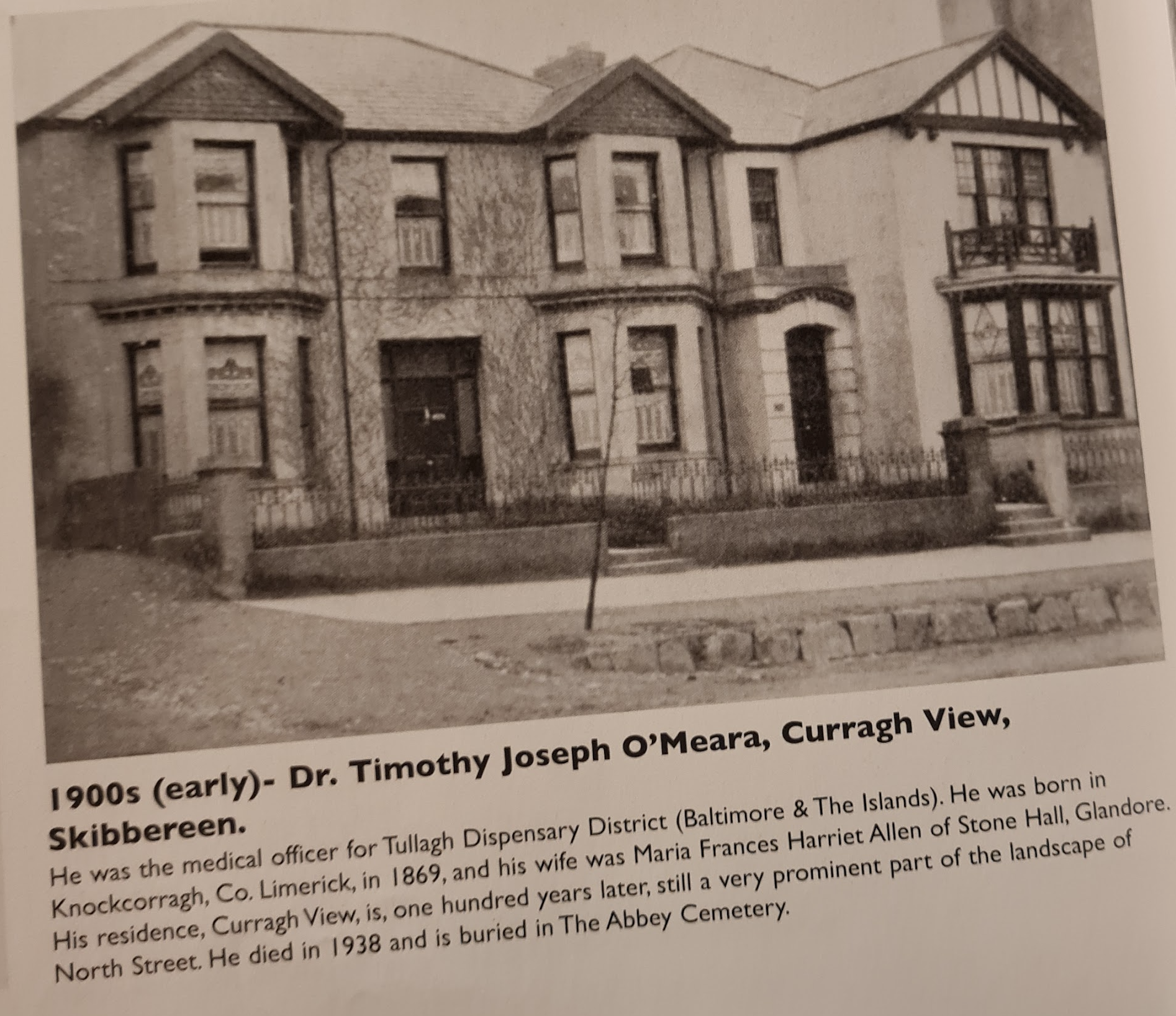
Dr. Timothy Joseph O’Meara BA, MB, (1870-1928) 1910, Curragh Rise/View, Skibbereen, b Knockcurragh Co. Limerick, son of Michael, ed Rockwell, Queens College, Cork, member local associations m 1899 Mary Harriett d Christopher Allen, Stone Hill, Glandore, she Church of Ireland the children Catholic. listed 1921. Appointed dispensary doctor Baltimore 1898 joint medical officer Skibbereen Hospital 1911 with Dr. Burke. 1911 three servants. 1904 involved in the local Industrial Development Association, Resigned 1921. Dyed 1938 enormous funeral. Probate son son Dr. Robert Allen Quain O’Meara, Sorrento Road, Dalkey, £2,215. O’Meara, Robert Allen Quain his son a leading world wide medical scientist.
..
1871-, 1901, 1910, 1914, 1919, 1921, 1923, 1932, 1935, 1938 Dr. Timothy Joseph O’Meara, A.R.M.B.R.U.I. Former Admiralty surgeon. Dispensary Doctor including Cape Clear. Magistrate “Dr. Timothy Joseph O’Meara BA, MB, 1910, Curragh Rise/View, Skibbereen, b Knockcurragh Co. Limerick, son of Michael, ed Rockwell, Queens College, Cork, member local associations m 1899 Mary Harriett d Christopher Allen, Stone Hill, Glandore, listed 1921. Christopher Allen, (1824-1866), Roughgrove, Bandon, Stone Hall, Glandore. Sitting Union Hall, 1861. 1856 Attending Funeral Right Honourable James Earl of Bandon. Probate 1866 to widow, £4,000. Son John Constantine Allen, (1856-1893), Captain, 18th regiment spent a lot of time in India probate Captain Edward Allen, Royal Irish Rifles, £606. Daughter France married Dr. O’Meara, Skibbereen.
1899, attending the funeral of R. H. Townshend, J.P., Myross Wood, Leap. 1901, 4 servants. Subscriber appeal fund 1896 Dorney family. Attending the funeral Lieutenant-Colonel Thomas Somerville D.L. (1824-1898), Clontaff, Drishane.
1901 attending funeral of Mrs. Jennings, Oldcourt. 1904 funeral of Daniel O’Donovan, Solicitor and Land Owner, Skibbereen.
Attending the 1917 funeral of Michael Beechinor Collins, JP, Manager 1897-1917 in Skibbereen of Cork and Kerry Central Creamery. 1935 donor to Vincent de Paul.1906 attended the funeral of Frederick Eldon Potter, owner and editor of Skibbereen Eagle. 1909 attending the funeral of Dr. William Jennings, J.P. 1932 attending funeral Skibbeeeen of Henry Grantham rep of drug company A De. St.Lamas, Leicester 1932 campaigning for Skibbereen hospital. 1938 Funeral of Edwin Angus Swanton, Major Draper, Skibbereen. Wife Maria Allen of Stone Hall, Glandore his 2 sond distinguished medical careers. “
Dr. Timothy Joseph Meara, (1869-1939), Skibbereen, Evidence to The Royal Commission On Congestion in Ireland. Nominee of the Bishop of Ross. His area covers 20,900 statute acres, population of 5,750 of whom 1,260 lives on the Islands. Poor Diet now Tea substituted for Milk in Diet of Infants, Poor People Lives on Bread and Tea with Dried Fish. Poor Quality Insanitary Housing. Anaemia, Dyspepsia, Ophthalmia, Typhus Fever Common, Outbreak in 1886 has Schoolhouse on Toe Island Converted to Temporary Hospital, Pulmonary TB Common Blames Returning Irish Americans with TB Coming Home to die. Celtic Race in America prone to TB. Irish Girls in America get good money but work from 4 am to 7 or 8 pm.”
..
Dr. O’Mears was in a mixed marriage and it seems the children were brought up as Catholics . At least in the case of his son Robert Allen Quain O’Meas the parents followed the Church of Ireland tradition of assigning as one Christian name the mothers maiden name always very helpful in genealogical research.
These funeral listings capture a moment of time locally showing power structures, family networks and local hierarchies. The funeral attendance follows a regular formula. A huge attendance presumably the funeral director supplied the names. The hierarchy is the immediate family then in order of importance locally. Interestingly, there are a huge number of all religions in the area. People from different religious background tended to lead lives a little separate from each other but came together on communal occasions such as funerals
A strong representation of Catholic clergy as well as local Church of Ireland and Methodist clergy……,.
The history of the estate is as follows, this was McCarthy land. They moved their castle in Scart about 1 km north of the Bantry Drimoleague road past Durrus cross with no trace left to a very substantial castle at Gearhameen c 1615. Believing that peaceful time had come like Coppingers Court had no defensive features. Seized by the English post 1641 for ‘Rebellion’ it passed first into the hands of Colonel Reid, then about 1690 was acquired by the Evanson family.
Townlands in the Earl of Bandons Estate.
Briefly, those lands are bounded by the Durrus river and Dunmanus Bay from Crottees to Brahalish on the south side of the Muintervara Peninsula bounded by the high ground dividing the peninsula.
.
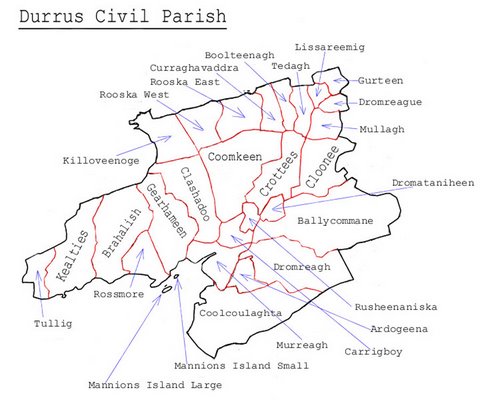
Durrus Townlands
Historical definition of Townland as the area that could be ploughed by a Seisreach (A Six-Horse team) in Forty Eight Days. This is from Pádraig Ó Loingsigh history of the parish of Caherdaniel.
Ancient Land Divisions:
Thomas Larcom, the first director of the Ordnance Survey of Ireland, made a study of the ancient land divisions of Ireland and summarised the traditional hierarchy of land divisions thus:[9][12] 10 acres – 1 Gneeve; 2 Gneeves – 1 Sessiagh; 3 Sessiaghs – 1 Tate or Ballyboe; 2 Ballyboes – 1 Ploughland, Seisreagh or Carrow; 4 Ploughlands – 1 Ballybetagh, or Townland; 30 Ballybetaghs – Triocha Céad or Barony.
Ahagouna (Irish: Ath Gamhna, meaning ‘Ford of the calves’). In Clashadoo townland. The ford with stepping stones still extant used before the bridges at Clashadoo built c 1700.
Carrigboy (116 acres) (Irish: Carraig Buidhe, meaning ‘yellow rock’). Location of Durrus village. The high road from here is built over land known as Carrig Cannon. Village demolished and rebuilt by Bandon Estate post 1853. Near the former farmyard of Denis John L O’Sullivan now housing the remains of a souterrain partly demolished during house building between the upper and lower road to Bantry.
Clashadoo (749 acres) (Irish: Claise Dubha, meaning ‘dark hollows’). Burial ground last burial 1930s layout of stones suggest an adult as well as children.. To the north on high boggy ground is Coolnaheorna or Coornaheorna (this appears in the 1740 deed to Francis Bernard as a half ploughland) covering the former farms of Kellys and Sullivans leading to the ‘Cumar’, and beyond to Loch na Fola (lake of the blood). This may have been far more extensive in former times as the stream feeding it may have been diverted; the stream (Moire or in Irish Maighre) on the western end has a deep hole formerly known as Poul Nora Poll Nora (Nora’s hole). Between Rossmore and Mannion’s Island at half tide a rock ‘Carrig Coolnaheorna’ is visible; this marked the spot where people from Upper Clashadoo were entitled to take seaweed to fertilize their smallholdings. On the road to Coomkeen, at the eastern end is a graveyard used for unbaptised infants, small stones, adults large stores, probably the site of Dun Clashadoo marked on the Ordnance Survey map. The ordnance survey map of 1842 shows ‘Cappanamanna’ on high ground to the west of the old rectory, it appears as ‘ a half ploughland at Cappamonagh’ in the 1740 deed to Francis Bernard and perhaps it may have some old connection with monks. Football field in the 1930s opposite the old rectory near the bridge. Fort Lís Clashadoo. The name Brookfield or Durrus Court is derived, I suppose, from the little brook which flows in front of Evanson’s house, and which was formerly called Moire (Maighre) by the old people. On the high northern ground there is 280 acres undivided held in common in 15 shares.
Coomkeen (915 acres) (Irish: Cum Caoin, meaning ‘gentle valley’). Mass rock on the lands of Timmy Whelehan deceased known as Tober an tSagairt, on the south side is Screathan na Muice (stoney slope of the pig) this is given as the address of one of the Dukelows in the 19th century, c 1850, marriage register of St. James’s church., and deed of 1862, to the north is Crock a wadra. On the flat bog before the turn for Clashadoo are clay pits on the right used for road making. The Coomkeen farmers had rights to sea wool between what is now the pier and the sand quay used to fertilize their holdings.
Crottees (490 acres) (Irish: Cruiteanna, meaning ‘humpy ridges’), location of large stone associated with Dukelow family. On the bounds with Clonee an area known as ‘Chapel Brake’ according to Dan Burke, Coomkeen, RIP, used as a church pre 1794 before new road built.
Dromatiniheen (97 acres) (Irish: Drom a’tSionnaichin, meaning ‘ridge of the little fox’). Ringfort on the south side. Fulach Fia discovered 2016 in works fro new GAA pitch. 1624 Inquisition Car 1.Rossmore (310 acres) (Irish: Ros Mor, meaning ‘large copse or large promontory’). Location of Rossmore Castle Rossmore Castle in ruins former McCarthy sometimes ascribed to O’Mahony tower house and location of former slate quarry. May have been a centre of pilchard industry 1730s. In the field west of Attridges off the road there is believed to be a
Mathieu (also spelled Matthew) Belsaigne, buried Innishannon, (1704-1761), Possible Founder of part of West Cork Huguenot Community, Descendant Matthew Belsange/Belsaigne, Freeman of Cork Landlord, Dunmanway Union, Kilmurray East, 1847
Leased by Mathew Belsange from the Baldwin estate in 1851 when it was valued at £10 10s. This property no longer exists.
His ancestor buried Innishannon:
Mathieu (also spelled Matthew) Belsaigne was an important figure in organising the Irish Huguenot Settlement Plan of 1751-1753 to bring persecuted Huguenot Protestant refugees from France to Ireland. He aided many families that sought a new home and freedom to practise their religion.
Mathieu, a woollen merchant associated with a woollen factory co-owned by his wife’s family, had refused to renounce his faith following the Treaty of Nantes.
Belsaigne (also spelled Bellesaigne or Belesaigne) settled in Innishannon in 1752 with a handful of Huguenot families and apparently was a merchant, perhaps in silk. He was associated with the Rev. Pierre Corteiz, a minister granted permission to read services in French and administer the Sacraments according to the rules of the Church of Ireland.
This is a partial analysis on the Landlords in Dunmanway Union. It is hoped to complete the exercise in the next week or so. Strictly spelling the Dunmanway Union contained areas such as Kilmichael being part of the Barony of West Muskerry which might be more appropriately be in Mid Cork rather than West Cork.
Proposed Land Improvement and Drainage Act 1847, Hansard
The first purpose for which he proposed to ask the Committee to consent to an advance of money, would be under the Land Improvement Act, which he believed would provide the most wholesome mode of employing it. In that case the natural relations between master
This is a partial analysis on the Landlords in Dunmanway Union. It is hoped to complete the exercise in the next week or so. Strictly spelling the Dunmanway Union contained areas such as Kilmichael being part of the Barony of West Muskerry which might be more appropriately be in Mid Cork rather than West Cork.
Proposed Land Improvement and Drainage Act 1847, Hansard
The first purpose for which he proposed to ask the Committee to consent to an advance of money, would be under the Land Improvement Act, which he believed would provide the most wholesome mode of employing it. In that case the natural relations between master





 West Cork History