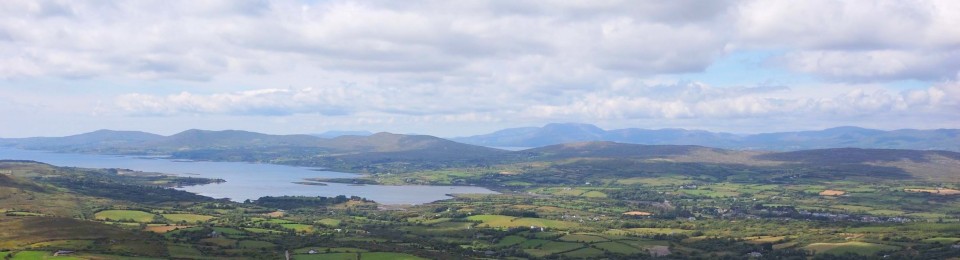
Petition c 1648 of John Winspeare, a shipwright living near Bantry Bay, makes his living upon the fishing trade
24 Friday Jul 2015
Posted in Uncategorized
24 Friday Jul 2015
Posted in Uncategorized
24 Friday Jul 2015
Posted in Uncategorized
Intelligence Organisation in Eire. CAB 66/3/31
be accepted, nor wholly dis-counted. One such report, however (of a U-boat coming into Bantry Bay and taking in provisions on the evening of the 9th November), comes first-hand from a reliable source. There are also reports that certain individuals in
Former reference: WP (39) 131
Date: 1939
Source: Cabinet Office papers
In Northern Ireland there is a belief that the ‘De Valera Government’ actively provided fuel and other supplies to U-Boats during the war. This is generally told alongside the notion that the most bombed city in the United Kingdom was Belfast. Other stories told are the Ulster Division at the Battle of the Somme.
24 Friday Jul 2015
Posted in Uncategorized
From the Encumbered estates Court 1854 where the title to land before the court is recited. This court was an attempt to ‘dry clean’ in a legal sense property which was so heavily encumbered that in effect in was unsaleable. Apart from bank mortgages much of this property, the insolvent estates of Irish landlords, was heavily affected by family settlements to provided for annuities for family members, marriage portions and so on. The famine was only the last straw which broke the camel’s back, the financial distress had been piling up since the collapse in agricultural prices with the ending of the Napoleonic Wars in 1817.
Deed 12th April and 13th 1738, Earl of Burlington and Cork (descendants of Boyle), Sir William Heathcote to Richard Tonson (one of the Tonsons was the illegitimate son of Hull, who ran a fishery in Schull and was a major landowner). All manorial rights…
View original post 121 more words
24 Friday Jul 2015
Posted in Uncategorized
The great collector of Irish music and Chief of Police in Chicago, Francis O’Neill (1848-1936), was born in the townland of Tralibane a mile or so off the Bantry Dimoleague road. In the same area is the townland of Gortatagort, Colomane. In this townland was born the mother of John Spillane the Cork songwriter. Christy Moore covers the song and it on You Tube ‘Christy Moore, John Spillane’s Gortatagort’.
In the nearby parish of Durrus there is a family photograph in the bicentenary book published for St. James Church.c 1910 of the Dukelow family Coomkeen in which Tina Dukelow b. c 1890 is shown with a fiddle, a neighbour Nell Burke bc 1910 played the melodeon. The music seemed to disappear over the years.
O’Neill collected a few tunes from a Beamish man from Caheragh/Drimoleague, there is no sign of him in the recent dictionary of Irish music a mystery…
View original post 3 more words
24 Friday Jul 2015
Posted in Uncategorized
present day Christchurch:
This was transcribed by Cork Antiquarian Richard Caulfield in 1877 and the following is an extract
‘Church of the Holy Trinity or Christ Church, Cork, occupies the
site of one of the two ancient Parish Churches, once within the
City walls. It was also called the ‘King’s Chapel,’ and is mentioned as the
Church of the Holy Trinity in the Decretal Epistles of Pope Innocent III.,
in the year 1199, and is rated in the Taxation of Pope Nicholas in 1291 at
fifteen marks. It was situated about 120 feet within the East wall of the
City, and beside it was the College of Christ Church, long since removed. The
Church-yard and adjacent ground was, till lately, within a few inches of the
surface, a marsh, and before the year 1S30 the vaults were filled with water
at the rise of every tide. When the present…
View original post 254 more words
24 Friday Jul 2015
Posted in Uncategorized
The O’Donovan, Landlord family of O’Donovan’s Cove, Durrus, related by Marriage with Puxley, Copper Mining Family of Allihies, Beara.
Timothy O’Donovan is writing including some of his family genealogy. The Puxleys were married into the Cork Lavellan family. They were of Norman descent and some branches conformed to the Church of Ireland. The Puxleys were middle men of the Bantry estate and Customs Men in Beara.
Various letters (1840s to 1860) from Timothy O’Donovan to Dr. John O’Donovan. A detailed reading demonstrates the complex network of interconnected families in West Cork. Somewhat surprisingly because of conversions and inter marriage many of the Protestant settler families and interconnected by blood with the old Gaelic order.
https://docs.google.com/document/d/16VJptRac8CKsG_ylR0Zm78DLE-rPwWHJ_q2n4HKpW5s/edit
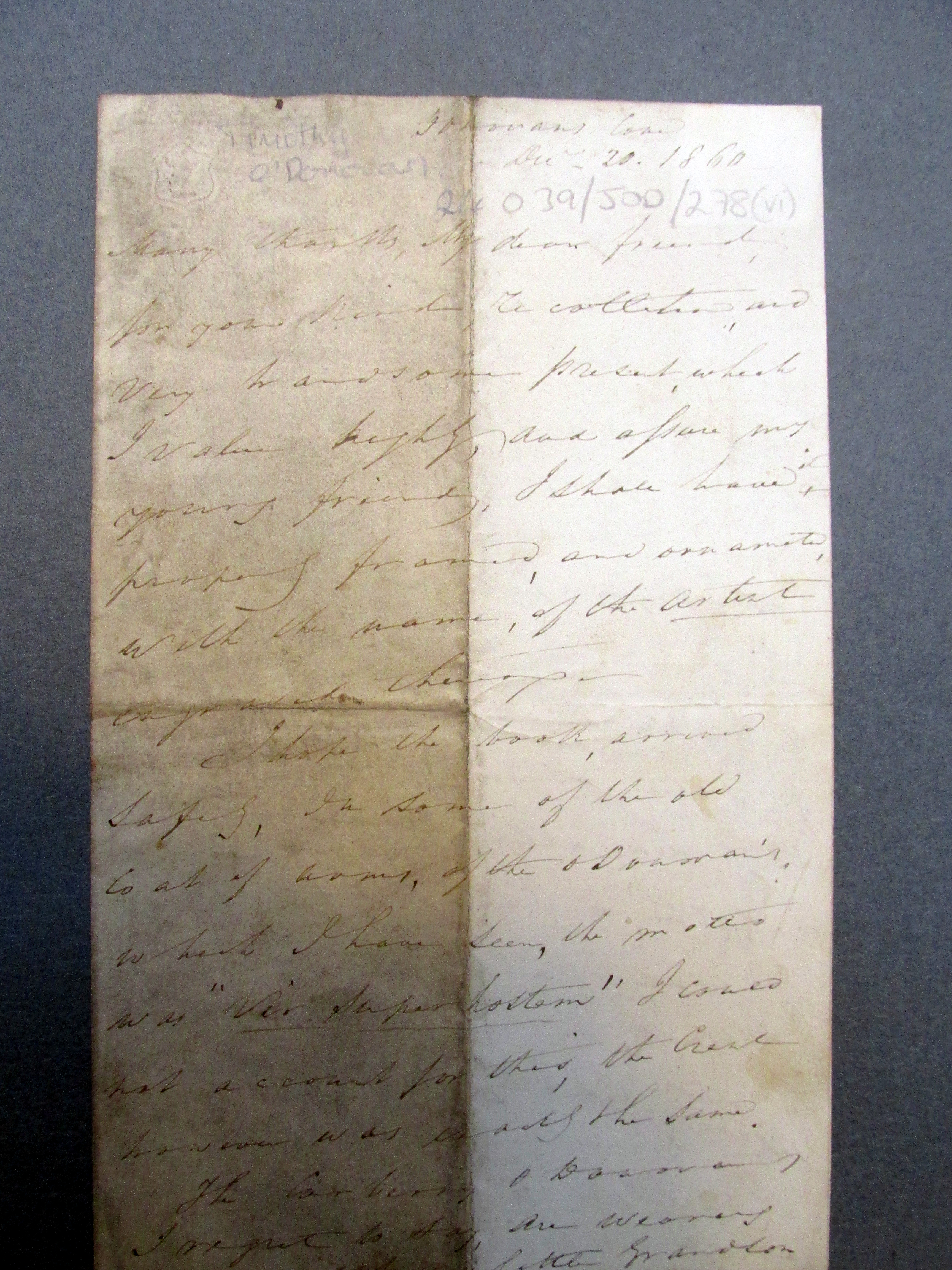
Letter to Dr. John O’Donovan, 24039/500/278/(vi)
O’Donovan’s Cove
December 20th, 1860
Many thanks my dear friend for your recent collection and very handsome present, which I value highly, and my young friend, I shall it have properly framed, and ornamented with name of the artist.
I hope the book arrived safely . In some of the old Coats of Arms of the O’Donovan family I have seen the motto was ‘Ver Super Hostem”. I could not account for this crest was always the same ..
The Carbery O’Donovan I regret to say are wearing
he is at present abroad and is now fourteen. His father has been in Germany for 3 years and was very reckless and extravagant but his property fortunately was strictly entailed the land is secured to his family.
His wife is grand daughter to Daniel O’Connell, the mother of my wife was a Miss Lavellan, Co. Limerick, a daughter of Philip Lavellin of Water park in the County of Cork. Her sister was married to Mr. Puxley of Dunboy Branch?. The grandson the present Mr. Puxley is a man of immense wealth the principal owner of the famous Allihies Mines in the Barony of Bere
I return Count McDonnell’s letter which is very interesting such as may be expected from one of the ancient race. I also return the other letters, with the Crest of the Wexford Donovans and your own. I hope to hear sometime from you of the … and from… look forward with hope to our meeting in the ensuing.
…….papers and the pleasure when of my young friend, your son, I would accompany you.
I have.. strict of the Irish Greyhound not the wolf dog called the …..‘Guirena an Fhia’
the Irish Grey Hound is called ‘Conn’ and was spelled Gre-hound, this breed is quite smooth silk like satin has a mistake to confuse the rough or wiry dog being of Scotch descent and never could compete with the true Irish in fleetship or beauty
Wishing you and yours every prosperity and happiness I remain your obliging friend an affectionate clansman,
Timothy O’Donovan
I also return the very pleasing testimonial of the merits of your son Edmund …Burke.


23 Thursday Jul 2015
Posted in Uncategorized
Lt Col Richard O’Donovan of Bawnlahan, Skibbereen, West Cork, son of Daniel O’Donovan, The O’Donovan of Clancahill’ and Jane Beecher, 1768; Major in 6th Dragoons 19 December 1799; Lieutenant-Colonel 2 May 1800; brevet Colonel 25 July 1810; subsequently Major-General 4 June 1813; Lieutenant-General 27 May 1825; Recognised at ‘The O’Donovan’, died Ireland November 1829.
From Evanson (Durrus) family history:
The first Mrs Evanson had sisters, one married the O’Shaughnessy (whose daughter married the O’Donovan, ancestor of the late General O’Donovan); and another married Mr Butler (the family of the Duke of Ormond); and another married Mr J Warren.
http://www.revolvy.com/main/index.php?s=Richard%20II%20O%27Donovan&item_id=737051
His kinsman Timothy O’Donovan, JP, O’Donovan’s Cove, Durrus corresponding with Doctor John O’Donovan:
Slightly edited letters to Dr. John O’Donovan, Scholar.
Family History 24039/JOD/278/(iii)
O’Donovan’s Cove,
February 1st, 1841
Sir,
Your letter of the 18th last should not have remained unanswered for so long but I was waiting to obtain some additional information on the query pertaining to the family of O’Donovan, The late General Richard O’Donovan, Lieutenant Colonel of the Enniskillen Dragoons, was undoubtedly the Chieftain of the Clann or Sept of O’Donovan. He died at the family seat of Bawnlahan Barony of Carbery, County of Cork about 11 or 12 years ago. He was married to a Welch lady her name was Powell by whom he had no issue, he left his estate to his wife and upon her death which happened soon after she bequeathed it to her brother a Major Powell a Welch man in whom possession it is at the moment and this ancient seat and property is now in the possession of a Welsh man.
The title of “O’Donovan” was after the general’s death affected by a Protestant Clergyman Morgan O’Donovan, but the claim was not recognised by the members of the O’Donovan family.
I am descended from a branch of the House of O’Donovan, who were obliged to fly the County Cork in the Civil wars of 1641 who took refuge in Co. Limerick, a considerable tract of land was protected in trust by the intervention of Protestant “Nominees’ who behaved in those olden days with great and fidelity honour to my ancestors.
This seat seat of O’Donovan’s Cove sits in the Parish of Kilcrohane ..in the part of the Barony of West Carbery and County of Cork. It is my property by inheritance my younger brother, Doctor Richard O’Donovan who has an independent estate resides at Norton Cottage, Skibbereen, we are both in the Commission of The Peace of Co. Cork.
There are several respectable family of the name who do not affix the “‘O” to the name.
I believe we are the two of the Sept of O’Donovan here with the largest landed property in respect of the west of the county.
The most ancient document were in the hands of the late James Donovan, Esq., M.D., Clonakilty, I do not know if they are in the possession of his sons, one of whom is a barrister in London (Alexander Grey’s Inns 1822, Court Reporter Court of Common Pleas 1836 Judge Dominica) the other is the Clerk of the Crown for Co. Cork, (from 1838) they are my first cousins.
Bawnlahan the family seat of the Chief O’Donovan is near Skibbereen and is a respectable old residence and domaine.
With respect of the information as to who is the senior or head of the O’Donovan family at present, I cannot inform you. who it is. It is of little import as a matter of courtesy it would be conceded to me by the great majority of of the representative of the Clan but I am not satisfied as to the strict right of my claim, and I would not assent to it.
I believe a person of the name of James Donovan, of Coolderrha. Parish of Myross, Barony of West Carbery, now reduced to the position of struggling farmer, a person of excellent character is the eldest representative of the House of O’Donovan.
I have given you all in my possession in response to the queries in your letter.
I shall be most happy to meet you here to discuss when the pedigree of our ancient family over a glass of good wine.
Yours etc
To:
John O’Donovan,
21, Great Charles Street, Dublin.
22 Wednesday Jul 2015
Posted in Uncategorized
ESCHEATED LANDS. MS 617, p. 176 1586
These documents are held at Lambeth Palace Library
Former reference: MS 617, p. 176
4 Pages.
Supplementary information: Calendar of the Carew Manuscripts preserved in the Archiepiscopal Library at Lambeth, ed. J. S. Brewer & W. Bullen (6 vols., 1867-73), vol. II, document 606.
Contents:
“Instructions to be annexed to the commission for the inquisition of the state of the tenants and occupiers of the lands and territories escheated to her Majesty by attainder of the late Earl of Desmond and others, for their treason in Munster.”
(1.) The Commissioners to make inquisition of all the occupiers, and how many have sued out letters patent, and how the patentees have observed their covenants for the inhabiting of the lands with English people, and what profits they have received; and to charge them to be ready to pay the rents, which are to be…
View original post 580 more words
22 Wednesday Jul 2015
Posted in Uncategorized
These documents are held at Oxford University, Bodleian Library, Special Collections and Western Manuscripts
Ormond to Orrery: written from Dublin MS. Carte 48, fol(s). 77 8 January 1667
Copy
Contents:
Sir Arthur Denny’s Narrative enclosed with Lord Orrery’s letter of the 4th inst is long and consists of more particulars than can now be noticed. Upon the whole matter, the Duke thinks that Sir Arthur has acted with much discretion… but it may be fit not to pursue it further… Lord Orrery has done well to seize upon the Friars in Bantry; and those of Quin should be dealt with in like manner… The Duke is sorry that his cousin Daniel O’Brien gets him not a better sort of Chaplains. It may raise a suspicion of him – such, it is hoped, as he will never deserve …
22 Wednesday Jul 2015
Posted in Uncategorized
Number Emigrants
CORK DISTRICT
26. Patrick St 400 15
27. French Church, &c. 54 2
28. Queenstown, &c. 30 4
29. Bandon 164 4
30. Dunmanway 77 –
31. Clonakilty 221 2
32. Skibbereen 294 1
33. Bantry 133 3
34. Youghal 69 4
35. Mallow & Fermoy 33 1
36. Kinsale 45 1
37. Tralee 108 3
38. Killarney, &c 30 –
From Irish emigration database http://ied.dippam.com/


