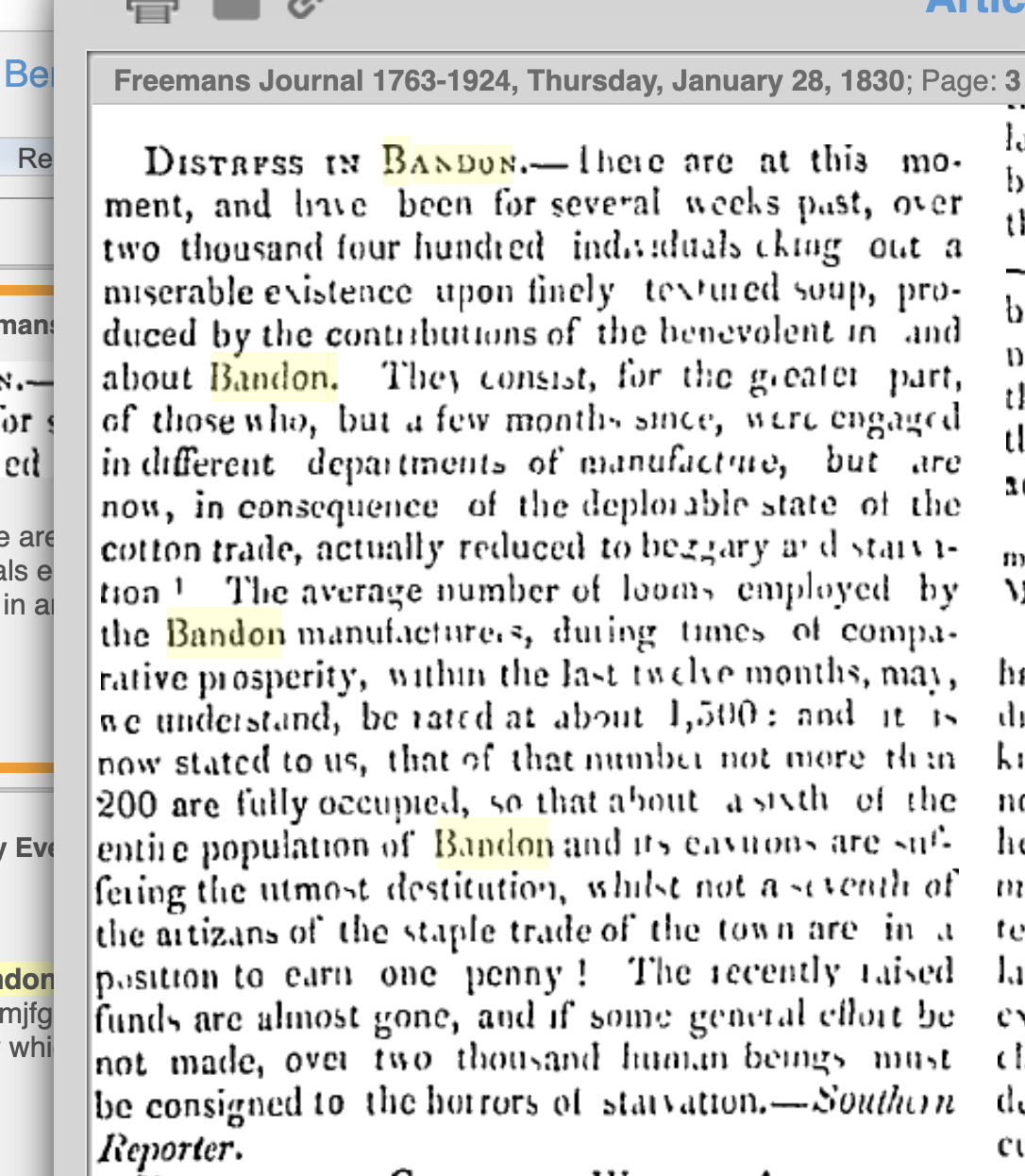
1830 Distress in Bandon. Number of Active Looks Dropped from 1,200 to 200. Deplorable State of the Cotton Trade. One sixth of Bandon’s Population in Destitution.
Marriage Records Schull and Skibbereen Registration Districts, p. 8
C 1830 Tithe Applotments. Townlands on Mizen measured in Gneeves, p. 12
Updated Clothiers, Flax, Linen, Textiles, Weaving, West Cork, Bandon, p. 13
Valuation Office Records Mizen, p.13
Huguenot Marriages, p. 14
Schull Burials, p. 14
Emigration from West Cork, Rochester, NY, The Croston’s of Bradford and Haverhill Massachusetts, p. 16
Funerals St. Luke and St. Simon Cyrene Episcopal Church, Rochester, p. 16
Marriage Licence Bonds, probably mostly not West Cork, p. 16
Marriages, p. 18
Marriages, Schull, p. 18
One Catholic marriage to McCarthy, p. 18
Skibbereen from 1852, p. 24
Selected Deaths Schull District, p. 25
Bantry, p. 28
Selected Deaths Schull District 1882-1899, p. 25
Royal Irish Constabulary, p. 30
1893 Anti Home Rule Meeting, Skibbereen, p. 31
1897 Juror, p. 32
Royal Navy service: Also mention of Captain Love who landed in Crookhaven in 1601, p.
33
Bandon Memorials, p. 34
Newspaper Extracts, p. 35
Appendix 1, Love Sullivan/O’Sullivan Descendants, p. 43-60
Introduction
This commenced with a request to assist in giving background on the Love family of West Cork in particular ‘The addresses listed for the Loves are Donegal, Goleen & Enaghhouchter Schull. It developed into something more significant trying to portray the lot of the poorer Protestant in the Mizen Durrus area in the late 18th and early 19th century. White the focus is on the Mizen area and other Co. Cork Loves fear=ture. The anime does not appear on banners History of Bandon and his listing of the post 1590s planters. However there are memorial of a love family in Bandon mud 17th century who appear reasonably prosperous. Also a sampling of marriage records for the Schull and Skibbereen Registration Districts involving Love family members from the mid 19th century to the late 19th century shows the interaction with other families.
In relation to the Townlands
Enaghoughter East (Eanach Uachtarach Thoir) , Kilmoe Civil Parish, Barony of West Carbery (West Division), Co. Cork 264 A, 0 R, 7 P
Enaghoughter West (Eanach Uachtarach Thiar) , Kilmoe Civil Parish, Barony of West Carbery (West Division), Co. Cork 165 A, 0 R, 4 P
What started as a mere report on a Magistrates meeting turned out to be something far more substantial. The Cork Examiner reported lampooned Alexander O’Driscoll for instigating the meeting citing his own troubles., Actually the loyal magistrates of West Cork had in effect been reeling from a catalogue of misfortune from the easing of the Penal Laws mid 18th century, entry of Catholics to the Legal profession 1790s, the attempted rising 1798, by about 1820 in Cork City at least by concentrating on business the Catholics had far surpassed to cities Protestants, Catholic Emancipation. Daniel O’Connell repeal is dealt with later. The Magistrates’ travails were to continue until independence of the larger part of the Island of Ireland in 1922. In His memoirs Lord shandon (Ignatious O’Briedn) was Lord Chancellor was scathing in his comments., His observations on the early action of the Irish Free State are reproduced later.
However every time Alexandr O’Driscoll appears in a newspaper report it throws light not only on his own venality but on the atrocious condition endured by the majority of the population, In a mixed religious area there were also many poor Protestants.
1841, West Cork density, comparable to China, Haita, India and Rwanda.
1841, population density. This map is taken from The Atlas of the Irish Famine, John Crowley, William J. Smyth and Mike Murphy, Cork University Press 2012. The population density of the populated areas is calculated by excluding mountain, lake and bog. The result is a density comparable to China, India and Haiti.
Courtesy Atlas of The Irish Famine also
Introduction, p. 1
1841, West Cork density, comparable to China, Haita, India and Rwanda., p.1843 Meeting in Bandon of West Cork Magistrates Fear of Rebellion, p. 3
Cork Examiner/Freeman’s Journal, p. 5-14
West Cork Landlords, p. 14
Lord Shandon Magistrate Criticism, p. 16
Daniel O’Connell, Repeal and Apprehensions, p. 16
Listing of most of the West Cork Magistrates in Attendance at Bandon Meeting, p. 18-30
Alexander O’Driscoll, p. 31
Game License List appeared in THE NEW CORK EVENING POST for Monday 24 March 1800, p. 31
1826. Donor to Durrus Churches, p. 31
1827 dispersed Skibbereen mob, p. 32
1844 Trustee Marriage Settlement, p. 34
Alexander O’Driscoll Landlord, Magistrate, Skibbereen, In trouble Again before the Lord Chancellor,
Tithes, p. 34
1816 Fracas at Mass in Skibbereen, p. 35
Background to Alexander O’Driscoll’s suspension as a Magistrate, p. 39
1844 Commentary on Memorial for O’Driscolls reinstatement, p. 50
1843 Skibbereen Meeting to divide Co. Cork for Assizes, p. 54
1844 O’Driscoll restored to the Bench petition allegedly signed by 22,900 persons, p. 54
1844 raised in the House of Lords by Earl Fortesque, p. 59
Grand Juror 1845, p. 62
1845 Railway Provisional Committee Bandon to Bantry, p. 62
1845 Alexander O’Driscoll Again, p. 65
1845 Attending funeral of Lady Carbery, p. 70
1845 Alleged conversion to the Church of Ireland, p. 71
1821 Bridge at Bealkenmara (Béal Cinn Mara) instigated by The O’Donovan, of Bawnlahan, authorised by Cork Grand Jury, Patrick Crowley contractor not paid by 1845, p. 71
1821 Bridge Referred to in the Diary of The O’Donovan, p. 74
Memorials, p. 76
Including
1807 Marriage settlement of Alexander O’Driscoll to Frances Haly (Healy?), Cork. Note the multiplicity of different landlords recited
Here 1799 Timothy O’Driscoll known locally as Tim the Gauger father of Alexander possibly got revenue job due to closeness to Beecher family:
Alexander O’Driscoll in Chief Secretary Papers it is assumed it is the man referred to here, p.88
1847 Viscount Bernard speech to Parliament re Lawlessness in West Cork. p. 93
Magistrates and others attending famine relief meeting Dunmanway, Cork Examiner 28th August 1846
This is a snapshot of those wielding influence in West Cork in the famine period.
Those listed are described as noblemen and gentlemen. Not strictly accurate even here. One benefit of independence is there are no more meetings of noblemen and gentlemen.
Of those 72 listed, around 37 are landlords or their land agent, Payne in Bantry for the White Estate, Swanston in Bandon for the Devonshire estate.some with enormous holding, some like Bantry businessman John O’Connell comparatively small holdings.
Influence of Large Landowners.
As landowners, Irish Conservative MPs, like their English counterparts, were prominent in local government. They were well represented as magistrates on the Grand Juries, which played a key role both in local government and in the administration of justice at the local level. These positions also enhanced their influence in their localities. More senior appointments, like that of High Sheriff and Deputy Lieutenants and Lord Lieutenants of counties, had a higher status and were usually reserved for larger landowners. Lord Lieutenants, in particular, had considerable say in the distribution of local patronage, particularly in the appointment of magistrates. To secure appointment as Lord Lieutenant was a clear sign of government favour, a fact that may account for the relatively low number of Conservative MPs appointed to this position during the years covered by this book. Throughout this period, Irish landowners retained a strong presence in Irish local government, the real decline in their influence coming only after the electoral reforms of 1884-85.
Ian D’Alton in his seminal work remarks that Cork Landlords were not particularly well off. 50% of the Estate were less then 400 acres, 80% less than 1,000. Very few would fall into the category of ‘A great landowner’ having a rental of £10,000. Furthermore as became evident with the advent of the Landed Estates Court many estates were heavily encumbered.
From the early 19th century falling rents and arrears of rent payments by middlemen further strained the finances of the estate. On some estates management and legal expenses were reckoned at 30% of gross rental.
A certain amount of fractiousness was observed in 1822 ‘the magistrates in the south can scarcely ever be prevailed upon to act together from their entertaining so many petty jealousies and animosities towards each other’
Then succeeding decades would not be kind to Landlords. The encumbered estates court, landed estates court in effect enabling lands heaving mortgaged to the dry cleaned and clear title given to the purchaser. The Land Wars of the 1880s destroyed any landlords and tenant relationships that may have existed…..,
Click here:
Magistrates and others attending Famine Relief Meeting. Dunmanway. 1846
n 1881 the Valparaiso Herald made its bow to the public. It was edited by P. O’Sullivan, was full of news and met with favor apparently, but after three years it passed out of existence.
General Charles Vallancey (1731-1812) Survey Report 1778, p.3
Sir Richard Griffiths report to Parliament 1828, p.3
An earlier account 1819 of the Mizen peninsula, Eliza (Dizzie) Townsend (Mrs. Lionel Fleming), p.4
Rev. Caesar Otway 1831, p.5
Projected Bandon to Bantry Railway 1845, p.6
Appeal to Sir Robert Peel to make Bantry a packet station, p.7
Courthouse meeting Dunmanway re projected railway, p.9
Report of Commission re Irish Packet Stations background, p.10
Extracts re West Cork report of Commission re Irish Packet Stations, p.12
Thomas Hungerford, Inspector Coastguards, family background, p.29
Emigration from Cork 1847-1850, p.34
Anthony Marmion author The Ancient and Modern History of the Maratime Ports of Ireland, p. 35
Crookhaven, p.36
Berehaven, p.41
Dunbeacon/Dunmanus, p.51
Viscount Bernard/Lord Bandon, p.55
1847 Report a memorial presented to the Lords of the Admiralty with regard to the Harbours and Lighthouses of Co. Cork, p.59
1863. Julius Reuter and William Siemens and the South-Western of Ireland Telegraph Company, Linking Cork to Crookhaven by Telegraph and British & Irish Magnetic Telegraph Company, Cork to Cape Clear, p.59
The start of the Communication Revolution, Picture of ‘The Atlantic Telegraph Cable Fleet’ at Berehaven, Bantry Bay, 28th July 1866, held at Cable and Wireless Archive, p.59
Bere Island British Naval Base, p.61
Introduction
Traditionally a packet station was a port used to carry mails or passengers over short channels. Here, in the 1851 report, however, what is contemplated is what port on the west coast of Ireland would be suitable for vessels going or coming to America.
The introduction of steam engines changed everything and competition with the Americans also. The level of technical detail considered in making their choice is fascinating. Then 8 years later they laid the first transatlantic cable for communication across the Atlantic from Valentia. That put the packet station to bed.
In terms of the earlier background you have a paradox, from the late 17th century West Cork was just off some of the main shipping lines in the world. At the same time transport links even to Cork were limited. By the end of the 18th century reasonable roads connected the main towns to Cork some had been built as turnpikes, an early version of tolled..
Click here:
1851 Proposed West Cork Packet Stations General Background.