https://irishdeedsindex.net/mem.php?memorial=562167
| Type of deed | Date of current deed | 29 Mar 1820 | Vol | Page | Memorial | ||||||
| Lease | Date of earlier deed | 837 | 32 | 562167 | |||||||
| No | Role(s) in earlier deed(s) | Role in current deed(s) | Family name | Forename | Place | Occ or title | A | ||||
| A | P1 | BEAMISH | Samuel | of | Mount Beamish [Co Cork] | Rev; Clerk | |||||
| B | P2 | DULLEA | Charles | of | Glaun, Parish of Ballymoney [Glan, Dunmanway], Co Cork | Farmer | A | ||||
| C | P2 | DULLEA | Edmund | of | Glaun, Parish of Ballymoney [Glan, Dunmanway], Co Cork | son of Charles Dullea [B]; Farmer | |||||
| D | life | DULLEA | Edmund | of | son of Dennis Dullea [E]; aged about 40 years | ||||||
| E | mentioned | DULLEA | Dennis | of | Glaun, Parish of Ballymoney [Glan, Dunmanway], Co Cork | ||||||
| F | life | DRISCOLL | Cornelius | of | alias Behee; son of John Driscoll [G]; then aged about 44 years; Cooper | ||||||
| G | mentioned | DRISCOLL | John | of | late of Ballincoursey, Co Cork | deceased | |||||
| H | mentioned | DULLEA | Dennis | of | |||||||
| I | mentioned | DULLEA | Edmund | of | |||||||
| J | mentioned | DULLEA | Maurice | of | |||||||
| K | WD WM | MOORE | Jeremy | of | Maulbrack [Skibbereen], Co Cork | Land Steward | A | ||||
| L | WD | SULLIVAN | Jeremiah | of | Mount Beamish [Co Cork] | Man Servant | |||||
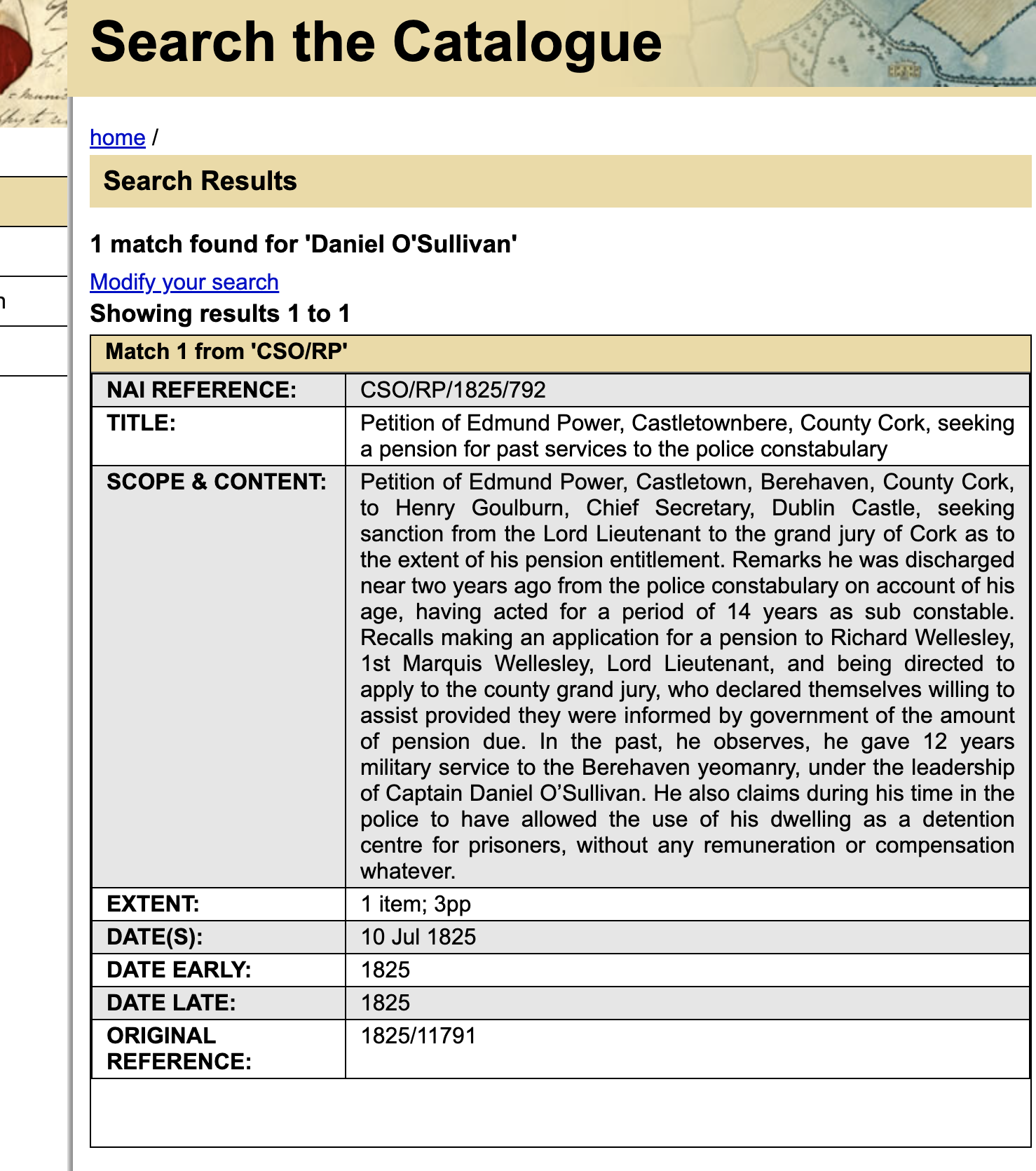
| M | WD | SULLIVAN | Timothy | of | Newtown, Co Cork | Police Constable | |||||
| N | WM | FALVEY | Dennis | of | Ballymountain, Co Cork | farmer | A | ||||
| Abstract | A leased to B & C, part of Glaun, Parish of Ballymoney [Glan, Dunmanway], Co Cork, for a period of lives. | ||||||||||
| MS | Date registered | 12 Jul 1828 | Date abstract added | 20210502 | |||||||
Abstract made by: RonPrice
Policing in Ireland
Law and Order
Policing
Peace Preservation Force1
The Peace Preservation Force was established in 1814 by Sir Robert
Peel2
, as a mobile force, supplementary to the pre-existing and underresourced baronial constabulary. The new force was under the
command of stipendiary magistrates (also known as chief magistrates of
police who had the powers of justices of the peace) whose staff each
included a clerk, chief constable and sub constables. The force could be
dispatched to any district which was proclaimed by the Lord Lieutenant
as disturbed. They were paid for by local rate-payers which made the
force unpopular with landlords. Many ‘peelers’ joined the Irish
Constabulary when it was created in 1822 and the force was eventually
fully amalgamated into the Constabulary in 1836.3
The papers reveal how the authorities began to reduce the force in the
mid-1820s. Included, for example, are requests from former Peace
Preservation Force policemen seeking appointment to the Constabulary
despite being illiterate (CSO/RP/1824/217); efforts to absorb the force
into the Constabulary in Tipperary to deal with increased outrage
(CSO/RP/1828/1631); attempts by a chief magistrate of police in
Limerick, to reverse a government order requesting him not to fill current
vacancies ‘with the view to the gradual reduction of that Force’
(CSO/RP/1829/237).
Irish Constabulary4
The Irish Constabulary, a centralized force, responsible for the whole
country except Dublin, was first established in 1822 by act of parliament.
It was a centrally controlled, hierarchical, armed, paramilitary force,
organised on a county by county basis. Constables and sub-constables
lived in barracks and were subject to military type discipline administered
by chief constables who in turn answered to sub-inspectors, county
inspectors, inspector generals and ultimately to the Chief Secretary. The
officer ranks were directly commissioned, with little promotional
opportunity available to the rank and file. Between 1836 and 1846 each
county contributed to the cost of their force but after 1846 the exchequer
shouldered the entire cost. In 1836 the constabulary was consolidated
with the Peace Preservation Force and from 1867 onwards was known
as the Royal Irish Constabulary.
The papers are filled with letters from individuals seeking positions in the
force; with requests for leave of absence from chief constables and. appeals from constables for reinstatement following dismissal for
drunkenness.
The papers demonstrate that disobedience or displays of partisanship
was not tolerated. For example constables who refused to take down an
‘Orange’ flag during the long-running dispute in Mountmellick were
dismissed (CSO/RP/1828/1524), as was Captain John Burke, chief
constable who attended a Brunswick Club meeting in Wexford
(CSO/RP/1829/160).
The papers reveal a tension between magistrates and government over
the precise role and duties of the new constabulary at local level. The
crown law officers made clear that constables were not to be used to
enforce civil bills, magistrates’ warrants, or enforce payment of tithes and
were also not permitted to assist the Revenue police except in cases of
a breach of the peace. These duties were to be carried out by baronial
constables and other officers (CSO/RP/1826/1718).
The papers contain letters from high-ranking police officers proposing
improvements to the force. It was suggested that policemen be moved
regularly to prevent them from becoming too familiar with their
communities (CSO/RP/1828/1712); that married constables were a
hindrance to the operation of the force (CSO/RP/1828/795) and that
chief constables, who often had military backgrounds, should not be
chosen from the gentry class and should be discouraged from displays
of military pomp (CSO/RP/1828/1361)
 West Cork History