The Mellifonds were of N orman extraction and because of the penal Laws some conformed to the Church of Ireland.
Gilbert Melefont, Gent. 1731/32 Parish Fanlobbus (Dunmanway). Probably Attorney, Dunmanway from 1730s Family heavily involved in Bantry area Donemark tenants of Kenmare Estate, middle men, later Magistrates in Dunmanway Melefont family member attained as rapparees in Balingeary area 1690, Sir Henry Blackhall on Munster Gallweys May be brother of David of Mellifont one of family Mary Mellifont married Henry Gallwey Bantry c 1700. Family of Norman origin prominent Kinsale
Convert Rolls, and Public Recantations, Co. Cork 18th and 19th Century and a Protestant Converts to be Catholic
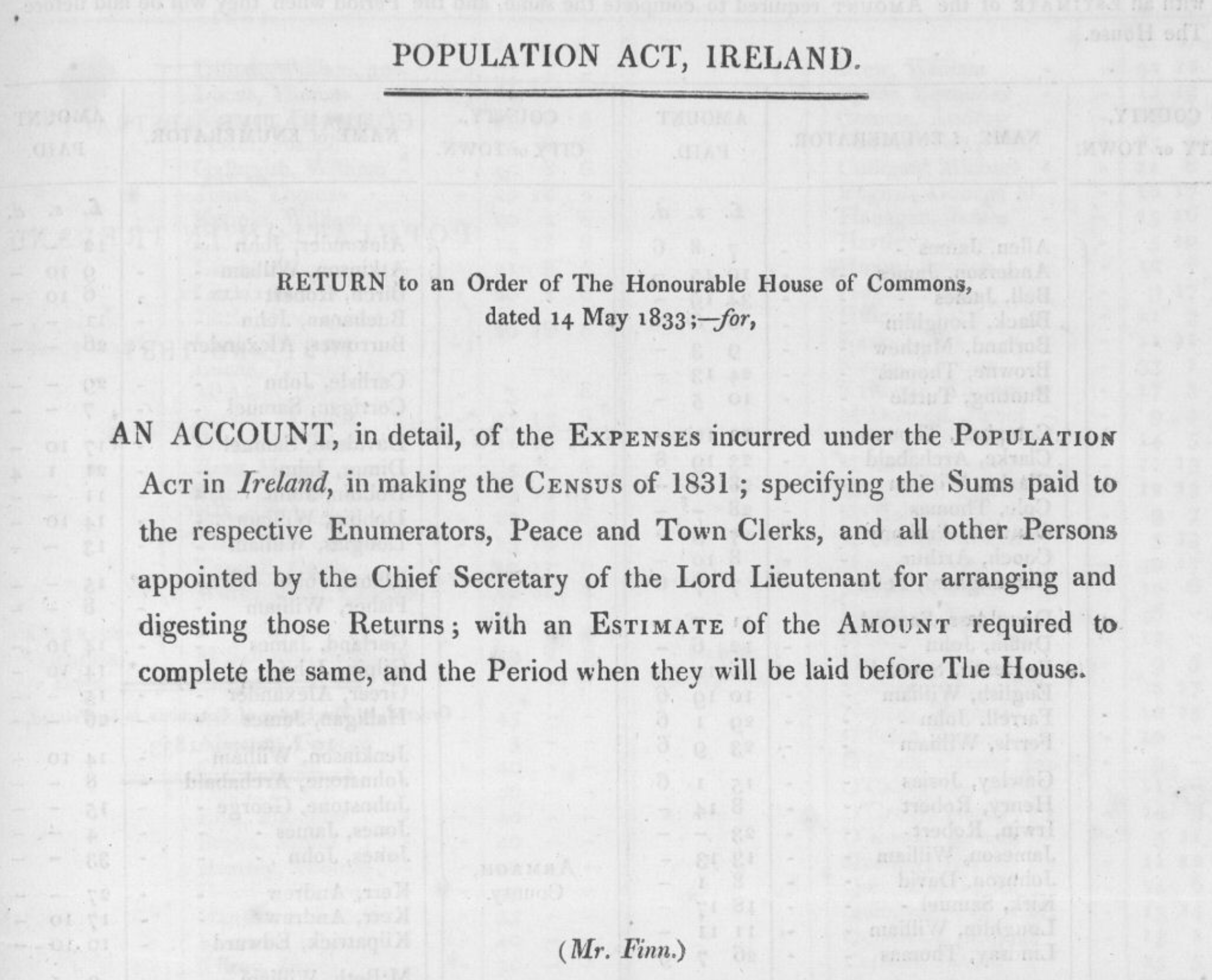
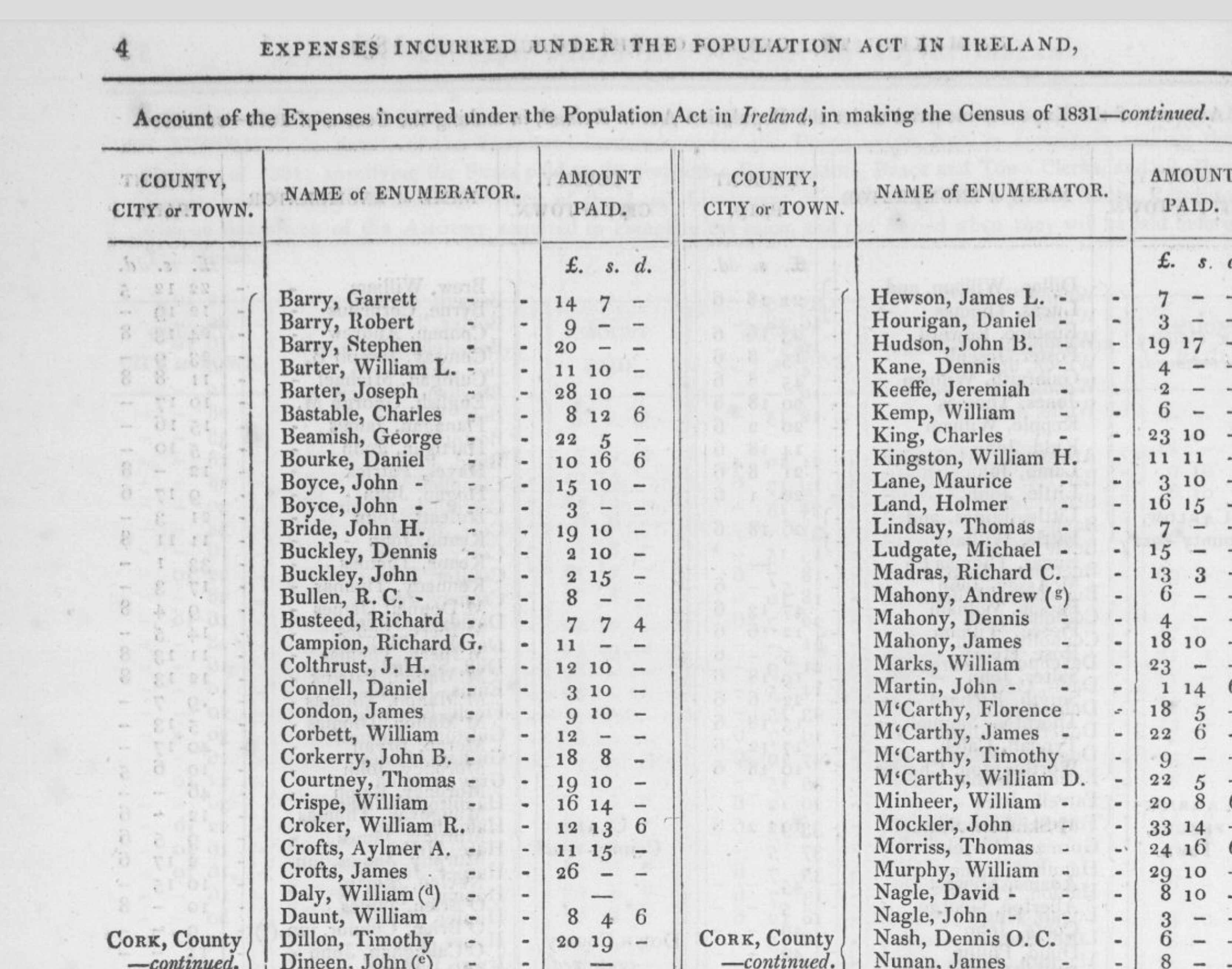
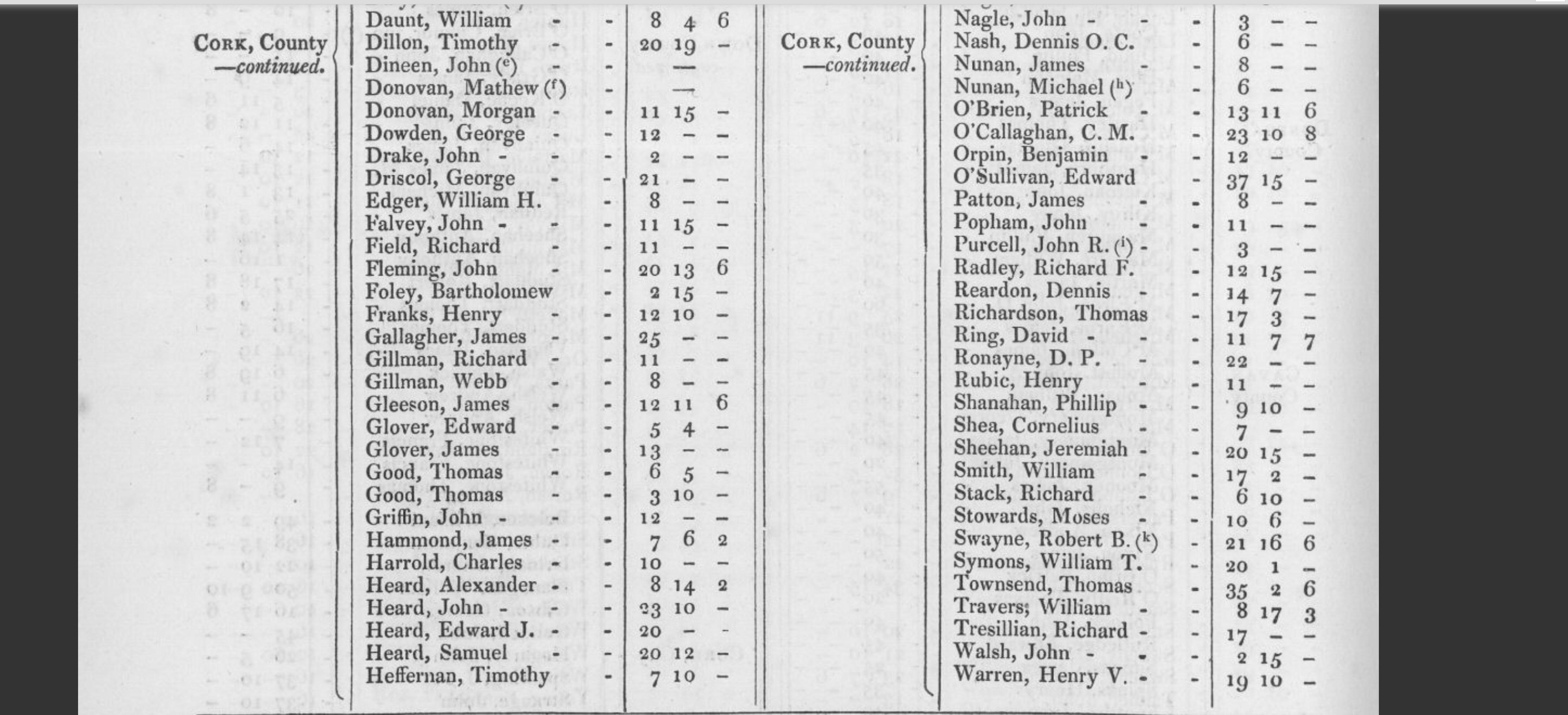
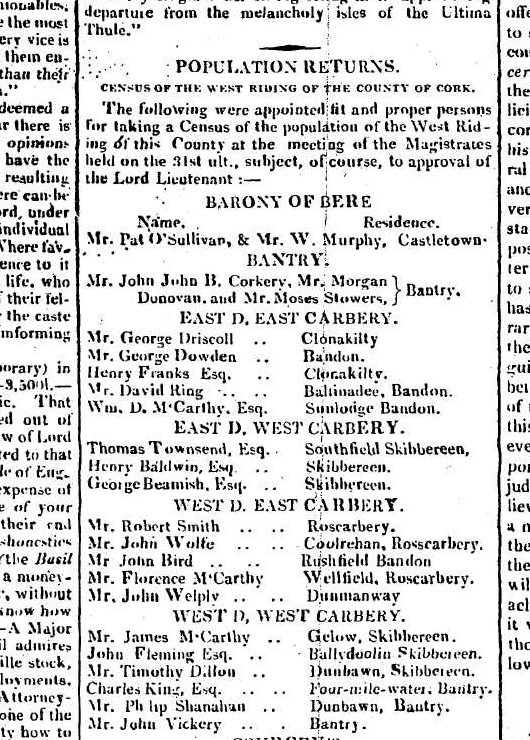
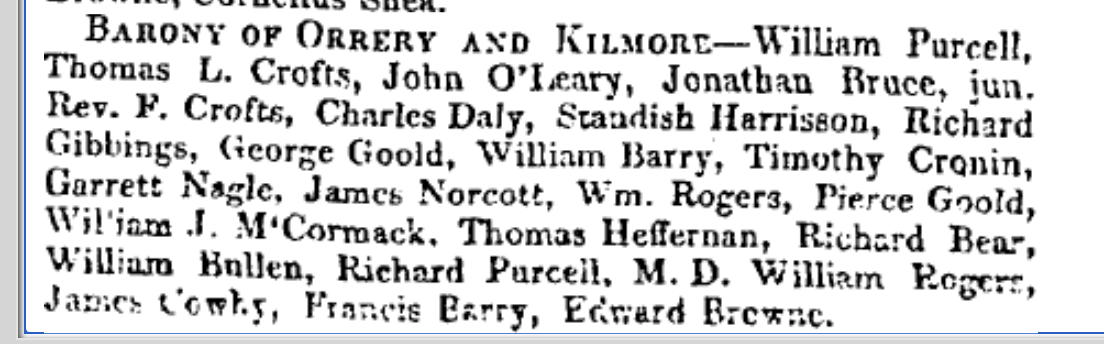
1831 Persons Appointed Fit and Proper Persons to Taking a Census, Barones Bere, Bantry, East Division, East Carbery, East Division, West Carbery, West Division, East Carbey, East Division, West Carbery, Courseys, Ibane and Barryroe, Kilmmeaky (Bandon)
.
Dunbeacon Graveyard:
6th March 1867 Mrs. Ann T.(ownsend) Shanahan Probably Dunbeacon Philip probably died 1892 aged 96 58 Grave: Erected by Philip Shanahan ot the memory of hs wife Ann T d 26th March 1867 aged 58 ” Philip Shanahan. was born Abt 1796; d.5 Aug 1892-Dunbeacon, County Cork, Ireland. Philip married Anne TOWNSEND on 14 Nov 1826 in East Schull, County Cork, Ireland . Anne was born about 1812. She died on 26 Mar 1867 in Dunbeacon. County Cork, Ireland. “
1892 Philip Shanahan Probably Dunbeacon Philip 1892 aged 96 96 Grave: Erected by Philip Shanahan ot the memory of is wife Ann T d 26th March 1867 aged 58
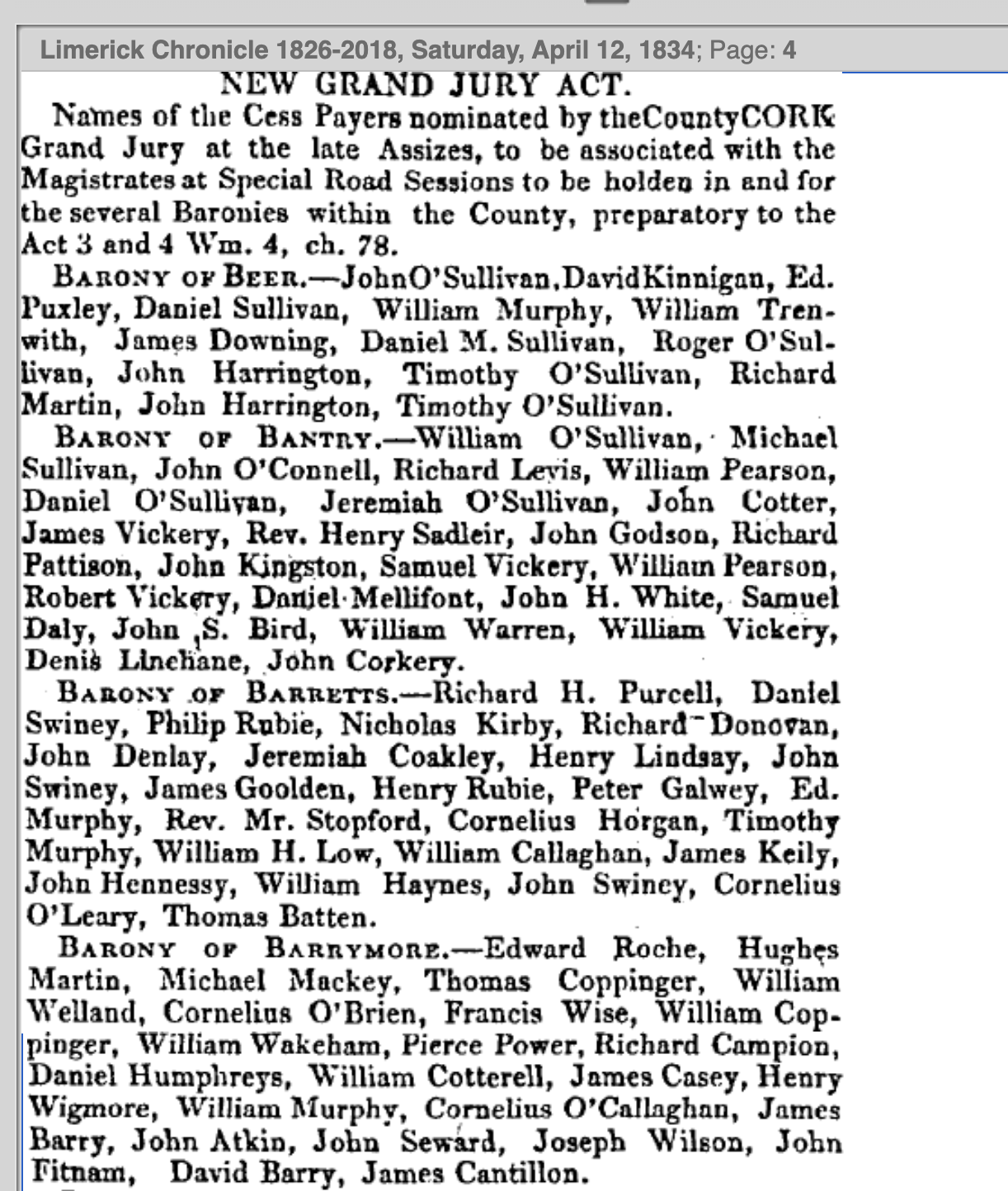
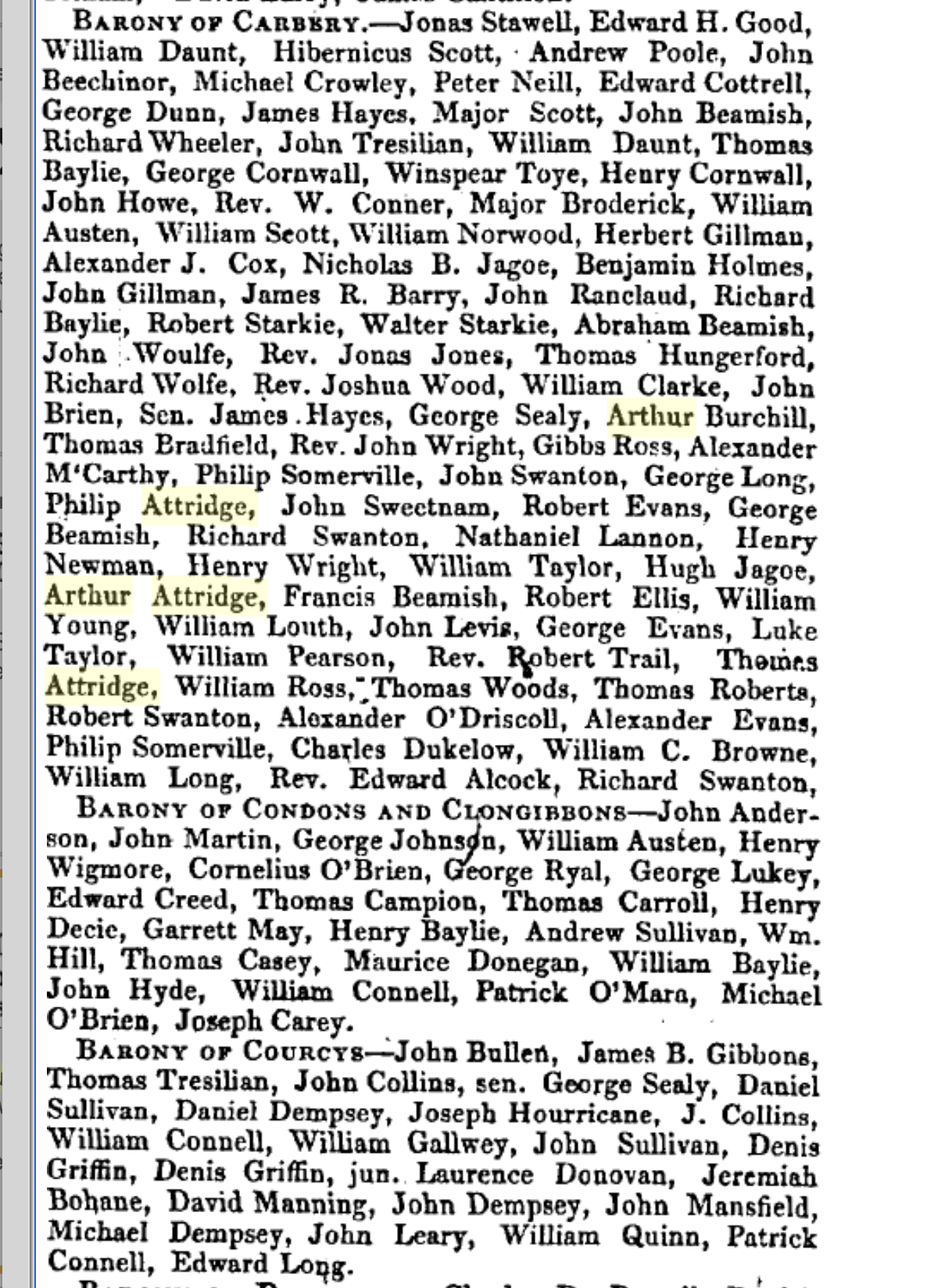
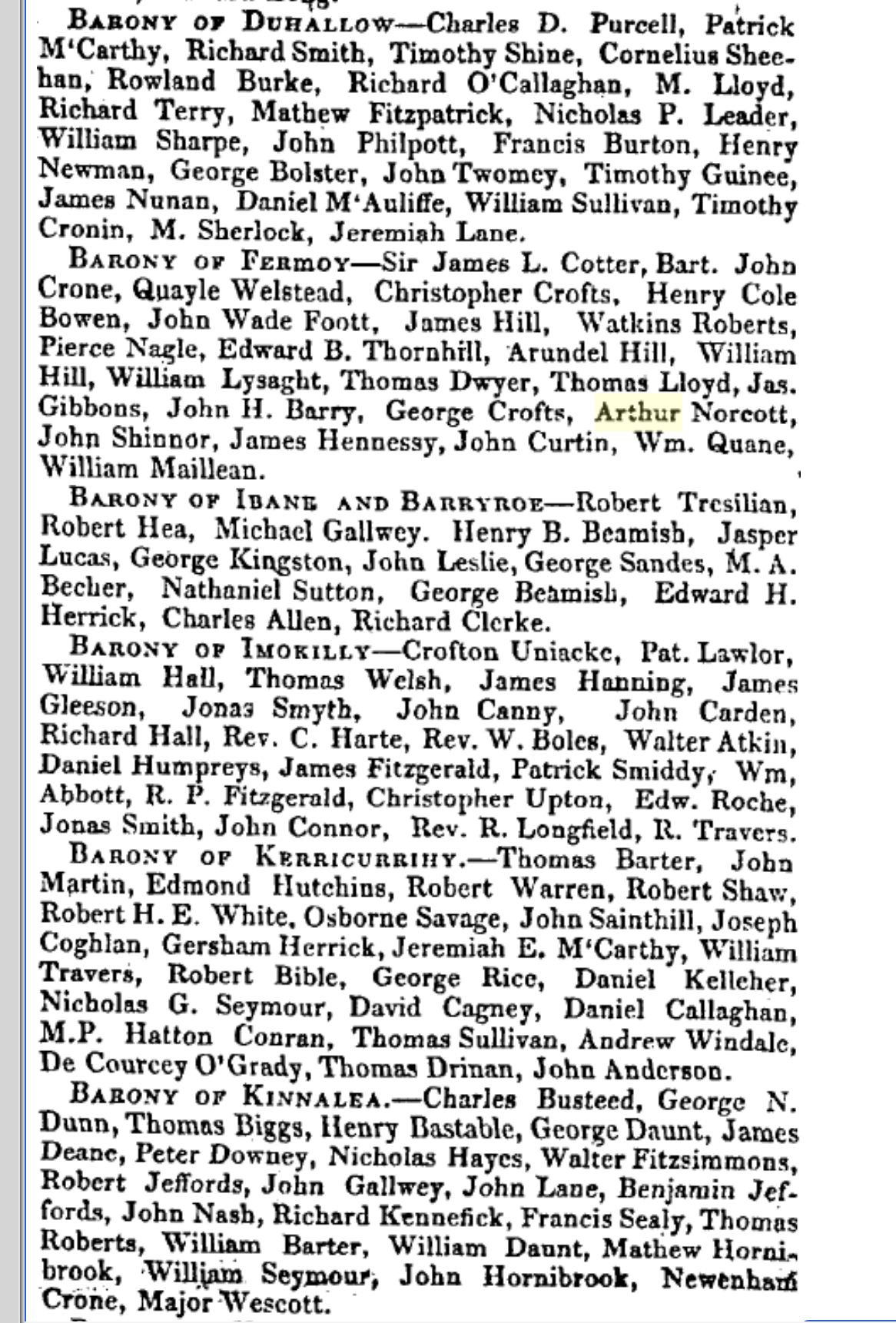
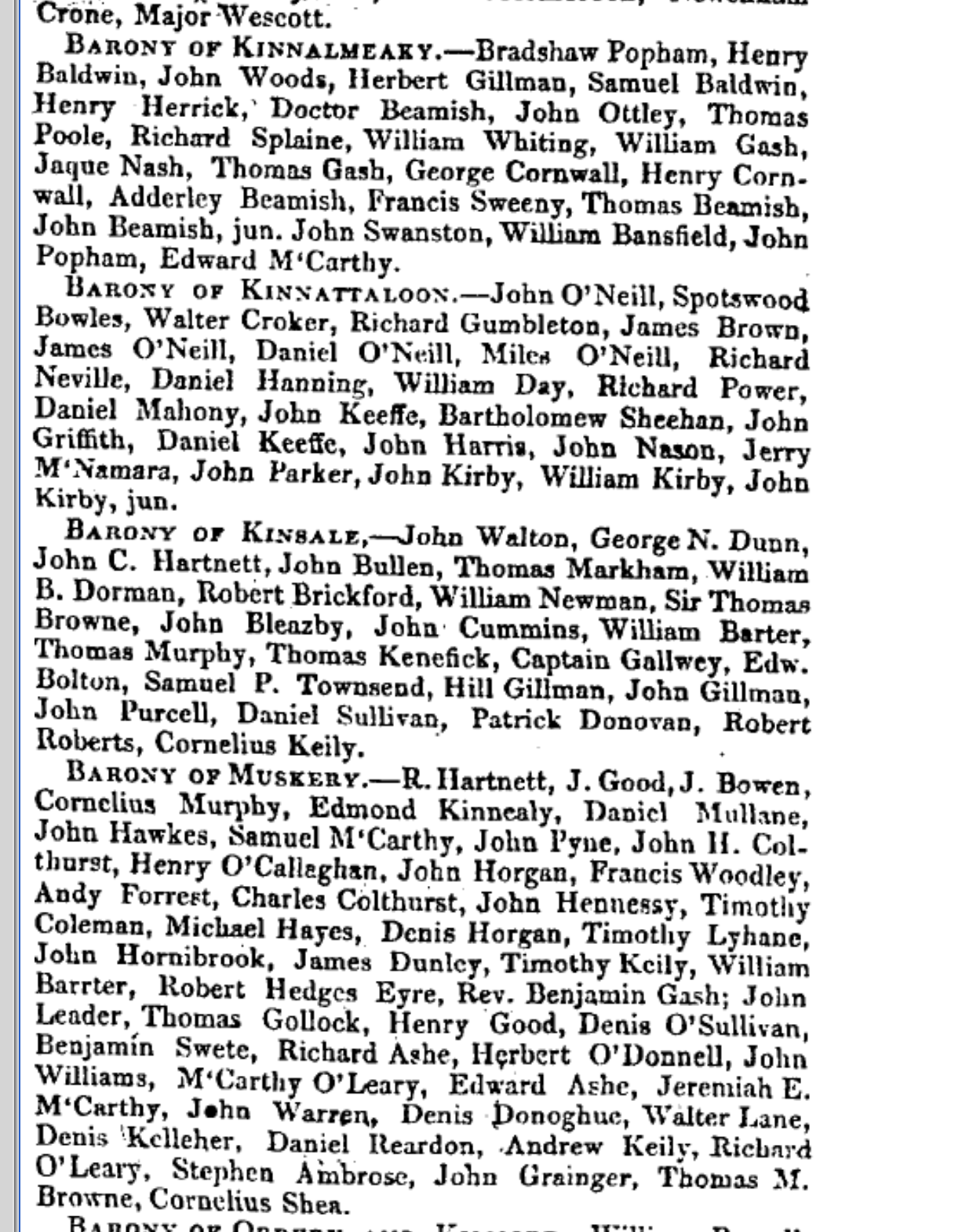
The Presentment system worked insofar as special Magistrates Session met locally to approve work on roads, bridges, harbours etc. Widely seen as corrupt favouring works for certain Landlords at the expense of cess (Rate) payers. This reform meant that prominent local citizens Catholic and Protestant farmers and business people sat at the Presentment sessions and had to approve work before they went to the Grand Jury sitting at the assizes.
1822, 1823, 1830, 1837 John Sweetnam Last Seneschal Aughadown and Schull Manors, later president of te Court of Justice before presumably Resident Magistrates Daughter Frances Gertude married William Clerke (1766-1820) possibly Skibbereen Mills. 1824. Letter from John Sweetman, seneschal of manor court of Bridgestown, Skibbereen, County Cork, to Chief Secretary’s Office, Dublin Castle, acknowledging directive for removal of four prisoners to the county gaol and communicating discomfort at prospect of releasing two debtors for fear of being sued for debts owed by the men; includes memorial from Swicham to Henry Goulburn, Chief Secretary, Dublin Castle, requesting clarification on application of a recent prison act to manor courts, especially as it relates to prisoners ‘confined for any sum not Exceeding ten pounds’, with response to same from John Sealy Townsend, KC and legal advisor to Chief Secretary’s Office, Dublin Castle. Died February 1824 at Mardyke House, Skibbereen. Ffolliott 1823. Letter from William Hull, Lemcon, Skibbereen, County Cork, to Henry Goulburn, Chief Secretary, Dublin Castle, referring to his former letter, emphasising the need to provide a simpler and less expensive means for the lower classes to recover small debts owed to them. Encloses, in support of his claim, a document entitled ‘ “a Manor Court Decree” taken by Richard Connell against Edward Butler, both of Kealfada, County Cork, demonstrating that the legal costs far outstrip the amount of the original debt; decree originally signed by John Sweetnam, seneschal [of Aghadown and Schull Manors], 4 October 1823. .
1876 Mr. John Sweetnam Last Seneschal Aughadown and Schull Manors, until 1859. Mardyke. Married Anne d George Beamish, Dunmore, Clonakilty. Not legally qualified, ‘private gentleman’, paid c £80 per annum not highly regarded. Manor Courts abolished 1859. Ballydehob with the Estate of Boyle later Duke of Devonshire. Son George b 1848 Rectr Creagh c 1900 ed St. Bee’s College. Evidence of John Jagoe, Bantry to Parliamentary Commission, Bantry c 1838 Correspondence with Chiel Secretary over recent 1822 Prison Act to Manor Courts Chief Secretary papers .
..
1821 Dr. Stephen Sweetnam MD Doctor, Airhill, Schull Guys .
..
Medical
1857-, 1892, 1897 Herbert Molesworth Sweetnam, Doctor, Skibbereen and Innishannon, General Practitioner B.A.T.C, Dublin T.N.C.S. and P.Ed and Z M: T.F.P.S.G. “Herbert Molesworth Sweetnam, Westropp House, Innishannon, Co Cork. Seventh son of Stephen Sweetnam, MRCS Eng of Schull, Co Cork. Educated at Faughnan’s School, Rosscarbery and at Trinity College, Dublin where he took the degree of BA and half the MB degree. He subsequently studied at the Royal College of Surgeons, Edinburgh and took the diplomas of LRCS and P Edin and LFM Glasgow. After practising in Skibbereen for some years, he settled at Innishannon in general practice. Medical Officer of the Innishannon Dispensary District and medical officer to the Post Office and referee to various Insurance Companies. Married first in December 1886 Rosa Sydney (who died 1895), daughter of Alexander John Montgomery of Dublin, and secondly in April 1898 Frances Penella, second daughter of Percival Symes Swan of Baldwinstown, Co Wexford, late agent of the Bank of Ireland, Tipperary and had issue by the second marriage, one son and one daughter
” 1899, attending funeral of R. H. Townshend, J.P., Myross Wood, Leap. Present Airfield, Schull at death of mother Mary Jermyn Sweetnam, widow of doctor aged 83 in 1897. “1892, attending funeral of Martin Jennings, Oldcourt, Skibbereen Southern Star 24th December 1892
.
1893, 1895, 1898 J. Sweetnam M.D. Doctor 1898 donor to Goleen relief fund 1893, attending funeral of Michael Sheehy, T. C., P.L.G., Skibbereen. 1895 Funeral of Bantry Solicitor Daniel O’Donovan aged 26. Native Skibbereen: Attending the 1894 funeral of George Robinson, Landlord and Magistrate, Southern Star 3rd February 1894, magistrates attending, R. Carey, H. Cullinane, Dr. Jennings, Dr. Levis, Captain Morgan. The O’Donovan, Colonel Somerville. .
1870 G. Sweetnam Doctor/Medical Student? Dary of Geoge Vickery, medical student, 1870.
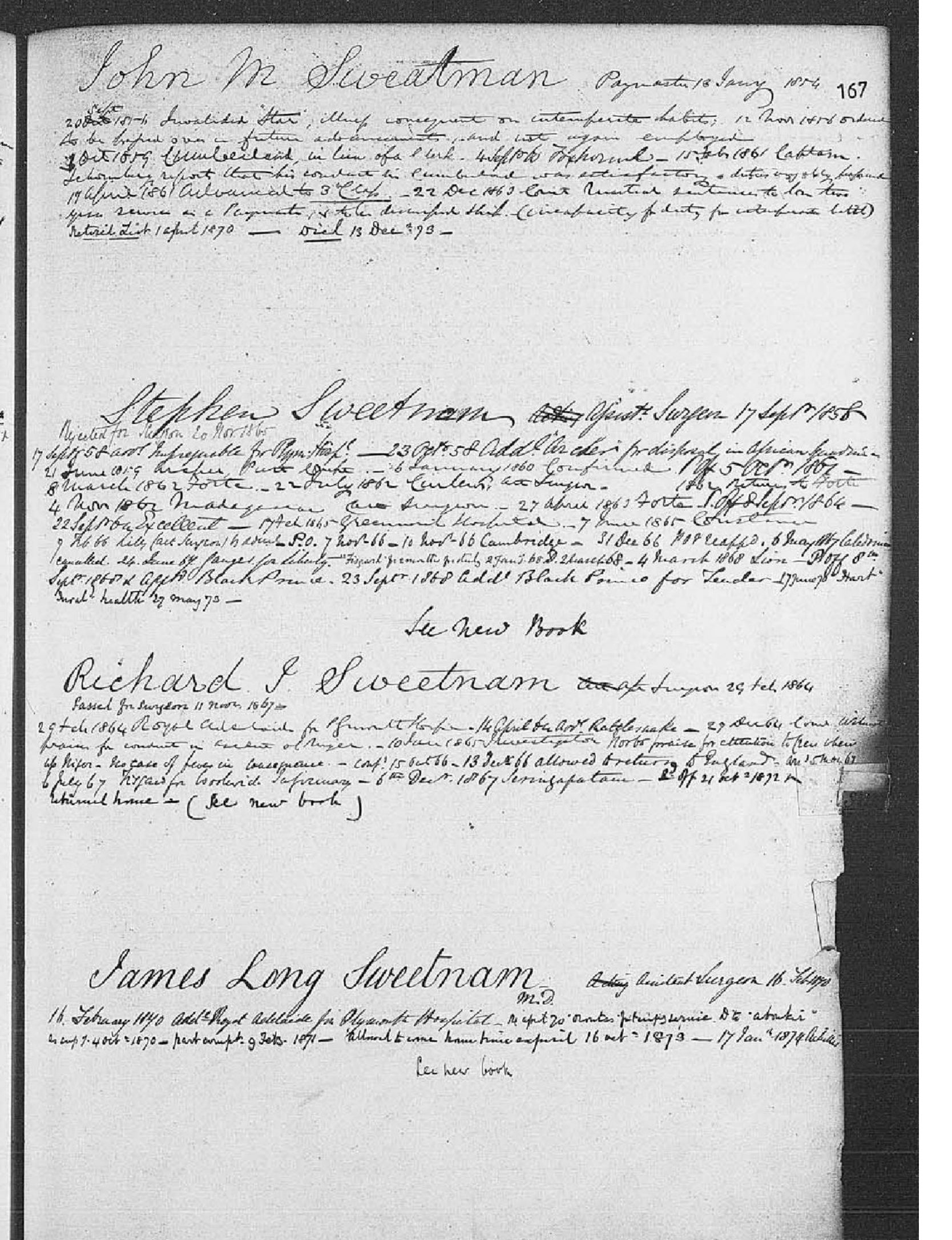
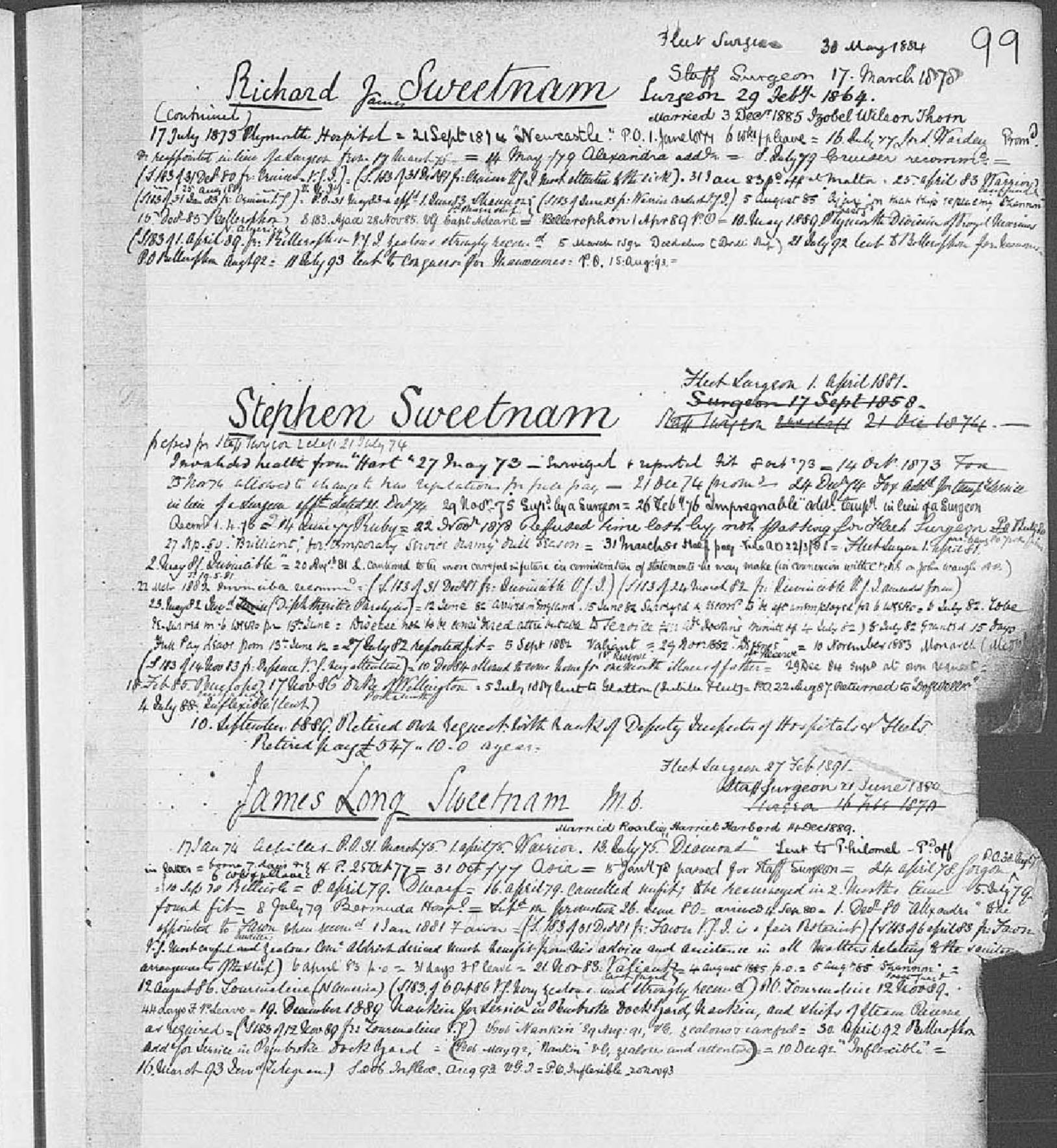
.. 1863 Dr. Richard James Sweetnam Qualified Royal College of Surgeons 1863 Air Hill. British Navy 1870? .
1807-1885, 1824, 1829,1835, 1846, 1870s Stephen Sweetnam M.R.C.S.L. Eng Dispensary Doctor Schull 1834-1852. Dispensary Officer 1840. 1829 acting as trustee over Skibbeeen properties from JOhn Attridhe to JOhn Sweetnam, Esq., River Cottage, Skibbeeen. Cert 1835. Praised for his work during famine. Relief Committee 1846. 1849 attending Ballydehob meeting proposes Agricultural Society for the Schull Union and Durrus/Kilcrohane. ListerAirfield Schull in Slater 1856 “Active as dispensary doctor in Schull during famine, 2nd wife Maria Jermyn Long 1835, She possbly Westfield, Aughadown. Possible first wife Jane Clerke 1832. Buried with Maria Aghadown Lower. 1877. Opening Skibbereen Railway
Daniel Donovan
David Hadden
John Levis, Glenview
S. W. Levis, Coroner
Dr. McCormack, Goleen
Dr. Popham, Bntry
Samuel Robinson
Dr. Swanton, Bantry
Dr. Sweetnam, Schull
Member election committee Nicholas Leader 1865 Cork County election. ” In the 1870s John (Swetman) Sweetnam of Skibbereen owned over 200 acres in county Cork while Stephen (Sweetman) Sweetnam MD, held over 220 acres in the Schull area. Members of this family held lands in the parishes of Abbeystrowry and Aghadown, barony of West Carbery, at the time of Griffith’s Valuation. Many were clergymen or medical practitioners. See http://www.learysweetnam.com “The Cork Southern Reporter : Thursday 10 November 1836
THE REV. MR. BARRY, P. P. OF EAST SKULL, has commenced the erection of a NEW CHAPEL for a poor population, in a remote District.
This necessary and long contemplated object could not, through a want of resources, have been before now carried into effect.
Mr. B. returns his thanks to the benevolent persons who, notwithstanding the many similar appeals and present weighty demands for local charities, have so liberally contributed the following sums : –” “1876 Dr. Stephen Sweetnam MD Doctor, Airhill, Schull Guys “”Inscription:
Stephen Sweetnam MD
died 8th April 1885
aged 78
Maria Sweetnam
died 11th May 1897
aged 83
“” “”Additional Information:
Dr Sweetnam was the dispensary doctor in Schull during the Great Famine. He was active in bringing relief to this area and is often referred to in famine reports from Schull. Maria Sweetnam (nee Long of Aughadown) was Dr Sweetnam second wife, his first wife was Jane Clerke of Skibbereen.”” “” Young Clerke was admitted to membership of the Inner Temple in London in November 1821 28. Another brother Jonathan Clerke 29 gained medical qualifications in Dublin and London in 1828. Stephen, brother of Frances Gertrude Sweetnam also gained medical qualifications at the same time and in a parallel manner to Jonathan Clerke.39 Alexander Clerk
“””
1866- George Sweetnam Probably Skibbereen district, may have gone to TCD 1911 Minister, Co.Derry Son Thomas William, medical student. “Son. 1877 Frank A. Sweetnam Father Stephen, doctor Aged 18, Midleton College
..
The Sweetnams were Seneschal son the Carbery/Freke Estate.
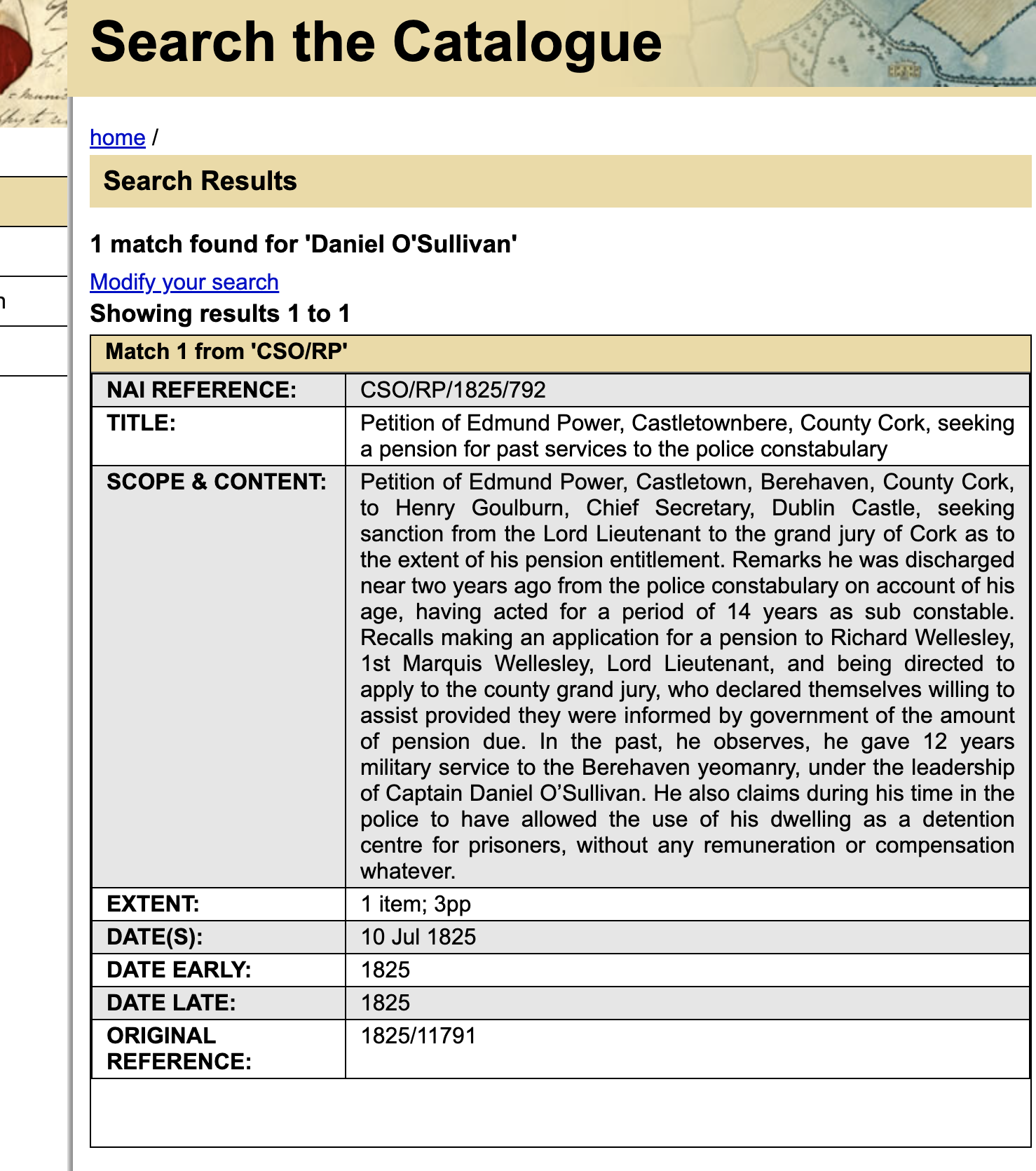
Law and Order Policing Peace Preservation Force1 The Peace Preservation Force was established in 1814 by Sir Robert Peel2 , as a mobile force, supplementary to the pre-existing and underresourced baronial constabulary. The new force was under the command of stipendiary magistrates (also known as chief magistrates of police who had the powers of justices of the peace) whose staff each included a clerk, chief constable and sub constables. The force could be dispatched to any district which was proclaimed by the Lord Lieutenant as disturbed. They were paid for by local rate-payers which made the force unpopular with landlords. Many ‘peelers’ joined the Irish Constabulary when it was created in 1822 and the force was eventually fully amalgamated into the Constabulary in 1836.3 The papers reveal how the authorities began to reduce the force in the mid-1820s. Included, for example, are requests from former Peace Preservation Force policemen seeking appointment to the Constabulary despite being illiterate (CSO/RP/1824/217); efforts to absorb the force into the Constabulary in Tipperary to deal with increased outrage (CSO/RP/1828/1631); attempts by a chief magistrate of police in Limerick, to reverse a government order requesting him not to fill current vacancies ‘with the view to the gradual reduction of that Force’ (CSO/RP/1829/237). Irish Constabulary4 The Irish Constabulary, a centralized force, responsible for the whole country except Dublin, was first established in 1822 by act of parliament. It was a centrally controlled, hierarchical, armed, paramilitary force, organised on a county by county basis. Constables and sub-constables lived in barracks and were subject to military type discipline administered by chief constables who in turn answered to sub-inspectors, county inspectors, inspector generals and ultimately to the Chief Secretary. The officer ranks were directly commissioned, with little promotional opportunity available to the rank and file. Between 1836 and 1846 each county contributed to the cost of their force but after 1846 the exchequer shouldered the entire cost. In 1836 the constabulary was consolidated with the Peace Preservation Force and from 1867 onwards was known as the Royal Irish Constabulary. The papers are filled with letters from individuals seeking positions in the force; with requests for leave of absence from chief constables and. appeals from constables for reinstatement following dismissal for drunkenness. The papers demonstrate that disobedience or displays of partisanship was not tolerated. For example constables who refused to take down an ‘Orange’ flag during the long-running dispute in Mountmellick were dismissed (CSO/RP/1828/1524), as was Captain John Burke, chief constable who attended a Brunswick Club meeting in Wexford (CSO/RP/1829/160). The papers reveal a tension between magistrates and government over the precise role and duties of the new constabulary at local level. The crown law officers made clear that constables were not to be used to enforce civil bills, magistrates’ warrants, or enforce payment of tithes and were also not permitted to assist the Revenue police except in cases of a breach of the peace. These duties were to be carried out by baronial constables and other officers (CSO/RP/1826/1718). The papers contain letters from high-ranking police officers proposing improvements to the force. It was suggested that policemen be moved regularly to prevent them from becoming too familiar with their communities (CSO/RP/1828/1712); that married constables were a hindrance to the operation of the force (CSO/RP/1828/795) and that chief constables, who often had military backgrounds, should not be chosen from the gentry class and should be discouraged from displays of military pomp (CSO/RP/1828/1361)


 West Cork History