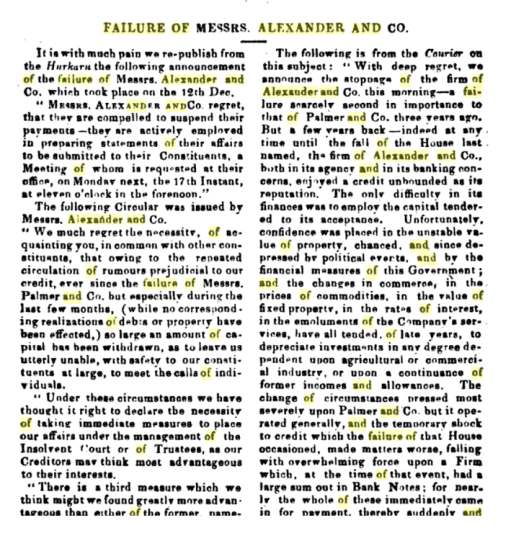
1833. Failure of Alexander and Company, Bank, Calcutta and West Cork and East India Company Connections with Some Military Service.
1833. Failure of Alexander and Company, Bank, Calcutta and West Cork and East India Company Connections.
..
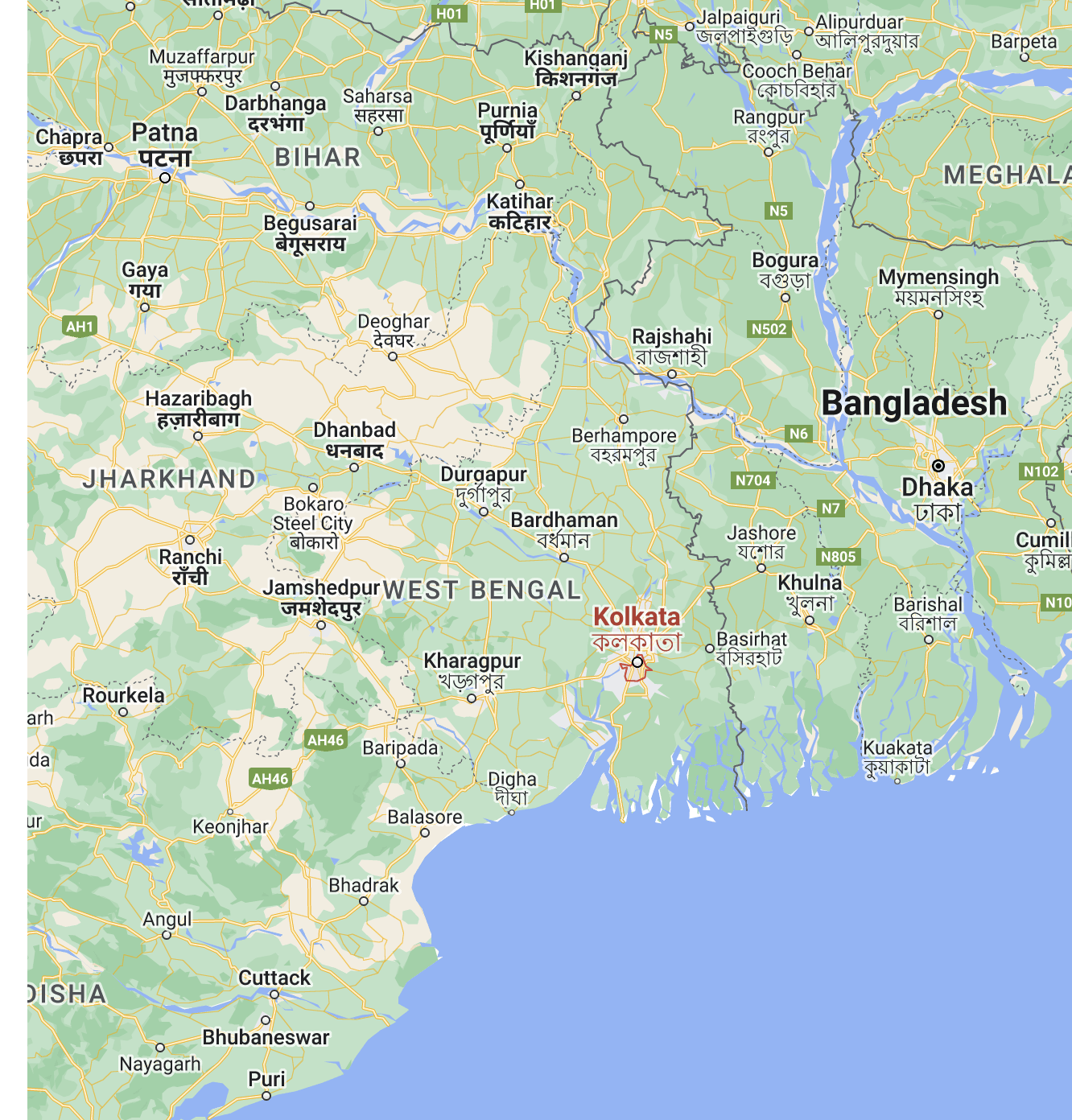
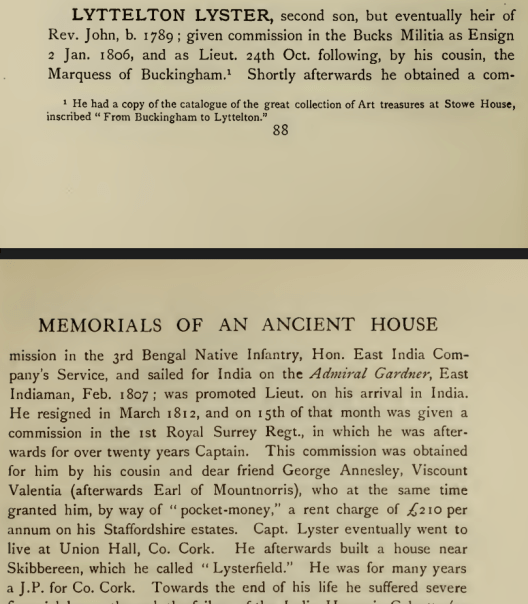
CSO/RP/1833/5063. Chief Secretary’s Office. Letter from Lyttelton Lyster, magistrate Rosscarbery [Ross Carbery, County Cork], to Edward John Littleton, [Chief Secretary, Dublin Castle], asking to be made a stipendiary magistrate, stating that he suffered financially from the failure of Messieurs Alexander and Company, Calcutta [Kolkata, India].
The Private Bank set up by Alexander & Co. The Bank of Hindustan was the first bank to introduce Bank Notes for the first time in India. These Bank notes were representative money only. The actual money was Gold and Silver coins. The Bank of Hindustan maintained reserves of actual money i.e., coins of Gold and Silver which were known as Rupia. The notes issued by the Bank always contained a Promise Clause to pay the bearer the actual money (Gold or Silver) on demand in exchange of notes issued by the Bank. Run on is a banking term when some sort of panic is created among the general public creating a fear that the Bank is not able to exchange its notes by the actual money(Gold or Silver) and depositors start running towards the bank to withdraw their money from the bank. In modern day banking it is called Bank Failure. The Bank Of Hindustan faced such run on three times but it survived every time only because of the fact that the bank was keeping sufficient stock of actual money and only that much notes were issued which were backed by equivalent or more reserves. In commercial crises of 1832 the Bank of Hindustan was closed and went under its parent firm M/S Alexander & Co.
Madras, this family moved from France to Cork via Amsterdam c 1750. They are included as the Rev. John Madas married Miss Evanson of the Durrus Landlord family c 1805. RevJohn Madras son of Rev. John Madras of Huguenot ancestry via Amsterdam married Martha Evanson daughter of Nathaniel Friendly Cove. Later Vicar of Aglish. Her mother Swanton, Ballydehob, niece of Judge Swanton New York, United Irishman. Voted 1826 City election for Conservative Callaghan. HIs son JOHN MADRAS, A.B., Incumbent of Abbeymahon, P. Donoughmore, and Curate of Templequinlan later a magistrate: County Freeman of Cork City voting in Cork City Election 1837.
Numerous descendants Protestant and Catholic. A granddaughter, Miss Curtis married Daniel O’Connell’s grandson, his father was a Resident Magistrate in Bantry.
Courtesy one of his descendants Mark Wickham:
Mark Wickham Bantry: Carey’s Lane, Cork. Huguenot graveyard.
That’s him. The Madras on the headstone was from Amsterdam and came with a French wife.
Some years ago I went to a Cork Corporation Heritage Week function in Carey’s Lane, Cork..
The Heritage officer, along with Dr Alicia St Leger, a Hugeonot historian, pronounced Madras with the silent French ‘s’.
My poor great-grandmother Margaret (Peggy) Madras-O’Callaghan died aged 46 in Drumahumper near Killarney. Her husband lived to be a hundred and was quite prominent in local politics. Although Dr Robert Conner Madras appears on her birth certificate and marriage certificate as her father I have no actual proof that he was her father.
Her mother was Joanna Linehan.
Edward Roche, (1771-1885), 1795, Trabolgan, Midleton. Son of Edmund Roche and Frances Coghlan, his mother probably a descendant of Jeremiah Coughlan, Carrigmanus, Mizen and Nathaniel Evanson, Durrus, ancestors of Lady Di. His brother Edmond ‘Mon’ Roche, extensive landowner Kildinan, Glenville, United Irishman, later acquitted when charged. Listed supporter of Act of Union, 1799. 1828 seeking reform of the House of Commons address Kilshannig bought off Devonshers bankers Cork Fermoy. Deputy Lieutenant 1838. Father Lord Fermoy. 1835 Subscriber Lewis Topographical Dictionary of Ireland 1837. 1840 calling for Testimonial to late William Crawford Cork benefactor. Trablogan built circa 1780, for the Roche family who’d held the 16,000-acre estate since about 1645. The original manor was most likely rebuilt with money from Edward Roche’s prodigious marriage in 1781 to the daughter of Sir George Wombwell, 1st Bt., Chairman of the Honourable East India Company. In Irish, “Tra” means ‘strand’ or ‘beach’ and “Bolgan” is either ‘bulging’ or ‘big wave’. Sometimes the gales off the Atlantic were so strong, it was impossible to open the hall door! Despite the estate’s size, it was poor agricultural land and brought in a comparatively low annual income of £7,000
July 1800, Co. Limerick, Alan (Alleyn?) Evanson Esq., Mary McMahon, Groom in South Cork Militia.
…
If you have Irish Huguenot ancestry good luck:
France DNA
From a friend who has Levis ancestry
Amongst my TV viewing recently was an episode of ‘DNA Family Secrets’, and one of the things mentioned was surprising news to me. Until I had seen this programme, I was completely unaware that is illegal for anyone in France to do a DNA test, I remember asking one of my Levis relatives if his DNA test had shown up his French heritage in his ethnicity background, which brought the response that it did not, which I was struggling to understand. But now I know about the fact that the population of France are not allowed to take DNA tests then this I feel explains the lack of any French heritage showing up in the Ancestry DNA tests!
I have since Googled to see why this is and I have pasted in one of the items on this subject –
Why is DNA testing illegal in France?
Private DNA paternity testing is illegal, including through laboratories in other countries, and is punishable by up to a year in prison and a €15,000 fine. The French Council of State has described the law’s purpose as upholding the “French regime of filiation” and preserving “the peace of families.”
Maybe you were aware of this issue but I was definitely taken aback by this news. Things of course may change in the future, but at the present the law is banning the tests being done in France, unless there is a medical, judicial or scientific reason but definitely not family history!
I was reading Dr. Jane Ohlmeyer, book on Ireland and empire. Following the book and lecture on the British acquisition of Bombay I started looking at my notes on those with a West Cork background who had colonial experience. I was surprised by the number, military, medical, engineering, legal and religious. I had not realised that forfeit Irish Land as well as producing revenue was used to give collateral security to fund slavery and sugar and tobacco enterprises. It seems that many of the grantees of Irish Land were associated with London networks such as the Thompson family heavily involved in the East India Company. Later in the end of the 17th century they were also probably involved in the Hollow Blade Company, a consortium of London merchants who financed Parliament in its war against the English King and surprise surprise they were repaid in grants of Irish confiscated land. In the same book she described in forensic detail the Irish involvement of both Irish Catholics and Protestants in the slave trade and tobacco and sugar plantations.
Ireland did not have colonies but was in the peculiar position of both being a colony and Irish people both Catholic and Protestant of all classes being complicit in slavery. This was not just with the English but with all colonial powers. Dr. Ohlmeyer cites a number of examples, the Danes had a small colony in the West Indies but no commercial network to sell the sugar from the slave plantations. Apparently their Lutheran religion proved no barriers to using Irish Catholic merchant networks on the Continent to sell their sugar. The Irish Catholic Caroll family had extensive plantation in Maryland and slaves. Charles Carroll of the family signed the American Declaration of Independence.
Richard Boyle the Great Earl of Cork acquired much of the land granted to Phane Beecher around Bandon. The iron from his works were used to bribe African Chiefs to sell their own people into slavery. The McCalmont family of Co. Derry had extensive plantations in Barbados and multiple slaves. when slavery was abolished. From the compensation they received they invested in West London real estate and initially leased Mount Juliet in Co. Kilkenny from the Butler family eventually acquired it outright.
The Munster ports ( like Bristol ) were heavily involved in the Atlantic ‘Triangular Trade’ and that was explicitly tied into securing and transporting slaves, and dealing in the products that then came from their work….cotton, indigo, rice, sugar and molasses etc. Of course Munster butter, bacon and beef ( the Provisions Trade) partly went to feed those enslaved too. Behind all were the investments, security on loans and profits coming back. The big houses, fine streets, public buildings and squares didn’t only come from Irish rents! There is no getting away from widespread complicity.
Dr. Ohlmeyer makes the point that work on the colonial archives of The Netherlands, France, Portugal and Spain has only begun and it is probable that many more Irish Connections will surface.
John William Becher, 1855, Castle Hyde, Fermoy, Usually Resident, £432. Subscriber Hollybrook as D.L. 1861 Rev. Gibson’s History of Cork. I have John William Becher as born 20 Jan 1849 and baptized 16 Feb 1849 at Abbeystrewry, Co Cork, the son of Richard “O’Donovan” Becher & Bessie Hungerford. In 1881 he married at the Catholic chapel at Skibbereen to Ellen Young. He was a farmer/farm servant. Still living in 1911.
Edward Beecher, 1767, Ballicallen. This is most likely Edward Becher, son of Lionel Becher & Catherine Dunscombe. He was of Bally Cotton & died at Crookhaven in July 1797. He married Jane Bousfield in 1756 & Ruth Herrick in 1761.
SIR JOHN WRIXON-BECHER, 3rd Baronet (1828-1914), JP DL, High Sheriff of County Cork, 1867, who espoused, in 1857, the Lady Emily Catherine Hare, daughter of William, 2nd Earl of Listowel. His son Sir Eustace William Wyndham Wrixon Becher (1860-1934) Bart, DL, 1915, Creagh, Skibbereen, Ballygiblin, Mallow, listed 1922. Executor of his father Sir John Wrixon Becher, M.A., D.L., (1828-1914), £11,299.
Sir Eustace William Wyndham Wrixon Becher (1860-1934) Bart, DL, 1915, Creagh, Skibbereen, Ballygiblin, Mallow, listed 1922. Executor of his father Sir John Wrixon Becher, M.A., D.L., (1828-1914), £11,299. 1911 living Roxboro, Co. Limerick living off land income, wife born London, 8 servants. His father was the third holder of the baronetcy created in 1831 for Sir William Wrixon-Becher and to his death passed to his son Sir John. He married, in 1907, Constance, daughter of Augustus, 6th Baron Calthorpe, and had issue, WILLIAM FANE, his successor.
Henry Becher (1664-, TCD in 1683 aged 19, son of Thomas Sherkin Island, 1705, witness to 1717 deed with Emanuel Moore. Henry Becher was Thomas Becher’s eldest son. He married Henrietta Owen in 1698. His heir was John Becher. Henry died in 1738. etc see document
Phane Beecher
From:
eecher/Becher
Burke’s ”Irish Family Records” and Smith both indicate that the Beechers were originally a Kent family. Fane Becher was granted over 12,000 acres in county Cork during the reign of Elizabeth I. Henry Beecher was granted land in West Carbery in 1669 and is recorded as the purchaser of land from Lord Kingston and Sir William Petty. In 1778 Mary daughter of John Townshend Becher of Creagh and Annisgrove, county Cork, married William Wrixon of Cecilstown, county Cork. She succeeded to the estates of her brother Henry Becher of Creagh. Their eldest son William Wrixon of Ballygiblin assumed the name of Becher and was made a baronet in 1831. He married an actress, Miss O’Neill, and had a number of children. Griffith’s Valuation records Sir William Wrixon Beecher holding an estate in the parishes of Castlemagner, Clonfert, Kilmeen, Knocktemple and Subulter, barony of Duhallow, county Cork. Sir Henry Becher, who succeeded his father in 1850, was among the principal lessors in the parishes of Castlehaven, Aghadown, Creagh and Tullagh in the barony of West Carbery, county Cork. Sir William Becher also held land in the parish of Kilvellane, barony of Owney and Arra, county Tipperary. The estate of Sir Henry Wrixon Becher of Ballygiblin amounted to 18,933 acres in county Cork and 358 acres in county Tipperary in the 1870s. Michael A Becher held townlands in the parish of Kilmeen, barony of East Carbery and in the 1870s Michael R. A. Becher of Ballyduvane, Clonakilty owned over 2,000 acres in county Cork. In 1854 lands and mining interests, the property of Edward Baldwin Becher, were offered for sale in the Encumbered Estates Court, and includes a report on the mines of Coolaghmore and Coolaghbeg. The Freeman’s Journal provides details of the purchasers of lots sold at auction, though it indicates that some lots were sold by private contract. In the 1870s the Becher estate in Cork (a combination of the Wrixon and Becher estates) amounted to over 18,000 acres while he also held lands in Tipperary. The estate of the representatives of the late John Beecher amounted to over 1600 acres in the 1870s. At the time of Griffith’s Valuation, Edward and George Beecher were among the principal lessors in the parish of Kilcoe while Richard Beecher was the lessor of townlands in the parish of Skull. Eliza Beecher held several townlands in the parish of Kilgarriff, barony of Ibane & Barryroe, at the same time. In October 1851, 17,000 acres, the estate of Richard H. Hedges Beecher, was offered for sale in the Encumbered Estates Court. Lot 1 included the owner’s house at Hollybrook. A sale of the remaining lots took place in February 1852 and included the house at Lakelands, leased to Richard O’Donovan Beecher. In April 1858, the house and demesne at Hollybrook were again offered for sale. The Freeman’s Journal reports their purchase, in trust, by Robert Johnson. An extensive family history of both the Becher/Beecher and Wrixon families is given by Grove White and published in the ”Journal of the Cork Historical and Archaeological Society” (1907) under Ballygiblin. The spelling Becher and Beecher are used almost interchangably thoughout the eighteenth and nineteenth centuries.
The one good news story here is that a young McCarthy girl from the Skibbereen District was bitten by a rabid dog. She went to Paris to be treated by Dr. Pasteur at public expense and made a full recovery.
Rabies is an infection associated with a wide range of wild and domestic animals. After dogs, cattle were the most commonly affected animals in Ireland in the late 1890s, mostly having been bitten by rabid dogs. The rabies virus is shed in the saliva of infected animals and may be transmitted by animal bite or by a lick to an open wound. It may also be acquired from an infected human as a result of injury related to their behaviour in the ‘furious’ stage of the disease. The virus enters the peripheral nerves via muscle cells and travels to the central nervous system, where it causes inflammation of the brain (encephalitis) and spinal cord (myelitis). The incubation period may last from two weeks to six months. Very often the primary wound is healed and forgotten by the time of clinical presentation.
When the virus reaches the central nervous system the victim presents with headache, fever, irritability, restlessness and anxiety. This may progress to muscle pains, salivation and vomiting. After a few days to a week the patient may experience a stage of excitement and be wracked with painful muscle spasms, triggered sometimes by swallowing saliva or water. Hence they drool and learn to fear water (hydrophobia). The patients are also excessively sensitive to air blown on the face. The stage of excitement lasts only a few days before the patient lapses into coma and dies.
In 1897 provisions were put in place under the Disease of Animals Act to prevent the further spread of rabies throughout Ireland. Under this general order all dogs in public places were required to be muzzled, and more stringent measures came into force as to the seizure, destruction and disposal of stray and unmuzzled dogs. Isolation was compulsory for any animal suspected of exposure to rabies. These measures had an almost instant impact on the infection of animals in the country. In 1895, 771 animals (567 dogs) were reported to be infected; in 1896, 687 (491 dogs). In the first six months of 1897, before the provisions came into force on 1 July, there were 335 animals reported as infected, but only 162 reported cases in the second six months. The project was deemed a success, as in 1898 the number of reported infections had been reduced to 132, and in 1899 to only 92. During 1898 the police seized 5,495 stray and unmuzzled dogs, and 4,364 of these were destroyed.
Over the last few years that rabies was prevalent in Ireland there were a number of human fatalities: in 1895 three males and two females (one from Leinster, three from Munster and one from Ulster); in 1896 two males and two females (one from Munster, two from Connacht and one from Ulster); and in 1897 four males (two from Munster, one from Ulster and one from Connacht). In 1898 four died, the last recorded human fatalities in Ireland due to rabies.
These statistics don’t get across the tragedy of individual cases. In December of 1894 Denis Moloney, a man in his seventies who lived alone in Cloughakeating between Ballinacurra and Patrickswell, was standing in the boreen leading to his house when he spotted a local stray terrier. He attempted to divert the dog away from his house but to no avail. The dog jumped at him and bit him on the left hand, causing a flesh wound between his fore and index fingers. After a number of weeks his appetite gradually failed and he took to his bed, but he still did not wish to avail of medical assistance and instead called on the services of a local ‘charmer’. Finally Dr O’Brien, medical officer of Patrickswell dispensary, was called in; after treating the patient and learning of the incident with the terrier he pronounced that the man had hydrophobia (rabies), to which he succumbed a few days later on 25 March 1895.
Cork City: 1760s rabies in city sporadically
Relevant Legislation from 1851 and Miscellaneous orders:


 West Cork History