


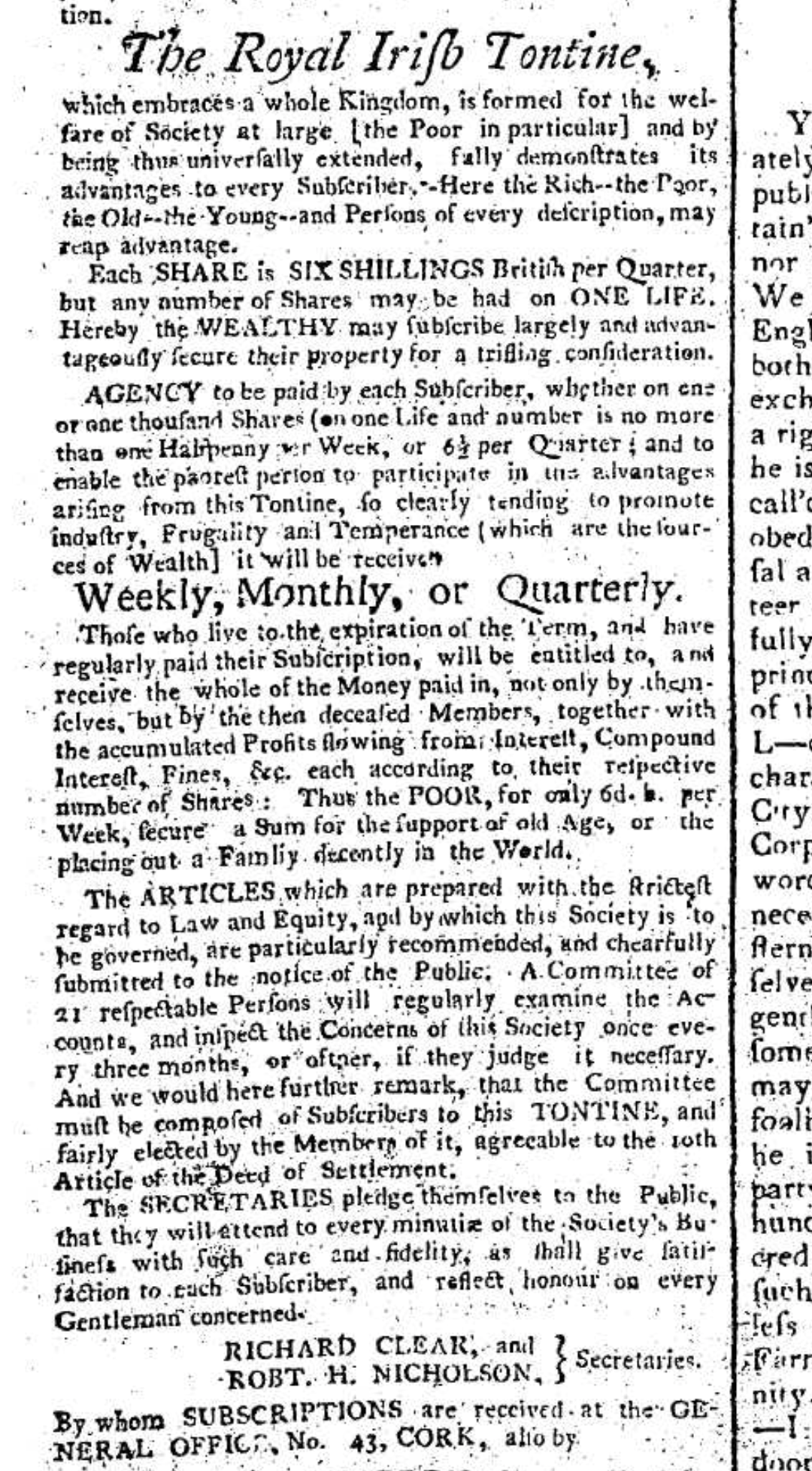
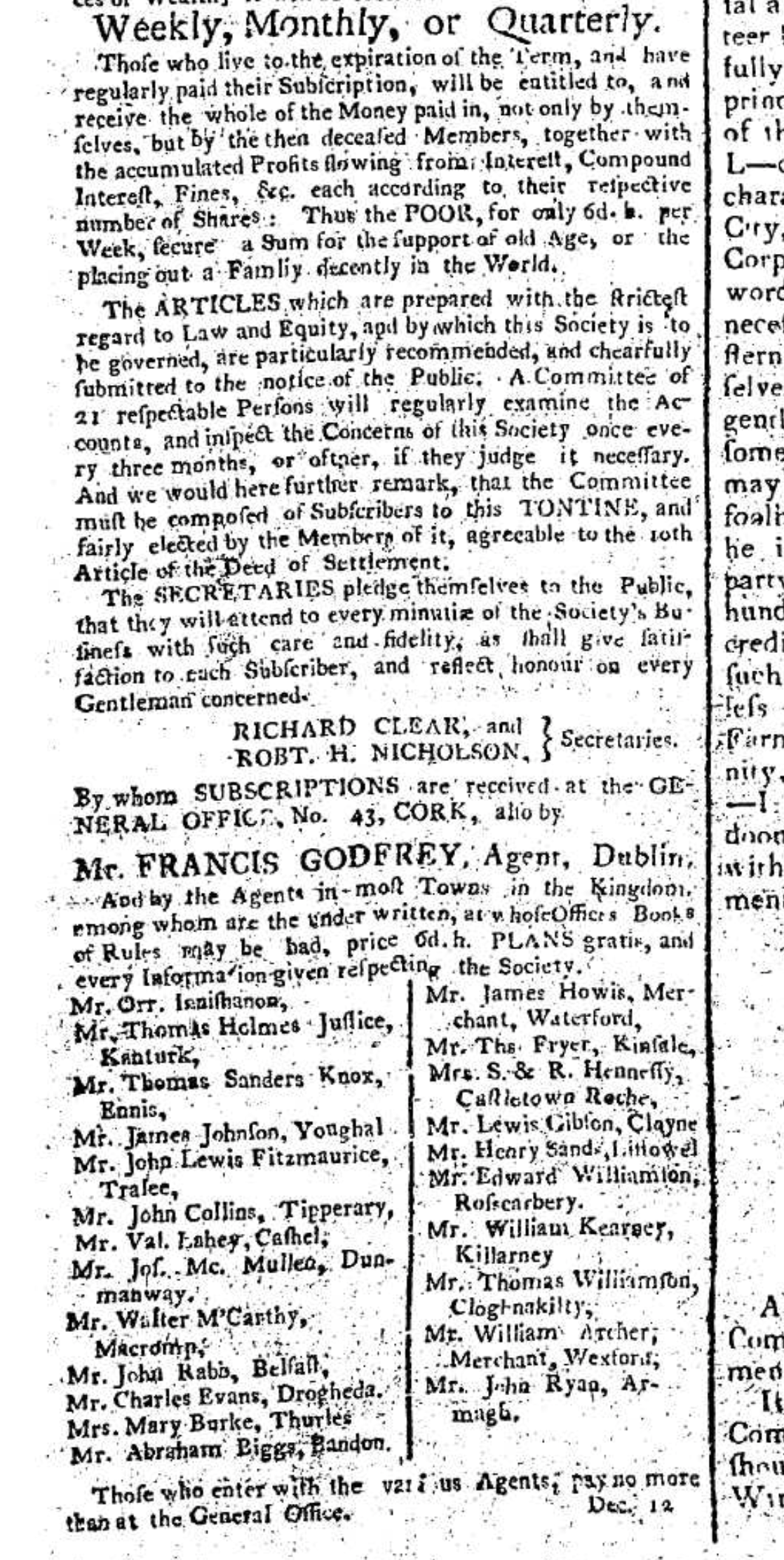
The Holmes Justice of Kanturk may have West Cork roots. The Secretary Nicholson of Cork may be of the family that controlled Woodford Bourne’s wine merchants.
What Is a Tontine?
Tontine is the name of an early system for raising capital in which individuals pay into a common pool of money and receive dividends based on their share of returns from investments made with the pooled money.
As members of the group died, they were not replaced with new investors so the proceeds were divided among fewer and fewer members. The surviving investors profited from the deaths of people they knew, a feature that many considered macabre.
KEY TAKEAWAYS
- Tontine is the name of an early system for raising capital where individuals pay into a common pool of money.
- In the U.S., tontines were popular in the 1700s and 1800s, then faded in the early 1900s.
- Tontine investors paid lump sums upon joining and received annual dividend-like payments until death.
- Shares of a deceased tontine investor were divided among the surviving members, and the shares for remaining members increase as more members die.
Understanding a Tontine
Although they seem alien today, tontines have a storied pedigree that reaches back at least half a millennium. The name comes from a 17th-century Italian financier, Lorenzo de Tonti.1 It is not clear whether he actually invented the tontine, but Tonti did famously pitch a tontine scheme to the French government in the 17th century as a way for King Louis XIV to raise money.
For this reason, historians suggest that Tonti’s idea originated with the financial folkways of his native Italy. The idea didn’t catch on at first, and Tonti eventually landed in the Bastille.
A few decades later, in the late Middle Ages tontines became widespread in Europe as a financing tool for the royal courts. Because levying taxes was often out of the question, European monarchs borrowed, predominantly via tontines, to fund their internecine wars.
At the height of their popularity in the 1900s, tontines represented almost two-thirds of the insurance market in the United States and accounted for more than 7.5% of the nation’s wealth. By 1905, there were an estimated nine million active tontine policies in the U.S., in a country of only 18 million households.2
 West Cork History