Private Bankers/Moneylenders. Denis McCarthy (1816-1896), Donnacha Talún, Bantry, probably Letterlickey, Durrus. Phil Woulfe (1829-1881). William ‘Billy the Banker’ Perrott, (1809-1881), Courtmacsherry.
In Ireland the term moneylender is loaded. In looking at Denis McCarthy and Phil Woulfe of Bantry it is worth remembering that even relatively prosperous people were outside the mainstream banking system. Both lent to Landlords by way of equitable mortgage i.e. deposit of title deeds. There was no need for formal registration and in the event of default they went into possession. This probably explains how Woulfe ends up as a Landlord on the former estate of Richard O’Donovan of Fort Lodge Durrus.
William ‘Billy the Banker’ Perrott, (1809-1881), Courtmacsherry.
He was more low key; the family background might be likened to Henry Ford’s people, small to middling Protestant farmers. There is a fascinating account of him collected by local children in the School Folklore Project in the 1930s. He would have been small scale in comparison to the other both of whom let very significant assets in their probate.
In the early 17th century equitable mortgage were frequently resorted in West Cork to by Richard Boyle, Great Earl of Cork and Sir Walter Coppinger.
It is thought that the O’Mahonys lost a great part of Mizen to Boyle in this way.
Boyle’s chicanery is often mentioned as a cause of the Great Rebellion of 1641.
Similarly the McCarthys tracts of lands at Caheragh and Durrus went to Coppinger on default. Maybe when the Land Commission records are finally made available it will explain as Land Registration in Ireland only commenced in 1708:
In the 18th century the Splaine family were major financiers in West Cork. Bandon attorney:
1786-1802 Philip Splaine Attorney Deed of 1798 also has Peter Splaine as witness. HIs apprentice 1793 Mayburry Duckett https://irishdeedsindex.net/mem.php?memorial=334665 1786 William Westropp Apprenticed to Philip Splaine 1802 James Vaughan writing clerk, probably of extended family.
Early Church Wardens, 1699, Bishop Mann Visitation of Church of Ireland Dioceses of Cork. Ref D121.1. 1827 Parliamentary Return of Vestries, 1851, 1861 Visitations, 9th January 2022
March 1798. Rosscarbery, Drimoleague, Castletownbere, Select Vestries meeting to Levy a Rate to provide Four Men to Serve in Militia and to Levy Seven and a Half Pence Per Gneeve. Further meeting August 1803 to levy £1-6-o per ploughland to raise 5 men for Militia and £5-13-9 on town of Rosscarbery. Cost of Levy for Cork City and County.
Late 18th early 19th Century Interplay of the Select Vestries of the Church of Ireland (State Church) in Local Administration, Barony of Carbery, Castlehaven, Drimoleague, Durrus, Cess Payer Representatives Named.
1827, Select Vestry Returns, Church of Ireland, Including Some Named Vestrymen and Churchwardens, Abbeystrewy (Skibbereen), Ballyvourney, Castlehaven, Creagh, Drinagh, Durrus, Fanlobus (Dunmanway), Innishannon, Kilbrogan, Macroom, Morogh, Tullagh (Baltimore)
Meeting of Select Vestry, Skibbereen, West Cork, 10th May 1832, to appoint Officers of Health under Statute of the 59th year of His Late Majesty, King George 3
Banking Collapse in Cork in the 1820s Roches and Leslies Bank and House of Commons, London, Select Committee Query re Collapse, only functioning Bank left Pikes. First run 1820 Deputation including Messrs Crawford and Gerard Callaghan deputed to see Lord Lieutenant in Dublin to solicit loan o £100,000. 2nd failure of Leslies 1825.
The effects of the banking collapse were felt in all area and made a bad situation immeasurably worse. For example in Dunmanway the Church of Ireland Vestry return for 1827 state that the previous years collection was deposited with Leslie’s Bank in Cork and lost when the Bank collapsed even though that happened in 1820.
A Grandfather (Timothy O’Donovan, (1789-1874), Landlord and Magistrate, Durrus) hopes for his grandson that he will go to the new Queens College in Cork. In his 1860 letter to Dr. John O’Donovan ‘Hopefully to the members of the Clan, he was educated at a French College but I mean to lead him to one of the Queen’s Colleges which though denounced by our clergy I consider this the greatest benefit ever conferred on Ireland’
Spare me a line wishing you and yours most prosperity I remain your affectionate friend and Clansman
Timothy O’Donovan now forgotten a hugely influential figure in politics 1820 to 1870s, among his achievement was eradicating the hated tithe system in Muintervara as the first place in West Cork to do so.
Many of his extended network descend from Alexander Donovan, Squince, Skibbereen.
1785. Will of Alexander O’Donovan, Squince, Skibbereen, West Cork, Various Townlands, Farm at Myross, Fishery, Salt Store, Fishing Boat, Possible Grand Father-in-Law of Timothy O’Donovan, Justice of The Peace, and Grandfather of Rickard Donovan, First Catholic Clerk of the Peace for Co. Cork 1838 since the 17th Century.
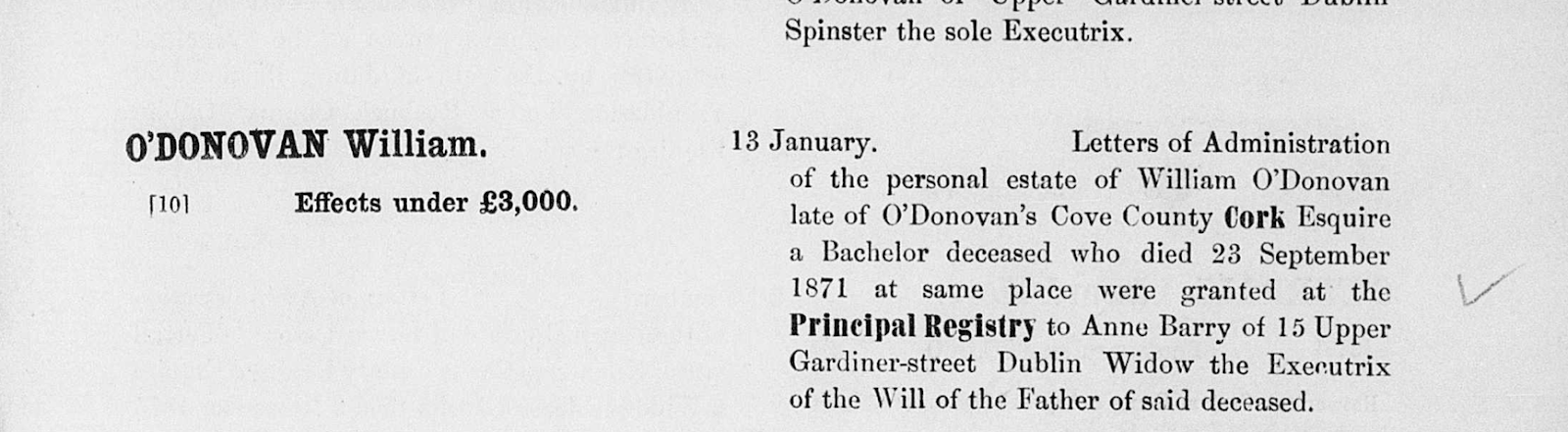
Richard, Junior, eldest or not or ill in 1850 or 1860 or William who died of liver failure in his early 30s leaving about £3,000 or he may the Richard Esq of O’Donovan’s Cove described a Flag Lieutenant at a Naval Dinner in Cobh in 1844. Married Anne Fitzgerald daughter of Thomas Fitzgerald, Merchant, Cork by Catherine McCarthy daughter of McCarthy of Woodview and niece of Daniel O’Connell M.P., he had one son Timothy. This may be the son and heir born at maternal grandfather’s house Sydney Place Cork 26th August 1844 father then living at Drombroe Cottage (near Bantry). He may be the son who wrongfully claimed the title ‘The O’Donovan’ at a public meeting in Cork he was challenged and abandoned the claim. In correspondence with Dr. John O’Donovan, Timothy O’Donovan refers to his son’s extravagance and luckily the land is entailed, he is estranged and living in Germany. His grandson is in school in France and his grandfather hopes he may go to the Queen’s College in Cork. In his will his grandson is dead.
1871, William O’Donovan, aged 36 O’Donovans Cove.
..
..
Luckily a lot of the letters between Timothy O’Donovan and Dr. John O’Donovan, antiquarian and one of Irelands greatest scholars have survived
1841-. Dr. John O’Donovan correspondence with Timothy O’Donovan, Durrus, James O’Donovan, Gravesend, Kent.
The recent illness of my eldest son in London has prevented me, from replying to your recent communication, and to thank you for sending the book containing the account of the funeral of my old friend Jerry na Duna, I am
I have dictated this to be copied and laid by here with other documents here, and with me…. then… would cause confusion in the remainder.
In reply to your queries I have to mention Timothy O’Donovan of Ardahill who was married to a grand niece of Daniel O’Connell died some years ago, leaving a numerous family he left a considerable fortune in land and money
The lands were sold some time ago by his sons to the late John O’Connell of Bantry and are now in the proprietorship of his brother Mr. James O’Connell of London formerly Bantry..
Richard Donovan of Lisheen is alive but has no male issue living.
Of the Squince family, the late? Captain Alexander Donovan, Captain of the Navy is the son of General Donovan who married a daughter of Colonel Hungerford of ‘The Island’ near Clonakilty was the eldest branch. Alexander is married to a Miss Cox of County Clare by whom he got a considerable fortune, his family were all Protestants, his present representative is a delicate little boy, who resides with his mother a Protestant in Kilrush, Co. Clare. He is heir to an independent property situate in Dublin and Clare.
I deeply regret the disappointment of being debarred coming to this old place over the autumn. I hope and trust we will meet and have a ‘Confab’ together before I depart this life
I am glad to ear you have such a battalion of stalwart Milesians
I shall be glad to introduce my little grandson now 15 years of age and the only heir to this place.
Hopefully to the members of the Clan, he was educated at a French College but I mean to lead him to one of the Queen’s Colleges which though denounced by our clergy I consider this the greatest benefit ever conferred on Ireland
Spare me a line wishing you and yours most prosperity I remain your affectionate friend and Clansman
Timothy O’Donovan
As he points out a power struggle involving the Catholic Church and the British authorities over control of the Queens Colleges meant the a Fatwa was issued against Catholics attending. Nevertheless many attended as did many West Cork Protestants doing medicine and engineering who not have been wealthy enough to go to Trinity College in Dublin.

 West Cork History