This gallery contains 16 photos.
Originally posted on Roaringwater Journal:
The month of May was come, when every lusty heart beginneth to blossom, and to bring…
04 Sunday Jun 2017
Posted in Uncategorized
This gallery contains 16 photos.
Originally posted on Roaringwater Journal:
The month of May was come, when every lusty heart beginneth to blossom, and to bring…
04 Sunday Jun 2017
Posted in Uncategorized
….
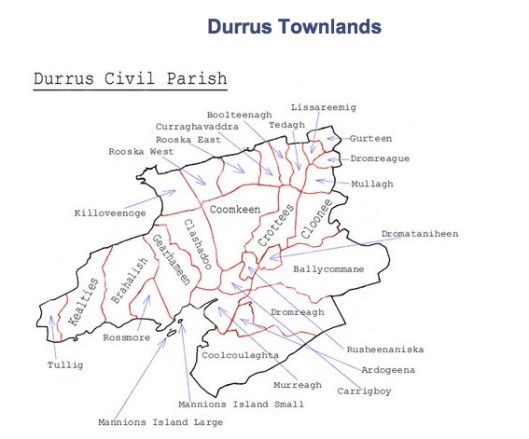
Ardogeena (152 acres) (Irish: Ard na Gaoine, meaning ‘Height of the flint stones’). On the east side is Lisdromaloghera (Irish: Lios Drom Luachra, meaning ‘Fort of the rushy ridge’). Bounded by Boolalaghta.
This in on what was formerly O’Mahony lands. The probably defaulted on a pre 1600 mortgage from Richard Boyle, Great Earl of Cork and he went into possession. These practices and his chicanery and sharp legal practices are often suggested as one of the causes of the 1641 Rebellion in the area.
The Evansons were settled on the former Mccarthy lands forfeit post 1641 at Durrus Court across Dunmanus Bay from around 1690. They acquired the lands and associated townlands from the Boyles c 1760. The conveyance gave rise to significant litigation in the 1850s as to whether it included the underlying mineral right at the time thought to be valuable.
They may have been in occupation earlier. One of the Evansons, Mrs.Beamish, is noted in the school folklore project for her charity during the famine having soup kitchen at Ardgouna. The general location was used for hare coursing from the 1850s.
Evansons:
https://docs.google.com/document/d/1c550F3fK7ZT0qUzH4DjP4I87TPHU5-yK-l4D-_cH-E4/edit#
….
Remains, the slip in the masonry near doorway may suggest a stable and the slit for ventilation, this was probably a three storey structure. The back wall is unstable and at risk of collapsing. In the main building the front wall collapsed some time ago.:
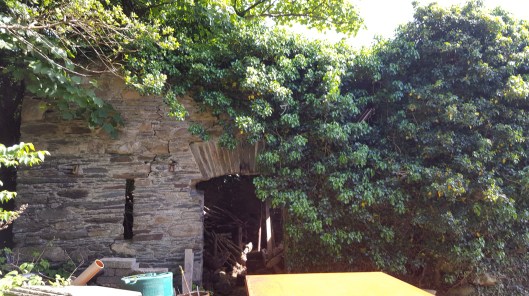
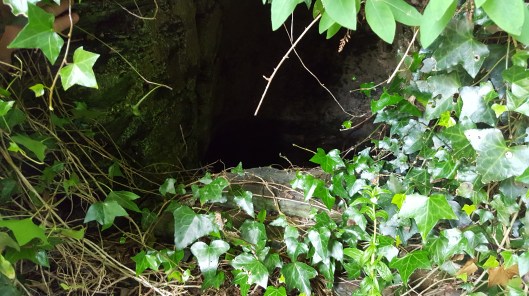
Well recessed at rear of structure:
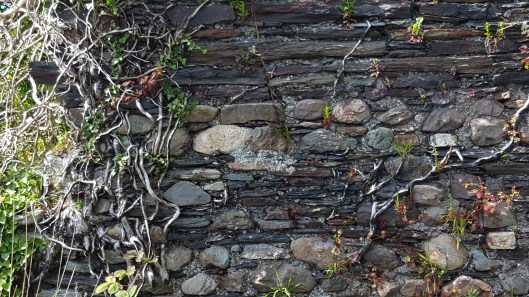
Stonework, a mix of field and quarried stone.
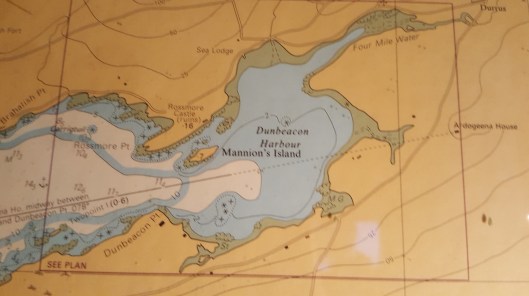
The house is shown on the Admiralty map as a guide to navigation as is one of the other Evanson houses at Sea Lodge across the bay:
..
….
Legal Tenure:
| Ardogeena | Probably in Plot 496A Earl of Cork, Protestant part of 896 acres | Probably O’Mahony | The land was originally sold by the Duke’s predecessor in title, Edward Boyle and his wife Mary by way of lease for 500 years from the 21st May 1626. The property including 3 ploughlands at Drumreagh, Dromelower and Ardgenane in Durrus including Murreagh was acquired by the Earl of Burlington and Cork and Sir William Heathcote who disposed of it to Richard Tonson in 1738 included as part of the Manorial rights to the Lord of the Manor of Ballydehob including the Durrus lands. In 1765 the Durrus lands were demised to Richard Tonson Evanson and renewed by Lord Baron Riversdale to Nathaniel Evanson in 1811, | 1714 Lease of Part Of Lands in West Carbery from Henry Boyle to Darby Mahoney Excepting Mineral Rights Probably including Townlands at Ardgoena and Drumreagh Later Part of Evanson Durrus Estate.
Leasehold Deed 4th September 1765, three Ploughlands at Murreagh, Ardogna, Dromreagh between Richard Tonson, Dunkettle, Cork and Richard Evanson, life interest to his wife Elizabeth (nee Shaw father woollen draper Cork?) son Nathaniel late Murreagh, all Evansons Four Mile Water. Marriage settlement Evanson 1818 to Beamish , Melian died childless, Mary Beamish had a fortune of £1,600, makes provision for 3 ploughlands of Droumreagh, Muraigh, and Ardaguina and also the impropriate tithes of of the Parish of Durrus. Kilcrohane and Kilmacomogue recited in deed of 24th September 1765 |
Evanson Marriage Settlement 4th October 1816
Melian died childless, Mary Beamish had a fortune of £1,600, makes provision for 3 ploughlands of Droumreagh, Muraigh, and Ardaguina and alos the impropriate tithes of of the Parish of durrus. Kilcrohane and Kilmacomogue recited in deed of 24th September 1765 |
Letter from John T Collins to Paddy O’Keeffe 6 Jan 1955 ‘To be let 25. 9. 1829. Commodious gardens and demesne of Ardageena ( Friendly Cove) 5 miles from Bantry and 12 of Skibbereen. Well equipped out offices. 6 horse stables with stables and walled in farmyard hay lofts etc. Any person taking house can set land from 18 A 96 acres. Good turbary sea manure and a sand quay sea bathing in perfection within 3 mins walk from house. Also to be let a large corn (Noted Store on Dunmanus Bay opposite Durrus Pier) store and kiln and a good corn growing country at the head of Dunmanus Bay. Great facility of shipping and lying of vessels of 60 tons at the store. Apply J Evanson Esq Adrgeena. | 1884, Elizabeth Hungerford Morris late Friendly Cove, Michael Hungerford Morris, Cork and Walter Thornhill, Solicitor Cork. He was given a Power of Attorney over tithes and rent charges over Durrus properties. (ROD 1884 20/6) | Nathaniel Evanson as Lessee of Impropriate Tithes | Richard Tonson Evanson selling 1854 at Landed Estates Court with Impropriate Tithes of part Kilcmacomogue and Durrus/Kilcrohane deriving from lease for lives renewable forever of 1765 | 1869 Reps Richard Tonson Evanson (Catherine Morris daughter?) William and Reps of J M Gumbleton. | 1901 Tenants in Fee | 1925 January Friendly Cove Mrs O’Brien 30a commodious house held under lease of 999 years from 5 April 1834 at a rent of £37 p.a. |
…..
02 Friday Jun 2017
Posted in Uncategorized
Ancient Bawnlanan Fair Day, Ascention Thursday
…
From Diary of The O’Donovan:
…
…
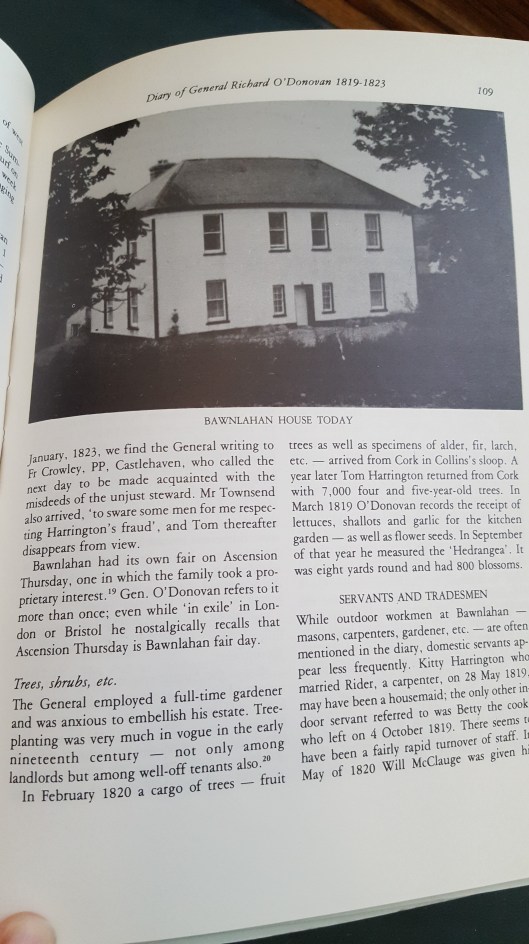
….
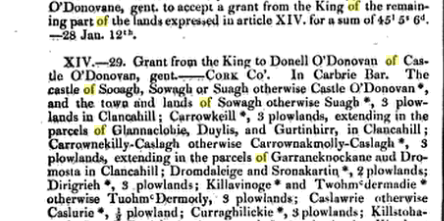
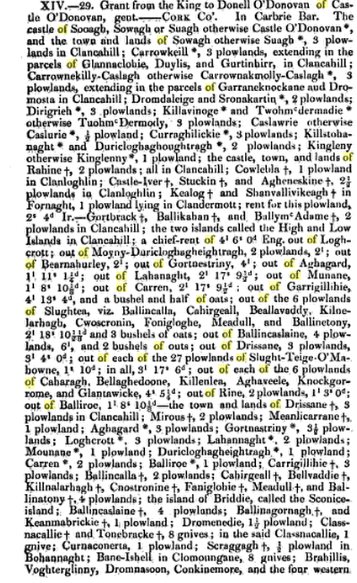
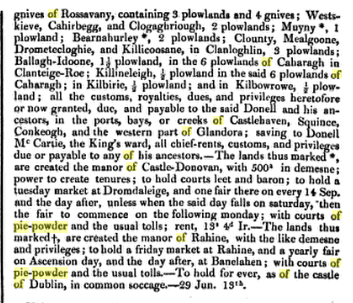
1616 Patent 13 of James 1
To hold Court of Leet and Baron at Bawnlahan, Market at Bawnlahan with Court of Pie Powder, Fair on Tuesdays at Drimoleague
…
…
02 Friday Jun 2017
Posted in Uncategorized
..
Discovery of Fadden More Psalter Probably from c 800 ad in a Bog Egyptian papyrus represents the first tangible connection between early Irish Church and the Middle-Eastern Coptic Church. Possible link to Irish Round Towers to Structures in Sinai
Egyptian papyrus represents the first tangible connection between early Irish Christianity and the Middle-Eastern Coptic
The Faddan More Psalter – the materiality of texts in early medieval Ireland
Courtesy Marie Daly
…..
 Philip Kosloski | Nov 30, 2016
In 2006 an Irish worker discovered an amazing find while digging in a bog with his backhoe at Fadden More.
Sticking out of the earth was an ancient manuscript, miraculously intact after more than a thousand years. Archeologists were quickly notified and carefully retrieved the manuscript and began at once investigating it and putting the pieces together.
Senior conservator John Gillis stated, “We never before had to deal with a manuscript recovered from a bog,” and said its survival after all these years in such an environment was “miraculous.”
It took more than four years of preservation work to discover the many treasures hidden inside the manuscript.
According to the National Museum of Ireland, “The Faddan More Psalter is composed of 60 sheets of vellum which are divided into five gatherings, or quires. The text is based on the Gallican Psalter, a version of the Latin Psalter devised by St. Jerome in the late 4th century. The text is written with iron gall ink, and a red and yellow pigments are used for decoration. It contains the standard 150 psalms. The opening letter of each psalm is marked by a capital and the opening words of Psalms 1, 51, and 101 are decorated, a convention used in other Irish psalters.” The Psalter has been dated to c. 800 and is one of the earliest Church documents found in Ireland.
When the manuscript was found it was opened to Psalm 83 and some saw it as a prophecy regarding the destruction of Israel. However, Dr. Patrick Wallace pointed out that the numbering of the Psalter was according to the Septuagint and differs slightly from our modern numbering system of the Psalms. He said what was found was “part of Verse 7 of Psalm 83 in the old Latin translation of the Bible [the Vulgate] which…would have been the version used in the medieval period.” The text of Psalm 83(84) reads:
1 Unto the end, for the winepresses, a psalm for the sons of Core.
2 How lovely are thy tabernacles, O Lord of host!
3 My soul longeth and fainteth for the courts of the Lord. My heart and my flesh have rejoiced in the living God.
4 For the sparrow hath found herself a house, and the turtle a nest for herself where she may lay her young ones: Thy altars, O Lord of hosts, my king and my God.
5 Blessed are they that dwell in thy house, O Lord: they shall praise thee for ever and ever.
6 Blessed is the man whose help is from thee: in his heart he hath disposed to ascend by steps,
7 In the vale of tears, in the place which be hath set.
8 For the lawgiver shall give a blessing, they shall go from virtue to virtue: the God of gods shall be seen in Sion.
9 O Lord God of hosts, hear my prayer: give ear, O God of Jacob.
10 Behold, O God our protector: and look on the face of thy Christ.
11 For better is one day in thy courts above thousands. I have chosen to be an abject in the house of my God, rather than to dwell in the tabernacles of sinners.
12 For God loveth mercy and truth: the Lord will give grace and glory.
13 He will not deprive of good things them that walk in innocence: O Lord of hosts, blessed is the man that trusteth in thee.
The most significant find was the original leather cover that protected the psalter. It was found intact and provided an insight into the origins of the Irish church. The inside of the leather cover “is lined with papyrus, a writing material produced from reeds grown in the eastern Mediterranean, famously in Egypt. The papyrus was probably placed inside the cover to act as a stiffener.”
Some scholars believe the “discovery of Egyptian papyrus represents the first tangible connection between early Irish Christianity and the Middle-Eastern Coptic Church.”
Two pages of the Psalter are currently displayed at the National Museum of Ireland and because they are so sensitive to light, they can only be displayed three months at a time. It is regarded as one of the greatest finds in Ireland since the Ardagh Chalice.
…..
01 Thursday Jun 2017
Posted in Uncategorized
…
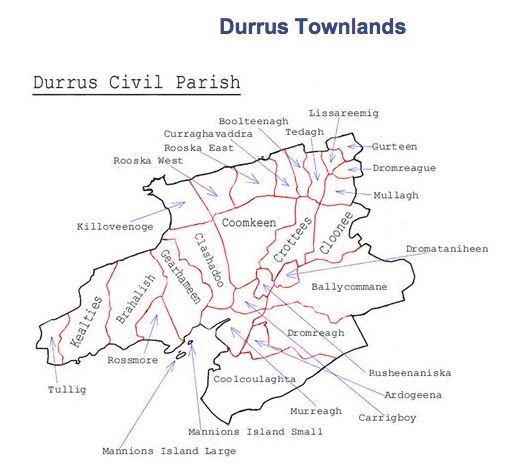
1835. Discovery of Ruins of Lost School at Sea Lodge (Gearhameen, (Irish: Gaortha mín, meaning ‘small wooded glen’), Durrus, West Cork. Master Timothy Daly, aged 24, Possibly from Dromnea. Kilcrohane.
Gearhameen (646 acres) (Irish: Gaortha min, meaning ‘small wooded glen’). On the east side is Coolnalong Castle seat of the McCarthy Muclaghs later the property of Lord Bandon. On the Clashadoo side is Fahies (na Faithi) containing a disused quarry operated by the Spillane family used to provide stone for the Catholic church. There was a Fullach Fia in a large field opposite Durrus Court removed during agricultural improvements in the 1950s. Location of 1835 school at Sea Lodge not on coast.
The Commission of Public Instruction, Ireland Report 1835
This sets out on a parish basis the provision of local education. The following are the details for ‘Durruskilcrohane’:
Female school kept by Eliza Daly with an annual grant from the British and Irish Ladies School Society of £12, it had 83 females, average daily attendance of 55 and increasing. Instruction consisted of reading, writing, arithmetic, needlework, the scriptures, and Church catechism.
Day school kept by James Kingston (he is described a RC elsewhere), with an annual grant from the Association for Discontinuing Vice of £8; house, rent free, and an acre of ground from the Vicar. 30 males average daily attendance 22 stationary. Instruction consisted of reading, writing, arithmetic, the scriptures, and Church catechism to the Protestants.
Day school kept by Samuel Hatfield, subscriptions from the Vicar and others and the payment by the children of 1s. 6d. a quarter, males 29, females 16. Instruction consisted of reading, writing, arithmetic, the scriptures, and Church catechism, established June 9, 1834.
Day school kept by Timothy Daly, an annual grant from the London Hibernian Society of 1s. per quarter for each child, and payments by the children of 1s per quarter, established 1832. 91 males and 11 females average daily attendance 65 increasing. Instruction consisted of reading, writing, arithmetic, and the scriptures. This is probably the school at Sea Lodge grant aided by the Society for the Education of the Poor in Ireland in 1821. Timothy Daly, a Catholic was 24 in 1824. Most of their schools in West Cork had Protestant teachers and the patrons were the local Church of Ireland clergy. In this case the patron was Nathaniel Evanson. The walls of the school are still extant to the west of Durrus Court at Gearhameen.
Sea Lodge was in the tithe applottments occupied by Nathaniel Evanson Junior some distance away Nathaniel Evanson Senior was at Durrus Court. The school was located up a bridge path now overgrown off the former road from Durrus Court to Gearhameen now the Sheeps Head Way. Given the involvement of the Evansons the landlords of Dromnea, Kilcrohane, the location of the former Daly Bardic School the master Timothy Daly may be from there.
Not to be confused with Sea Lodge on the coast road nearby.
National School kept by John McCarthy, annual grant from the Board of £8, and payment of 6d. a quarter by the children. 61 males 39 females average daily attendance 55 increasing. Instruction consisted of reading, writing, arithmetic, and the Roman Catholic Catechism.
Female school kept by Margaret Forbes, annual grant from the London Ladies Society of £12, 14 males 72 females average daily attendance 35 increasing. Instruction consisted of reading, writing, arithmetic, needlework, and the scriptures.
Hedge School kept by Thomas Toomey, payment by the children, from 1s. 6d. to 3s. a quarter, males 58 females 10 summer attendance 40. Instruction consisted of reading, writing, arithmetic, and the Roman Catholic Catechism
Sunday school books from the Sunday School Society males 25 females 55 average 40 increasing, the scriptures
….
01 Thursday Jun 2017
Posted in Uncategorized
..
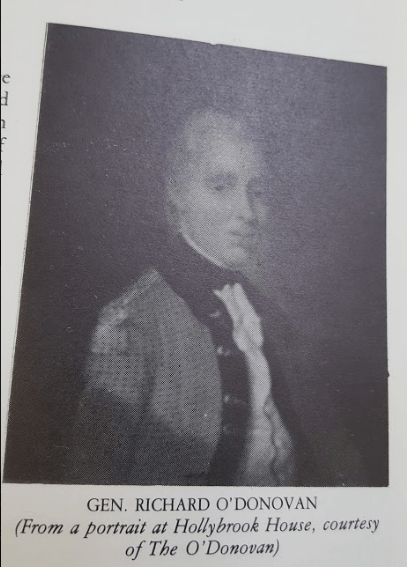
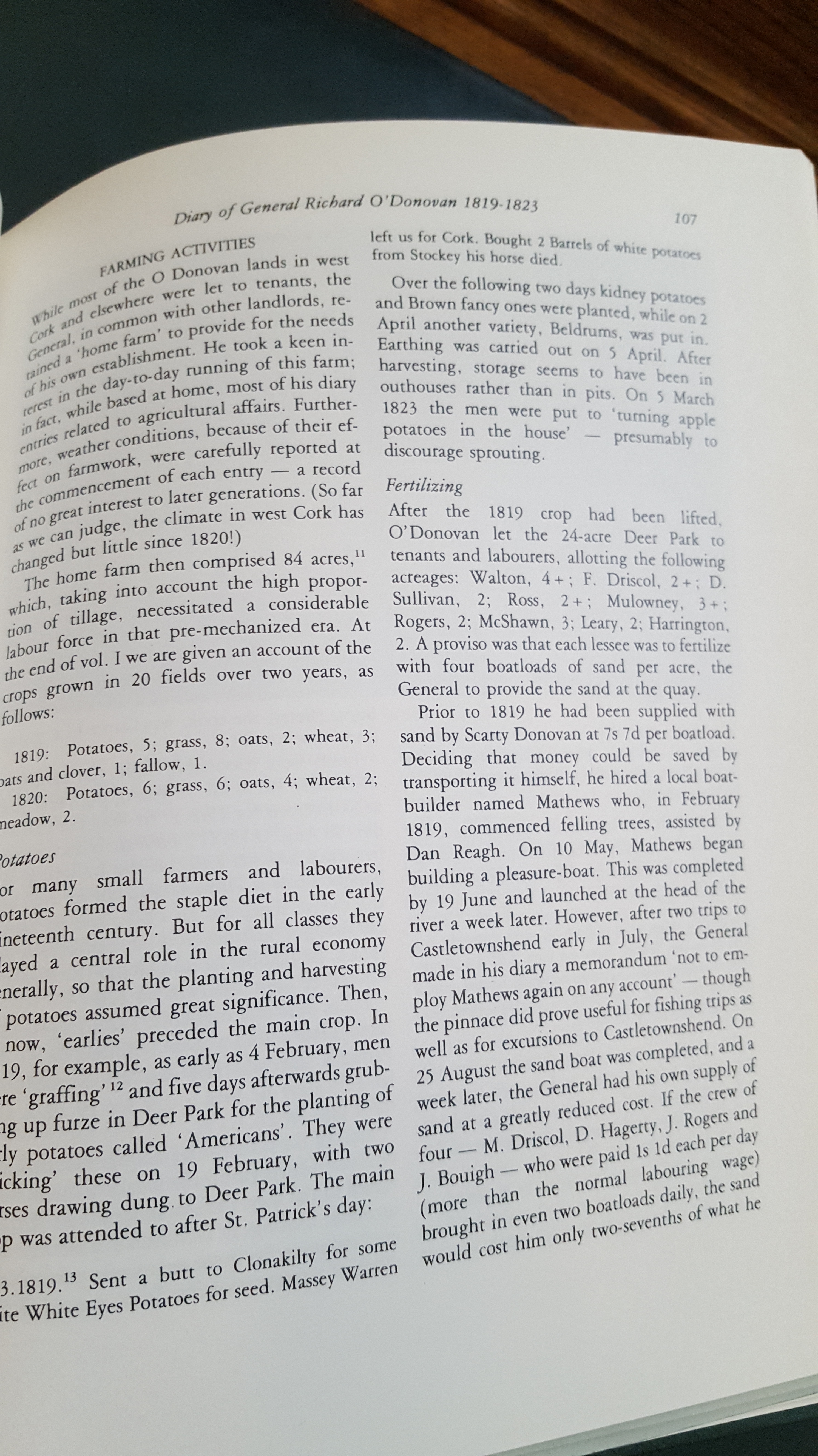
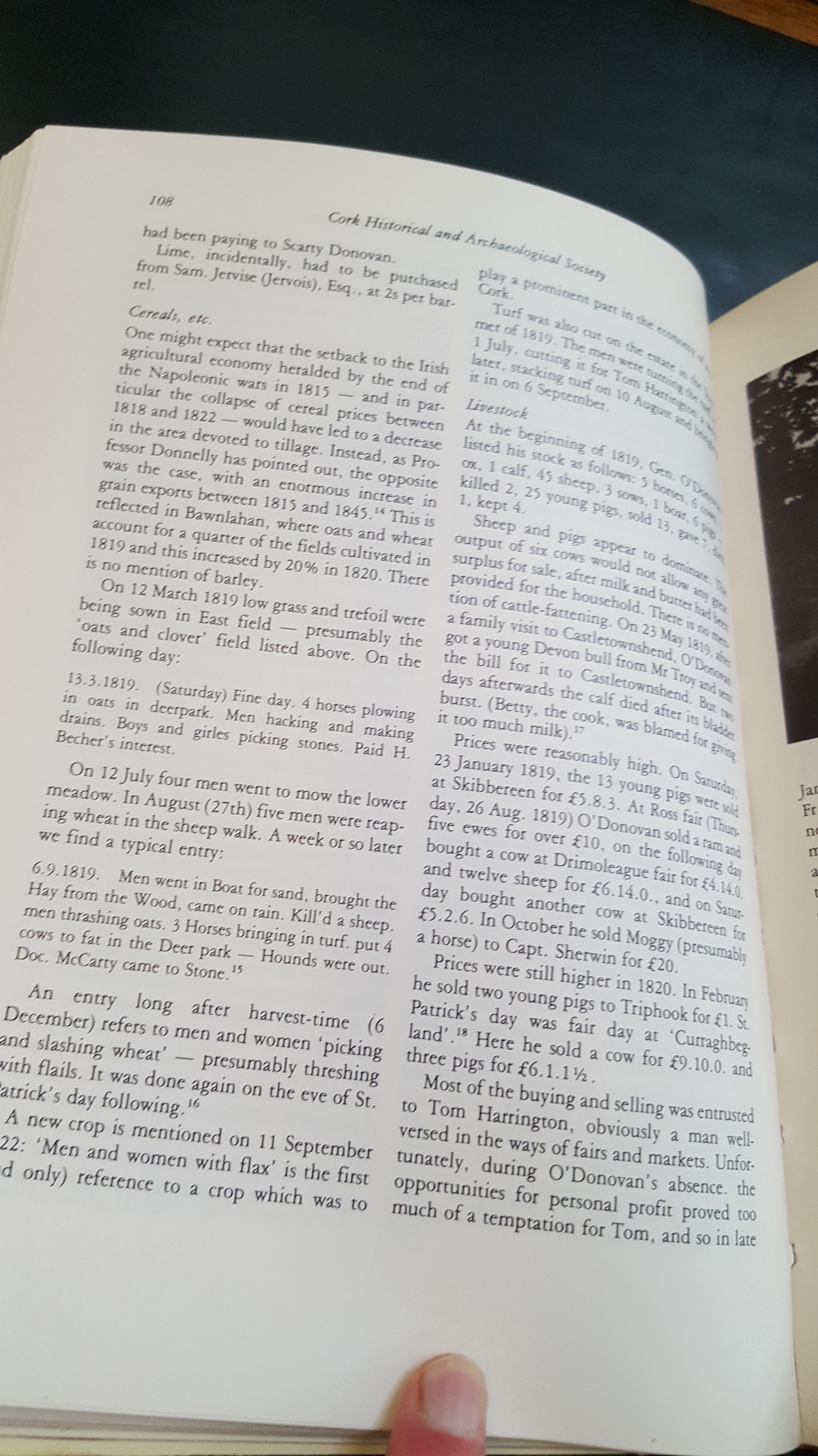
1819. At Bawnlahan, (Bán Leathan/Broad Lea), Skibbereen, West Cork, House of ‘The O’Donovan’, Lieutenant General Richard O’Donovan (1768-1829), Potatoes, Using Grufán 4th February, Planting Earlies ‘American’ 19th February, Main Crop after St. Patrick’s Day, Kidney Potatoes, Brown Fancy, Beldrums, White Eyed Potatoes, 1823′ Apple Potatoes’. Using Sea Sand as Fertilizer.
From his diaries at Bath (Avon) Reference Library transcribed Diarmuid Ó Murchadha, courtesy JCHAS, 1988.
….
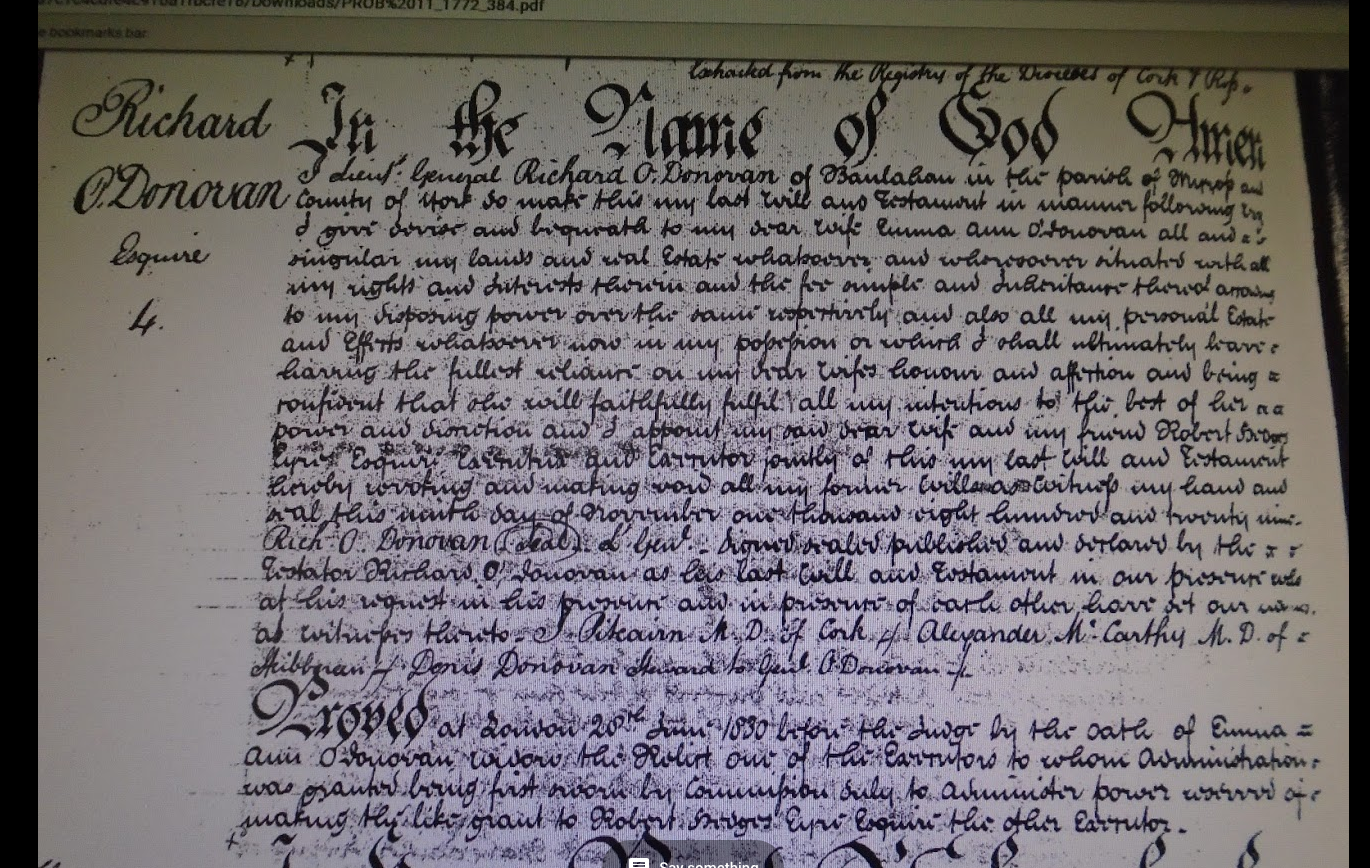
1829. Death of The O’Donovan, General O’Donovan in his 61st Year, Bawnlahan, Skibbereen, West Cork. and Passing of Chieftainship of Clann Cathal to Montpelier (Douglas, Cork) Branch.
Lt Col Richard O’Donovan of Bawnlahan, Skibbereen, West Cork, son of Daniel O’Donovan, The O’Donovan of Clancahill’ and Jane Beecher, 1768; Major in 6th Dragoons 19 December 1799; Lieutenant-Colonel 2 May 1800; brevet Colonel 25 July 1810; subsequently Major-General 4 June 1813; Lieutenant-General 27 May 1825; Recognised at ‘The O’Donovan’, died Ireland November 1829.
1763. Magazine of Magazines [Limerick] April 1763 “At Corke, Daniel O’Donovan (The O’Donovan) of Banlahan (Myross, Skibbereen) to Miss Jane Beecher”
1639 Ode In Old Irish (Translated) to Daniel O’Donovan, Superintendent of the West of Munster…Illustrious Chieftain of the Corenian Blood. From the papers of Lieutenant General Richard O’Donovan (The O’Donovan), Bawnlahan (1768-1829)
….
….
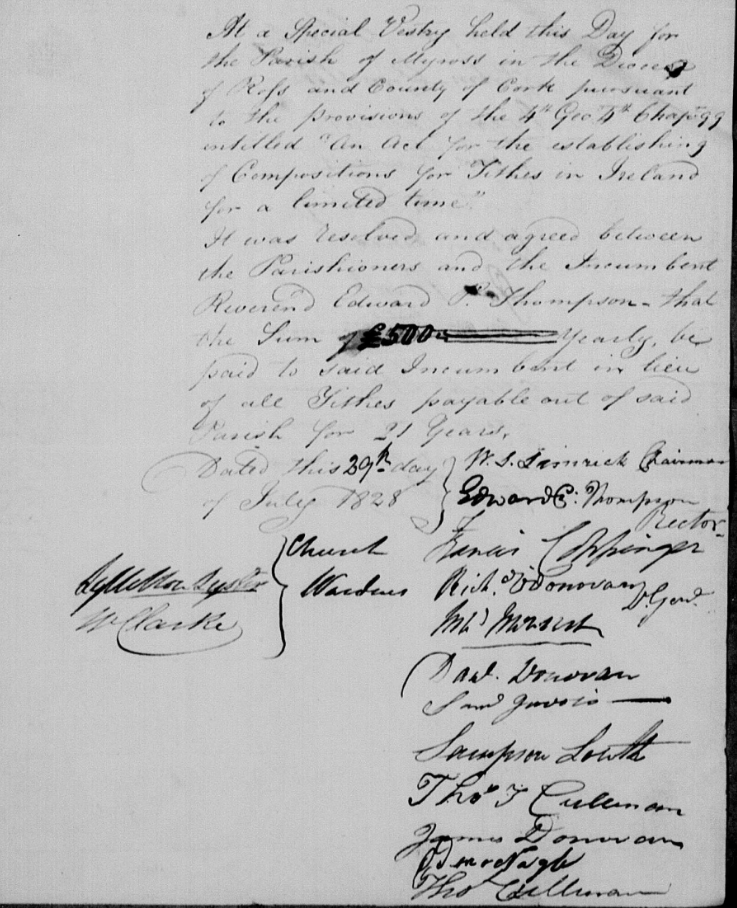
1825 Myross Select Vestry setting tithes at £500, churchwardens, Lyttelton Lyster, Glandore, William Clarke (Agent Rev. Thompson), Chairman W.S. Limrick, Rev. Edward. P. Thompson, Rector, Francis Coppinger (Magistrate), Myross Wood, The O’Donovan, Richard O’Donovan, Gent., Bawnlahan, Daniel Donovan, Samuel Jervois, Brade, Sampson Louth, Thomas F. Cullinane, James Donovan, Thomas Cullinane.
Myross Select Vestry re tithes note among vestrymen is a Catholic Magistrate:
Francis H. Coppinger Esq., Myross Wood, Rosscarbery, Pre 1830, 1832 tithes, sitting Union Hall,1835, Subscriber Lewis Topographical Dictionary of Ireland 1837. Member Commission on Magistrates 1838. May be Francis Coppinger Esq., Parkmore for 1839 Bandon dinner for Daniel O’Connell. Monkstown Dublin, 1870, 2,047 acres. Attending dinner Devonshire Arms Hotel Bandon for Daniel O’Connell 1839, listed Parkview, Bandon, listed 1843. Bandon 1840 petition for Catholic Equality. Invitation by Henry Townsend DL, 1839, on behalf of The Reformers of the West Riding of Cork to Daniel O’Connell MP to Dinner in Bandon, Co Cork, with 200 Liberals in attendance including, Francis Bernard Beamish MP (1802-1868), Rickard Deasy (1766-1852) Brewer Clonakilty, James Clugston Allman Distiller Bandon, James Redmond Barry J.P., Commissioner for Fisheries, Edward O’Brien, Masonic Lodge Bandon, John Hurley Brewer, Major E. Broderick, Henry Owen Beecher Townsend (1775-1847), Major Mathew Scott J.P. (1779-1844), Philip Harding, Carrigafooka, Macroom, Richard Dowden (1794-1861) Unitarian, Frances Coppinger Esq., Parkview, Bandon.
A meeting of the parishioners of Myross was held in the chapel in Union Hall on 24 February 1832, chaired by a member of the local gentry and Justice of the Peace, Francis Coppinger of Myross Wood. “It was fully attended.. ..about five hundred persons present, the bulk of the substantial farmers, many of the gentry and some squalid‐looking with starvation staring out of their countenances. and covered with tatters, butall tithe payers” (SR). Evidence from many of those present spoke of the “great oppression of the tithes since Parson Thompson came to the parish” (SR) and the harsh methods imposed by his agent William Clarke on those unable to pay the tithe. The aim of the meeting was to agree and submit a petition to the British parliament regarding the unjust system of tithes in Ireland which was seen as a source of much distress and misery, especially in the parish of Myross.
This provoked an angry reaction from the more influential landed proprietors. “The combination entered into against the Rector of Myross stands now clearly revealed in all its blameable colours. The motive to it is particularly rancorous ‐ the behaviour of the contributors without a shadow of justice, or reason ‐ and the object of it to add if possible another unoffending victim to the list of persecuted and ruined Clergymen” (CC).
In response Francis Coppinger wrote to the editor of the Southern Reporter in which he provided copies of affidavits sworn before him; amongst them was one (No. 9) “County of Cork. DENIS HALLAHAN, BRYAN HOURIHAN and MARY HOURIHANE, widow, all of South Reen in the Parish of Myross, and in said County, came before me and voluntarily and severally on the oath of the Holy Evangelist, that in the autumn of 1830, Wm. Clarke distrained a quantity of dried fish, their property, for the money due to Mr. Thompson; that Clarke having brought the fish to his own house, deponents severally applied for their respective parts of it in order to take it to market for sale, at the same time offering Clarke security for the tithe if he would allow them to dispose of the fish; that Clarke did not attend to their application, but kept the fish in his own possession, until deponents were obliged to let him have it at his own price, which was very little more than one‐half of what they consider its real value, and also charged them costs along with having the fish at his own price. Sworn before me this 10th day of March 1832. FRANCIS COPPINGER” (Southern Reporter). Thanks to Brian Limrick
..
…

 West Cork History