• About
  • Customs Report 1821-2 (and Miscellaneous Petitions to Government 1820-5) and some Earlier Customs Data, including staffing, salaries, duties including, Cork, Kinsale, Youghal, Baltimore, with mention of Bantry, Crookhaven, Glandore, Berehaven, Castletownsend, Enniskeane, Passage, Crosshaven, Cove, Clonakilty, Cortmacsherry.
  • Eoghan O’Keeffe 1656-1723, Glenville, Co. Cork later Parish Priest, Doneralie 1723 Lament in old Irish
  • Historic maps from Cork City and County from 1600
  • Horsehair, animal blood an early 18th century Stone House in West Cork and Castles.
  • Interesting Links
  • Jack Dukelow, 1866-1953 Wit and Historian, Rossmore, Durrus, West Cork. Charlie Dennis, Batt The Fiddler.
  • Kilcoe Church, West Cork, built by Father Jimmy O’Sullivan, 1905 with glass by Sarah Purser, A. E. Childs (An Túr Gloine) and Harry Clarke Stained Glass Limited
  • Late 18th/Early 19th century house, Ahagouna (Áth Gamhna: Crossing Place of the Calves/Spriplings) Clashadoo, Durrus, West Cork, Ireland
  • Letter from Lord Carbery, 1826 re Destitution and Emigration in West Cork and Eddy Letters, Tradesmen going to the USA and Labourers to New Brunswick
  • Marriage early 1700s of Cormac McCarthy son of Florence McCarthy Mór, to Dela Welply (family originally from Wales) where he took the name Welply from whom many West Cork Welplys descend.
  • Online Archive New Brunswick, Canada, many Cork connections
  • Origin Dukelow family, including Coughlan, Baker, Kingston and Williamson ancestors
  • Return of Yeomanry, Co. Cork, 1817
  • Richard Townsend, Durrus, 1829-1912, Ireland’s oldest Magistrate and Timothy O’Donovan, Catholic Magistrate from 1818 as were his two brothers Dr. Daniel and Richard, Rev Arminger Sealy, Bandon, Magistrate died Bandon aged 95, 1855
  • School Folklore Project 1937-8, Durrus, Co. Cork, Schools Church of Ireland, Catholic.
  • Sean Nós Tradition re emerges in Lidl and Aldi
  • Some Cork and Kerry families such as Galwey, Roches, Atkins, O’Connells, McCarthys, St. Ledgers, Orpen, Skiddy, in John Burkes 1833 Commoners of Great Britain and Ireland:
  • Statement of Ted (Ríoch) O’Sullivan (1899-1971), Barytes Miner at Derriganocht, Lough Bofinne with Ned Cotter, later Fianna Fáil T.D. Later Fianna Fáil TD and Senator, Gortycloona, Bantry, Co. Cork, to Bureau of Military History, Alleged Torture by Hammer and Rifle at Castletownbere by Free State Forces, Denied by William T Cosgrave who Alleged ‘He Tried to Escape’.
  • The Rabbit trade in the 1950s before Myxomatosis in the 1950s snaring, ferrets.

West Cork History

~ History of Durrus/Muintervara

West Cork History

Monthly Archives: July 2015

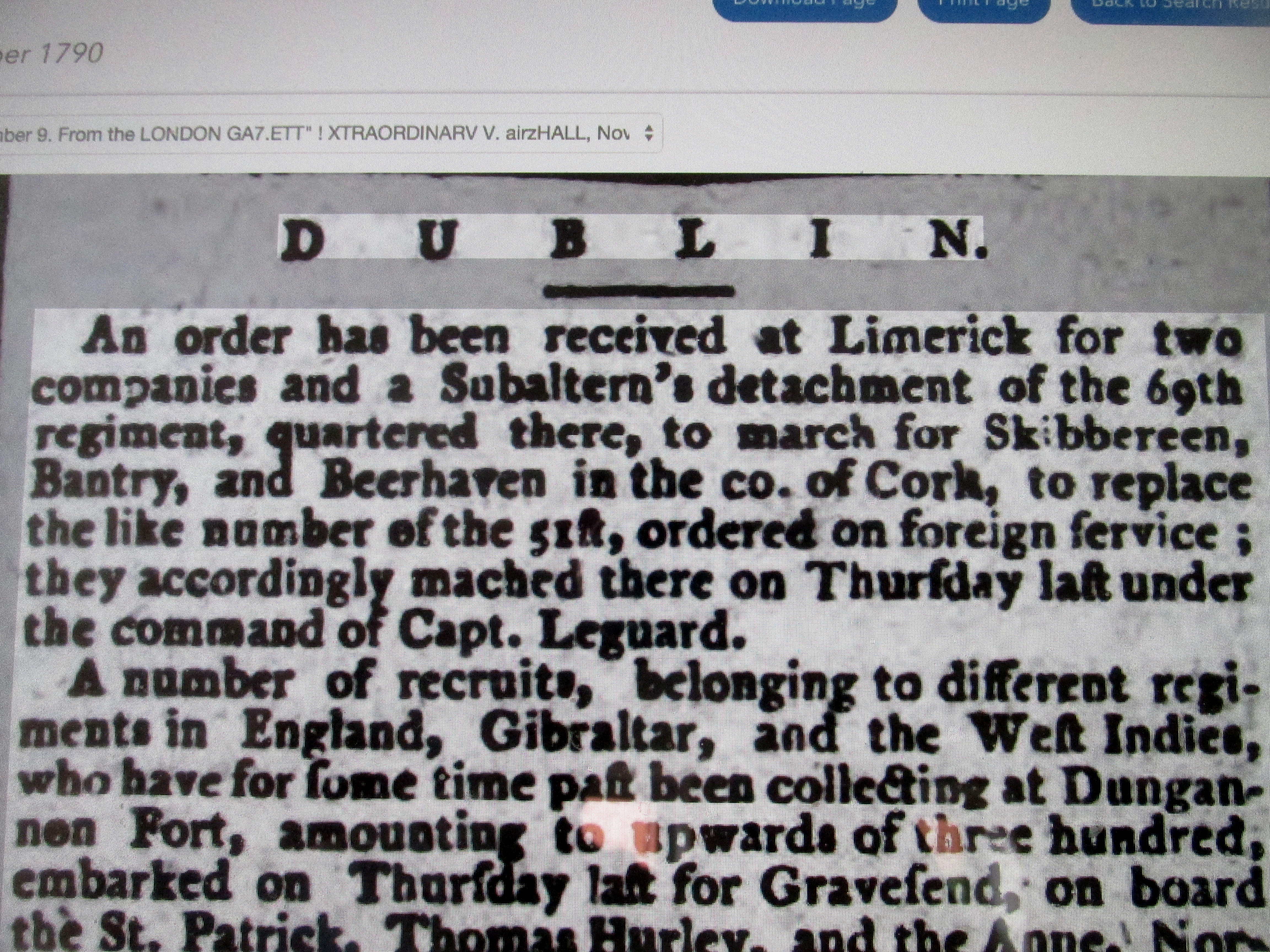
British Army troop Movements, West Cork, 1789 1st Royal replacing 21st and 24th Regiments who are going to the West Indies to Berehaven, Bantry and Skibbereen, 1790, 66th Regiment replacing 51st Regiment to Skibbereen, Bantry, Berehaven, 1819, 81st Regiment replacing the 97th to Clonakilty, Skibbereen, Bantry, Whiddy Island, Bere Island.

05 Sunday Jul 2015

Posted by durrushistory in Uncategorized

≈ 1 Comment


British Army troop Movements, West Cork, 1789 1st Royal replacing 21st and 24th Regiments who are going to the West Indies to Berehaven, Bantry and Skibbereen, 1790, 66th Regiment replacing 51st Regiment to Skibbereen, Bantry, Berehaven, 1819, 81st Regiment replacing the 97th to Clonakilty, Skibbereen, Bantry, Whiddy Island, Bere Island.

1-IMG_5676

2-IMG_5687

3-IMG_5688

4-IMG_5677

5-IMG_5678

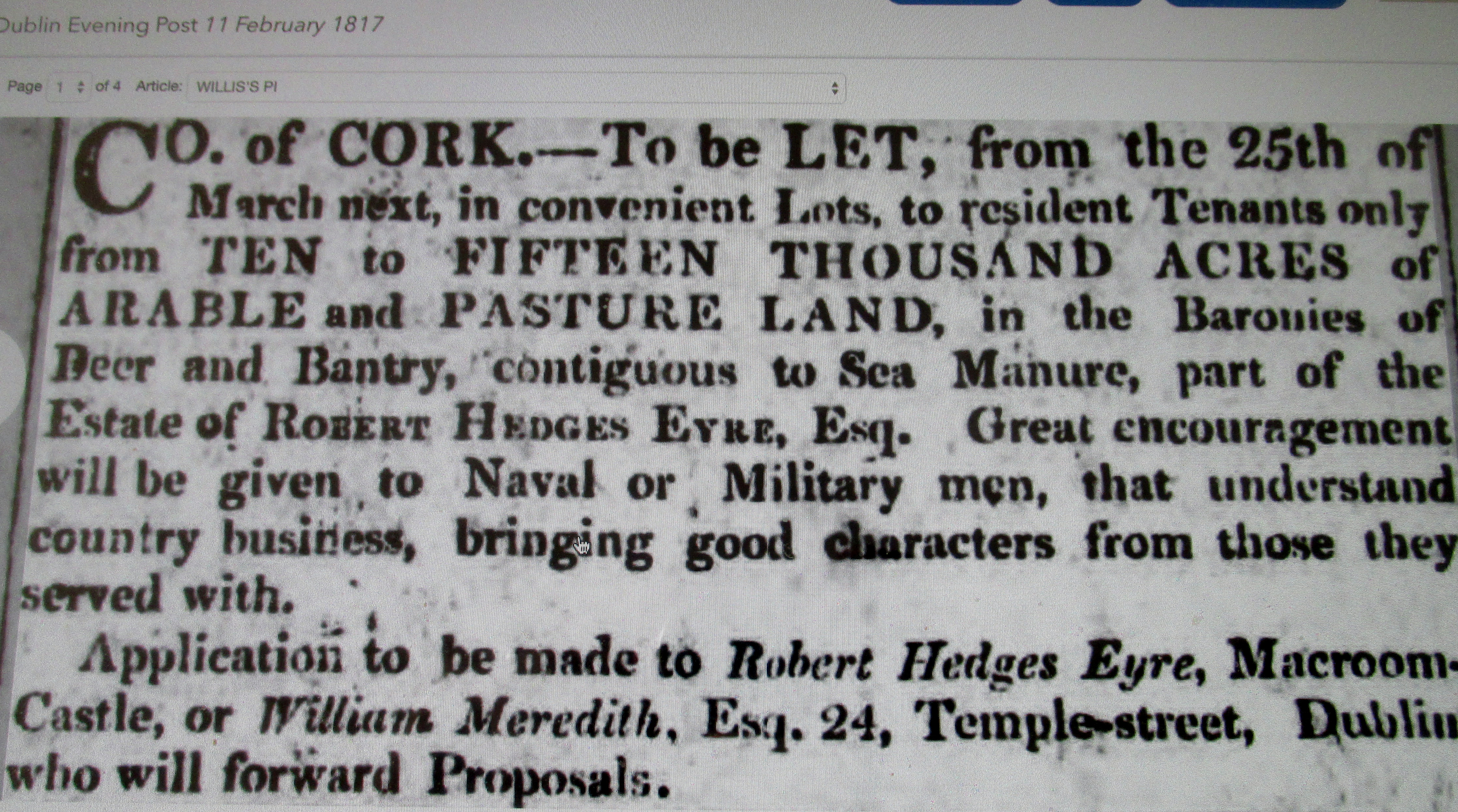
1817, To be Let on Estate of Robert Hedges Eyre Esq., 10 to 15,000 acres, in Lots, in Barony of Bere and Bantry, Great Encouragement Given to Military or Naval men who Understand Country Business must Be Resident.

05 Sunday Jul 2015

Posted by durrushistory in Uncategorized

≈ Leave a comment


1817, To be Let on Estate of Robert Hedges Eyre Esq., 10 to 15,000 acres, in Lots, in Barony of Bere and Bantry, Great Encouragement Given to Military or Naval men who Understand Country Business must Be Resident.

1-IMG_5686

Proposals invited 1810 for the Supply of Bread to the British Army, on Bere Island and 1818 to Supply Ordnance at Bantry Bay with Candles, Fuel, Coal and Turf.

05 Sunday Jul 2015

Posted by durrushistory in Uncategorized

≈ 1 Comment


Proposals invited 1810 for the Supply of Bread to the British Army, on Bere Island and 1818 to Supply Ordnance at Bantry Bay with Candles, Fuel, Coal and Turf.

Post the attempted invasion Bantry Bay was highly militarised with Martello Towers , one on Garnish Island , Gun Forts at Whiddy and the Naval Installation on Bere Island.

1-IMG_5683

2-IMG_5684

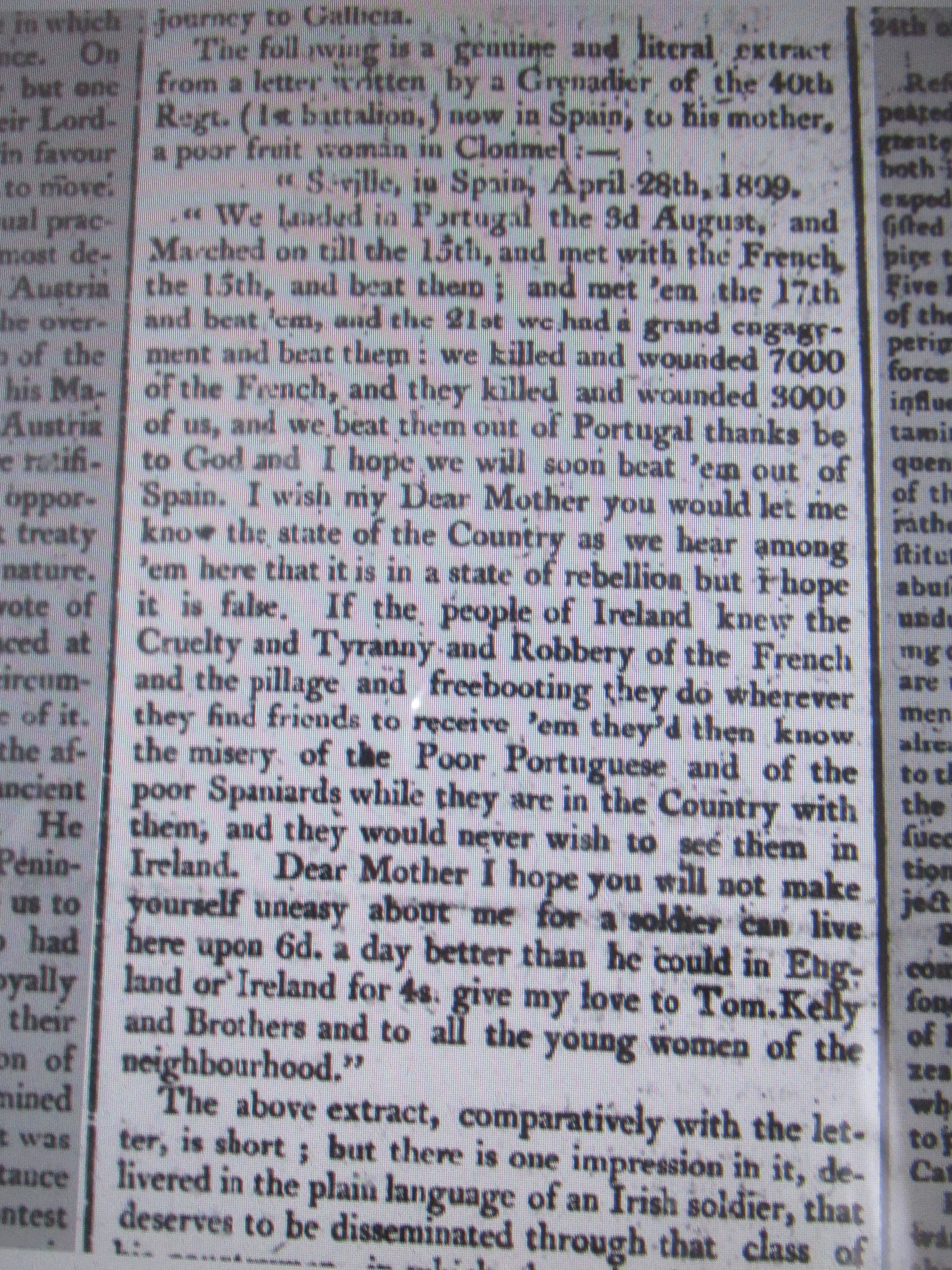
Letter 1809 from Seville, from Grenadier, 40th Regiment, 1st Battalion, to his Mother a Poor Fruit Seller in Clonmel, Describes Battles in Portugal and Spain, can live comfortably on 6d a day.

05 Sunday Jul 2015

Posted by durrushistory in Uncategorized

≈ Leave a comment


Letter 1809 from Seville, from Grenadier, 40th Regiment, 1st Battalion, to his Mother a Poor Fruit Seller in Clonmel, Describes Battles in Portugal and Spain, can live comfortably on 6d a day.

1-IMG_5680

2-IMG_5681

Letting by Direction of William Henn, of the Court of Chancery, Dublin, 1807, during Minority of Richard White and John Hamilton White of Lands at Whiddy Island, Hog Island, Houses at Bantry and Lands at Knocknamuck.

05 Sunday Jul 2015

Posted by durrushistory in Uncategorized

≈ Leave a comment


Letting by Direction of William Henn, of the Court of Chancery, Dublin, 1807, during Minority of Richard White and John Hamilton White of Lands at Whiddy Island, Hog Island, Houses at Bantry and Lands at Knocknamuck.

The Lawyers are Popes of Cork and Besnards of Dublin. The Besnard family had at the time one of the largest sailing factories in Europe at Douglas in Cork.

1-IMG_5679

2-IMG_5680

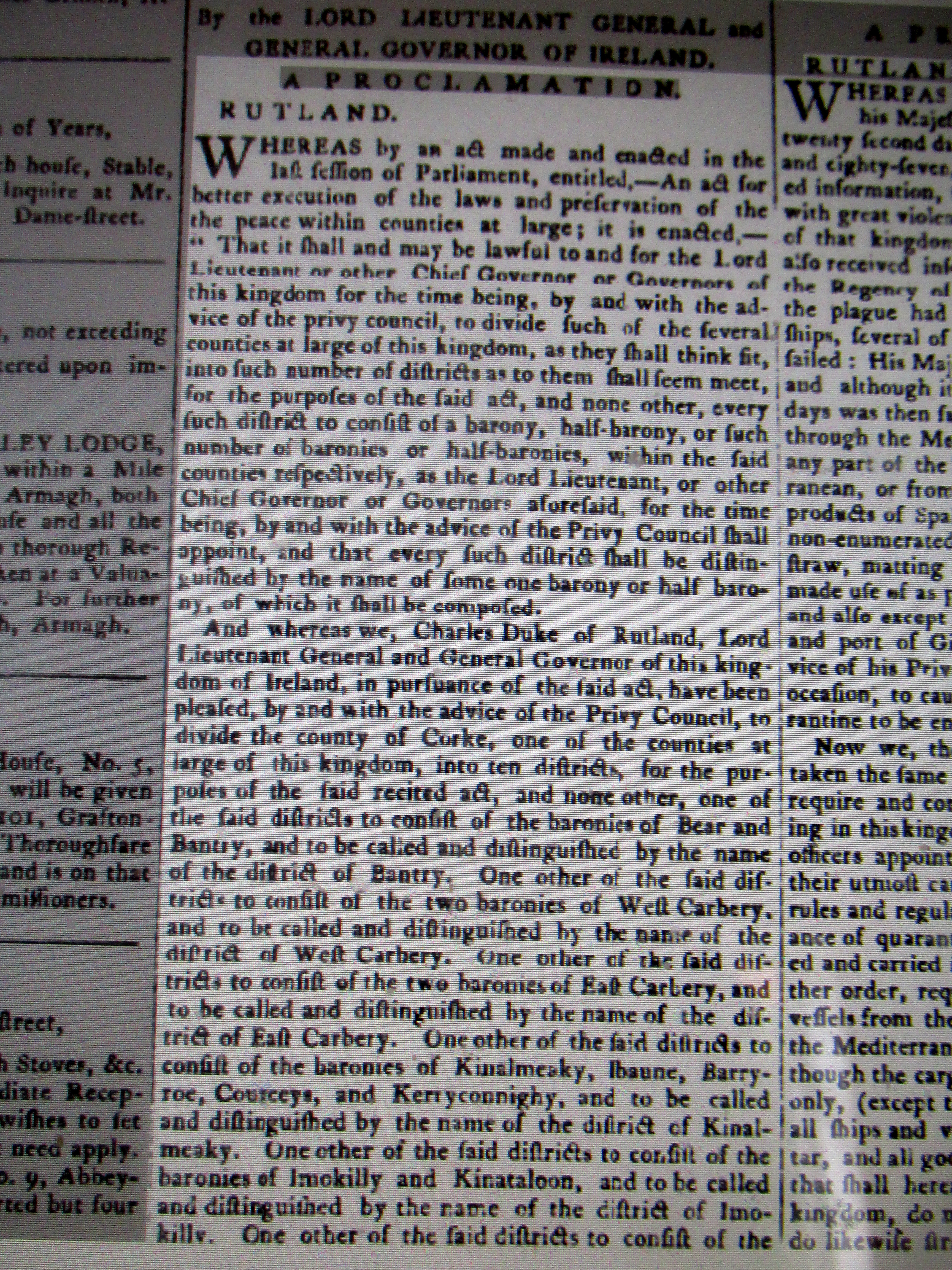
Proclamation, 1787, by the Lord Lieutenant on the Advice of the Privy Council, Dividing Co. Cork, into ten Districts Including baronies of East and West Carbery, Bantry and East Muskerry. Bantry was later changed to include Bere.

05 Sunday Jul 2015

Posted by durrushistory in Uncategorized

≈ Leave a comment


https://www.google.ie/maps/place/Brade,+Co.+Cork/@51.631761,-9.2292821,11z/data=!4m2!3m1!1s0x4845aec8800e760f:0x3f56622540a0fe5e

Proclamation, 1787, by the Lord Lieutenant on the Advice of the Privy Council, Dividing Co. Cork, into ten Districts Including baronies of East and West Carbery, Bantry and East Muskerry. Bantry was later changed to include Bere.

2-IMG_5673

3-IMG_5674

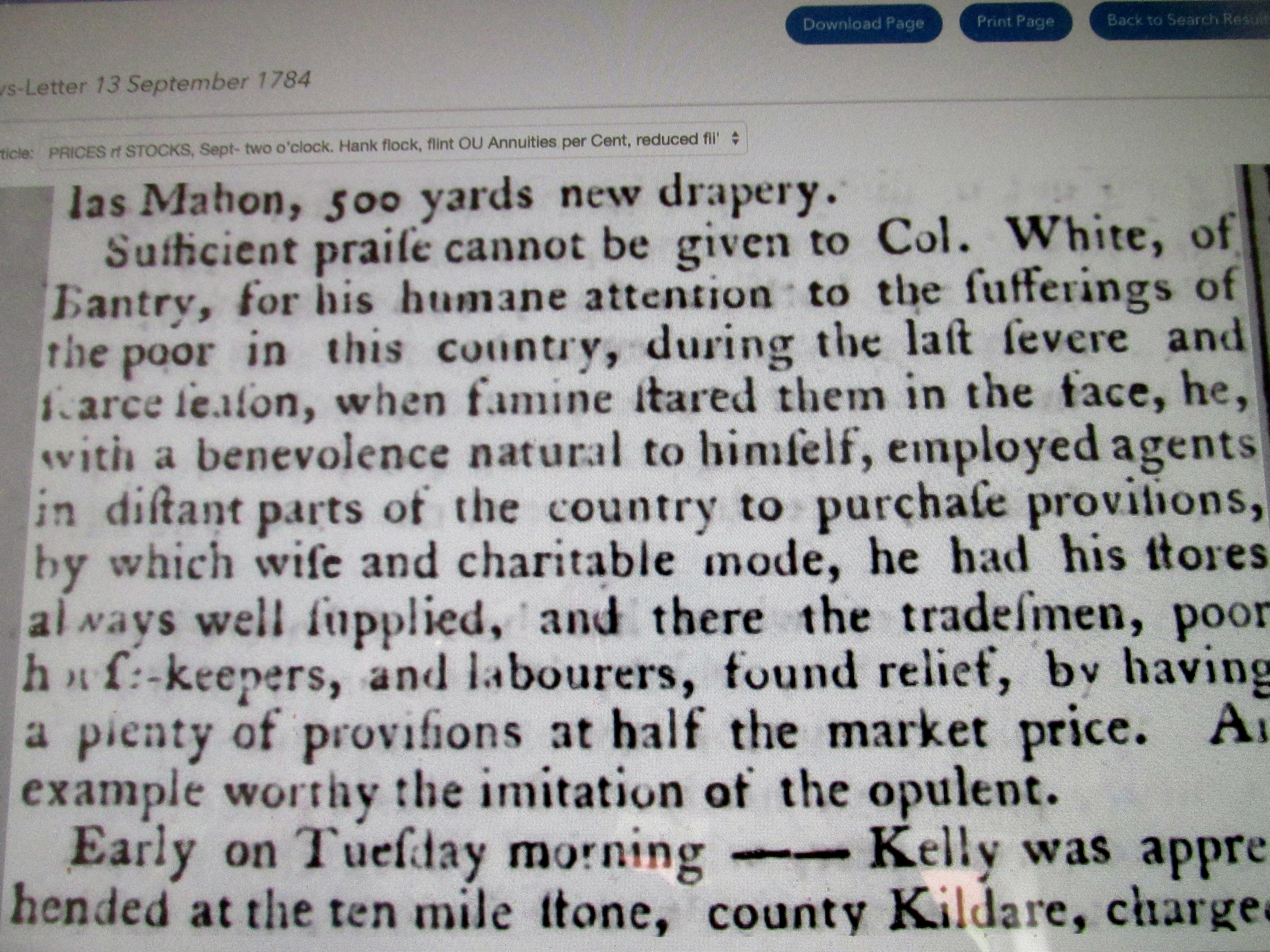
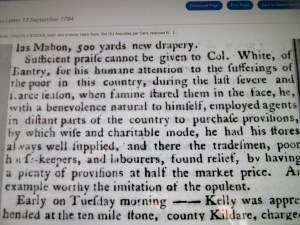
1784, Benevolence of Richard White (Later Lord Bantry) in making Provisions Available to Tenantry in Famine and other Famines.

05 Sunday Jul 2015

Posted by durrushistory in Uncategorized

≈ 2 Comments


1784, Benevolence of Richard White (Later Lord Bantry) in making Provisions Available to Tenantry in Famine and other Famines.
1-IMG_5671

Richard Pococke (1704 – 1765), the English-born Bishop of Ossory, travelled in the South West and in 1758 wrote the following in respect of Bantry ‘he chief support of the town is fish and a clandestine import of French brandy’ and re the Beara area, which would have a reference to the other peninsulas ‘they keep their sheep and black cattle …. They can legally send no fish to France but salmon, all the rest goes to Spain’…… ‘They make huts to keep their cattle in the mountains in summer and live on new churn milk’. …… ‘Girls married at the age of thirteen and boys at sixteen’ … ‘People here live to a great age, notwithstanding they drink drams immoderately, living on fish and potatoes, and the sea air makes this custom less pernicious … but then smallpox is very mortal among them, supposed to be owing to the first died. A sort of scurvy also, which sometimes come near to a leprosie, is frequent among them. They have great notions of fairies in all these parts, which take the place of witches in other places. ….. All workmen, though only making a ditch or thrashing, do all sorts of handicraft in a private house or fields, had the shameful custom these parts more than any other, of holding a string or something across the way and begging money’. In relation to smallpox it might be noted that in 1842 the Ordnance Survey Name Book for Rooska mentions a disused sand pit since levelled formerly used to bury smallpox victims. A Bandon doctor, John Milner Barry had noted in 1800 that exposure to cowpox gave immunity to smallpox; this was known in West Cork as ‘shinach’ from ‘sine’ the Irish word for teat. There were outbreaks of fever in the mid-1740s, 1762, 1771 and a major epidemic in 1800, 1801

Famines and Disease

There was a ‘Great Frost’ from December 1739 until September 1741 which had severe effects on crop losses and precipitated a food crisis. Within this period there was drought in the spring of 1740 which decimated the barley and wheat sown the previous autumn. It was followed by an outbreak of typhus, dysentery and smallpox in children. In Cork the Duke of Devonshire in January 1740 prohibited the export of corn except to Britain.
In March 1741 Thomas Prior, founder of the Royal Dublin Society, said that Sir Thomas Cox of Dunmanway related that due to a failure of the potato crop 500 people had died in his area. Around 350,000 people died including one fifth of Munster’s population. It was referred to as Bliain an Air, the year of the slaughter. This famine may have been even more severe than the great famine of 1847 in terms of mortality from starvation and disease
Famine threatened in 1784. Richard White, later Lord Bantry was praised for his foresight in providing relief and food at reduced prices for people in the area.
here were ‘minor’ famines in 1817 and 1822 at least 14 partial failures of the potato crop between 1816 and 1842. There was a very wet cold summer and autumn in 1816, a typhus epidemic broke out and up to 65,000 died countrywide from fever.

In 1822, reports of distress commenced in April. Among the relief measures were the efforts of the City of London Tavern, a grouping of business and banking people in London who sent the Rev. John Jagoe (Schull) a cargo of meal for Schull and Durrus.
The Rev Alcock and Father Keleher (Kelleher) gave evidence to the Royal Commission on the Poorer Classes in Ireland poverty in 1835, the population being 9,606, and said that as regards illegitimacy there were not more than 15 illegitimate children in the previous 3 years out of a population of 9000 with no deserted children. Not less than 50 widows with 2-3 children each will get potatoes from their relatives must beg for the wretched rags they wear and their children will go into service and at first get little if any wages. Scarcely any old men or women in this parish that have never been married and are supported by their children in a wretched way. Beggars do not like to beg in their own parish those that come are from outside parishes and they are an encumbrance on the cottier and poor farmer and are rarely refused shelter and apart from getting food seek wool and flax. Some 20 men have gone looking for seasonal work in August with a further 150 in September they return in the first week of December; few have gone to England in the last 3 yeas having heard poor reports and some there from the parish have gone to America. Some are married men and while they are away their wives and children have as much in their cabin and potato garden as if the head of family was at home. Evidence was also given by Messrs Timothy O’Donovan J.P. and Alex Evanson J.P. that they were not aware of any deaths by lack of food in the immediate past, suggesting that the famine of the previous decade may not have been fatal.
Cholera struck Cork in April 1832 and in the city nearly 500 died in the fever hospital, Skibbereen was deserted, the wife of the Protestant Curate of Schull Rev. O’Neill was dead within ten hours. William Stanley Vickery who wrote an account of his early years including his years with his grandparents in Moloch and Bantry lost his parents in Skibbereen to cholera in this period. There was a further outbreak in early 1849; casualties usually were half of those affected, 82 died in Bantry.
The pre-famine period was one of extreme poverty for those at the bottom. Father Mathew said “if you wish to seek out the poor, go to Bantry”… This is shown in the following extract from the journal of Asenath Nicholson an American Missionary who visited Bantry in 1845 and found a wild dirty sea-port with cabins built upon the rocks and hills’ the people going about, not with sackcloth upon their heads, for this they could not purchase, but in rags and tatters such as no country but Ireland could hang out. I found some deplorable cabins and looking into one, the sight was appalling….I saw a pile of dirty broken straw, which served as a bed for family and pigs; not a chair, table, or pane of glass, and no spot to sit except upon the straw in the corner, without sitting in mud and manure’.
Poor times affected all. William Justin Dealy, who ran ships from Bantry to Canada writing to his brother in New Brunswick 1840, said that the fishery had collapsed, there was no demand for timber and trade was terrible. He had difficulty remaining solvent and feared he would not be able to pay for his boys’ education in Rosscarbery. He managed to stay afloat as a fellow timber merchant Mr Riordan from Kenmare chartered a cargo from him.
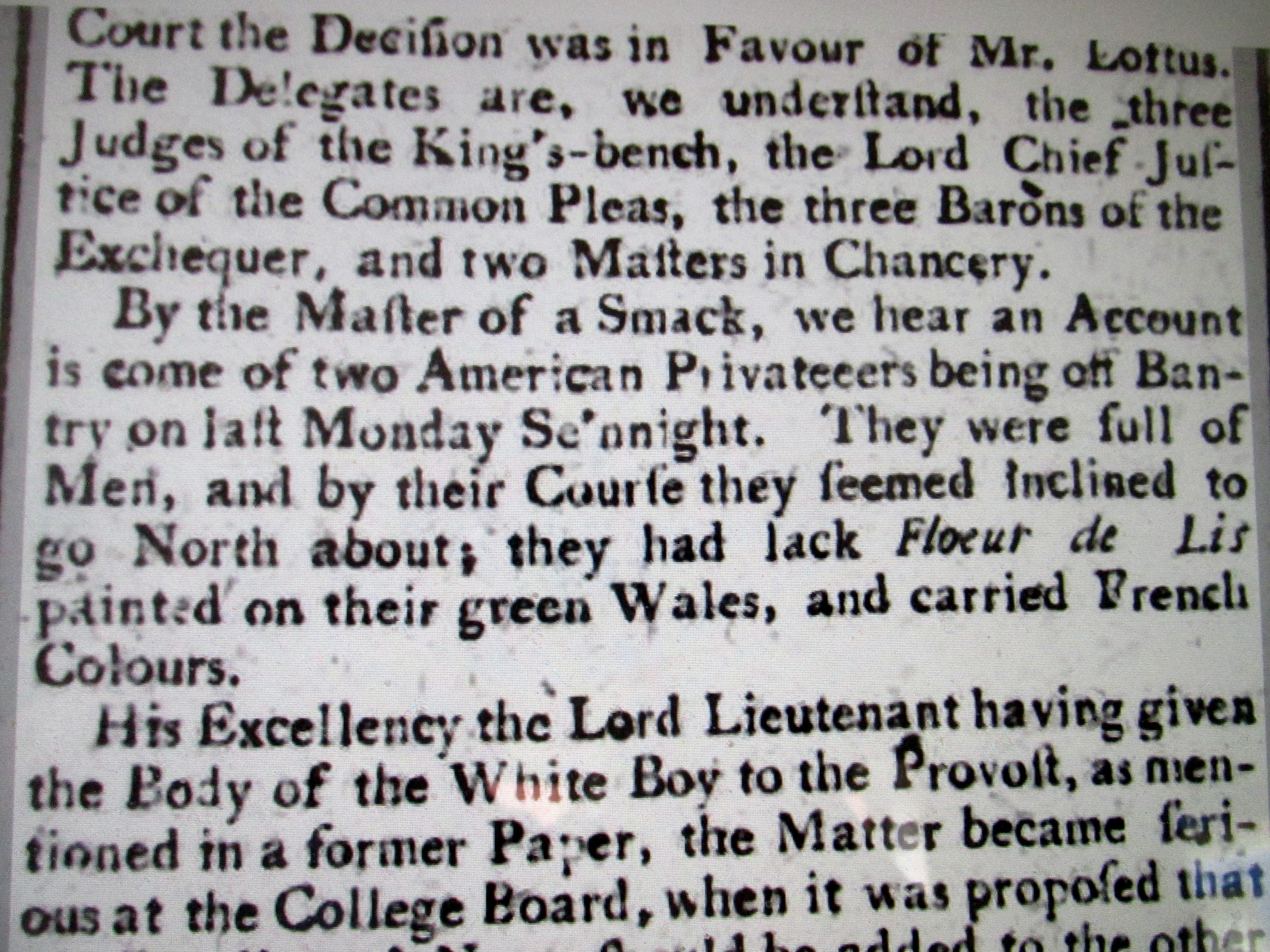
1778, Two American Privateers off Bantry.

05 Sunday Jul 2015

Posted by durrushistory in Uncategorized

≈ Leave a comment


1778, Two American Privateers off Bantry.

1-IMG_5668

2-IMG_5669

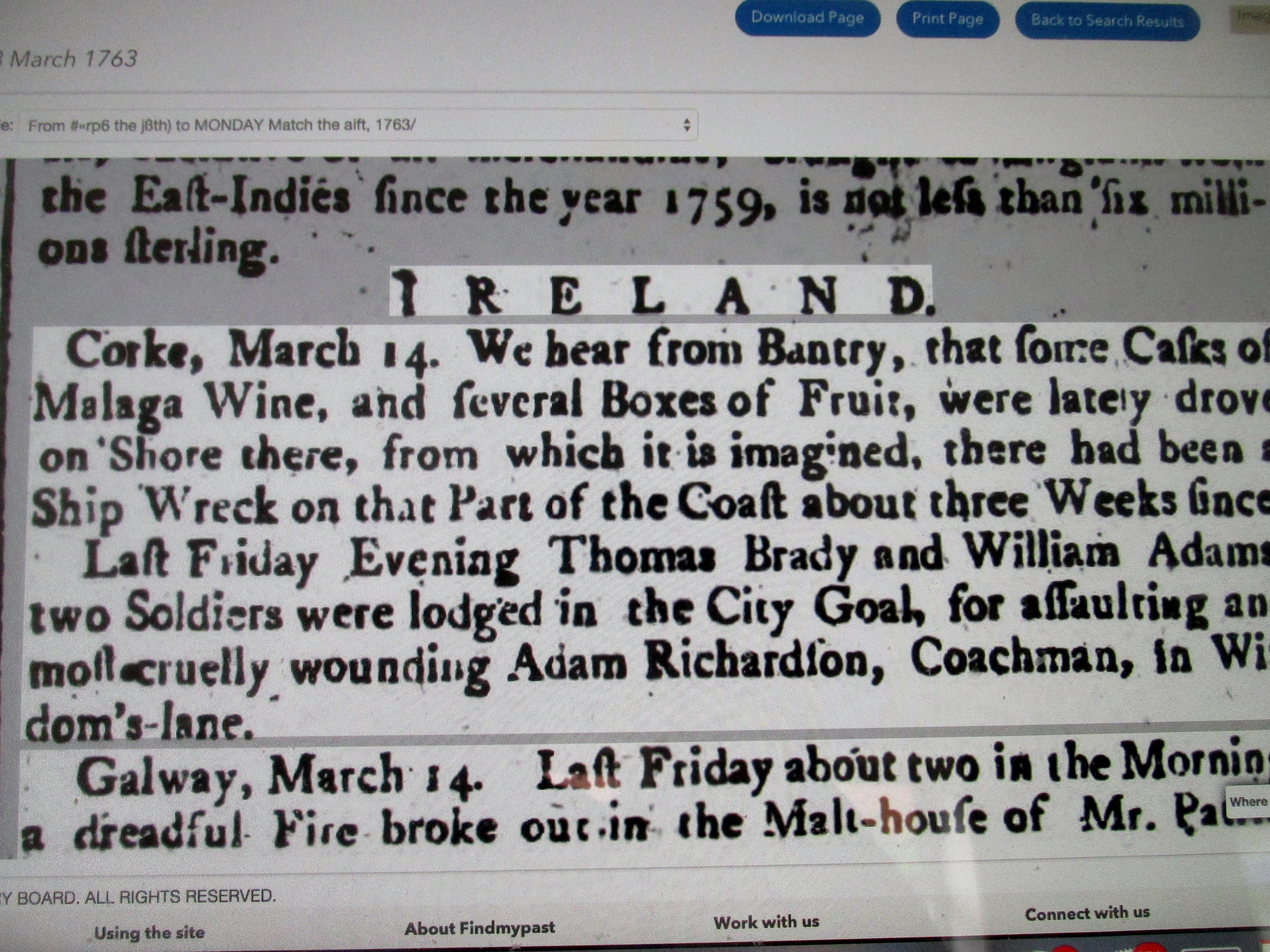
1763, Casks of Madeira Wine and Boxes of Fruit from Shipwreck, Bantry Bay.

05 Sunday Jul 2015

Posted by durrushistory in Uncategorized

≈ 1 Comment


1763, Casks of Madeira Wine and Boxes of Fruit from Shipwreck, Bantry Bay.

1-IMG_5666

2-IMG_5667

Gallery

Hares in Abundance

05 Sunday Jul 2015

Posted by durrushistory in Uncategorized

≈ Leave a comment

This gallery contains 8 photos.


Originally posted on Roaringwater Journal:
“And now, Sir Hare, good-day to you. God guide you to a how-d’ye-do with me…” (from the…

← Older posts
Newer posts →

Blog Stats

  • 866,192 hits

16th Regiment of Foot assisted female emigration australia ballyclough bantry bay caithness legion cavan regiment of militia cheshire fencibles coppinger's court inbhear na mbearc Irish words in use 1930s lord lansdowne's regiment mallow melbourne ned kelly new brunswick O'Dalys Bardic Family. o'regan Personal Memoirs rosscarbery schull sir redmond barry sir walter coppinger st. johns sydney Townlands treaty of limerick Uncategorized university of Melbourne victoria

16th Regiment of Foot assisted female emigration australia ballyclough bantry bay caithness legion cavan regiment of militia cheshire fencibles coppinger's court inbhear na mbearc Irish words in use 1930s lord lansdowne's regiment mallow melbourne ned kelly new brunswick O'Dalys Bardic Family. o'regan Personal Memoirs rosscarbery schull sir redmond barry sir walter coppinger st. johns sydney Townlands treaty of limerick Uncategorized university of Melbourne victoria
Follow West Cork History on WordPress.com

Enter your email address to follow this blog and receive notifications of new posts by email.

Join 507 other subscribers

Feedjit

  • durrushistory's avatar durrushistory

Archives

  • April 2026
  • March 2026
  • February 2026
  • January 2026
  • December 2025
  • November 2025
  • October 2025
  • September 2025
  • August 2025
  • July 2025
  • June 2025
  • May 2025
  • April 2025
  • March 2025
  • February 2025
  • January 2025
  • December 2024
  • November 2024
  • October 2024
  • September 2024
  • August 2024
  • July 2024
  • June 2024
  • May 2024
  • April 2024
  • March 2024
  • February 2024
  • January 2024
  • December 2023
  • November 2023
  • October 2023
  • September 2023
  • August 2023
  • July 2023
  • June 2023
  • May 2023
  • April 2023
  • March 2023
  • February 2023
  • January 2023
  • December 2022
  • November 2022
  • October 2022
  • September 2022
  • August 2022
  • July 2022
  • June 2022
  • May 2022
  • April 2022
  • March 2022
  • February 2022
  • January 2022
  • December 2021
  • November 2021
  • October 2021
  • September 2021
  • August 2021
  • July 2021
  • June 2021
  • May 2021
  • April 2021
  • March 2021
  • February 2021
  • January 2021
  • December 2020
  • November 2020
  • October 2020
  • September 2020
  • August 2020
  • July 2020
  • June 2020
  • May 2020
  • April 2020
  • March 2020
  • February 2020
  • January 2020
  • December 2019
  • November 2019
  • October 2019
  • September 2019
  • August 2019
  • July 2019
  • June 2019
  • May 2019
  • April 2019
  • March 2019
  • February 2019
  • January 2019
  • December 2018
  • November 2018
  • October 2018
  • September 2018
  • August 2018
  • July 2018
  • June 2018
  • May 2018
  • April 2018
  • March 2018
  • February 2018
  • January 2018
  • December 2017
  • November 2017
  • October 2017
  • September 2017
  • August 2017
  • July 2017
  • June 2017
  • May 2017
  • April 2017
  • March 2017
  • February 2017
  • January 2017
  • December 2016
  • November 2016
  • October 2016
  • September 2016
  • August 2016
  • July 2016
  • June 2016
  • May 2016
  • April 2016
  • March 2016
  • February 2016
  • January 2016
  • December 2015
  • November 2015
  • October 2015
  • September 2015
  • August 2015
  • July 2015
  • June 2015
  • May 2015
  • April 2015
  • March 2015
  • February 2015
  • January 2015
  • December 2014
  • November 2014
  • October 2014
  • September 2014
  • August 2014
  • July 2014
  • June 2014
  • May 2014
  • April 2014
  • March 2014
  • February 2014
  • January 2014
  • December 2013
  • November 2013
  • October 2013
  • September 2013
  • August 2013
  • July 2013
  • June 2013
  • May 2013
  • April 2013
  • March 2013
  • February 2013
  • January 2013
  • November 2012
  • October 2012
  • September 2012
  • August 2012
  • July 2012
  • June 2012
  • May 2012
  • April 2012
  • March 2012
  • February 2012
  • January 2012
  • December 2011
  • November 2011
  • October 2011

Blog at WordPress.com.

  • Subscribe Subscribed
    • West Cork History
    • Join 507 other subscribers
    • Already have a WordPress.com account? Log in now.
    • West Cork History
    • Subscribe Subscribed
    • Sign up
    • Log in
    • Report this content
    • View site in Reader
    • Manage subscriptions
    • Collapse this bar
 

Loading Comments...