From a family history on Ancesty.com:
https://docs.google.com/document/d/1joX-fV4x_3Z-AGYaqrS6gec4HSdrVjSoxx2GxgJ4YUA/edit
19 Sunday Jan 2014
Posted in Uncategorized
From a family history on Ancesty.com:
https://docs.google.com/document/d/1joX-fV4x_3Z-AGYaqrS6gec4HSdrVjSoxx2GxgJ4YUA/edit
18 Saturday Jan 2014
Posted in Uncategorized
Bandon:
ttps://www.google.ie/maps/place/Bandon,+Co.+Cork/@51.7461234,-8.7318174,12z/data=!4m2!3m1!1s0x4844f4296d3db1af:0xa00c7a99731fbb0
Belding, Michigan:
This site has the Memoir, a bundle of contradictions! of Sam Bird, Bandon from the 1870s his father’s fondness for a glass of grog at night, The old Irish Church, The King’s James Bible Translated from Irish, Shooting Snipe, Anti Home Rule Politics, the family decimated by TB, Methodist Preachers, writing with the Non de Plume Brian Ború
18 Saturday Jan 2014
Posted in Uncategorized
https://durrushistory.wordpress.com/2011/10/28/j-j-oleary-businessman-dublin/
The Hurley family have a long lineage in Ballycomane, Durrus, they had a large farm pre 1780 there when the Vickery family moved in. There was a a marriage between John Vickery and Hanora Hurley around the same time so there may be a connection there. In the 1870s elements of the family were active in East London with Dukelows and Swantons in Fenian activities and there is a connection with Michael Collins who lodged with one of their associates when he came to work in London.
One of the Hurleys was active in Home Rule Politics in the 1890s and was later involved with the County Council.
Sean Hurley may have been associated in Dublin with JJ O’Leary also from Cork, and be one of the pioneers of Aer Lingus

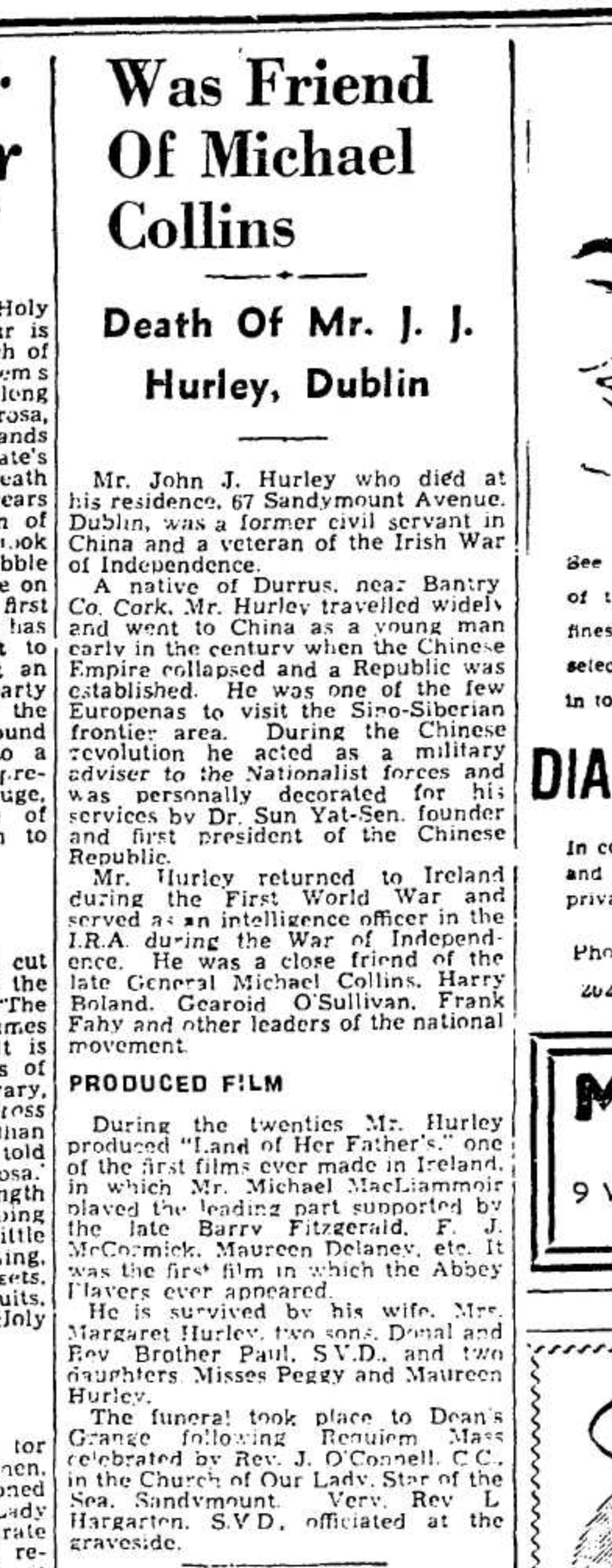

The Chinese Embassy in Dublin have been asked if they can add anythink to Mr. Hurleys early years in China.
18 Saturday Jan 2014
Posted in Uncategorized
Do bhí trí rud nár thuig Aristocle: Teacht agus Imeacht na Taoide, Obair na mBeach agus Intinn na mBan, there were three things that Aristocle never undrestood, the coming and going of the tides, the work of the bees and a woman’s mind
From Mr O’Connor, Ballydavid, Dingle, Co. Kerry mid 1970s
18 Saturday Jan 2014
Posted in Uncategorized
In 1537, four ships from Lisbon, laden with wine, consigned to the Waterford merchants, were, by stress of weather, driven to take shelter at Baltimore. One of these, the Santa Maria de Soci, was boarded by Conoghure O’Driscoll, chieftain of Sherkin, and his sons, and piloted safely into Baltimore Harbour. The officers and men of the ship were invited to an entertainment to Baltimore Castle by the O’Driscolls, and while there enjoying themselves were manacled. The O’Driscolls and their men went in their boats to the ship, took possession of the wine, and freely distributed it among their followers.
The Waterford people, hearing of the seizure, sent an armed expedition under the command of Captain Dobbyn. On arriving at Baltimore, he liberated the crew, and immediately sailed back to Waterford. Of the 100 tuns of wine, 25 only remained unconsumed. Some short time after, an expedition of 400 men, well equipped, set sail from Waterford in two large vessels under command of Bailiff Woodlock and Captain Dobbyn. Arriving in Baltimore Harbour they anchored near the Franciscan Abbey on Sherkin Island. Very soon they commenced operations, attacked and battered the castle of Dunilong, which they entered, and took away large quantities of malt, barley, and salt; they burned forty of the chief pinnaces, and forty more, with the big galley of thirty oars, were conveyed to Waterford as trophies of war. The Franciscan Abbey, with the mill annexed, was greatly damaged, and the inhabitants and houses of the island were visited with fire and sword, and little mercy shown. The islands near were treated in a similar manner, and, to complete the work, the attacking party passed over to Baltimore, stormed the Castle of Dunashad, and burnt and sacked the town.
1537 The O’Driscolls of Baltimore, West Cork and the Sancta Maria de Soci from Lisbon
18 Saturday Jan 2014
Posted in Uncategorized
Tribute of O’Sullivan Bere family to McCarthy Mór from the 1300s from Fr. O’Halloran’s Researches 1914
In about the 14th century the O’Sullivan family was divided into two branches; the elder branch was represented by the O’Sullivan Mor, whose seat was at Dunkerron, near Kenmare:
and the other branch by the O’Sullivan Beare, who dwelt at Dunboy.
http://en.wikipedia.org/wiki/Donal_Cam_O’Sullivan_Beare
The O’Sullivans paid tribute and were under the feudal sovereignty of McCarthy Mor.
http://en.wikipedia.org/wiki/MacCarthy_dynasty
They were bound to attend him in the field, and O’Sullivan Mor was the marshal of his army. He was obliged to pay for every arable ploughland five galloglasses or kern, or six shillings and eightpence, or a beef for each, at the option of McCarthy.
McCarthy was to receive half-a-crown for every ship that came to fish or trade in O’Sullivan’s harbours, and he was to give McCarthy merchandise at the rate he purchased it.
O’Sullivan Beare was bound to entertain McCarthy and his train two nights at Dunboy every year, and whenever they travelled that way.
O’Sullivan was to send horse meat to Palace for McCarthy’s saddle-horses, and pay the groom three shillings and fourpence out of every arable ploughland. He was to find hounds, grey-hounds, and spaniels, when he came, and one shilling and eight-pence annually to his huntsman out of every ploughland.
Their territory extended from Bantry Bay to Castlemain. In a Parliament held at Dublin in 1585 there sat Donall O’Sullivan Mor, also Eogan O’Sullivan Beare. They were concerned in the wars of Desmond and Tyrone. A general pardon was granted by James I., in the first year of his reign, to Owen O’Sullivan Mor of Dunkerron. The 9th James I.—the king granted to Owen O’Sullivan of Berehaven the castle, town, and lands of Dunboy;
http://en.wikipedia.org/wiki/Dunboy_Castle
57 carucates of other lands; and the chief rents out of Dunboy, Glengariff, Bonane, etc., to hold to him and his heirs for ever. The subsequent wars were fatal to the fortunes of these houses.
Several of the old Irish castles are still in a good state of preservation, but those of the O’Sullivans are nearly altogether demolished. Of this race the old legend says: Nulla manus, tam liberalis atque generalis, atque universalis, quam Sullivanus.
18 Saturday Jan 2014
Posted in Uncategorized
Taoiseach of the O’Mahony Sept an old man Living in a wretched mud hut outside Enniskeane, West Cork, 1900 and the family lineage.
In 1900 Tim Mahony, of New York then finishing his training as a priest in Louvain and destined to be a distinguished Prelate called to see his family relations. His parents were Irish born, one side descending from Barnabas Lantry (Langtree), of Cromwelian Stock who married an O’Leary (her family were large farmers and had a mill outside Drimoleague) and had 23 children in Caheragh. He wrote a letter setting out his experiences and among the O’Mahony realtions he refers to the Head of the family an old man living with his wife in destitution in a hut outside Enniskeane. The O’Mahonys had owned much of the Bandon Valley.
Father O”Halloran describes the family history in 1914:
17 Friday Jan 2014
Posted in Uncategorized
Surrender and Re-Grant by Donal O’Donovan, Castledonovan, Drimoleague, West Cork, 1610s
In the 1610s Donal O’Donovan deviated from traditional policy and accepted the English title to his family lands as follows: ‘Donal O’Donovan of Castledonovan, Gentleman of the Castle the called Sowaagh..and a large extent of country specified therein, together with all customs royalties, dues and privileges due and payable to the said Donal and his ancestors in the ports, bays of Castlehaven etc. ‘ The agreement provided for the creation of two Manors, on eat Castednovan and one at Rahine. The lands were reconveyed to Donal O’Donovan for a sum of £447.13 shilling sterling and a remaining part of £45,5s 6d. In 1626 the Castle structure was renewed by him.
from Richard S. Harrison’s book, ‘Four Hundred Years of Drimoleague”, 1999
17 Friday Jan 2014
Posted in Uncategorized
US Senator Hammett, Dunmanway and Mississippi (1799-), Senator Patrick Joseph Sullivan (1835-1935), Kilcrohane and Wyoming, Judge Robert Swanton (1764-1840), New York and Ballydehob, New York Maritime Court, Frank O’Neill, Bantry and Chicago, Chief of Police
17 Friday Jan 2014
Posted in Uncategorized
Christmas was formerly observed in the Highlands on what is now known as “Twelfth Night”. In the Celtic lands, the people did not at first take to the introduction of the New Style calendar in 1752, and tenaciously clung to the ‘old way’ of things, including their conviction of Jan. 6th as the “real” Christmas day. Still celebrated in Ireland as Nollaig na mBan:
https://www.irishcentral.com/roots/womens-christmas-nollaig-na-mban-celebrate-ireland
http://en.wikipedia.org/wiki/Little_Christmas
http://thedailyedge.thejournal.ie/nollaig-na-mban-1251251-Jan2014/
http://bigreaders.myfastforum.org/archive/oiche-nollaig-na-mban__o_t__t_113.html
The Feast of the Epiphany is also called coir-ceim-coilleach, which means ‘the cocks step’; the first noticeable lengthening of the daylight hours.
From Twelfth Day, the day begins to lengthen by a male hen’s span or stride, Breton Proverb.
Meaning a little each day
There is a hint here of how different cultures measure the year and time.
For the Pre Islamic Arab world:
https://en.wikipedia.org/wiki/Islamic_calendar#Pre-Islamic_calendar
 West Cork History