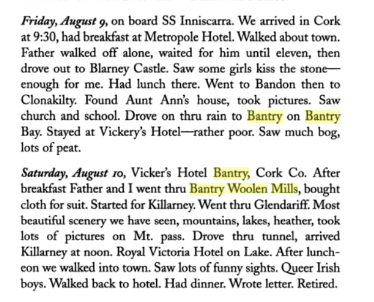
Thackeray visit to Bantry 1842


durrushistory's avatarWest Cork History

From Recollecting John Clarke Sullivan, Nemasket, Mass. USA

http://nemasket.blogspot.com/2010/03/john-clark-sullivan.html

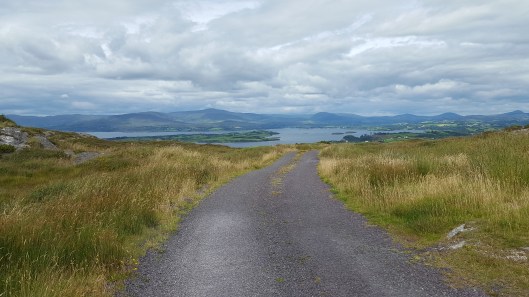
Bantry was typical of Irish towns of the era, with great disparities between the Anglo-Irish population and that of the Native Irish. The great scenic beauty of the region contrasted sharply with the poverty of a large number of its inhabitants. English novelist William Makepeace Thackeray captured this contrast in The Irish Sketch Book of 1842. Describing Bantry a year prior to Sullivan’s birth, Thackeray wrote:

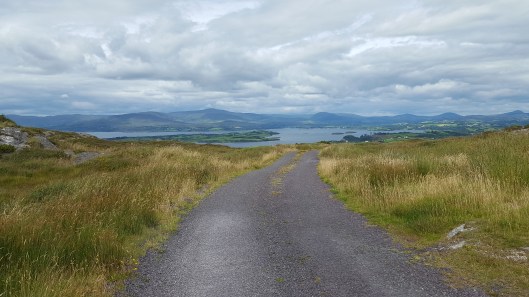
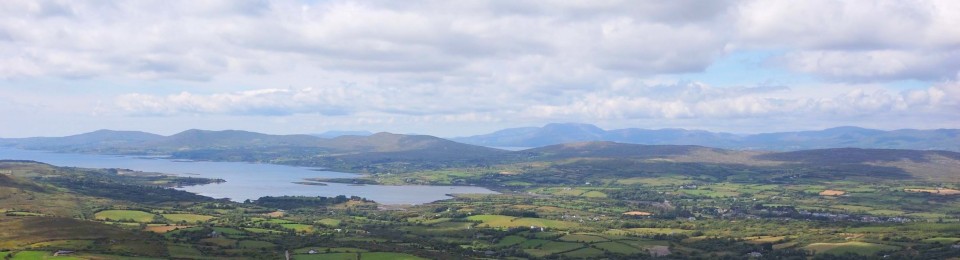
The harbour is beautiful. Small mountains in green undulations rising on the opposite side; great grey ones further back; a pretty island in the midst of the water, which is wonderfully bright and calm. A handsome yacht, and two or three vessels with their Sunday colors out, were lying in the bay. It looked like a seaport scene at a theatre, gay, cheerful, neat, and picturesque. At a little distance the town, too, is pretty…

View original post 364 more words

From ‘Harvey’s Jocular Medley’, ‘The Annual Fair will be held on the 13th May 1738 at Donovan’s Leap, (West Cork) now called Tonson’s Leap in West Carbery. Affords a place where vast numbers of cattle may be exposed fro sale. Free of customs and Tolls for three years. Having a glass of Whisky in a Tent at Balagurteen Fair (near Dumnanway), 1828 prior to emigrating to Canada.


durrushistory's avatarWest Cork History

From ‘Harvey’s Jocular Medley’, ‘The Annual Fair will be held on the 13th May 1738 at Donovan’s Leap, (West Cork) now called Tonson’s Leap in West Carbery. Affords a place where vast numbers of cattle may be exposed for sale. Free of customs and Tolls for three years. Having a glass of Whisky in a Tent at Balagurteen Fair (near Dunmanway), 1828 prior to emigrating to Canada.

The Tonson referred to is believed to descend from an illegitimate line of Sir William Hull of Leamcon, Schull from c 1600.

Fair from John T. Collins newspaper extracts, courtesy JCHAS

Ballygurteen from Eddy family papers, Canada.

Letter from Lord Carbery, 1826 re Destitution and Emigration in West Cork and Eddy Letters, Tradesmen going to the USA and Labourers to New Brunswick

1-IMG_0692

Ballygurteen Fair 1828 from Eddy Family History Canada
Clifton Gloucester NB April 4th 77

Dear Sir

I make bold to write you…

View original post 700 more words

Sale of Dunmanway Co. Cork, Lordship of Manor 1858, including Tolls of Ballygurteen fair, Patent allows 3 per year, 2 held, 1858, producing £30 per annum.


1840, Ballygurteen (Dunmanway/Clonakilty), West Cork, Fairs 24th June, 25th July, 28th December, under a patent Granted to the Reverend Sir Michael Cox, Bart in the Reign of George 111 (1738-1820).


Tolls and Frequency of Fairs in Baronies of Bantry and Bere and West Carbery, 9 Fairs Skull, Bantry 1843, 4 Fairs from a Grant by Duke of Devonshire, Dunmanway, 4 Fairs Ballygurteen, Clonakilty, 6 Fairs Goleen, 12 Fairs and a Weekly Market at Ballydehob, Lord Belhaven’s patent at Castletownbere. No Disturbances in Collecting Tolls Except at Bantry Once.


durrushistory's avatarWest Cork History

The information was collected by the RIC.  Tolls were traded as a form of property.

View original post

1938 School Folklore Project, Sarah Dukelow, Clashadoo, Durrus, Co. Cork.


durrushistory's avatarWest Cork History

https://www.google.ie/maps/place/Clashadoo,+Co.+Cork/@51.6319007,-9.5460531,12z/data=!4m2!3m1!1s0x48459fd56e65e3f7:0xd76f2e9f91b569c0

Sarah Dukelow is still alive , former teacher, July 2016. The teacher in her school Líam Blennerhassett, from Tralee was particularly inspiring. Part of the collection has now gone online the rest in phases will happen. The collection is the most extensive in the world.

She said that two of her informants were Jack Dukelow and Mick Bohane the parish Priest’s manservant.

From Mick she got a poem in Irish which she transcribed. He did not speak Irish but this was by his grandmother in the style of the lament composed by Eibhlín Ni Chonaill on the death of her husband, ‘Caoineadh Art Ó Laoighre’. She wrote it in the jotter supplied but the teacher did not send all the jotters to Dublin. She said that went to Dublin was only a fraction of what she collected.

Jack Dukelow died in around 1954 and was from Rossmore, grandfather of…

View original post 122 more words

PRESENTMENTS BANTRY AREA, CO. CORK, 1846 and Background Data on Some of the Recipients.


durrushistory's avatarWest Cork History

The presentments were list of works, ‘presented’, by land owners to the Grand Jury in the hope that financial assistance would be forthcoming to enable them to be carried out.  This is from the Cork Examiner of the 8th November 1846.  For Cheskin read Seskin.

It is not clear if the money was paid directly by the Grand Jury adn later reimbursed centrally.  Some later drainage schemes were financed from Dublin.

Samuel Hutchins, listed 1835 at Ballylickey, 1838.  1835 in Bantry paying £5 toward Catholic Rent, frequently praised as a Liberal Protestant. 1840 petition on Catholic Equality. Attending address Ardnagashel 1840 Great Meeting Bantry re Poor Law. Listed 1843, Ardnagashel, Bantry.   Estate passed to him on death of younger brother Emanuel in 1839,  Brother of botanic artist Ellen Hutchins.  1820 Member Cork Library. 1837 donated £5 to Justice (Catholic Repeal) Rent.  Set up a soup kitchen during Famine.  Extensive…

View original post 599 more words

£3 note


durrushistory's avatarWest Cork History

While reading the evidence before a parliamentary enquiry into land tenure taken in Bantry in 1844 and came across a reference to a tenant paying his landlord with a £3 note.  I never came across this before, I do remember the old orange 10 shilling note.

When I checked it out the history was interesting.  Ireland apparently joined sterling in 1825 (currency fluctuations are not new) and the Bank of Ireland was given authority to issue notes.  Included was the £3 and 30 shilling notes.

In 1844 a farm laborer was lucky to get 8p. per day and the salary of a Resident Magistrate started at £300 per annum.  If you took  a laborer now at a low €75 a day that would give the value of £3 at €6,750 or the pay of the modern equivalent of a Resident Magistrate a District Justice at €123K then the value of £3…

View original post 17 more words