Will of Alexander Donovan, Squince, Parish of Myross, Co. Cork, Will Dated 22nd December 1785, Memorial Sworn at Skibbereen 29th May 1800. To his son Doctor James Donovan, Doctor of Physic, his interest in lands at Rinogreny, Keamore, Saravelly, Co. Cork, to his son Alexander Donovan his interest in the farm at Myross with all the utensils belonging to the fisheries, salt house, and large boat subject to the head rent and lands at Manhelare and Cusronan , Filmuck, and Carhngariff (Cahhugariff), Co. Cork, Executors his sons James and Alexander. Witnesses Daniel Collins, now Skibbereen, Doctor of Physic, John Wright, Glandore, Merchant, Richard Donovan recently deceased (1800), Warrensbrook. Witnesses to Memorial (1800), Daniel Collins, Richard Tomkins, Gent.


https://www.google.ie/maps/place/Squince,+Co.+Cork/@51.5311695,-9.13664,15z/data=!3m1!4b1!4m2!3m1!1s0x4845ae64dbfb0df5:0xaed3cfebbb61bc1c

Will 238    Will of Alexander Donovan, Squince, Parish of Myross, Co. Cork, Will Dated 22nd December 1785, Memorial Sworn at Skibbereen 29th May 1800.  To his son Doctor James Donovan, Doctor of Physic, his interest in lands at Rinogreny, Keamore, Saravelly, Co. Cork, to his son Alexander Donovan his interest in the farm at Myross with all the utensils belonging to the fisheries, salt house, and large boat subject to the head rent and lands at Manhelare and Cusronan , Filmuck, and Carhngariff (Cahhugariff), Co. Cork,  Executors his sons James and Alexander.  Witnesses Daniel Collins, now Skibbereen, Doctor of Physic, John Wright, Glandore, Merchant, Richard Donovan recently deceased (1800), Warrensbrook.  Witnesses to Memorial (1800), Daniel Collins, Richard Tomkins, Gent.

Registry of Deeds References

518, 427, 345908

The Irish Manuscript Commission have digitalised some of their old publications.  This is from a series on Memorials in the Registry of  Deeds.  These survived the destruction of 1922.

http://www.irishmanuscripts.ie/servlet/Controller?action=digitisation_backlist

The reference to fishing is interesting.  The O’Donovans of O’Donovan’s Cove, Durrus (Kealties/Tullagh) acquired an interest in a small estate c 1750, most unusual for a Catholic family.  There is a possibility they were involved in the pilchard fishery as there is a ‘Palace’ nearby.  One of the family, Timothy, was one of the first Catholic Magistrates in Co. Cork  and gave written evidence to a Parliamentary enquiry sitting in Bantry in 1836 which showed a remarkable knowledge of the fishing industry.  He is buried in the ancestral tomb at Caheragh Old Graveyard.

One of the 1800 witnesses to the Memorial, Richard Tomkins may have been an Attorney, for some reason they are rarely described as such.  The name is alive and well in the area, Larry Tomkins was a star footballer with the Castlehaven winning Gaelic Football teams with the late John Richard O’Donovan.
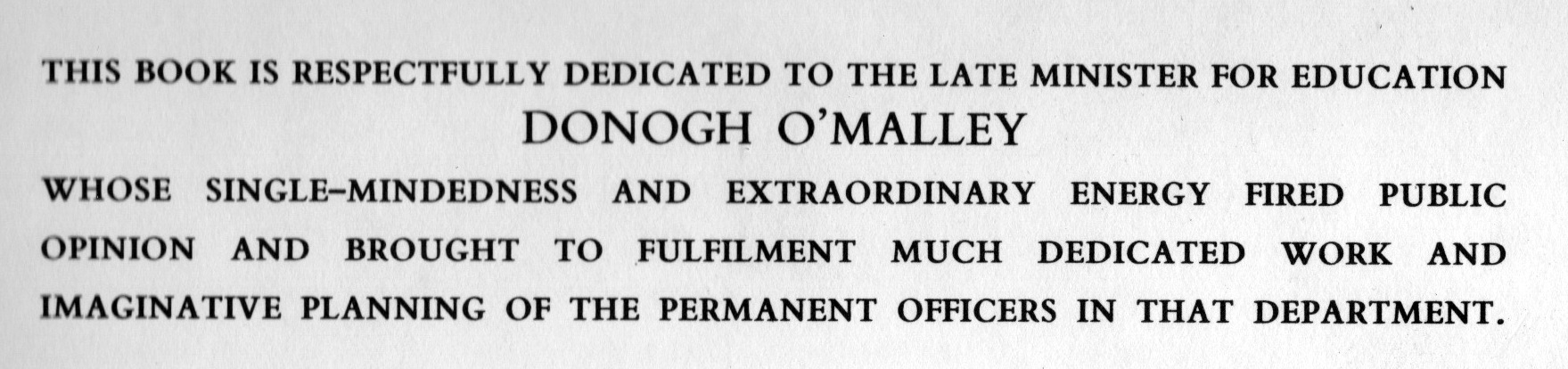
Early Irish History and Antiquities and the History of West Cork By Rev. W. O’Halloran 1916, O’Donovan Genealogy.

The use of the Registry of Deeds Project as a Genealogical Aid, Some West Cork Names, Attridges, Beecher, Bernard, Coughlan, Cotter, Crowley, Dalys, Evans, Freke, O’Driscoll/Driscoll, Dukelows, Evanson, Hutchins/Hutchinson, Jennings, ]ago, Kingston, McCarthy, Mellifont, Murphy, Puxley, Shannon, Swanton, Somerville, O’Sullivan/Sullivans, Townsend, White, Woulfes, Vickeries, The Fund of Suitors of the High Court of Ireland and Mortgage Deed In Irish, Co. Clare 1540.


The use of the Registry of Deeds Project as a Genealogical Aid, Some West Cork Names,  Attridges, Beecher, Bernard, Coughlan, Cotter, Crowley, Dalys, Evans, Freke, O’Driscoll/Driscoll, Dukelows, Evanson,  Hutchins/Hutchinson, Jennings, ]ago, Kingston, McCarthy, Mellifont, Murphy, Puxley, Shannon, Swanton, Somerville, O’Sullivan/Sullivans, Townsend, White, Woulfes, Vickeries,   The Fund of Suitors of the High Court of Ireland and Mortgage Deed In Irish, Co. Clare 1540.

After the Forfeitures and Confiscation of the lands Irish Catholic Gentry in the late 17th century the Registry of Deeds was set up c 1704 to ensure a functioning system of Land Registration for Ireland.   It operated on the basis that a summary of the relevant deed called a memorial was prepared itemising the parties, the transaction, it was witnesses and lodged at the Registry.  Before the coming into being of the system if a person purchased property there was no way of knowing if there was a mortgage or charge affecting it.

http://members.pcug.org.au/~nickred/deeds/memorial_extract.cgi?my_memorial=460736&my_indexer=RonPrice

Thankfully the record shave survived intact.  In the 1990s a fund known as ‘The Fund of Suitors’ of the Irish High Court was utilised to refurbish the King’s Inns and Registry of Deeds located between Henrietta Street on Constitution Hill.  The fund consists of monies accumulated but not claimed intestacies, Wards of Court funds etc., periodically the accumulated surplus is applied to a worthy cause.   In this case it was well spent.  The restoration is excellent and it is possible to examine the original leather covered ledgers and indexes.

By and large the broad mass of the population Catholic and Protestant are not represented.  It tended to be people of property.  However many family settlements are recorded. In farming areas in the 18th an 19th century a common form of leasing was the use of leases for 3 lives.   In those case usually two of the lives were for named young children related to one of the parties and the town lands are often recorded.  Accordingly it is a very valuable source of family information.  Also the document are often witnesses by non family members again locating name to areas.

The Registry of Deeds project is Volunteer based and so far something over 10% of the relevant deeds have been transcribe.

http://www.irishgenealogynews.com/2013/09/registry-of-deeds-index-project-latest.html

This is an example involving Michael Sullivan, Bantry, he was a Catholic and the children of his marriage to Vickery were brought up in the Church of Ireland, he was  the holder of substantial property, heart Tax Collector, and one of the  the ancestors of an enormous extended family world wide of Sullivans, Vickeries, Bryans among others.  Interestingly one of the early deeds from the Bantry area involved Donough O’Daly c 1705, he was presumably of the family that up to some years before had the western half of the Munitervara Peninsula.

http://members.pcug.org.au/~nickred/deeds/memorial_extract.cgi?my_memorial=460736&my_indexer=RonPrice

http://members.pcug.org.au/~nickred/deeds_index/name_index.php

The Norman Common Law took root in Ireland early and ran even in Gaelicised area.  The Manuscript section of the National Library have an original mortgage deed from 1540 in irish over lands at the Burren.  It is substantial the same in content as a modern mortgage deed.

1608 Mortgage of lands in the Burren, Co. Clare written in old Irish, with Conveyancing Deeds of 1540 in Irish

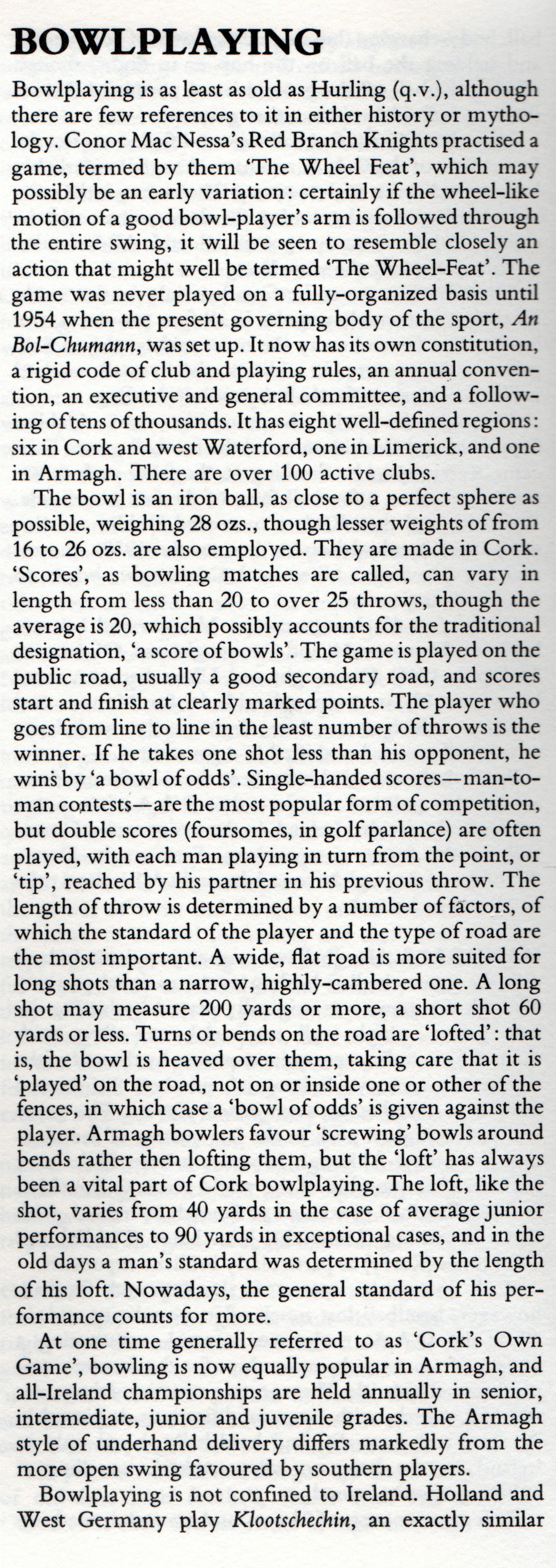
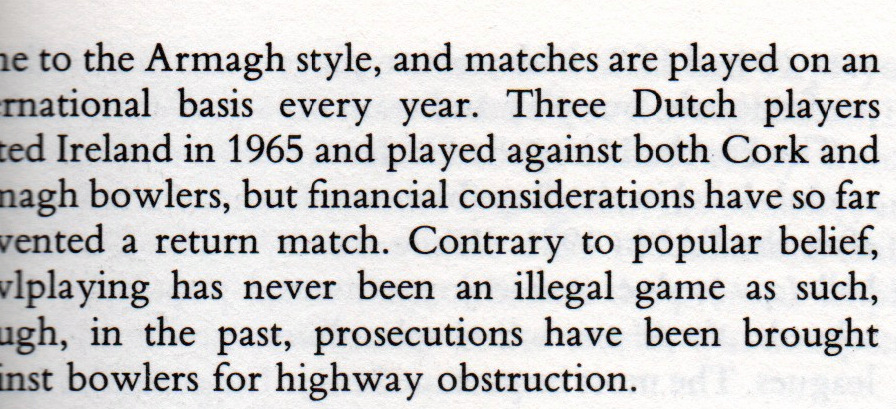
Bowl Playing West Cork, Armagh and the Myth of Illegality


Bowl Playing West Cork, Armagh and the Myth of Illegality

The author Flor Crowley, national Teacher, and Chairman 1965 An Bol-Chumann, native of Dunmanway author of Local History Articles and Books..

Words in Irish from Dunmanway, West Cork from Flor Crowley N.T. (National Teacher), Behigullane, Dunmanway. .

https://durrushistory.com/2014/08/20/pre-1965-farming-practices-west-cork-red-elephant-and-epicure-potatoes-working-with-the-grufan-threshing-with-the-steam-engine-winnowng-of-wheat-and-oats-working-in-the-bog/

1-Scan 1426

1-Scan 1429

1-Scan 1482 2-Scan 1483

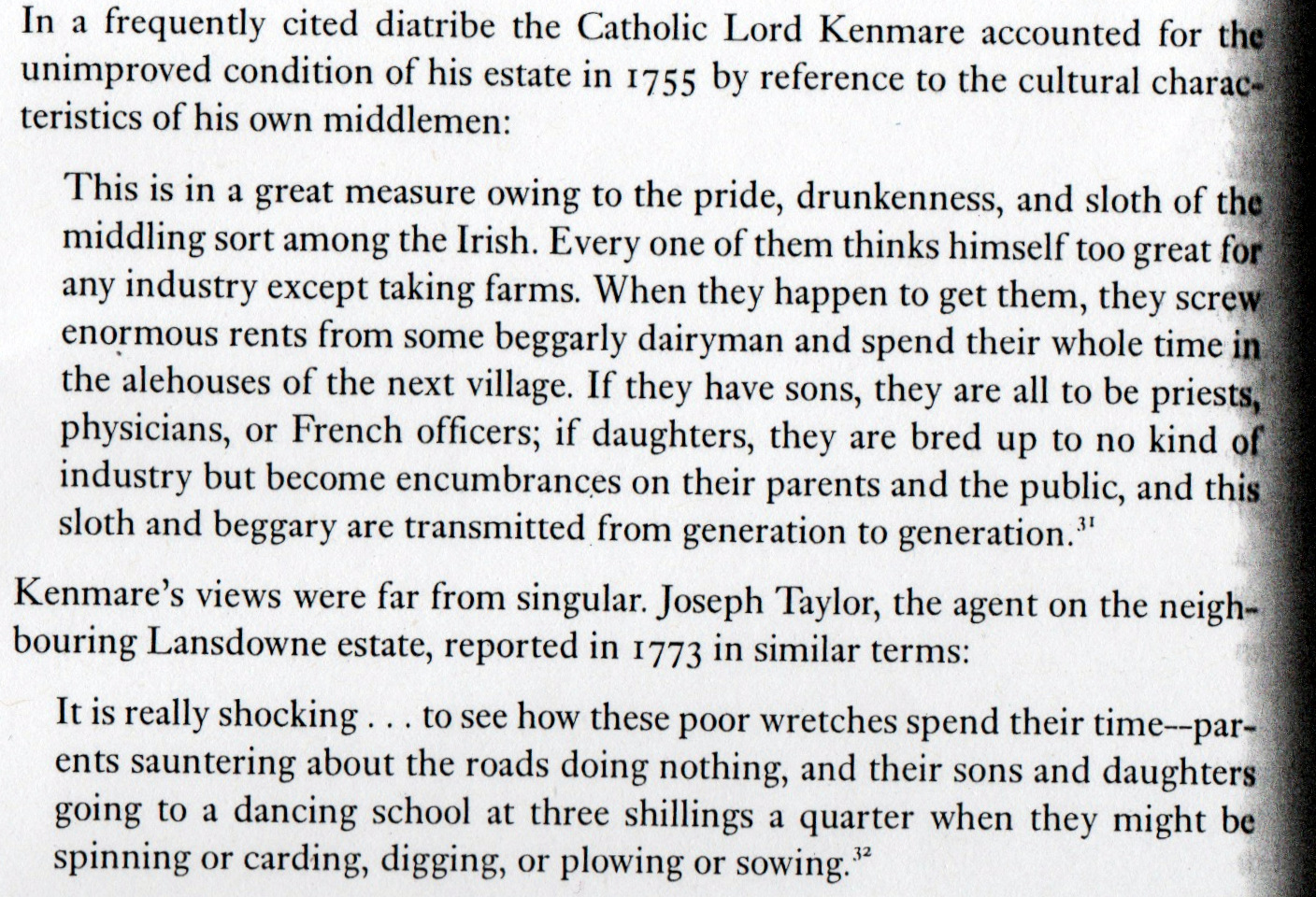
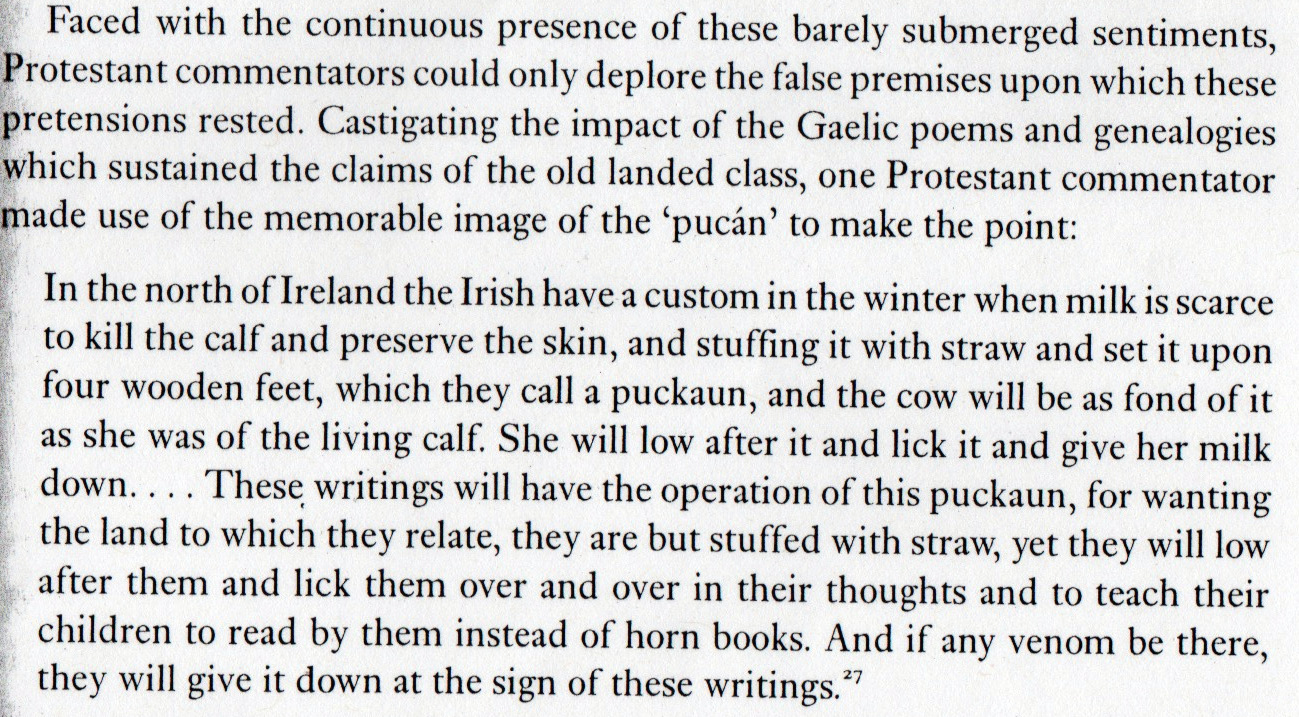
Catholic Middlemen on the Kenmare and Lansdowne Estates 1755 and 1775, Pride..Sloth..Drunkiness..Every one thinks himself too great for any industry except taking farms. When they happen to get them, they screw enormous rents from some beggarly dairyman and spend their whole time in the alehouse to the next village. If they have sons, they are to be bred to be priests, physicians or French officers; if daughters, they are bred to be no kind of industry but become encumbrances on their parents and the public an this sloth and beggary are transmitted from generation to generation. …1775.. Sauntering around the roads dong nothing, and their sons and daughters going to a dancing school at three shillings a quarter when they might be spinning or carding, digging or ploughing or sowing.


Catholic Middlemen on the Kenmare and Lansdowne Estates 1755 and 1775, Pride..Sloth..Drunkiness..Every one thinks himself too great for any industry except taking farms.  When they happen to get them, they screw enormous rents from some beggarly dairyman and spend their whole time in the alehouse to the next village.  If they have sons, they are to be bred to be priests, physicians or French officers; if daughters, they are bred to be no kind of industry but become encumbrances on their parents and the public an this sloth and beggary are transmitted from generation to generation. …1775..  Sauntering around the roads dong nothing, and their sons and daughters going to a dancing school at three shillings a quarter when they might be spinning or carding, digging or ploughing or sowing.

Kevin quotes this in an article about Catholic Middlemen.  It is the Records of the Kenmare estate online from the Irish Manuscript commission.

Middle men Bantry area 1740s of Kenmare (Brown) Estate: Michael Murphy Newtown, Casey Miller, Newtown, Thomas Hutchins, Ballylickey, Various Galweys, Gilbert and Richard Mellefont Donemark, Beversham Harman Laheran, Henry Puxley Gortaneer, John Young Direenkallig Robert Young Droominateenly, Isaac and Joshua Doe, Forester

1-Scan 1476

Richard Hedges of Macroom, Co. Cork, 8th June 1714, Irate letter, ‘All Mountains, Bogs, and Rocks, Entirely Inhabited by Irish from Dunmanway to Kanturk, which is 40 miles of Barbarous Country, there is not an English Gentleman of note there except William Brown, Minister at Macroom, some Heads of Irish Clans not only carry Arms and Harbour Unregistered Non-Jurist Popish priests but have gained Ascendant over Civil power there being but few Protestants and they are Overawed by the Multitude of Papists.


Richard Hedges of Macroom, Co. Cork, 8th June 1714, Irate letter, ‘All Mountains, Bogs, and Rocks, Entirely Inhabited by Irish from Dunmanway to Kanturk, which is 40 miles of Barbarous Country, there is not an English Gentleman of note there except William Brown, Minister at Macroom, some Heads of Irish Clans not only carry Arms and Harbour Unregistered Non-Jurist Popish priests but have gained Ascendant over Civil power there being but few Protestants and they are Overawed by the Multitude of Papists.

The Hedges and Davies of Macroom  were active with the Whites, Fenwicks and Blairs of Dunmanway later Bantry (some of whom had been students at the Inns of Court in London) in acquiring vast tracts of land at knockdown prices from the Hollow Blade Company.  Not involved with them but active in the purchase was Francis Bernard of Bandon, this formed the base of the Bandon estate.

Macroom Castle of the Descendants was burned in 1922.

http://landedestates.nuigalway.ie/LandedEstates/jsp/property-show.jsp?id=3036&estate_id=1093

Manuscript MS 757, National Archives, from Kevin Whelan’s article on Catholic Middlemen.

1-Scan 1474

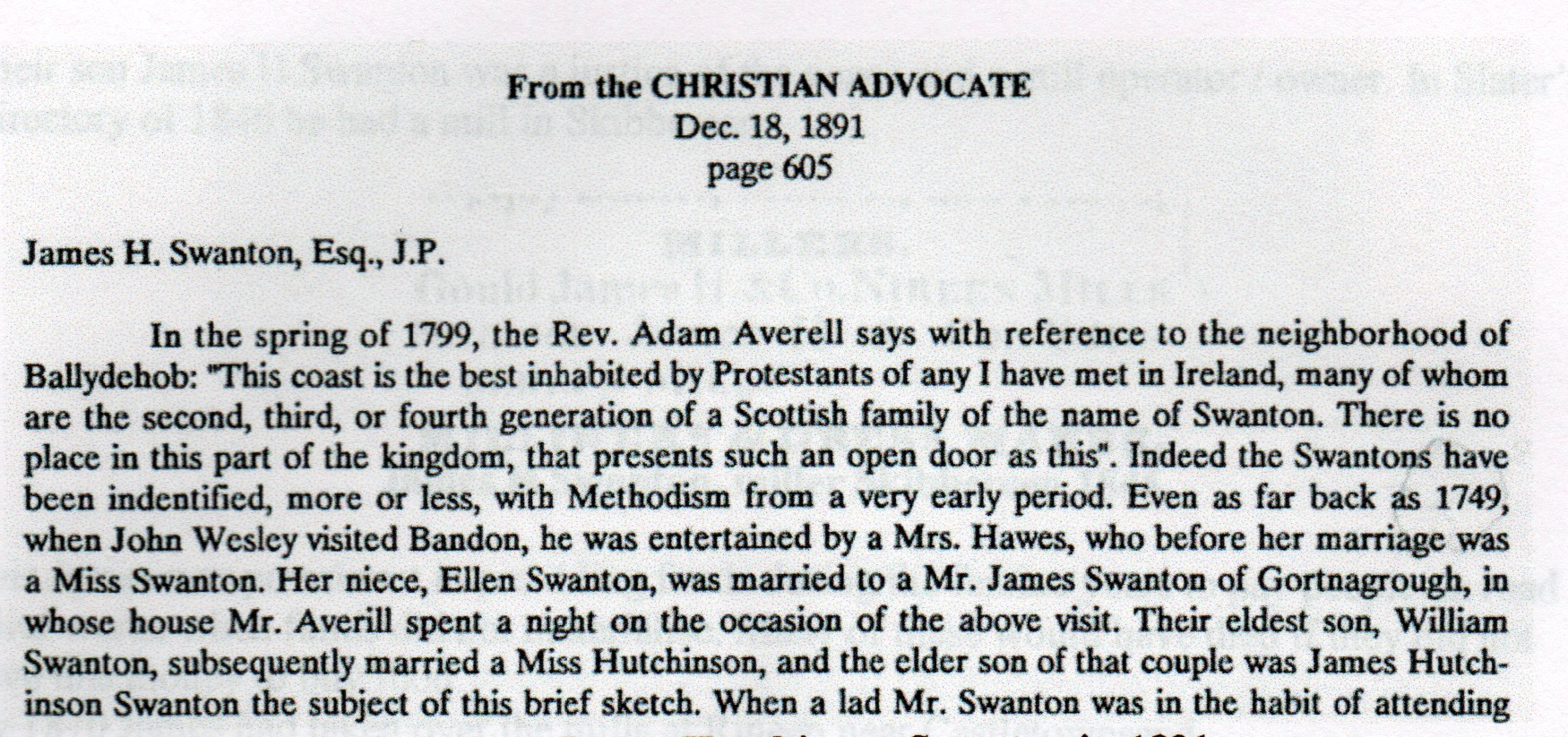
Methodist Minister, Rev. Adam Averill, 1799, on possible Scottish Origin, of West Cork, Swanton family and reputed Scottish Plantation, Castlehaven/Skibbereen c 1690s, Andersons, Hamiltons.

Tags

, , , , ,


https://www.google.ie/maps/place/Castlehaven,+Co.+Cork/@51.5108647,-9.1919606,12z/data=!4m2!3m1!1s0x4845af85f3f3c235:0x1800c7a937dfd780

Methodist Minister, Rev. Adam Averill, 1799, on possible Scottish Origin, of West Cork, Swanton family and reputed Scottish Plantation, Castlehaven/Skibbereen c 1690s, Andersons, Hamiltons.

It is interesting that the West Cork Somervilles, descend from a Rev. Somerville who fled to Ireland from persecution in Scotland c 1690 and may coincide if there was such a Plantation.

Re the names Hamilton may be Scottish or a corruption of an old Gaelic name.

The Swantons have a tradition of industry, hard work and dissent which some would say are Scottish virtues.

1-IMG_7820 1-Scan 1473

Some Birth, Marriage and Death Records from 1592 of Church of Ireland, Methodist, Quaker and old Catholic Families, Skibbereen District, West Cork and Rochester, New York.

Tags

, ,


https://www.google.ie/maps/search/skibbereen,++Cork/@51.5559239,-9.2621303,11z

Some Birth, Marriage and Death Records from 1592 of Church of Ireland, Methodist, Quaker and old Catholic Families, Skibbereen District, West Cork and Rochester, New York.

From around 1820 Catholic Records are generally available on irishgenealogy.ie. There was significant intermarriage in the 18th and 19th century and by looking up a ‘Protestant’ name on this site you come across intermarriage or neighbours acting as sponsors in baptisms or witnesses on marriage.

Protestant records suffered from being sent to Dublin Public Records Office for safe keeping and may were destroyed in 1922.  Sometimes by accessing Canadian, US, Australia an British records it is possible to make up some of the gaps.

http://churchrecords.irishgenealogy.ie/churchrecords/search.jsp?namefm=&namel=&location=skibbereen&yyfrom=&yyto=&submit=Search

These records are a mere snapshot.

Births:

https://docs.google.com/spreadsheets/d/1m9FgxKSHtnyAvObc6Li4TKTmAaNdKne4P8Z2qRurU4c/edit

Marriage:

https://docs.google.com/spreadsheets/d/1i1w4CiMviphSsz3jOEMvF_3uw-F04ksPFgmdjum2y0Y/edit#gid=0

Deaths:

https://www.google.ie/maps/search/skibbereen,++Cork/@51.5559239,-9.2621303,11z
Courtesy Susan Beretta, Salt Lake City:

Local Loan Reproduction Records 1830s:
http://corkgen.org/publicgenealogy/cork/reproloan/Schull.html

https://durrushistory.com/2012/09/02/schull/Tithe Aplotments 1820s:

http://corkgen.org/publicgenealogy/cork/reproloan/Schull.html

Griffith 1850s:

http://www.askaboutireland.ie/griffith-valuation/

Rochester,New York, there was mass emigration from the 1820s and many names in the greater Schull area (as well as Durrus) appear in church and other records of Rochester, new Yorkm in the 1820s a boom town now those days sadly past:

Extracts from the Parish Register of St. Marks and St. Simon Cyrene, Episcopal Church, Rochester, New York. United States, for interconnected West Cork families from Schull, Durrus, Drimoleague and Dunmanway areas from c 1830s.

Emigration from the Bandon/Rathclaren area, Co Cork from c 1815 to Bathurst, New Brunswick, Canada

Tags

, , , ,


Eedy family history:

http://studylib.net/doc/6811055/excerpt-from-2001-eedy-history


Rathclaren:

https://www.google.ie/maps/search/Rathlaren+Cork/@51.656201,-8.7002135,14z

Bathurst, New Brunswick:

https://www.google.ie/maps/place/Bathurst,+NB,+Canada/@47.6259605,-65.6281926,8z/data=!4m2!3m1!1s0x4c98941b3ad5d61d:0x505c13c653ce030
The ending of the Napoleonic Wars withe Battle of waterloo caused a huge collapse of farm prices and triggered a widespread depression. In the greater Bandon area this was worsened by the dependance of the textile industry much home based which could not withstand competition from England.

There are many accounts of widespread distress among Bandon weavers.

Emigration from the Bandon/Rathclaren area, Co Cork from c 1815 to Bathurst, New Brunswick, Canada

Sharon Haggerty, in Vancouver, British Columbia, has set up a focus e mail for those interested.

An account of the Kilgariff, Clonakilty, West Cork, Eedy family to Clifton and Bathurst, New Brunswick, Canada some of the names mentioned Knowles, Bateman, Beamish, French, Morris, Stanley, Woulfe, Crowley, O’Donovan, Cahalane, Donoghue, A Glass of Whiskey Ballygurteen Fair prior to Emigrating.

can-chaleur-bay-irish@rootsweb.com.